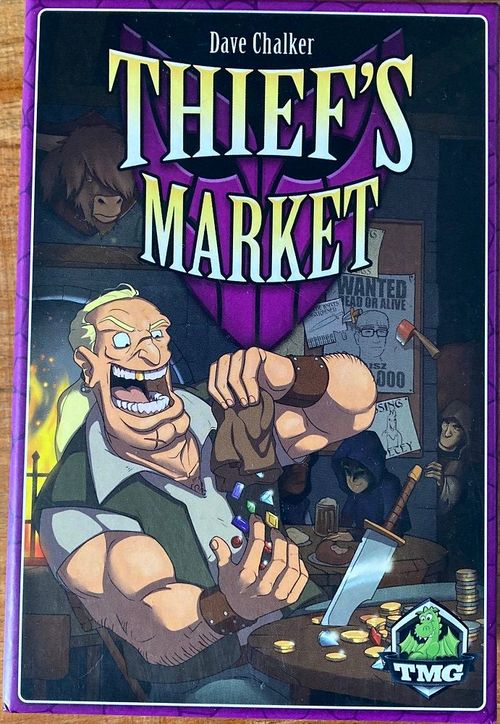
Thief's Market
Thief's Market Rulebook
Table of Contents
Table of Contents
Components & Setup
- 1 Start Player Marker: Give this to the player who most recently stole something.
- 33 Gold Tokens: Give each player one, then place the remaining tokens off to one side of the playing area, in a general supply within easy reach of all players. There is not meant to be a limit to these. If you run out, use something else as a substitute. The number of gold a player has is always public knowledge.
- 33 Infamy Tokens: Place these near the Gold tokens. There is not meant to be a limit to these either, but how many a player has is not public knowledge: hide Infamy Tokens you receive under your Player Reference Card. Please note that some cards and dice provide Infamy tokens (which are worth Notoriety Points at the end of the game), and some cards are worth a set amount of Notoriety just for having the card (and do not provide tokens).
- 13 Loot Dice: If playing with 5 players, you will use all the dice. If playing with 4 players, you will use 11 dice. If you are playing with 3 players, you will use 10 dice. Return any unused dice to the box.
- 5 Player Reference Cards: Give one to each player, and return any extras to the box.
- 49 Market Cards: Separate these into "A", "B", and "C" decks based on the letter on the back of each card. Shuffle each deck separately, then remove random cards from each deck so that there are 13 cards in the A deck, 12 cards in the B deck, and 11 cards in the C deck. The removed cards will not be used this game and should be placed in the game box without looking at them.
Place the three decks in a line along one edge of the table. Finally, deal 5 cards from the A deck face-up in a row beside the A deck to form the starting "Market" of cards available for purchase.
Gameplay Overview
Each round is played in two phases. In the first phase, the dice will be rolled and the players will take turns either claiming some dice (and possibly the start player marker) from the center to form a pile of objects in front of them, or stealing a previously claimed pile from another player.
When a pile is stolen, at least one object must be returned to the center from the pile, and dice returned to the center are re-rolled. Once everyone has a pile in front of them, players enter the second phase, where they each have an opportunity to trade in dice and gold to buy cards from the Market. At the end of the round, the Market is refilled from the decks.
When the last deck doesn't have enough cards to refill the Market, the game ends and the player with the most Notoriety Points wins.
The Loot Dice
The loot dice each have six sides, as follows:
- Red, White, Blue, and Green Gems: These dice are used to purchase cards during the "Making Purchases" phase.
- Yellow Bags: These dice are turned in for Gold tokens at the end of the round. Please note that dice themselves are not Gold tokens, and cannot be spent as such.
- Purple Masks: These dice are turned in for Infamy tokens at the end of the round, which are worth one Notoriety Point each at the end of the game.
Phase 1: Splitting the Loot
At the start of each round, the start player rolls all the dice into the middle of the table, and then places the start player marker into the middle next to the dice. The dice and the start player marker all count as "objects" in the center.
The start player then takes any quantity of objects from the center and puts them in a "pile" in front of themself. (Be careful not to change the face of the dice when moving them.) Play then passes clockwise to the next player.
Subsequent players then either take any number of objects from the center, or chooses to steal the entire pile in front of another player. When stealing, the stealing player must return at least one object to the center, and may return more than one, as long as the stealing player keeps at least one object from the stolen pile. This means you may not steal from a player who only has one object.
Any dice that are returned to the center are rerolled.
Example: After the dice are rolled, the first player (Erin) takes a die displaying a red gem, a die displaying a blue gem, and the Start Player token. The second player (Michael) can either take objects from the center, or steal the Erin's pile. If Michael chooses to steal, he'll take the entire pile, then decide what to return to the center. He could:
- Keep the red and blue gems, returning the Start Player token;
- Keep the red gem and the Start Player token, returning and rerolling the blue gem;
- Keep the blue gem and the Start Player token, returning and rerolling the red gem;
- Keep any one single thing, returning and rerolling the rest
Play continues clockwise to the next player who does not already have a pile in front of them. Players continue either taking objects from the center or stealing another player's pile until every player has a pile in front of them.
Note: If there is only one player who doesn't have a pile in front of them, AND that player chooses to take from the center, they must take all the objects from the center. Thus when every player has a pile in front of them, there are also no objects in the center. This prevents the Start Player marker from remaining unclaimed.
Phase 2: Making Purchases
Starting with whomever took the start player marker in the Splitting The Loot phase and proceeding clockwise around the table, each player has the chance to purchase a single card in turn. The cost of a card is shown along the left side of the card, next to the card's illustration.
When dice are used to purchase cards, the dice are returned to the center for the next round. Gold tokens are wild and may be used in place of any color gem for the purpose of purchasing cards, and are returned to the general supply when spent. You may spend any number of Gold tokens this way during a single turn. Please remember that the yellow faces of the dice are not Gold tokens and cannot be spent as such.
A player may only buy one card per round, unless a card that player owns says otherwise. The next player may then purchase a card, and so on, until everyone has had one chance to buy a card in the purchase phase. If you have cards that provide additional purchases, all your purchases are made at the same time. After that, the round ends.
End of the Round
At the end of the round, all yellow bag dice are turned in for 1 Gold token each, and all purple laurel dice are turned in for 1 Infamy token each. Please note that these gold tokens are gained after the "Making Purchases" phase, and so will not be able to be spent until next round.
All dice, whether used to purchase this round or not, are returned to the center.
Replace purchased cards from the same deck, filling the corresponding row of cards up to 5. So if 3 cards are purchased from the A deck, refill that row with 3 more cards.
When the A deck runs out of cards and there are still cards that need to be refilled, immediately add 5 cards from the B deck to the tableau in a row next to the B deck. If the B deck does not have enough cards, add 5 cards from the C deck in a row next to it. If the C deck does not have enough to replenish the C cards that were bought, the game is over. Please note that when you start dealing cards from a new deck, the cards from the prior deck still remain in the Market - thus it is possible to have more than 5 cards in the Market at a time.
If you have started on a new deck and a card from an older deck is purchased, that card is not replaced.
Example: The A deck has run out and 5 cards have been dealt in a row beside the B deck. The 2 A cards in the market remain available, but only the cards from the B deck will be refilled at the end of the round when purchased.
After refilling cards as necessary and putting all the dice and the start player marker back in the center, a new round is begun by whoever took the Start Player marker.
Game End
The game ends immediately when, at the end of a round, the C deck does not have enough cards to replace all the purchased cards.
- The player with the most Henchman icons on their cards (in the upper left corner) earns 3 Notoriety Points (not tokens). The player with the second most Henchman icons earns 1 Notoriety Point (not tokens).
- The player with the most Gold tokens at the end earns 3 Notoriety Points (not tokens). There is no second place for Gold tokens.
If there's a tie in any of these cases, each tied player receives 1 fewer Notoriety Point than they would otherwise.
Players add these points together with those indicated by the cards they've purchased, plus one point for each Infamy token they have. The player with the highest total Notoriety Points, wins! If there's a tie for first, the tied player with the most cards wins. If there's still a tie, the tied player with the most score tokens wins. If still tied, the first player to grab the start player marker and run from the room shouting "You fools! Muahahaha!" wins.
Market Cards
Some market cards are worth points at the end of the game.
Some cards allow players to manipulate dice during the purchase phase, and other cards have an effect immediately when purchased. Cards that grant abilities may be used the same turn they are purchased. Market cards remain with you the entire game - they can never be stolen.
Most cards can only be used during your turn in the purchase phase. Those that are used at other times will specify when they can be used. When you spend resources to activate cards, the spent resources are returned to the center of the table in the general supply.
Every card has at least one "type" icon in the corner (such as the Henchman icon). Some of these icons are referenced by other cards, and some are currently only there to provide thematic context. Each card also shows its purchase cost, in gems and other dice faces, along its left edge, and the letter of the deck (A, B, or C) it belongs to.
Card Reference
Alchemical Lab — Once per round, you may turn one red gem dice from your pile to the white, blue, or green gem side.
Anthropomorphic Water Buffalo — Whenever you purchase any card with a red gem in the cost, including this one, you gain one Infamy token.
Big Haul — When you gain this card, Gain a number of Infamy tokens equal to the number of objects that were in your final pile during the "Splitting the Loot" phase this round.
Bondsman — Once per round, you may turn one red gem dice from your pile to its yellow Bag side.
Bookie — Once per round, you may turn one blue gem dice from your pile to its yellow Bag side.
Brooch — At the end of the game, this card is worth 3 Notoriety.
Coercion Coordinator — Once per round, you may spend one blue gem dice from your pile to gain one Infamy token.
Collecting Golem — For every full two Henchman icons you have (next to the card names) at the end of the game, this card is worth 3 Notoriety points.
Concealed Safehouse — At the end of the game, if you have one card with the Safehouse icon (next to the card name), this card is worth 2 Notoriety points. If you have 2 or more cards with the Safehouse icon, this card is worth 4 Notoriety points.
Corrupt Official — During any round in which your final pile at the end of the "Splitting the Loot" phase contained one or more white gem dice, you may purchase an additional card when it is your turn to purchase (This may be used the same turn you purchased this card, if applicable). You must still pay any costs as normal when purchasing this additional card.
Crown — At the end of the game, this card is worth 6 Notoriety.
Deceptive Bits of Colored Glass — Once per round, you may turn one white gem dice from your pile to the green, blue, or red gem side.
Disgruntled Minion — During any round in which your final pile at the end of the "Splitting the Loot" phase contained one or more red gem dice, you may purchase an additional card when it is your turn to purchase (This may be used the same turn you purchased this card, if applicable). You must still pay any costs as normal when purchasing this additional card.
Easily Impressed Noble — Whenever you purchase any card with a white gem in the cost, including this one, you gain one Infamy token.
Executive Assistant — During any round in which your final pile at the end of the "Splitting the Loot" phase contained one or more green gem dice, you may purchase an additional card when it is your turn to purchase (This may be used the same turn you purchased this card, if applicable). You must still pay any costs as normal when purchasing this additional card.
Exit Strategy — Any number of times per turn, you may exchange one Gold token for two Infamy tokens.
Eyepatch of Command — At the end of every "Splitting the Loot" phase in which your final pile contained the Start Player marker, you gain 1 Infamy token.
Fence — Once per round, you may turn one white gem dice from your pile to its yellow Bag side.
Fortified Safehouse — At the end of the game, if you have one card with the Safehouse icon (next to the card name), this card is worth 2 Notoriety points. If you have 2 or more cards with the Safehouse icon, this card is worth 4 Notoriety points.
Fur Coat — At the end of the game, this card is worth 4 Notoriety.
Gauntlet of Evil Intent — Once per round, you may spend one purple laurel dice to gain 1 Gold token.
Giant Belt Buckle — At the end of the game, this card is worth 4 Notoriety.
Glamer — Once per round, you may turn one blue gem dice from your pile to the white, green, or red gem side.
Guy in a Trenchcoat — During any round in which your final pile at the end of the "Splitting the Loot" phase contained one or more blue gem dice, you may purchase an additional card when it is your turn to purchase (This may be used the same turn you purchased this card, if applicable). You must still pay any costs as normal when purchasing this additional card.
Imbalanced Scales — Whenever you turn in one or more of your yellow Bag dice for Gold tokens, gain one additional Gold token. Only one additional token is gained at a time, regardless of how many dice were used.
Insurance Racket — Each turn, you may purchase an additional card. All of your card purchases cost one dice less (of your choice).
Island Estate — Whenever you turn in one or more of your purple laurel dice for Infamy tokens, gain one additional Infamy token. Only one additional token is gained at a time, regardless of how many dice were used.
Legitimate Jeweller — Once per round, you may turn one yellow Bag dice from your pile to the white, blue, green, or red side.
Local Celebrity — Once per round, you may spend one white gem dice from your pile to gain one Infamy token.
Loyalty Program — At the end of the game, this card is worth 1 Notoriety for every OTHER card you have.
Lucky Animal Appendage — When your set is stolen, dice that were returned to the center from it are not rerolled. Right before the purchasing phase, you may reroll one of the dice in your final set.
Menacing Monocle — At the end of the game, this card is worth 3 Notoriety.
Nearby Safehouse — At the end of the game, if you have one card with the Safehouse icon (next to the card name), this card is worth 1 Notoriety point. If you have 2 or more cards with the Safehouse icon, this card is worth 2 Notoriety points.
Necklace — At the end of the game, this card is worth 2 Notoriety.
Pawnbroker — Once per round, you may turn one green gem dice from your pile to its yellow Bag side.
Philosopher's Stone — Once per round, you may turn one green gem dice from your pile to the white, blue, or red gem side.
Political Campaign — At the end of the game, this card is worth 1 Notoriety for every full two Infamy tokens you have.
Provisioned Safehouse — At the end of the game, if you have one card with the Safehouse icon (next to the card name), this card is worth 2 Notoriety points. If you have 2 or more cards with the Safehouse icon, this card is worth 4 Notoriety points.
Public Relations Expert — Once per round, you may spend one green gem dice from your pile to gain one Infamy token.
Rumor-Monger — Whenever you purchase any card with a green gem in the cost, including this one, you gain one Infamy token.
Scepter — At the end of the game, this card is worth 6 Notoriety.
Shadowy Hood — At the end of the game, this card is worth 2 Notoriety.
Sticky-Fingered Dockhand — Whenever you purchase any card with a blue gem in the cost, including this one, you gain one Infamy token.
Tailor — Once per round, you may spend one red gem dice from your pile to gain one Infamy token.
The Heist — When you gain this card, Gain a number of Infamy tokens equal to the number of objects that were in your final pile during the "Splitting the Loot" phase this round.
Treasure Map — At the end of the game, this card is worth 7 Notoriety, unless any other player has a card with the same icon, in which case this card is worth 2 fewer Notoriety.
Unlabeled Potion — When you buy this card, immediately discard it (return it to the box) and gain the next card that would be dealt from the top of the deck at no cost, if possible.
Wicked Clutches — Whenever your pile is stolen during the "Splitting the Loot" phase, you gain 1 Infamy token.