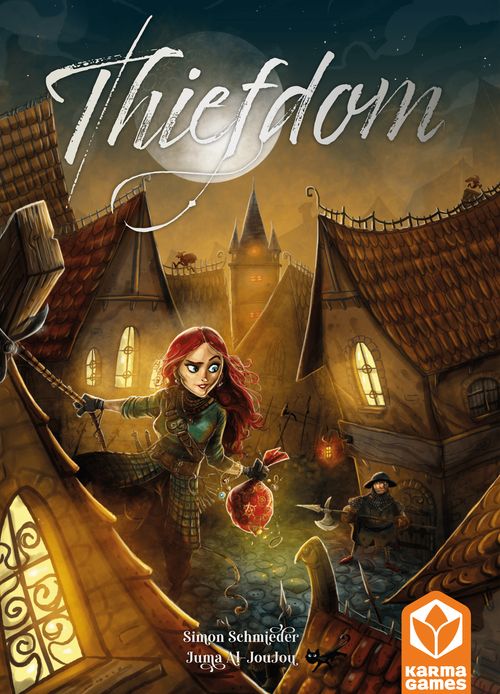
Thiefdom
Thiefdom Rulebook
Table of Contents
Table of Contents
Game Material
- Wood: 4 stamina markers*, 4 victory point (VP) markers*, 12 thieves*, 4 player boards*, 7 patrol boards, 4 guards, 4 nobles, 1 carriage, 1 solo player D8 (8-faced dice), 2 player aids, 1 solo player compass board
- Cardboard: 1 round marker, 30 gold coins, 24 badges, 30 liquors, 12 wines, 30 gems, 8 double-sided city boards, 2 VP boards, 4 villas, 16 planning tokens*, 1 loot board, 4 catacombs, 4 hideout markers*, 8 "4 goods" tokens, 4 paintings, 4 bag tokens, 16 smuggling missions, 10 wanted posters
- Cards: 36 guests, 24 equipment
- (* in the 4 player colors)
This rulebook also includes a how-to-play video, a rules quiz, and links to rulebooks in other languages, all reachable via QR codes in the print edition.
Setup (3–4-Player Game)
1. Shared Area
Take the 8 city boards and separate out the 2 boards showing a river. Randomly place these 2 boards above each other so that the rivers are on the right side of the board and connected to each other. Then, shuffle and lay out the other 6 city boards (using either side in any orientation) to the left of the 2 river boards as shown, to create a 4x2 city map with all boards combined. Each city board has an entrance located on the center square of each side, and has a number and letter, you will use these to help set up the rest of the shared play area.
Place the victory point boards to the far left of the city. Place the victory point board with the compass rose on the top. The compass indicates north (N) and south (S). The river is in the east and the vineyards (on the victory point board) are in the west of the city. Place the carriage on the lantern closest to the entrance marked on the victory point board. Place the round marker on the first space of the round track (#1 crescent moon on the victory point board).
The city boards have 8 open entrances, 4 facing north and 4 facing south. Take the 4 catacombs and look at their back side to see where to place each one. They must be placed next to open entrances of specific city boards (A/B sides of city boards).
Shuffle the 4 villas and place them at the remaining free northern and southern entrances of the city boards (A/B sides of city boards). Place a random painting on each villa, showing the reward side.
Use the 3–4-player side of the loot board and place it next to the city boards. The loot board depicts the guards, the nobles, and the carriage. Place 1 badge and 1 bag token on each corresponding slot, and all wanted posters as a stack on the corresponding slot.
Sort the rest of the goods by type (wine, gems, liquor, badges, and gold) and make a general supply.
Shuffle the smuggling missions and place 1 face up on each of the designated slots on the city boards (A/B sides of city boards). Place the remaining smuggling missions in a face-down deck next to the board.
2. Cards and Figurines
Shuffle the guests and place them face down as a deck next to the board within easy reach.
Sort the 24 pieces of equipment according to their backside into 2 decks (red circle and red semicircle) to have 2 sets of 12 cards. Shuffle both decks separately and place each as a face-down deck next to the board. Then, draw 4 cards from the deck with the red circle and place them face up next to the deck.
Randomly place the 4 guards on the spaces with lanterns in front of the entrances of the villas.
Note: Guards have a field of view marked with eyes. Their field of view must be oriented away from the villa, toward the city. The guards standing in the southern part of the city therefore have their field of view oriented north, and vice versa.
Randomly place the 4 nobles on the spaces with lanterns closest to the entrances of the catacombs.
Setup (2-Player Game)
Set up the game like a 3–4-player game with the following changes:
- Return the city boards 1A/B and 5A/B to the box. Build the city with the remaining 6 city boards in a 3x2 grid.
- Use the 1–2-player side of the loot board.
- Noble D and guard D are not used; return them to the box.
- Return catacomb 1A/B and one randomly chosen villa to the box.
3. Player Area
Each guild consists of 3 thieves. Each player picks a player color and places the corresponding player board in front of them. Then, each player also takes in their player color: 3 thief figurines, 4 planning tokens, 1 VP marker, 1 hideout marker and 1 stamina marker.
Each player also receives 8 gold (4 gold coins and a "4 gold" token) which is placed into their hideout inventory on the right side of their player board as shown. Every player places their VP marker on spot 10 of the VP track.
Select the patrol boards corresponding to the number of players (depicted in the top right corner) and return the remaining ones to the box. Shuffle the patrol boards and randomly deal 1 to each player. Place them face up next to your player boards. The player with the start icon on their patrol board is the starting player for the first round.
Goal of the Game
In Thiefdom you are leading a guild of thieves over the course of 6 nights, during which you'll control your 3 thieves as well as neutral figures. Have your thieves work together, using special equipment or the help from friends met at the tavern, in order to steal valuable items from various places all over the city. Sell your loot for profit, and accumulate the most VP for your guild.
You will score VP during the game as well as at the end of the game. Track your VP using your marker on the VP track. It is possible to lose VP during the game, however you will never go below 0 VP.
After 6 rounds and the end game scoring, the player leading the thieves' guild with the most VP wins.
Gameplay
Game Concepts
The City
Bacharach consists of a labyrinth of alleys, which, starting from the Rhine river, wind their way through complexes of houses and locations and finally ends in the vineyards.
Buildings
a. Houses: Areas of the city boards highlighted in gray. There are 5 different types of houses: towers, gardens, blacksmiths, stables and the church.
Houses only differ from each other in relation to specific guest abilities, which are described in detail in the appendix.
b. Locations: Areas of the city boards highlighted in orange are locations. These are:
- 1x Market
- 2x Dealer (1x in a 2-player game)
- 1x Dungeon
- 2x Tavern
- 4x Smuggler (3x in a 2-player game)
- 4x Villa (3x in a 2-player game)
See "Using a Location" for detailed descriptions of locations.
Catacombs: Thieves can move from one catacomb to any other catacomb.
Walls: Without the relevant equipment, walls are impassable for thieves.
Alley spaces: The alley network of the city is represented by dark blue cobblestones.
Lanterns: Lanterns are special alley spaces. They mark the crossroads of the alleys.
The Goods
There are 2 types of goods in Bacharach, loot and gold.
-
Loot: badges, gems, liquor, wine and paintings are loot. Usually, loot has to be bought or stolen and then delivered. It is placed on the thief's brown sack (left side of the thief's inventory).
-
Gold: Gold is the currency of the game and is earned while smuggling or, of course, stolen. Gold is placed on the thief's yellow sack (right side of the thief's inventory).
Notes: a) Without additional equipment, each thief can carry a maximum of 4 gold and 4 loot each. Use the "4 goods" tokens to show that you have 4 goods of the same type in an inventory. b) All goods (except for paintings) and wanted posters are unlimited in quantity. If you ever run out of these, steal something from another game to use in its place.
Figures
- The Thieves' Guilds
Each guild consists of 3 distinct thieves who start with the same set of skills. However, thieves can gain new skills by carrying equipment and befriending guests in the tavern.
Each of your thieves has its own inventory for loot and gold (4 slots each). When in your hideout, thieves of your guild can place any goods from their own inventory into the hideout inventory, and pick up goods from the hideout inventory. This does not cost an action point. If thieves deliver loot or pay gold during the game, it must always be done from their own inventory.
Note: Goods can be discarded from an inventory at any time to make room for other goods. Return discarded goods to the general supply.
- Townsfolk
Besides the thieves, all sorts of other characters move through the alleys of Bacharach.
The townsfolk are neutral figures that are moved by all players; they consist of guards, nobles and the carriage.
Adjacency
For all purposes, two objects are considered adjacent if they are orthogonally adjacent to each other (not diagonally).
Field of View
Each figure has a field of view. This defines the alley spaces that each figure is able to see.
Note: A field of view can expand across multiple city boards and goes through any figure.
- Thieves
For thieves, the field of view plays a role when using certain equipment. A thief's field of view extends in a straight line from the space they are standing in, through all adjacent spaces until the view gets blocked by a location, a house, or a wall. If the thief is standing in a building, their field of view extends from the building as if it were 1 contiguous space.
- Nobles and the Carriage
A noble's and the carriages' field of view is limited to the space they are standing on or spaces they pass through while moving.
Start of the Game
1. Equipment Draft
The first step of the game is to draft and buy starting equipment for your thieves. Take the equipment deck with the red semicircle on the backside. Proceed with the drafting as follows:
Deal each player 3 cards face down. From these 3 cards, each player selects 1 card and places it face down in front of them. Then, pass the remaining 2 cards face down in counterclockwise direction to your next opponent.
Each player now selects another card from these 2 cards and places it face down in front of them. Then, passes on the remaining card in counterclockwise direction.
All players place this last card face down with their previously selected ones.
All players now have 3 equipment from which to choose. They may purchase up to 2 pieces of equipment with gold from their hideout. Paid gold is returned to the supply.
Players may assign equipment to their thieves by sliding it partly beneath the player board, below the respective thief's area, following these equipment placement rules:
Throughout the game, a player may own multiple copies of the same equipment, but:
- No thief can carry duplicate equipment;
- Each thief may carry a maximum of 2 pieces of equipment;
- Once an equipment is owned by 1 of the 3 thieves, it can never be redistributed to another thief.
Once all players have bought and assigned 0–2 pieces of equipment, proceed with the next step.
Shuffle all remaining equipment (those not purchased by players and the remaining deck of cards with a red circle on the back) into a face-down deck and place it next to the board. This pile then contains a mixture of circle and semicircle cards.
2. Placement of the Hideout Markers
Starting with the player to the right of the starting player and then moving counterclockwise, all players place their hideout marker and their 3 thieves in a house (and not a location) of their choice, following these rules:
- You are not allowed to place your hideout marker in the church. Come on, really?
- There can only be 1 hideout marker in a house at a time. This is a competition, after all!
The house where you have placed your hideout marker, is considered to be your hideout.
Round Structure
The game is played over 6 rounds. A round consists of 3 phases and is split into night and day.
The night consists of 2 phases:
- Planning Phase
- Action Phase
The night is followed by the day at the end of a round. The day consists of 1 phase:
- Administration Phase
Night: 1. Planning Phase
In the planning phase, each player decides the order in which their thieves and the townsfolk they control will be performing their actions.
Players do this simultaneously using the 4 planning tokens. Each player places their planning tokens face down on the corresponding slots on their player board and patrol board. Once all players have completed their planning, all planning tokens are revealed at the same time.
Night: 2. Action Phase
During the action phase, players take turns in clockwise order until all players have had 4 turns. They take 1 turn with each of their 3 thieves and 1 turn with the townsfolk, in the order decided during the planning phase.
The starting player (the one with the starting symbol on the patrol board) begins with their #1 planning token. They take the planning token and place it above their player board (the number facing down) to indicate it has been used. Then, they perform the actions corresponding to where the token was placed (moving the townsfolk or controlling one of their thieves).
After the #1 planning token is resolved, continue clockwise with the next player until all players have resolved their #1 planning token. Then, all players resolve their #2 planning token, beginning again with the starting player, and so on. The action phase ends after all players have resolved all of their 4 planning tokens.
A. Townsfolk Actions
If you just removed your planning token from your patrol board, you must now move the noble(s), guard(s), and the carriage, if listed on your patrol board. Move the figures in the order indicated on the patrol board, from left to right. Each figure's movement rules are described in detail below.
Movement of the Townsfolk
General movement:
- Only 1 figure may stand in 1 alley space at a time.
- Townsfolk always begin and end their movement on lanterns.
- Townsfolk skip over any occupied alley space or lantern. They move over the occupied space and continue their movement from the next unoccupied space.
- Townsfolk can never change their direction of movement by 180 degrees. Due to skipping occupied lanterns, they may however move in a complete circle and end up back on their starting lantern.
Individual movement: In addition to the general movement rules, nobles, guards and the carriage have the following individual movement rules:
- Nobles
You may move the noble in any direction through the alleys. When skipping over an occupied lantern, you can again choose the direction that leads to a lantern. Nobles must end their movement as soon as they reach an unoccupied lantern.
Example: Noble C moves to the northern lantern. On their way, they skip over the carriage. They cannot enter the dead end, as they would change their direction by 180 degrees during movement.
- Guards
A guard can only move in 3 directions, determined by their current field of view: forward/left/right. Choose any of these 3 directions and move the guard in that direction. When skipping over an occupied lantern, you can again choose among those 3 directions. Whenever a guard moves, they always look straight ahead on their path and have to turn 90 degrees when moving around a corner.
A guard must end their movement as soon as they reach an unoccupied lantern, while looking in the direction of their last movement.
Example: Guard A's field of view is facing north. They can reach 5 unoccupied lanterns. You can see the guard's field of view at the beginning of their movement and at each of the 5 possible ends.
Before their movement, the guard looks north toward the carriage. The white thief in the guard's back is safe for now, since the guard can neither see them now nor change their direction by 180 degrees.
If the guard moves to one lantern, they would skip over the purple thief. If they move to another lantern, they would see the yellow thief. Either case would lead to an attempted arrest (see the next paragraph).
Attempted Arrest by a Guard
A guard attempts an arrest of a thief when the thief is in their field of view. This can happen in 3 different ways:
- The thief is temporarily in the guard's field of view during the guard's movement (which also happens when the guard skips over the thief);
- The thief is in the guard's field of view at the end of the guard's movement;
- The thief moves into the guard's field of view. In this case, the thief's movement is interrupted.
If any of the above 3 happens, the thief is laid down. If, at the end of any movement or action, 1 or multiple thieves are laid down, check whether they can prevent an arrest (using equipment or a friend). If they can, stand the thief figurine back up. If they cannot, they are now arrested. If you prevented an arrest during your thief's turn, resume their current action.
Note: Attempted arrests can also be triggered by certain players' actions (e.g. "Cudgel" or "Crossbow").
Arrest
Thieves are clever and always have small tools at hand that allow them to open handcuffs and escape to their hideout. However, in the process they have to drop all the goods they have. Being caught is also a disgrace to your guild, of course!
Proceed with the following in case of an arrest:
- Return all arrested thieves to their respective hideouts.
- Each player loses 2 VP for each of their thieves that got arrested this turn.
- Any goods that an arrested thief was carrying are placed in the dungeon on city board A/B.
Note: If your thief gets arrested during their turn, it only ends their current action, but they can still finish their turn.
- Carriage
You may move the carriage in any direction through the alleys. At every crossway you can choose where to move. Skip exactly one unoccupied lantern during movement, and end the carriage's movement on the second unoccupied lantern it reaches.
B. Thief Actions
Each of your thieves has 1 turn during each night, and 3 action points per turn.
The action icon is an orange triangle with a black mask.
During the action phase, you may use your stamina marker once per night to give 1 of your thieves 1 additional action point. That thief may then perform 4 actions instead of the usual 3. To indicate which thief gains the additional action point, place the stamina marker on the stamina spot on your player board.
A thief may spend action points to perform any of the following actions per action point, including several of the same type in a row:
- Movement
- Theft from townsfolk
- Using a location
- Using a card action
Note: You may end a thief's turn without spending all their action points.
1.) Thief Action: Movement
General Movement of Thieves
Performing a movement action grants the thief 3 movement points during this action. Each movement point allows the thief to move 1 space. Each alley space, house and location counts as 1 space.
The following rules apply to the movement of a thief:
- Only 1 figure may stand in 1 alley space at a time.
- Skipping over occupied spaces: Any occupied alley space is skipped and does not count as a space. If you skip over rival thieves, you lose 1 VP, per rival thief you skip over. The rival guild does not gain VP (see example below).
- Catacombs: All alley spaces adjacent to a catacomb are considered adjacent to each other for movement. Catacombs do not count as spaces: If you move through the catacombs, only count the unoccupied spaces in front of the catacomb that you step in and the first unoccupied space behind the catacomb you are stepping out of during movement.
- Teleport: When a thief is able to "teleport" with specific equipment or friends, they appear without moving and thus ignore entrances (see the following section). Cunning thieves know secret ways of getting from one area to another.
Entering and Exiting Buildings
Buildings have entrances. These entrances are marked with a dotted line. Thieves can only enter and exit buildings through entrances from and to an alley space adjacent to the building, expending 1 movement point.
If a thief enters a building, the current movement action ends immediately, surplus movement points are forfeited.
Example: You enter a house with the second of your 3 movement points. You cannot exit the house with your third movement point, as the third movement point is forfeited. Of course, you may perform an additional movement action to exit the house.
A thief exits a building through the dotted line on any adjacent alley space, spending the first movement point for the first adjacent alley space they move onto.
a) Houses: All adjacent alley spaces to a house are entrances.
b) Locations: Locations only have entrances on some spaces.
Exchange of Goods Between Thieves of the Same Guild
If you skip with 1 of your thieves over another of your thieves on an alley space, goods can be exchanged between these thieves along the way. It does not count as an action.
Note: Apart from alley spaces, goods can only be exchanged in your own hideout.
Example: The encircled thief can reach the stable house by skipping over the other thief and may exchange goods while skipping over them.
c) Entering hideouts: If 1 of your own thieves enters the house that is your hideout, they are always considered to be in the hideout. All your thieves are allowed to be in the hideout at the same time.
Rival thieves are allowed to enter your hideout, however, they do not suspect that your guild is hiding there and therefore have no access to your hideout inventory.
d) Entering a building where rival thieves are located: If a thief enters a building where rival thieves are already located, the thief entering the building loses 1 VP for each rival thief.
Thieves in their own hideout are hidden. Therefore, they don't suffer from the abovementioned penalty, nor do they increase the penalty for rival thieves entering the same house. Thieves in their hideout do not actually meet rival thieves.
Example: A white thief is located in the yellow hideout, where there is a yellow thief. A blue thief enters the same house and loses 1 VP due to the white thief in there, but does not lose another 1 VP due to the yellow thief in their hideout. If now a 2nd yellow thief enters their hideout they do not lose any VP despite the 2 rival thieves in the same house.
2.) Thief Action: Theft from Townsfolk
As an action, you can steal from or rob townsfolk with your active thief. The thief must stand in an alley space adjacent to the respective townsfolk in order to carry out this action. Each thief can steal from or rob multiple townsfolk figures per night, but not twice from the same figure in the same night.
1. Robbing the Carriage
When robbing the carriage, the thief immediately receives:
- 1 wine.
- A wanted poster, in case the thief has none yet. This thief is now wanted. Place the wanted poster on the designated slot of the wanted thief on your player board.
Note: a) A thief can rob the carriage despite being wanted. b) Each thief can only have one wanted poster at a time.
The carriage transports the beloved fire wine through the city. Since this is a robbery, the carriage driver now knows the thief's face.
Wanted Poster
You may discard a wanted poster from your thief when:
- They are in their hideout (doesn't count as an action). Changing their outfits to disguise themselves is what thieves learn first.
- They use the dungeon (see "Use a Location"). When you do this, you get 3 VP. Destroying the evidence is very glorious.
- The wanted thief gets arrested.
A thief that has a wanted poster can be arrested by any townsfolk. If they enter the field of view of a noble or the carriage (which can only happen if they skip over the townsfolk or the townsfolk skip over them), resolve Attempted Arrest as if they had been caught by a guard.
A thief with a wanted poster is wanted city wide. A phantom image has been shown to the nobles. The carriage driver also recognizes you. Be careful. They immediately sound the alarm when they spot the wanted thief.
2. Stealing from a Guard
If your thief is standing on an alley space that is adjacent to a guard AND not in their field of view (i.e. at the back or flank of a guard), they may steal from this guard. When stealing from a guard, you may steal 1 badge from them for 1 action.
Take the badge of the corresponding guard from the loot board.
Note: It is not possible to steal from a guard while the thief is in their field of view, even if the thief would not be arrested thanks to an equipment or friend.
3. Stealing from a Noble
If you are standing on an alley space adjacent to a noble whose bag token shows 2 gold or 1 gem, you may steal from the noble for 1 action. When stealing from a noble, you may receive either 2 gold or 1 gem from the general supply and flip the bag token of this noble on the loot board.
This noble is now considered empty-handed and no one can steal from them again until their bag token is flipped back up.
3.) Thief Action: Use a Location
A thief in a location may use it, for 1 action point. It does not matter if there are other thieves in the location. Each thief may use multiple locations, but may not use the same location twice in the same night.
Actions that can be performed depend on the location. For 1 action point, a thief can perform all available actions of a location (if not stated otherwise) in any order. However, each action can only be performed once and cannot be interrupted by any other action.
If you deliver goods while using a location, they are always returned to the general supply. If an exchange icon is marked with the infinity symbol, the thief can repeat the exchange as often as they like during the action.
Market
As people bustle about in the crowded market, they haggle with merchants while thieves unobtrusively reach into their pockets here and there.
- The thief fills up their gold inventory to the maximum. You steal here and there while everyone is distracted.
- The thief may exchange any number of liquor for 1 VP each. A round of liquor on you makes everyone happy.
Villa
The villas are loaded with gems as well as masterfully drawn paintings.
The thief must choose 1 of 2 possible actions in a villa, 1 of which is always marked with a padlock. The option with a padlock is only available to thieves that are equipped with a "Lock Pick" (see "Appendix" for the list of all equipment).
- EITHER: Fill this thief's inventory to the maximum with gems.
- OR: Steal the painting from the villa if it is still there. The painting goes into the thief's inventory and takes up 4 slots.
Note: The villas are never replenished with paintings after the start of the game.
Dealer
The dealers of the city are silent and mysterious personalities. A bit creepy looking, they sell equipment, are on the lookout for rare paintings, and are known for their great passion for gems.
- The thief delivers a painting and receives the bonuses depicted on it. Return the painting to the box.
- The thief may exchange gems for 1 VP each.
- The thief may purchase and immediately buy 1–2 equipment cards on display, paying each associated cost. Immediately receive the VP depicted on the top right of the card. At the end of your turn, replenish the equipment display to 4 equipment cards if any were purchased. If the deck has become depleted, shuffle the discarded cards face down to form a new deck.
Note: A thief can hold up to two pieces of equipment at a time and cannot discard them.
Tavern
The tavern is a lively place. People of all classes come together here. They drink, play, party, and trade. The basement is filled with homemade liquor, a fresh supply of wine is always welcome, and many friendships have begun here.
-
A) Guests: If this thief's friend slot is empty, they reveal the top 4 cards from the guest deck. If the deck has become depleted, shuffle the discarded cards face down to form a new deck. The player must now choose 1 of the following 3 options:
-
A1) Make a friend: Pay the cost of 1 of the revealed guests and form a friendship with them. Immediately receive the VP (and goods, for some guests) depicted on the bottom right of the card. Then, slide down the card, face up, in the friend slot, underneath the top part of this thief's area on your player board.
Note: Once a thief has made a friend, they are considered a "friendly thief" by that guest, and their friendship lasts for the rest of the game.
-
A2) Bar fight: Choose any 1 of the 4 drawn guests. Then, slide it in the friend slot, with the card facing down this time. Immediately receive 1 VP as noted on the back of the card. If you chose option A1 or A2, this thief will neither be able to make friends nor engage in a bar fight for the rest of the game.
-
A3) Don't receive a card: If you neither want to make a friend nor have a bar fight, you may choose to not take any of the revealed cards.
Once the player has chosen 1 of these 3 options, place all remaining cards on the face-up discard pile.
-
-
B) The thief may buy liquor for 1 gold each.
-
C) The thief may exchange wine for 2 VP each.
After a bar fight, that thief is now known in town as a rapscallion, and no one wants to be their friend anymore. As word of the brawl spreads around town and the tale takes on epic proportions, you at least got some glory. In any case, don't worry about the 3 poor souls who were not chosen during this tavern visit. They spend the evening together and write their own story. Whether they play games all night, make a friendship for life, or have a philosophical discourse ... who knows?!
Dungeon
The dungeon is a dark place. All the loot confiscated by guards during arrests lies here. It's naturally tempting for any good thief to take back their honestly stolen goods.
- If there are any goods in the dungeon from a previous arrest, the thief may fill up their inventory with these goods.
- The thief may exchange badges for 2 VP each.
- If the thief is carrying a wanted poster (see "Robbing a Carriage"), they may discard it and immediately receive 3 VP for it. Return the wanted poster to the general supply. Your thief burns the charcoal drawing made by the carriage driver's description of the thief. This humiliation of the guard earns you some honor.
Smuggler
A good thief must know the right people to take their freshly acquired goods out of the city. A small boat at night or a cart in broad daylight, smugglers know the best ways to sneak "sensitive" items under the guards' noses.
- Fulfill the smuggling mission. Deliver the demanded goods and exchange them for the reward (goods and/or VP). Take the fulfilled smuggling mission from the board and place it in your player area.
Note: It is not possible to use the smuggler, when the smuggler does not have a smuggling mission. Smuggling missions are replenished during the day phase of rounds 2 and 4.
4.) Thief Action: Use a Card
If your thief has equipment or a friend, they may have access to additional actions.
Cards with the action icon can be used by spending 1 action point, and may have restrictions on when and where you can use them.
Cards with the action icon and 2 stars, one on either side, are action upgrades. These give a permanent or one-time improvement to the shown action.
Example: If you have befriended the guest Kunrad, the friendly thief gets 1 gem and 1 VP when performing the market action.
For a list of all cards and detailed explanations of the available actions, see "Equipment" and "Guests" on pages 16–18.
Day: 3. Administration Phase
After the action phase ends, the night is over and the day administration phase is carried out. Skip this phase in round 6.
- Move the round marker to the next spot on the round track (next crescent moon).
- Each player places their stamina marker back next to their player board. They then collect their planning tokens, ready to be placed for the next round.
- Each player passes their patrol board counterclockwise to the next player, thus changing the starting player.
- Each player receives 1 VP for each thief they have on an alley space. Keeping a lookout in the dangerous streets is risky and earns the respect of rival thieves.
In the administration phase of round 2 and 4, also carry out the following:
- Flip the bag tokens of the nobles on the loot board to the side with the goods shown.
- Refill the loot board with badges from the supply, back to one badge per designated slot.
- Place 1 smuggling mission from the deck on each smugglers' designated slot, if it's empty.
- The equipment cards on display are discarded and replaced with 4 cards from the deck. If the deck has become depleted, shuffle the discarded cards face down to form a new deck.
End of the Game
After the action phase of round 6, the game ends. Move the round marker to the full moon. The players now count their VP.
-
Each player earns VP based on the total goods they hold, including items in their hideout inventory and each thief's inventory, as follows:
- Set of 4 gold — 1 VP each
- Set of 2 gems — 1 VP each
- Set of 2 liquor — 1 VP each
- 1 badge — 1 VP each
- 1 wine — 1 VP each
- 1 undelivered painting — 3 VP each
-
Count any end-game bonuses from your friends with a full moon icon.
Note: Friends who give extra VP for goods in your hideout inventory, do not grant extra VP for goods in your thieves' inventory, even if the thieves are in the hideout.
-
Score 1 VP for each of your thieves in your hideout.
Victory
The guild with the most VP wins the competition and is elevated to the status of "Master Guild". In case of a tie, the guild with the most goods tokens in its possession at the end of the game wins.
In the unlikely event that there is still a tie, the winner is determined by who has more goods tokens of specific priority types (badges, then gems, then liquor/wine, per the tie-break table on the victory page).
If there is still a tie, the winner is determined by who was the last player in turn order round 1.
Variants
Smuggling Mission Variant for Reduced Luck
During setup, place a stack of 2 face-up smuggling missions next to 4 of the city boards. Return all other smuggling missions to the game box. During the administration phase of rounds 2 and 4, if a smuggling mission slot on a city board is empty, use the top smuggling mission from the stack beside that board to replenish it. You may always view the bottom smuggling mission in each stack. This variant reduces the luck factor and enhances strategic depth.
Chaotic Planning
To speed up the game, you can play the planning phase differently. Each player shuffles their planning tokens and places them randomly on the designated spaces on their player board and patrol board. This variant is good for getting to know the game or for playing the game a little more loosely. You should agree to not play too slowly when agreeing to use this variant.
Solo Game
In the solo variant, you and your guild go up against the guards alone, trying to score as many VP as possible. Use the solo helper app to streamline your solo games!
Setup
Set up the game like a 2-player game with the VP board on the left side and the river on the right side of the city from your point of view, but use the 3 patrol boards for the solo game.
As usual, take a player board and the materials in the color of your guild. However, return planning token #4 back to the box. Unlike the normal game, you do not deal patrol boards yourself, but shuffle the 3 patrol boards and place them as a face-down deck next to the board.
Also, place 3 rival thieves (of one player color) next to the board.
Place the compass next to your player board where the patrol board would otherwise be. North should face the city boards, and the side with your starting player icon is facing up. Place the D8 dice on the compass.
Take the player board of a rival thief player color and use the backside. It will guide you through the solo game.
Gameplay
Equipment Draft and Placement of Hideout
To draft equipment, first draw 3 cards, pick 1 of them, then draw 2 cards, again keep 1, then draw another single card from the deck.
From the 3 equipment, you can now buy 0–2 equipment and distribute it among your thieves as you wish. Then, place your hideout marker.
Round Structure
Night: 1. Planning Phase
Plan the order in which the thieves will perform the actions by placing the planning tokens face up on your player board.
Night: 2. Action Phase
In the solo game, the thief's turn and the townsfolk's turn are carried out alternating. In the first round, you are the starting player as depicted on the compass, and you perform your actions with your thief with planning token #1.
You then perform the townsfolk actions:
- Flip the top patrol board on the top of the pile.
- Roll the 8-faced dice to determine in which direction the townsfolk will be moving this action.
- The figures listed on the patrol board now perform a movement in the order indicated on the patrol board, by following the direction on the compass that matches the result of the dice roll.
- Normal movement rules apply and, when skipping over another figure, the townsfolk will keep moving in the direction of the compass.
- If the figure cannot move in this direction for some reason (wall, house/location, dead-end street or because the guard cannot move backwards), the small arrows on the compass will point towards the alternate direction to follow.
In addition to the movement, place the rival thief, whose shape is shown at the top right of the patrol board, on the specific location determined by a new roll of the D8 using the following rules. From the second night on, a rival thief can stay in its location if the dice roll indicates so.
Example: In the example above, there are 5 unoccupied lanterns. Guard C can reach 4 of them with the respective dice rolls indicated.
If an 8 is rolled: A 7 or an 8 indicates a movement toward the west. Therefore, the guard would first attempt to move to the lantern located west. However, as the guard's field of view is orientated east, this lantern is behind the guard. Hence, the guard cannot move to that lantern because they would have to turn by 180 degrees to move there, which breaks the guard's movement rules.
In order to figure out the guard's move, take the compass board and check the arrow next to the 8. This arrow indicates the direction the guard must move, in case the previously determined direction is not available. The orange arrow at the 8 points toward the north. As the guard can move north, they do so. They then simply follow the usual rules of movement and stop at the indicated lantern.
Note: If you enter a location with a rival thief, you lose 1 VP per rival thief in that location, just as in the multiplayer game.
After you have carried out all townsfolk's actions depicted on the patrol board, it is your second thief's turn. Then, you turn over the next patrol board and again perform the movements shown, and so on, until all of your thieves and all patrol boards had their turn.
Note: If you get arrested in a solo game, goods are discarded and not placed in the dungeon.
Day: 3. Administration Phase
In the administration phase, you turn over the compass. The second round starts with the townsfolk's action, and so on.
End of the Game
The game ends after 6 rounds. Check the table on the back of the player board to see how well you did. Feel free to share your result with a photo of the layout on Boardgamegeek.
Appendix: Cards
Equipment and guest cards vary in how they function:
a. Bound to an action. These cards split into 2 groups:
i. Cards that cost an action point to be used. These cards enable you to perform new kinds of actions. ii. Cards that are a bonus for another action and cost no action point itself. These cards make an already available action better. In order to use the card, you have to perform the action the card is referring to.
b. Free actions: These cards are not bound to an action and can be used without spending an action point. Those also split into 2 groups:
i. Cards showing specific indications about time, frequency and location. You can only use the card when those indications are met. ii. Cards with no specific indication about time, frequency and location. You can use the card as often as you want during the turn of the thief, who has the card.
Note: Some of these cards can have an effect on all thieves from your guild. This is indicated by the "Your guild" icon.
Example: The friendly thief can turn 1 liquor into 1 wine in a garden house, without spending an action point and once per turn.
1. Equipment (2 x 12)
-
Climbing Tools — (1x per turn, movement, bonus for another action) During movement, the thief may skip over a wall once per turn. The thief may enter and leave a location over a wall. The location entrances may be ignored during this movement if the thief climbed over an adjacent wall.
-
Crossbow — (1x per turn, action) As an action, the thief can shoot at a single guard in their field of view. The player receives 1 VP and immediately moves the guard following the regular guard movement rules. This could lead to an arrest. A thief can shoot at a guard while standing in a building.
-
Cudgel — ("Steal from a guard", bonus for another action) During the action "Steal from a guard", the player receives 1 VP and immediately moves the guard following the regular guard movement rules. This could lead to an arrest. The Cudgel may also be used if the guard is no longer carrying a badge. It cannot be used against a guard while in field of view of that guard, even if another bonus prevents arrest.
-
Fishing Rod — (1x per turn, building, action) As an action, the thief can steal from the carriage from an adjacent building. The thief receives 1 wine and the player receives 2 VP. Don't receive a wanted poster. This does not count as a "Robbing the Carriage" action.
-
Grappling Hook — (1x per turn, building, action) As an action, the thief can "teleport" in a straight line across the alley from 1 house or location to another location/house (Thematically, they jump from roof to roof). All figures in the alley are ignored (no exchange of goods between thieves is possible), they can even move across guards this way without being arrested. Entrances (see "Entering and Leaving Buildings") are also ignored. The grappling hook does not allow the thief to cross walls.
-
Sack — (Thief's inventory, free action) The sack adds 2 empty slots to the thief's inventory. The sack can hold both loot and gold. Example: In the market / villa, you can fill your inventory up to 6 gold / 6 gems.
-
Messenger Pigeon — (1x per turn, action) As an action, the thief can exchange up to 3 goods with another thief from their guild. This happens simultaneously. Take up to 3 goods (no painting) from both inventories, then redistribute them as you wish between the 2 thieves anywhere on the map.
2. Guests (36 x)
-
Antonius — (1x per turn, church, free action) The friendly thief may receive 1 wine when they are in the church.
-
Apollon — (1x per turn, garden, free action) The friendly thief may exchange 1 liquor from their own inventory for 1 wine once per night in a garden.
-
Beatrix — (Church, free action, once per game) Return Beatrix to the church. When the friendly thief is in the church, immediately receive 3 VP and 3 action points to spend with this thief. Then, return this guest to the box.
-
Benjamin — (Free action) The friendly thief does not lose VP when encountering rival thieves.
-
Bernhard — (1x per turn, action) 1x per turn: the friendly thief may put 1 gold in the dungeon so that 1 chosen guard loses their field of view and cannot arrest the friendly thief for this round. The friendly thief may still not steal a badge from that "blind" guard while being in their original field of view.
-
Elise — (End-game bonus) Each gold in the guild's hideout inventory grants 1 VP at the end of the game.
-
Grimm — (End-game bonus) Each badge in the guild's hideout inventory grants 2 VP at the end of the game.
-
Helmut — (End-game bonus) Each liquor in the guild's hideout inventory grants 1 VP at the end of the game.
-
Iwana — (End-game bonus) Each gem in the guild's hideout inventory grants 1 VP at the end of the game.
-
Janus — (Market, bonus for another action) During the market action, the friendly thief can exchange liquor for 2 VP each, instead of 1 VP.
-
Jin — (1x per turn, movement, bonus for another action) The friendly thief may skip over any building during movement, as if the building were a figure. Continue the movement on any alley space orthogonally adjacent to the building. They do not enter the building. Jin, the architect, knows shortcuts through everyone's property.
FAQs
Movement and Field of View
- When moving neutral figures, you can determine their direction at every crossroad where their move does not end. However, they may never turn by 180 degrees.
- Guards have a field of view, marked with eyes. They can only move in the direction their eyes are pointing, or turn left and right.
- When you skip over a friendly thief who is standing in an alley space, these two thieves may exchange goods. Apart from that, two friendly thieves can only exchange goods when located in their own hideout.
- When you enter a building where rival thieves are located, you lose VP (unless it is their or your hideout).
- When carrying a wanted poster, your thief will get arrested by nobles and the carriage if your thief skips over them, or if they skip over your thief.
Thief's Actions
- Each of your thieves may use the same location at most once per night.
- When you use a location with several effects, you can perform these effects in any order.
- You may not steal from or rob the same figure with the same thief twice in the same night.
- In every villa, either the painting or the gems are protected by a lock and the locked item can only be stolen by a thief equipped with the lockpick.
Miscellaneous
- Turn order is clockwise; the patrol boards are passed on counterclockwise.
- In the last round, you gain VP for having your thieves in your hideout, not for those located in alley spaces.
- When you need to draw cards from a deck of cards that is depleted, shuffle the discarded cards face down to form a new deck.
Do you still have unanswered questions? Visit Thiefdom on Boardgame Geek and check the forum for an answer! The designers visit the forum regularly and will help the community in answering all questions.