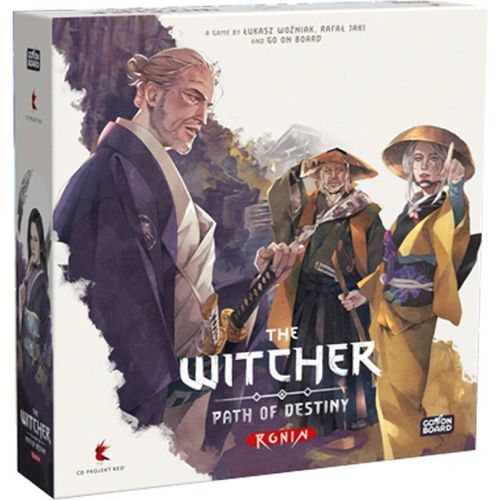
The Witcher: Path of Destiny – Ronin
The Witcher: Path of Destiny – Ronin Rulebook
Table of Contents
Table of Contents
Introduction
Game Description
The Witcher: Path of Destiny RONIN is a competitive, 1-5 player tableau-building card game, where each of you becomes one of the characters forming fragile alliances in a unique version of the Witcher universe.
In The Witcher: Path of Destiny RONIN you are members of one team, but players compete and make partnerships to write their name in the annals of history. The player who cunningly manages to help their companions the most while outwitting them at the same time will be remembered.
The Witcher: Path of Destiny RONIN is a standalone game and isn't compatible with the Witcher: Path of Destiny or its gameplay expansions. While the rules for both games are mostly the same, we advise you to read through the rulebook carefully to familiarize yourself with the differences.
Look for the following icon marking any changes.
Components
Component List
- 80 Action cards in 5 colors
- 4 double-sided Active Symbol cards
- 1 Extra Experience token
- 6 Chapter cards (with the starting initiative order on the back)
- Symbol tokens:
- 40 Fight tokens
- 40 Magic tokens
- 40 Exploration tokens
- 40 Diplomacy tokens
- 30 Lost Symbol tokens
- 1 bamboo-like playmat
- 1 turn marker
- 5 Partnership markers
- 5 double-sided Partnership boards (symmetric side A and asymmetric side B)
- 1 Aid card
- 7 sets of Player components, each containing:
- 1 player board
- 4 Ability cards
- 5 starting Action cards
- 1 Player token
- 4 Ability tokens
- 1 golden Experience marker
- 1 regular Experience token
- 1 miniature
- 1 standee
Components Details
Transcription note: the printed component list reads "Ablility tokens"; it is given here as "Ability tokens".
Symbols
There are four Symbols in the game. They represent the effects of players' actions. Players gather Symbols in several ways; most often, by playing Action cards with Symbols on them to their tableaus.
The four Symbols are: Magic, Diplomacy, Exploration and Fight.
Symbol tokens are used to show Symbols that a Player has gained as a result of any card effects, Abilities or bonuses. Whether the Symbol is on an Action card or a Symbol token, it counts for all its effects.
Some effects require the Player to lose a Symbol. The Player may either discard the Symbol token from their token pool or use the Lost Symbol token to cover the matching Symbol on any of their Action cards in their Timeline – a tableau of cards (more on page 16).
Chapter Cards
Chapter cards will show the pairs of Active Symbols for each of the 3 Chapters and the Side Quest Symbols. The Chapter card shows the starting Initiative order on the back.
- Left Active Symbol and Right Active Symbol – the Active Symbols in the 1st Chapter.
- Initiative Order – shown on the back of the card.
- Side quest – shown below the Active Symbols.
- Cards in hands with chosen symbols – shown on the card.
Active Symbol cards corresponding to the Active Symbols for the 1st Chapter are placed on the designated place on the playmat.
Active Symbols will reward Players with Experience Points and Victory Points. Non-Active Symbols – the other 2 Symbols, that will not count towards gaining any Points during this Chapter.
Player Board
Each Player board has artwork, a name, Abilities, and an Experience Points track on it. After reaching a certain point on the track, the corresponding Ability is unlocked and the Player may use it once per game (page 12). At the end of the game, the Player will gain Victory Points based on the position on the track.
- Name and artwork.
- Abilities.
- Experience Point track (and End game Victory Points).
Action Card
- Color.
- Symbols.
- Artwork.
- Tea Ceremony effect.
- Condition, Effect and Bonuses.
- Result.
- End game Victory Points.
Partnership Board
Partnership boards are placed between neighboring Players (Partners) during the setup. The Partnership track represents how tightly the Players cooperate and provides them both with immediate Bonuses and end-game Victory Points. Players mark their Partnership level with the Partnership marker, starting with 0 (the Tea Pot symbol is 0).
Each board has a Symmetrical side A and an Asymmetrical side B, with different bonuses for each pair of Players. Before the game, all Players should agree to play using the same side (A or B) for all boards. Choose the Symmetrical side for your first game.
Transcription note: the per-spot bonus pictograms and short bonus captions printed along the Partnership tracks on the boards are raster artwork in the source PDF, and their text is too low-resolution to transcribe reliably. They are not reproduced here; consult the printed boards for the bonus on each spot. The general rules for gaining Partnership Points, Partner's Abilities and Partnership Scoring are given in full below.
Game Setup
-
Place the playmat on the table. The playmat organizes the main play area; each Player should have space for their Player board as well as their Timeline – a tableau of Action cards played in one Chapter.
-
Draw Chapter cards. Shuffle 6 Chapter cards, draw 1, and place it next to the playmat.
- 2A. Place the Active Symbol cards matching the Symbols for the 1st Chapter in the designated place on the playmat.
- 2B. The Chapter cards also specify the initial Player order (on the back of the card) on the Initiative track. Players will place their standees after choosing the Characters, with the Character highest on the Initiative being closer to the Active Symbol cards.
- 2C. Place the Turn marker on the 1st spot of the Turn track.
-
Place the cards. Shuffle the Main deck with Action cards and place it face-down on the designated spot on the playmat. Then draw a pair of cards from the top of the Deck and place them face-up on each of the designated spots (rows) on the Playmat, preparing a Pool of available Action card pairs.
- For 1, 2, and 3 Players – there are 4 spots available.
- For 4 and 5 Players – there are 5 spots available.
-
Place the Extra Experience token. Place the Extra Experience token next to the bottom available spot on the playmat.
- For 1, 2 and 3 Players – on the fourth spot.
Player Components
After choosing their Characters the Players set up their Character components:
-
Experience markers. The Regular Experience marker is placed on the 0-spot of the Experience Points track on the Player board. The Golden Experience marker is placed on the spot indicated on the right of the track.
-
Ability tokens. 1 is placed on the first Ability from the left, active side up (the one with an icon), which indicates the Ability is available from the beginning of the game. The remaining 3 are placed next to the Player board.
-
Character miniature/standee. Used on the Initiative track; it is placed according to the Initiative shown on the Chapter card.
-
Victory Point token. Place it on 0 of the Victory Point track.
-
Starting Action cards. Take your 5 starting Action cards. They form your starting hand.
-
Ability cards. Keep the 4 Ability cards face-down near your Player board for now. They feature the 1st and 3rd Ability of the Character and they may be exchanged between the Players during the game through Partnership tracks bonuses.
General Rules and Terms
The game is played through 3 Chapters, each of them divided into 3 Turns.
Symbols and Active Symbols
There are always two Active Symbols that the Players aim to gather – each one corresponds to the light arrow pointing left, or the dark one pointing right – the Paths of Destiny.
The 2 remaining Symbols are called Non-Active Symbols. Even though these do not bring any direct benefits, they can still be used by cards' effects or Player Abilities.
Active Symbols – At the end of each Chapter, Players check which of these will determine their destiny and allow them to gain Experience Points (for the one they have most of) and Victory Points (for the one they have fewer of).
At the end of the Chapter, each Player will individually evaluate their Timeline and Token pool.
Gaining Victory Points wins the game, so Players should be focused on keeping the balance between the Active Symbols.
Gaining Victory Points
Whenever a Player gains any Victory Points, they move their token on the Victory Point track. When a Player gains their 30th Point, they move their token back to the 0 spot and continue, adding 30 Points to their total at the end of the game.
Gaining Experience Points
Whenever the Player gains any Experience Points, the Player moves their marker on the Experience Point track.
When the Player reaches the 20 Experience spot, they move the marker to the spot below the track, get the Golden Experience marker and place it on the 0 spot of the Experience track.
Any additional Experience they gain for the remainder of the game is tracked by the Golden marker. It does not affect the Abilities in any way but grants the Player additional Victory Points at the end of the game.
When the Player reaches the 20 Experience spot again, they do not move the Golden Experience marker anymore and cannot get any more Experience Points.
After the Player reaches or moves over a new Ability spot, they place the Ability token on it with the active (the one with an icon) side up. The Ability is now available for the Player to use.
Abilities
The Player begins the game with one Ability (first from the left) available to them.
Each Ability can only be used once per game and the Ability description indicates when it can be used. If two or more Players want to use their Abilities at the same time, they should be able to do that simultaneously. If there is a need to resolve them in a particular order, follow the Initiative order on the Initiative track.
After using the Ability, the Player turns the Ability marker to the inactive side to show that it has already been used.
Gaining Partner's Abilities
After reaching certain spots (for example the 3rd or 10th spot on a symmetrical Partnership track), Partners will be able to gain each other's Abilities.
When a Player gains their Partner's Ability, they take the corresponding Ability card from their supply and place it face-up next to the Player board, available to be used.
After using the Ability card, the Player flips it face-down.
Example: Geralt and Yennefer share a Partnership track, and after resolving a Tea Ceremony effect, they advance to the 3rd spot on the track. Its bonus – "gain your Partner's 1st Ability card or gain 2 Experience Points" – is now resolved and both Players choose to gain the Ability card. They take the face-down card from their Partner, corresponding to their 1st Ability, and put it next to their Abilities face-up, ready to be used.
The detailed rules for resolving the Tea Ceremony Step are explained on page 18.
Turn Structure
Each Chapter (game round) is divided into 3 Turns, and each Turn is divided into 3 Steps:
- Drafting cards
- Playing cards
- Tea Ceremony
At the end of a Chapter, Players will score Points, clean up their Timelines, and prepare for the next one.
1. Drafting Cards
Following the Initiative order (top to bottom), Players take their turns Drafting cards from the available pool.
- If this is not your first Turn in the game, discard the topmost pair of Action cards still in the Pool onto the face-up Discard pile next to the Main deck.
- Then, move all the remaining pairs of cards (if any) up, filling the topmost spots, and reveal new Action cards to refill the available spots in the Pool.
- The Player on the topmost Initiative spot moves their Character miniature to any available space and takes the two corresponding Action cards to their hand. Then the next Player chooses their cards, and so on.
The topmost spot, next to the Main deck, may be chosen by multiple Players, and each subsequent Player places their miniature below the others already present in that space. After placing their miniature here, the Player draws 2 cards from the top of the Main deck.
If the deck runs out at any time, shuffle the entire discard pile and form a new Main deck.
All other spaces can be chosen only by one Player. Those spaces have 2 face-up cards assigned to them.
Although taking the bottom spot means being last in the Initiative order, it comes with a benefit – after the Player places their miniature there, they immediately get one Experience Point.
After all the Players drafted their cards, they move their miniatures back to the Initiative track, keeping their new order. Then go to the Playing Cards Step.
2. Playing Cards
Each Player chooses 2 Action cards from their hand to play. Once a Player has chosen their cards, they hold them face-down keeping their order, and wait for the other Players.
Once all Players have chosen their cards, they reveal them simultaneously and add them to their Timeline resolving any effects, apart from the Tea Ceremony ones, in the Initiative order.
- Most cards show Symbols on the top left part of the card. These Symbols may match the Active Symbols or they may be Non-Active Symbols. The Symbols may also be gathered as Symbol tokens, through various effects.
- Many of the Action cards have an effect (effects are described in detail on the last page of this rulebook).
- Standard effects are resolved after cards are played. The Standard effects of the two cards just added to the Timeline are resolved one by one, starting from the card on the left.
- Effects on played cards affect the Symbols in the Token pool, all the cards played earlier to the Timeline, as well as the card they are on. For example, if an effect refers to the Non-Active Symbol and so happens, that the proper Symbol is present on this card, the Player may use it.
- If the Player can resolve the effect of the card, they must do so, to the maximum extent possible.
- If the Player gains any Symbols, they place the corresponding token on the left side of their Timeline, thus creating their own Token pool.
- If the Player has to lose a Symbol, they may either choose to discard a Symbol token or use the Lost Symbol token to cover the proper Symbol on any card in their Timeline.
- Some cards feature Tea Ceremony Symbols and effects that result in gaining Partnership points. These effects, marked by an icon, will be resolved in the next Step of the Turn – Tea Ceremony.
Example: Exploration is a Non-Active Symbol in the current Chapter. A Player has an Exploration Symbol in their token pool and plays a card with the effect: "Lose 1/2/3 Non-Active Symbols to gain 1/2/3 Fight Symbols." They discard the Exploration Symbol token from their pool, cover the Exploration Symbol on the played card, and gain 2 Fight Symbol tokens to their token pool.
Effects can be used once, but the result of some effects depends on the level at which the condition is met. A summary of icons can be found at the end of the rulebook.
After all Players have resolved the effects of the cards played, go to Step 3: Tea Ceremony.
3. Tea Ceremony
During the Tea Ceremony Step, Players resolve the Tea Ceremony effects on cards in their Timelines, starting with the Player at the topmost spot on the Initiative track and following the Initiative order:
- Resolve the Tea Ceremony effects on the Action cards played this Turn.
- Check for a pair of matching Passing the Tea Symbols.
Cards with Tea Ceremony Effects and Passing the Tea Symbols allow the Player to gain a Partnership Point, which means the Partnership marker moves up one spot on one of their Partnership track. The effect may add Points to only one, or both tracks.
Move the Partnership markers accordingly. Both Partners gain any Bonuses from the spot on a shared Partnership track, the marker moved to or through.
Tea Ceremony Effects on the Action Cards
Resolve the Tea Ceremony effects on cards played this Turn.
- Example card effect: "Lose 1 Exploration Symbol and add 1 Partnership Point to both of your Partnership tracks."
- Example card effect: "Choose a Partner to your left or right and for each blue card in their Timeline (up to 3) gain 1 Partnership Point on a track shared with them."
Passing the Tea
These Symbols on an Action card may point towards left or right, at the neighboring Players.
A pair of matching Symbols is created if there are Passing the Tea Symbols anywhere in the neighboring Players' (Partners') Timelines pointing at each other.
- Passing Tea to the Right and Passing Tea to the Left are the two Symbols.
If there's a pair of such Symbols, both Partners cover those Symbols with Lost Symbol tokens and gain 2 Partnership Points, moving up their Partnership track by 2 spots.
A Player may create multiple pairs of Passing the Tea Symbols in a Turn, with both or one of their Partners. If Partners have a pair of Passing the Tea Symbols pointing at each other, they must resolve their effect.
Example: Two neighboring Players (Partners) played cards with Passing Tea Symbols this Turn, or already had them in their Timelines from previous Turns. The Symbols are not covered by the Lost Symbol tokens and are pointing at each other. Geralt and Yennefer put Lost Symbol tokens on the Symbols and gain 2 Partnership Points on the shared track.
After the Tea Ceremony Step ends, move the Turn marker by 1 spot to the right and start the next Turn. After three Turns, the Chapter ends.
Gameplay
The End of the Chapter
After the third Turn, the Chapter ends and Players gain Experience and Victory Points.
Gain Experience Points. Each Player individually checks which of the Active Symbols they have the most of on Action cards in their Timeline and their Token pool. They gain 1 Experience Point for each.
Gain Victory Points. Each Player then gains 1 Victory Point for the other Active Symbol present on Action cards in their Timeline and their Token pool.
Example: Magic and Fight are the Active Symbols.
- Player A has 5 Magic and 6 Fight – gains 6 Experience Points and 5 Victory Points.
- Player B has 8 Magic and 2 Fight – gains 8 Experience Points and 2 Victory Points.
- Player C has 4 Magic and 4 Fight – gains 4 Experience Points and 4 Victory Points.
If the Turn marker reaches the end of the track, continue with the End Game scoring. Otherwise, prepare for the next Chapter.
Clean Up Timelines. Players discard all tokens (Symbols and Lost Symbols) from their pools.
Players perform the following step simultaneously and reveal the chosen card(s) at the same time:
- After the 1st Chapter, each Player chooses any 1 Action card from their Timeline to keep and discards all the remaining ones. The chosen card is placed as the first card played for the next Chapter.
- After the 2nd Chapter, each Player chooses any 2 Action cards from their Timeline to keep and discards all the remaining ones. They don't need to keep the card chosen after the 1st Chapter. The chosen cards are placed in a freely chosen order as the first cards played for the next Chapter.
If any of the kept cards have a Standard effect that can be applied, it is resolved immediately. Any Tea Ceremony effects will be resolved during the next Tea Ceremony Step.
Setup the Next Chapter. Replace the Active Symbol cards with the next ones, according to the Chapter card. Start the first Turn of the next Chapter.
The End of the Game
After the 3rd Chapter, Players do not discard any cards from their hands, Timelines, and Symbols from their Token pool. They now resolve the final scoring to determine the Winner of the game.
Side Quest Scoring. Each Player selects one of the Non-Active Symbols in the 3rd Chapter (they are shown on the bottom of the Chapter card). They reveal their hand and score 1 Victory Point for each card with a chosen Symbol.
Example: Exploration and Fight were Active Symbols during the 3rd Chapter, and Diplomacy and Magic were Non-Active Symbols. Player A (Ciri) chooses Diplomacy and reveals their hand. They score 4 Victory Points. Player B (Geralt) chooses Magic and reveals their hand. They score 2 Victory Points.
Experience Points Scoring. Each Player scores Victory Points according to the last spot reached by their Golden Experience marker on the Experience Points track. If the Player has not gained at least 20 Experience Points, they get no Victory Points. (See "Gaining Experience Points", page 12.) In the following example, the Player gains 7 Victory Points.
Partnership Scoring. Each Player compares their Partnership tracks and determines on which one they are at the lower level. They score Victory Points shown next to the highest space with Victory Points they reached.
Example: The Player gains 2 Victory Points.
Determine the Winner of the Game
The Player who has the most Victory Points is declared the winner. In case of a tie, the Player higher on the Initiative track wins.
2-Player and Solo Modes
When playing with 1 or 2 Players, an automated opponent(s), called Automa, is used. It cannot win the game but interacts with the board and cards. Automa uses a regular Character board and some Character components.
Setup Changes
When placing the Partnership tracks, prepare a space for the Automa.
After Players have chosen their Characters, select one board for each Automa in the game and prepare its components:
- 1 Player board, 4 Ability cards, 1 miniature/standee.
- Experience Markers. Do not place Experience markers on the board. Automa does not gain Experience Points.
- Ability Tokens. Do not place Ability tokens on the board. Automa does not unlock or use its Abilities.
- Character Miniature/Standee. Used on the Initiative track, it is placed according to the Initiative shown on the Chapter cards.
- Victory Point Token. Do not place it on the Victory Point track. Automa does not gain Victory Points.
- 5 Starting Action Cards. Put them back in the box. Automa has no cards in hand.
- 4 Ability Cards. Keep them face-down near the board.
When playing with 2 Players, Automa is considered to be sitting between the Players. Each Player will share a different Partnership track with it. When placing Partnership tracks on the asymmetrical sides, Players choose the track between themselves and Automa. Place a random Partnership track between the Players. (Printed as "Parnership track".)
Example: Game setup for 2 Players (Automa plays as Geralt).
When playing solo, there are 2 Automas, one sitting on the left, and one on the right of the Player. Place a chosen Partnership track on each side of the Player area. Do not place a Partnership track between Automas.
Example: Game setup for 1 Player (Automa plays as Geralt and Yennefer).
Choose the difficulty level and gain Partnership Points on both tracks:
- Summer (easy) – 4 Points (apply any bonus from the spots moved through).
- Autumn (normal) – 2 Points.
- Winter (hard) – 0 Points.
Gameplay Changes
Automa is an automated Player who drafts and plays cards to its Timeline following the Initiative order and gains Partnership Points.
Drafting and Playing Cards
When it is time for Automa to draft cards, it selects a spot following the priority:
- a pair of cards with the most Active Symbols,
- a pair of cards higher in the pool,
- if there is no Action card with an Active Symbol in the pool, it moves to the spot next to the Main deck, drawing 2 cards from its top.
Immediately after drafting, Automa plays the cards to its Timeline, ignoring any effects.
Note: when placing cards played by Automa, make sure that their orientation is correct: Passing Tea to the Right should point to the Player sitting counter-clockwise to Automa. Matching pairs are always created from Passing Tea to the Left and Right Symbols.
Example: Automa plays as Geralt and drafts the shown cards, which are added to its Timeline. Effects of both cards are resolved in the Tea Ceremony Step of the Turn. Automa resolves the green card: its regular Tea Ceremony effect is ignored and Automa gains 1 Partnership Point on both of its tracks. The pink card shows a Passing Tea to the Right Symbol, which for now has no effect. If the Player sitting to Automa's right (Ciri Player) plays a card with a Passing Tea to the Left Symbol, they will gain 2 Partnership Points on the track shared with Automa.
Tea Ceremony
In the Tea Ceremony Step of the Turn, in the Initiative order, Automa resolves the Tea Ceremony effects: ignores their conditions and results, and instead gains 1 Point on Partnership Tracks it shares with any Players. Resolve the matching Passing Tea Symbols according to the regular rules.
Resolve any Tea Ceremony effects and Passing the Tea Symbols as you would with another Player, according to the Initiative order.
The End of the Chapter
Automa does not gain any Experience or Victory Points.
The Next Chapter
Automa discards all cards from its Timeline.
The End of the Game
Automa does not score any points.
In a 2-Player game, the Player with the most points wins the game. In case of a tie, the Player higher on the Initiative track wins.
In the Solo Mode game, the Player wins the game if they score 35 or more Victory Points.
Game Structure Summary
Game Setup
- Set up Chapter cards.
- Choose Characters.
- Set up Partnership boards.
1st Chapter – Play 3 Turns:
- Drafting cards
- Refill the spots.
- Choose cards in the Initiative order.
- Move Characters back to the Initiative track.
- Playing cards
- Choose 2 cards in hand, reveal them, and play them to Timelines.
- Resolve cards' Standard effects (other than Tea Ceremony).
- Tea Ceremony
- Resolve cards with Tea Ceremony effects.
- Resolve Passing the Tea Symbols.
- The End of the Chapter
- Determine the Dominating Symbol.
- Gain Experience Points.
- Gain Victory Points.
- Clean up Timelines.
2nd and 3rd Chapter
The End of the Game
- Score Side Quests.
- Score Experience Point tracks.
- Score Partnership tracks.
Glossary
Page references are to the printed rulebook.
- Abilities – 12, 13, 14
- Action cards – 7, 27
- discarding – 20
- drafting – 15
- playing – 16
- Chapter cards – 6, 11
- Experience Points – 12, 22
- Initiative – 6
- Partnerships – 7, 14, 18
- Scoring – 12, 20, 21, 22
- Side Quest – 21
- Symbols – 5
- Active, Non-Active – 6, 11
- Timeline – 16, 20
Action Cards Effects
A card with an effect affects:
- itself,
- all previous cards in the Timeline,
- all Symbols in the Token pool.
The result of the card's effect is applied only if its condition is met.
A condition may require:
- having a specific Symbol or card color,
- loss of a specific Symbol.
The Player must always apply the effect of the played Action card, to the maximum possible extent. They may not forfeit it. The result of some effects is variable and depends on the level the condition is met.
If the effect removes any Symbol, the Player chooses any corresponding one, discarding Symbol tokens or marking Symbols on cards with Lost Symbol tokens.
Note: if the condition requires the Player to have the exact number of Symbols or colors indicated, and the Player exceeds it, the Player does not meet the condition.
When the Player resolves this condition, they check the number of the Action cards in the shown color, in their Partners' Timelines. They may select any of their Partners and gain the corresponding number of Partnership Points.
Example: The Partner on the left has 4 blue cards and the Partner on the right has 3 blue cards. The Player chooses the Partner on their left and gains 3 Partnership Points.
Effects Summary
The printed chart on the last page lists the conditions and the results separately, each with a description. The icons are shown here by their description.
Conditions
- Lose a Symbol (e.g. Exploration).
- Lose 1/2/3 Symbols (e.g. Exploration).
- Lose 1/2/3 Non-Active Symbols.
- Have 2 or more cards in the specified color (e.g. red) in your Timeline.
- The chosen Partner has 1/2/3 cards in the specified color (e.g. green) in their Timeline.
- Have exactly 1 card in the specified color (e.g. green) in your Timeline.
- Have exactly 2 cards in the specified color (e.g. red) in your Timeline.
- Have 1/2/3 card in the specified color (e.g. green) in your Timeline.
- Have exactly 2 Non-Active Symbols in your Timeline.
- Have 2 or more Non-Active Symbols in your Timeline.
Results
- Gain 1 Partnership Point on both of your Partnership tracks.
- Gain 1/2/3 (depending on the level the condition is met) Partnership Points on the chosen Partnership tracks.
- Gain 1/2/3 (depending on the level the condition is met) Active Symbols corresponding to the Left Path.
- Gain 1/2/3 (depending on the level the condition is met) Active Symbols corresponding to the Right Path.
- Gain 2 Active Symbols corresponding to the Left Path.
- Gain 2 Active Symbols corresponding to the Right Path.
- Gain 1 of each Active Symbol.
- Gain 2 shown Symbols (e.g. 2 Fight).
- Gain 1/2/3 (depending on the level the condition is met) Symbols (e.g. Fight).
- Gain shown Symbols: 1 Exploration, 1 Magic and 1 Fight.