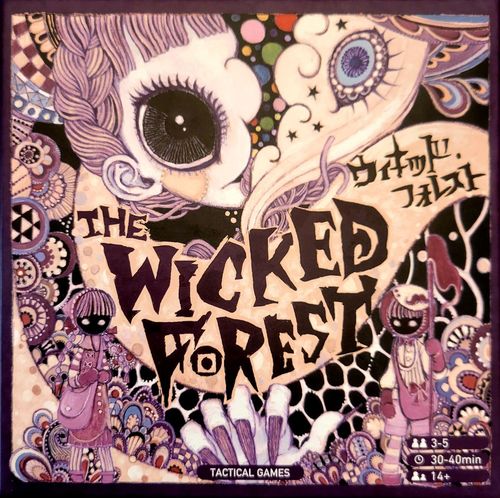
The Wicked Forest
The Wicked Forest Rulebook
Table of Contents
Table of Contents
- 1. Game Overview
- 2. Goal and End of Game
- 3. Components
- 4. Game Setup
- 5. Game Flow
- 6. Exploration Preparation Phase
- 7. Exploration Phase
- Crystallization
- Types of Ability Crystal Tiles
- Processing a Player Who Chose Stay
- End Conditions of the Exploration Phase
- Exploration Cards Depicting the Witch Revealed Twice
- Acquiring Forest Magic Tiles
- 9. End Phase
- 10. End of the Game and Scoring
1. Game Overview
Players become villagers who want to help someone dear to them, and enter the forest where the evil witch dwells. In this game, players reveal one Exploration Card at a time, and each time, the players in the forest choose either to Return or to Stay. A player who chooses to Return gains the Flowers of Defilement depicted on the Exploration Cards already revealed, and can use them to acquire Ability Crystal Tiles and Magic Crystal Cards. Players who Stay in the forest continue exploring. However, if after a player chooses to Stay, Exploration Cards depicting the Witch are revealed and two of them are now face up, the players who remain in the forest gain nothing and are eliminated until the next round.
2. Goal and End of Game
Goal of the Game
The player who holds the highest total of Magic at the end of the game wins. Magic is the sum of the Magic written on the Ability Crystal Tiles and Magic Crystal Cards acquired during the game, plus the Magic on the Forest Magic Tiles.
End of the Game
The round after the Exploration Card draw pile runs out for the second time becomes the final round. When the final round ends, the game ends.
3. Components
- Exploration Cards: 30. These cards represent the forest where the witch lives. They are turned face up during the Exploration Phase. Each Exploration Card depicts Flowers of Defilement in five colors: red, green, blue, yellow and white (white may be treated as any color). There are 10 cards that depict the Witch.
- Flower of Defilement tokens: 100 (25 each of red, green, blue and yellow). A player takes these tokens when acquiring Flowers of Defilement.
- Forest Magic Tiles: 8.
- Summary Cards: 5.
- Villager pawns: 5.
- Leader marker: 1.
- Player boards: 5.
- Tile trays: 2.
Crystals
Ability Crystal Tiles and Magic Crystal Cards are acquired during Crystallization by paying the Flowers of Defilement depicted on the face-up Exploration Cards. Acquiring an Ability Crystal Tile gives an ability and a small amount of Magic. Acquiring a Magic Crystal Card gives a large amount of Magic.
Ability Crystal Tiles: 45
There are 45 Ability Crystal Tiles in three types: Cultivation Crystal Tiles (20), Exchange Crystal Tiles (20) and Expansion Crystal Tiles (5). Each tile shows the number and color of Flowers of Defilement required to acquire it, and the Magic it is worth. Each type has a front and a back side.
- Cultivation Crystal Tiles
- Exchange Crystal Tiles
- Expansion Crystal Tiles
Magic Crystal Cards: 20
There are 20 Magic Crystal Cards (5 each in red, green, blue and yellow). The front shows the Magic of the card and the number and color of Flowers of Defilement required to acquire it. The back shows the Magic of the card.
4. Game Setup
- Shuffle the Exploration Cards well and place them face down in the center of the table as a draw pile.
- Take 9 cards from the Exploration Card draw pile and lay them out face down in a row to form the forest.
- Group the Forest Magic Tiles and the Flower of Defilement tokens (red, green, blue and yellow) by color, and place them near the draw pile. This is called the Supply. The Supply is considered unlimited. If a component runs out, use a substitute.
- Look at the backs of the Ability Crystal Tiles and sort them by type and color. Then, for each type, return to the box any tile whose top-left number on the front exceeds the number of players, as these are not used. For each type, stack the remaining tiles face up so that the tile with the smaller top-left number is on top. Place each stack in the matching Crystal Tile space on the tile tray, where the icon on the back of the stack matches the space.
- Example, 5 players: stack the tiles numbered 5, 4, 3, 2 and 1, from the bottom up, with 1 on top.
- Example, 3 players: return the tiles numbered 5 and 4 to the box, and stack the tiles numbered 3, 2 and 1, with 1 on top.
- Sort the Magic Crystal Cards by the color of the Flowers of Defilement on their front. Stack each color face up so that the card with the smaller Magic is on top.
- Each player takes a Villager pawn in a color of their choice, the Player board of the same color, and a Summary Card.
- Choose a leader player by any method, and give them the Leader marker.
The setup example shown in the rulebook is for 4 players. Its components are labeled: (1) Exploration Card draw pile, (2) the forest, (3) the Supply, (4) the stacks of Ability Crystal Tiles, (5) the stacks of Magic Crystal Cards, (6) the player boards and pawns, and (7) the Leader marker.
5. Game Flow
The players repeat rounds until the game ends. Each round consists of three phases, played in order: the Exploration Preparation Phase, the Exploration Phase and the End Phase.
6. Exploration Preparation Phase
This phase does not occur in the first round of the game.
Each player who owns a Cultivation Crystal Tile gains one Flower of Defilement of the color shown on each such tile.
- A player cannot gain Flowers of Defilement that cannot be placed in their Bag.
After that, as many times as the player likes, they may pay one Flower of Defilement from their Bag to the Supply, and then move one Flower of Defilement of the same color from their Bag to their Storehouse. This is called storing. Flowers of Defilement that cannot be kept in the Bag can be taken and kept for later use as the game progresses.
- Flowers of Defilement in the Storehouse can be used for Crystallization in the same way as those in the Bag.
- Exchange Crystal Tiles cannot be used to store Flowers of Defilement.
The personal board shows the Storehouse and the storing icon: a Flower of Defilement moves from the Bag to the Storehouse, and one Flower of the same color is paid to the Supply.
7. Exploration Phase
At the start of the Exploration Phase, all players are in the forest.
The leader player chooses one Exploration Card lying face down in the forest and turns it face up. Each time an Exploration Card is revealed, each player in the forest chooses either to Stay or to Return.
Choosing Stay or Return
- To Stay: the player holds their Villager pawn in a closed hand, secretly, and keeps the hand closed where everyone can see it.
- To Return: the player places their Villager pawn in a separate location, secretly, and keeps their hand closed where everyone can see it.
When every player in the forest is ready, all players open their hands at the same time to reveal their choices. Each player then resolves their choice as follows.
- A player who chose Return gains the Flowers of Defilement shown on the Exploration Cards already revealed, and then may acquire any number of Magic Crystal Cards and Ability Crystal Tiles.
- If any player chose to Stay, the players repeat the process of revealing an Exploration Card and choosing to Stay or Return.
- If a player encounters the Witch twice in the forest, that player gets nothing.
The Villager pawn is kept at hand until the next Stay or Return choice.
Processing a Player Who Chose Return
When a player chooses Return, at that point they gain the Flowers of Defilement depicted on all Exploration Cards revealed so far. The number of Flowers gained depends on how many players chose Return. After gaining Flowers, a player who chose Return continues on to Crystallization. The Exploration Cards remain face up until the end of the round.
If only one player chose Return: that player gains from the Supply Flowers of Defilement equal in number and color to all the Flowers depicted on the revealed Exploration Cards.
If more than one player chose Return: each player who chose Return gains from the Supply a number of Flowers of Defilement equal to the total number of Flowers depicted on all revealed Exploration Cards, divided by the number of players who chose Return at the same time. Fractions are rounded down. Even if the result is 1 or less, each player can gain at least 1 Flower.
- Each Flower gained is chosen one at a time from the Flowers depicted on the revealed Exploration Cards.
- The same Flower on the same Exploration Card cannot be chosen twice by one player.
- A Flower chosen by another player can be chosen again.
Example: the forest contains six face-up Exploration Cards: red, red, white, blue, green and blue-and-red. Together they depict 7 Flowers of Defilement. Two players choose Return at the same time, so the 7 Flowers are divided between them, and each player gains 3 (the remainder is discarded).
- Player A wanted 3 green Flowers. Only 1 green is revealed, so Player A treats a white Flower as green and gains it, then gains the revealed green and the revealed blue.
- Player B wanted 3 blue Flowers. Player B treats a white Flower as blue and gains it, then gains the 2 revealed blue Flowers.
A white Flower of Defilement on an Exploration Card may be chosen as any color of red, green, blue or yellow.
Acquired Flowers of Defilement
Acquired Flowers of Defilement are placed in the Bag on the personal board. In the initial state, a player's Bag can hold a maximum of 6 Flowers of Defilement. If a player gains Flowers that cannot be placed in the Bag, the player chooses Flowers from the Flowers already in the Bag and the newly acquired Flowers, and returns them to the Supply until the Bag holds no more than its capacity.
If a player acquires an Expansion Crystal Tile in a later Crystallization, the number of Flowers of Defilement the Bag can hold increases to 10.
Crystallization
How to Crystallize
A player who chose Return, after gaining Flowers of Defilement, performs Crystallization. If several players who chose Return do so at the same time, they perform Crystallization in clockwise order starting from the player closest to the leader player. If the leader player is among them, they go first.
- A player may acquire any number of Magic Crystal Cards and any number of Ability Crystal Tiles at the same time. Ability Crystal Tiles are taken from the top of each stack, one at a time.
- To acquire a Magic Crystal Card or an Ability Crystal Tile, the player must pay the Flowers of Defilement depicted on it from their personal board to the Supply.
- Acquired Magic Crystal Cards and Ability Crystal Tiles are placed face down near the player's personal board.
- A white Flower of Defilement depicted on a Crystal Tile can be paid as any of red, green, blue or yellow.
Magic Crystal Cards: a player may acquire any number of cards from one stack. These cards are how a player gains a large amount of Magic.
Ability Crystal Tiles: over the whole game, each player can acquire only one Ability Crystal Tile from each stack. Acquiring an Ability Crystal Tile gives the player an ability usable during the game. The abilities are described under "Types of Ability Crystal Tiles" on page 15. Once acquired, an Ability Crystal Tile can be used until the end of the game.
Each of the nine stacks of Ability Crystal Tiles yields one tile, taken from the top of that stack.
Example of Crystallization
The personal board holds 8 red Flowers of Defilement, 1 blue and 1 green.
- The player pays 7 red Flowers of Defilement to the Supply and acquires 2 red Magic Crystal Cards, worth 3 Magic and 4 Magic.
- The player pays 1 blue Flower of Defilement to the Supply and acquires the blue Exchange Crystal Tile.
- The player pays 1 green Flower of Defilement to the Supply and acquires the green Exchange Crystal Tile.
- 1 red Flower of Defilement remains. Enough Flowers remain to acquire the red Cultivation Crystal Tile, but the player already holds a red Cultivation Crystal Tile from a previous round, so it cannot be acquired.
No other Magic Crystal Cards or Ability Crystal Tiles can be acquired, so Crystallization ends.
Types of Ability Crystal Tiles
Exchange Crystal Tiles
Exchange Crystal Tiles can be used only during Crystallization when acquiring Ability Crystal Tiles or Magic Crystal Cards, and can be used once per acquisition. A player with an Exchange Crystal Tile may exchange one Flower of Defilement of the color depicted on the tile for one Flower of Defilement of any color, and pay with that Flower.
- A player cannot acquire more than one Exchange Crystal Tile from the same stack.
- An acquired Exchange Crystal Tile can be used immediately.
- Flowers of Defilement stored in the Storehouse can also be exchanged.
The number of Flowers of Defilement required to acquire an Exchange Crystal Tile depends on the order in which it is acquired. Some Exchange Crystal Tiles also show Magic.
Example of using Exchange Crystal Tiles: the player owns green and yellow Exchange Crystal Tiles and the Flowers of Defilement red, red, red, blue, yellow, green and green. The player wants to acquire the red Cultivation Crystal Tile and a red Magic Crystal Card.
- First acquisition: the player uses the green Exchange Crystal Tile once, exchanging green for red to pay, and acquires the red Cultivation Crystal Tile.
- Second acquisition: the player uses the green and yellow Exchange Crystal Tiles once each, exchanging green and yellow for red and red to pay, and acquires the red Magic Crystal Card.
Cultivation Crystal Tiles
Each round, during the Exploration Preparation Phase, a player gains 1 Flower of Defilement of the color depicted on each Cultivation Crystal Tile they own.
- A player cannot acquire more than one Cultivation Crystal Tile from the same stack.
- During the Exploration Preparation Phase, a player cannot gain Flowers of Defilement that cannot be placed in the Bag.
The number of Flowers of Defilement required to acquire a Cultivation Crystal Tile depends on the order in which it is acquired. Some Cultivation Crystal Tiles also show Magic.
Expansion Crystal Tiles
An Expansion Crystal Tile enlarges the Bag on the personal board where Flowers of Defilement are placed, so that the number of Flowers of Defilement that can be placed increases to 10.
- A player cannot acquire more than one Expansion Crystal Tile.
When acquired, the Expansion Crystal Tile is placed face down within the frame on the personal board.
Processing a Player Who Chose Stay
A player who chose Stay waits until the players who chose Return have gained Flowers of Defilement and finished Crystallization. Then the leader player again chooses one Exploration Card lying face down in the forest and turns it face up. Once it is revealed, only the players still in the forest choose again between Stay and Return. Players who chose Return are processed as described above. Players remaining in the forest keep revealing Exploration Cards and choosing Stay or Return until an end condition of the Exploration Phase is met (see below).
Even if a player who chose Stay becomes the last player in the forest, after choosing Stay they must still reveal the next Exploration Card and then choose Stay or Return.
End Conditions of the Exploration Phase
The Exploration Phase ends when any of the following occurs:
- All players chose Return, so no player remains in the forest.
- Two Exploration Cards depicting the Witch have been revealed.
- All 9 Exploration Cards in the forest have been revealed.
If the Exploration Phase ends without any player having met the Witch twice, the players still in the forest return safely from the forest, gain Flowers of Defilement, and then perform Crystallization.
Exploration Cards Depicting the Witch Revealed Twice
If the total of face-up Exploration Cards depicting the Witch reaches 2, then the players still in the forest at that moment have met the Witch twice. Those players gain no Flowers of Defilement and are eliminated from this round. An eliminated player can do nothing until the next round.
Acquiring Forest Magic Tiles
At the end of the Exploration Phase, each player who meets one of the following conditions acquires one Forest Magic Tile from the Supply. The acquired Forest Magic Tile is placed near the personal board. For scoring, each Forest Magic Tile counts as 3 Magic.
- A player who returned without meeting the Witch twice and who was the last remaining player in the forest.
- All players who remained in the forest without meeting the Witch twice, when all Exploration Cards in the forest had been revealed.
9. End Phase
Once all players who safely returned from the forest have finished Crystallization, the following steps are carried out.
- Gather all the face-up Exploration Cards in the forest into one pile as the discard pile.
- Keep the discard pile face up so that it is not confused with the Exploration Card draw pile.
- Along with the cards that remain face down in the forest, lay out Exploration Cards face down from the draw pile so that the forest again has 9 cards. If the draw pile runs out, shuffle the discard pile well to make a new Exploration Card draw pile, and lay out Exploration Cards face down until the forest has 9 cards.
- The leader player passes the Leader marker to the player on their left.
After these steps, all players begin the next round.
10. End of the Game and Scoring
The next round after the Exploration Card draw pile runs out for the second time becomes the final round. When the Exploration Phase of the final round ends, the game ends.
When the game ends, each player adds up the Magic on the Magic Crystal Cards and Ability Crystal Tiles they acquired, and adds 3 Magic for each Forest Magic Tile acquired. The player with the most Magic wins.
- If the leading players are tied, the tied player with more Flowers of Defilement on their personal board wins.
- If the winner is still not decided, the tied leading players share the victory.