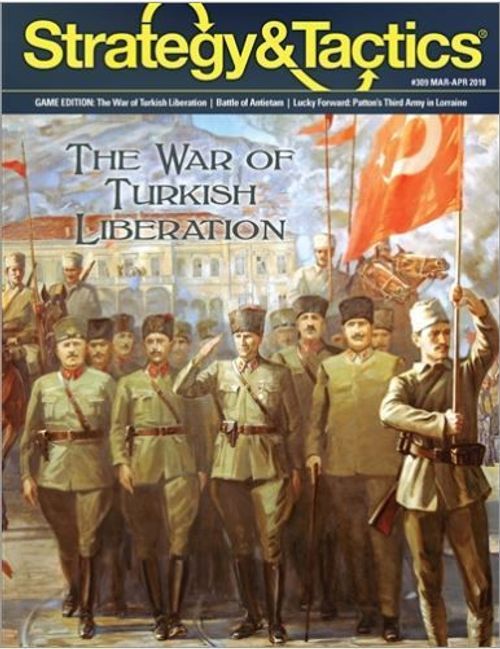
The War for Turkish Liberation
The War for Turkish Liberation Rulebook
Table of Contents
Table of Contents
- 1.0 Introduction
- 2.0 Components
- 3.0 Set-up & Hex Control
- 4.0 Sequence of Play
- 5.0 Placing Arriving Units
- 6.0 The White Russian Army
- 7.0 Caucasian Republics
- 8.0 Movement
- 9.0 Stacking
- 10.0 Combat
- 11.0 Regular & Irregular Units
- 12.0 Purchasing Units
- 13.0 British, French, Italian Forces
- 14.0 Supply
- 15.0 Turkish National Prestige
- 16.0 Victory Conditions
- 17.0 Events List
1.0 Introduction
The War for Turkish Liberation begins during the first half of 1920, when the victors of World War I (Greece, France, Italy, and Great Britain) tried to implement the partition of the Ottoman Empire that had been agreed to at the treaty of Sevres. There are two players in this game; the Revolutionary player and the Imperialist player. The Revolutionary player controls the Bolshevik and Turkish Nationalist armies, and the Imperialist player controls the armies of Greece, Armenia, Azerbaijan, and Georgia.
There are 11 game turns (from the spring, 1920 game turn to the autumn, 1922 game turn). At the end of game turn 11, the Imperialist player wins if he has accrued enough victory points for capturing key objectives throughout Turkey and adjacent countries. The Revolutionary player wins if he prevents his opponent from capturing key objectives.
2.0 Components
This game is complete if it includes one counter sheet containing 228 counters and one 22x34in map of Anatolia, the Caucasus and adjacent areas. The map sheet includes all relevant charts and tables necessary for game play. Players will need to provide one 6-sided die.
Note: The counter sheet includes 14 variant counters for Cold War Hot Armor (S&T 307) and 14 replacement counters for World War I (S&T 294).
The counter sheet includes the forces of Wrangle's White Army, as well as the occupation forces of Britain, Italy and France (these nations are initially neutral and not controlled by either player unless attacked or because of certain events (4.0, 13.0, & 17.0).
2.1 Unit Types
There are two basic types of land combat units: regular units (they can be either infantry or cavalry) and irregular units. There are also supply convoys (14.0) that represent replacements, military supplies of all types, weapons, and ammunition. Supply convoys may be used to restore depleted units to full strength, to enhance combat operations, or to place out-of-supply units into a supplied status.
Unit types: Infantry, Cavalry, Irregular. Markers: Supply Convoy, Air Support, Naval Gunfire Support, Event Chit, Prestige Marker, Turn Marker, Leader Marker.
There are one-sided and two-sided units. Many units in this game are two-sided units. As such, they must suffer at least two depletions via Combat Results before they are eliminated. The front side of a two-sided piece indicates a full-strength unit, whereas the back side indicates a reduced-strength (i.e., depleted) unit.
Counter front shows: Unit ID, Denotes Reinforcement, Unit Size, Number of Steps, Type Symbol, Attack Factor, Defense Factor, Movement Allowance.
Most irregular units are one-sided. Turkish and Armenian irregular units are two sided. The front side of the counter represents loyal irregular troops and the reverse side (the side with the black stripe) indicates rebel irregular units (11.0).
2.2 Organizational Sizes
Units are designated by organizational size. Organizational size has no impact on game play.
- XX: Division
- [xx]: Divisional Group
- X: Brigade
- III: Regiment
2.3 National Colors
The nationality of each unit in the game is indicated by the background color of the counter.
2.3.1 Revolutionary Unit Colors
- Turkish Nationalist: White on red
- Bolsheviks: Red on white
2.3.2 Imperialist & Neutral Unit Colors
- Greek: White on Blue
- British: Black on Tan
- French: Black on Light blue
- Italians: Black on Yellow
- Armenians: Black on Orange
- Caliphate Army or Kuva-yi Inzibatiye: Black on purple
- Azerbaijan: White on Green
- Georgia: White on Wine Red
- White Russians: Black on light green
2.4 Abbreviations on Units
Unit identification is printed on the upper left-hand corner of each game piece. This information has no bearing on game play whatsoever, but is included here for historical interest purposes:
Revolutionary/Turkish Nationalist Units
- Kavkas: Caucasus
Bolsheviks
- 9A: 9th Army units
- 11A: 11th Army units
- Az: Azerbaijan Mixed Division
Imperialist Units/Armenian Units
- D: Druzhina
- F: Fidayi (irregular militias)
- R: Rifle
Azerbaijan Units
- Ag: Agdam
- MI: Mounted Infantry Division.
- Si: Sirban
Caliphate Units
- K-yi I Kuva-yi Inzibatiye ("Security Forces")
French Units
- COC: Corp d'Occupation de Constantinople
- DC: Division Cilicie (156th Infantry Division)
- LA: Legion Armenienne (Armenian Legion)
Georgian Units
- PG: People's Guards militia
- R: Rifle
- S: Sukhumi Border Guard Regiment
Greek Units
- Cr: Cretan Division.
- Ep: Epyrus Division. Later renamed 8th Division.
- Ind: Independent Division.
- Sm: Smyrna Division. Later renamed 10th Division.
- Xa: Xanthi Division. Later renamed 12th Division.
Italian Units
- GCR: Gruppo Cavalleggeri di Roma
- Li: Livorno Brigada
- RIC: Reparto Italiano di Constantinopoli (Italian Detachment at Constantinople).
White Russian Units
- Al: Alekseev
- Ch: Chechnya
- Dz: Drozboski
- G: Guards
- Ko: Kornilov
- K: Kuban
- Mk: Markov
- TA: Terek-Astrakhan
2.5 The Map
Each hexagon encompasses about 30 miles (50 kilometers). Anatolia and European Turkey are divided into the "areas of influence" determined by the Treaty of Sevres. These areas govern several aspects of game play (reinforcement recruitment and placement, for instance). The map also shows the approximate borders of the briefly (1918-1921) independent Caucasus Republics of Georgia, Azerbaijan and Armenia.
Map Errata:
- The city of Edirne (hex 2701) is misspelled (Edime) should read Edirne.
- The city of Eskisehir (hex 2104) is misspelled (Eshkisehir), should read Eskisehir.
3.0 Set-up & Hex Control
All units not having an "R" in the upper right corner are considered "at start" units that must be set up prior to beginning play. All units marked "R" do not set up but can be recruited during the game per 12.0. Set units up in the order given below.
Designer's Note: Zones of Control are not used in this game. Additionally, there are no special first game turn rules.
3.1 Revolutionary & Turkish Nationalist Units
- Place any two Turkish Nationalist infantry divisions at Edirne (2701). See 8.4 for procedures concerning the Edirne Garrison.
- Place all other at-start Turkish Nationalist regular units (including cavalry) on or within two hexes of the below cities. At least one unit must be placed in or near each city. The leader counter Ataturk may be placed with any of these units.
- Ankara (hex 2107)
- Eskisehir (2104)
- Erzurum (1918)
- Samsun (2312)
- Trabzon (2216)
- Kayseri (1811)
- Konya (1706)
- Afyon (1904)
- Bursa (2203)
- Place the five at-start Turkish Irregular units (Nationalist side up) in or adjacent to any of the following hexes. No more than one unit can be placed at any one location.
- 2102
- 2004
- 1802
- 1903
- 2204
- Pick at random any five 9th Army Bolshevik units and one Supply Column (SC). Place them on or adjacent to hex 2820.
- Pick at random any five 11th Army Bolshevik units and one SC unit. Place them on or adjacent to Vladikavkaz (2721).
- Set aside all remaining Bolshevik units. They may be recruited during the Administrative Phase.
Exception: The 1 AZ Division is only available if 7.3 applies.
3.2 Imperialist Units
The Imperialist player sets up second.
Greek Set-up: Place the at-start Greek units in or adjacent to Smyrna (hex 2000) and/or hex 2600 (Thrace). The 12 Xa Division (marked with a "T" in the upper right corner) must be placed in Thrace.
- Place four SC units at Smyrna.
- Place one SC unit at hex 2600 in Thrace.
International Zone Set-up: Set-up British, Italian, and French units marked "IZ" in International zone hexes.
Italian Zone Set-up: Place the Li and CGR units in any hex of the Italian occupation zone around Antalya (hex 1604).
French Zone Set-up: Place the French DC and LA units in any hex in the French occupation zone.
Note: The eastern border of the French Zone runs along the river in hex 1514 and 1414.
Armenian Set-up: Place all at-start Armenian units: 2 x infantry divisions; 1 x cavalry brigade; 3 x infantry brigades; 3 x irregular units; and, 2 x SC units, on or adjacent to any of the three below locations:
- Sarikamish (2120)
- Yerevan (2023)
- Kars (2121).
Georgian Set-up: Place all at start Georgian units: 2 x infantry divisions; 2 x infantry regiments; 3 x irregular units; and 1 x SC unit, in any or all the below locations:
- Sujumi (2618)
- Tiflis (2322)
- Batum (2319)
Azerbaijan Set-up: Place all at start Azerbaijani units: 2 x infantry divisions; 1 x cavalry division; 2 x infantry regiments; and 1 x SC unit on or adjacent to Ganja (2124).
3.3 White Russian & Markers Set-up
Place the game turn marker in the Turn 1 (Spring 1920) Box of the map's game turn track.
Set the British, Italian, French and Greek naval gunfire markers, White Russian units, Caliphate units and "R" marked units off to the side of the map for now (they'll be utilized later).
Note: Naval gunfire markers are not units and do not need to be purchased.
Place all event markers that are back printed as "Event A" in an opaque container. Place the "B" event markers off to the side of the map. They will be used later.
3.4 Hex Control
A hex is considered "owned" by whatever nationality's unit was the last to have occupied that hex (even if that hex is not currently occupied by any such unit). Ownership is not the same thing as "control," however, which only applies to hexes that are presently occupied by a unit.
Hex control is only ever attributed to each hex that any specific unit is presently occupying. In other words, unoccupied hexes are not controlled by any nationality, and thus any nationality may move or trace a line of supply into and/or through an unoccupied hex without limitation or penalty. In that regard, it is even possible for opposing lines of supply to cross one another through unoccupied hexes.
Note: There are no zones of control in this game.
3.5 Fog of War
Owing to spies and the increasing effectiveness of aircraft reconnaissance, there is no so-called "Fog of War" in the game; In other words, both players may freely inspect any stack or hex of the opposite player's forces.
4.0 Sequence of Play
The game consists of 11 game turns. Each turn represents about three months (beginning in the spring of 1920). Each game turn (including game turn one) is divided into three separate segments (the three segments constituting one complete game turn). Each of the segments consists of sequenced phases, which must be played in the exact order listed.
Note: Play begins normally there are no first turn special rules.
4.1 Administrative Segment
Random Events Phase
Random events represent diplomatic and military events beyond the scope of the game that influence the general course of military operations.
- "A" event markers are available beginning game turn one. "B" event markers are added to the cup at the beginning of game turn seven, before picking random event markers.
- In each Random Events Phase, one player (player's choice) randomly picks two event markers. Apply the events per the Events List (17.0).
- If a "No Event" marker is picked, return it to the pool immediately (do not replace it by drawing another chit).
- If due to current circumstances an event chit instructs players to treat it as a No Event, return that chit to the pool unless otherwise directed by the event. Do not replace it by drawing another event.
- Unless otherwise instructed in the event description, events are not returned to the pool.
Exception: Sovietization of the Caucasus (17.2).
Replacement Points Phase
Both sides determine the number of replacement points (RP) they have available for each nationality and then expend those RP to purchase units following the below order of activity (12.0).
- Tally the total number of RP received by the Turkish Nationalists. Then, recruit new and/or eliminated Turkish Nationalist ground, air, and supply convoy units.
- Tally the total number of RP received by the Bolsheviks. Then, recruit new and/or eliminated Bolshevik ground, air, and supply convoy units.
- Tally the total number of RP received by each Imperialist Army. Then, recruit new and/or eliminated Imperialist ground, air, and supply convoy units.
Note: The British, French, and Italian armies only gain RP if at war, thus they may not recruit units if currently neutral.
- The Revolutionary player may attempt to recruit Turkish or Armenian pro-Bolshevik irregular units as per (11.0), possibly modified by the current Grand National Assembly prestige level.
Placement Phase
Place newly created/rebuilt/recruited units on the map (5.0).
4.2 Operations Segment
Imperialist Movement/Combat Phase
The Imperialist player conducts all movement and then combat for all Imperialist units that he intends to move and/or conduct combat with, completing the movement and then combat of one nation (of the Imperialist player's choice) at a time.
Example: The Imperialist player may decide to move and then conduct combat with the Armenian units, and then the Greek units, followed by Azerbaijan, and then by Georgian units, or in any other order he prefers. He must complete all movement and combat with one nationality before moving on to the next.
Revolutionary Movement/Combat Phase
The Revolutionary player conduct all movement and then combat for all Turkish Nationalist units. Only then can he conduct movement and then combat for all Bolshevik units that he intends to move and/or conduct combat with.
Important: Bolshevik units may not move and conduct combat before Turkish units.
4.3 End of Turn Segment
If it is the end of turn 11, determine victory as per 16.0. If not, move the game turn record marker to the next box on the Game Turn Record Track.
5.0 Placing Arriving Units
Units that are rebuilt, recruited, or received per random events during the game must be placed on the map (within stacking limits) in accordance with the below instructions. All units are placed during the Placement Phase. If a unit cannot be placed due to stacking restrictions or the presence of enemy units, that arrival is forfeited and returned to the eliminated unit's pool.
5.1 Turkish Nationalist Arrivals
Regular Turkish Nationalist: Ground unit arrivals must be placed in any city in the Ottoman Empire, Kurdistan, and/or the below cities. The city may not be occupied by Imperialist units nor may it be in the International or other Foreign Zones.
- Van (1721)
- Erzurum (1918)
- Trabzon (2216)
Irregular Turkish Nationalist: Units may arrive in any hex within the following areas:
- Italian Zone
- Greek Zone
- French Zone
- Ottoman Empire (not in the International Zone)
- Kurdistan
- Within one hex of Van (1721) if owned by Turkish Nationalist units.
- Within one hex of Erzurum (1918) if owned by Turkish Nationalist units.
- Within one hex of Trabzon (2216) if owned by Turkish Nationalist units.
5.2 Bolshevik Arrivals
Bolshevik units are placed in any hex on the north edge of the map, inside Russia.
5.3 Greek Arrivals
Greek units are placed in any of the following (if not occupied by Turkish Nationalist units):
- Smyrna (2000)
- Hex 2600 (Thrace)
5.4 Armenian Arrivals
Regular Armenian: Units are placed in or adjacent to Yerevan (2023) (if not occupied by Bolshevik or Turkish Nationalist units).
Irregular Armenian: Units are placed in or adjacent to any of the following locations (if not already occupied by Bolshevik or Turkish Nationalist units):
- Erzurum (1918)
- Sarikamish (2120)
- Van (1721)
5.5 Azerbaijan Arrivals
Azerbaijan units are placed in any of the following cities:
- Ganja (2124)
- Within one hex of 2126 (Azerbaijan)
5.6 Georgian Arrivals
Georgian units are placed in any of the following cities:
- Sujumi (2618)
- Within one hex of Tiflis (2322)
5.7 French, Italian, and British Arrivals
French and Italian units are placed in their respective zones. British units are placed in the International Zone.
6.0 The White Russian Army
As explained in 3.0, the White Russian units are set aside at the beginning of play. This army represent the forces of Wrangle that defended the Crimean Peninsula against the Red Army. In November 1920, Wrangle's Army evacuated Crimea and moved to Constantinople. After a short wait, they were finally allowed to sail to Bizerte, in French North Africa. They became exiles and their warships were handed over to the Soviets. Historically, the Allies did consider sending the White Army to fight Ataturk's forces.
6.1 White Army activation
When the event marker "Evacuation of Crimea" is picked, the White Russian Forces must be placed in the International Zone in or adjacent to Constantinople. They may not be stacked with any other Imperialist unit. At the beginning of that turn's Imperialist Movement/Combat Phase, roll one die. If Balikesir (2202) and/or Bursa (2203) are Greek controlled, add one to the die roll.
- On a modified die roll of 1, the White Army is withdrawn.
- On a modified die roll of 2-5, they remain in or adjacent to Constantinople for one more turn.
- On a modified die roll of 6, the White Army may reinforce the Greek Army. They may operate freely as allies of the Greeks.
Example: If event Evacuation of Crimea is picked on turn five, then the Imperialist player must roll to determine the fate of that army at the beginning of the Imperialist Movement/Combat Phase of turn five.
If the modified die roll result was 2-5, the White Army must remain at Constantinople until the next game turn. At the start of the next Imperialist Movement/Combat Phase, the Imperialist player rolls another die. Use the same die roll modification as the first die roll.
- On a modified die roll of 1-5, the White Army is withdrawn.
- On a modified die roll of 6, the White Army may reinforce the Greek Army. They may operate freely as allies of the Greeks.
White Russian units may not be replaced nor rebuilt. They may use a Greek SC for supply and combat purposes. They may not stack nor attack with Caliphate, Greek, British, French, or Italian units. They are considered a separate faction and with the exception noted above are treated separately from all other nationalities or factions. They conduct their segment immediately after the Greeks.
7.0 Caucasian Republics
The Armenian, Azerbaijan, and Georgian counters represent the armed forces of the Southern Caucasus Republics.
- The Turkish Nationalists are only at war with Armenia. Turkish Nationalist forces may never attack or enter Azerbaijan or Georgia territory.
- The Bolshevik Army is at war with all Caucasian Republics. They may attack and enter any of the republics.
- Each republic is subject to separate surrender conditions (7.1 to 7.4). If a republic surrenders all forces of that republic are permanently eliminated (they may not be rebuilt).
- Each republic is a separate entity. Units from different republics may not stack together, participate in the same combat, or use another republic's supply convoys and or RP.
7.1 Armenian Surrender
Armenia will surrender the moment that Yerevan (2023) or Kars (2121) are occupied by Bolshevik or Turkish units.
Exception: If the event "Support to Armenia" has been played, Armenia will only surrender if both Yerevan and Kars are occupied by Bolshevik or Turkish units.
7.2 Georgian Surrender
Georgia will surrender the moment that any one of the following cities is occupied by Bolshevik units:
- Tiflis (2322)
- Sujumi (2618)
- Batum (2319)
Exception: If the event "Support to Georgia" has been played, Georgia will only surrender if all three of the above cities are occupied by Bolshevik units.
7.3 Azerbaijan Surrender
Azerbaijan will surrender the moment that Ganja (2124) is occupied by Bolshevik units.
Note: If Azerbaijan surrenders, The Nationalist player immediately places the 1Az Bolshevik unit in Ganja (2124).
7.4 Sovietization of the Caucasus
Event "Sovietization of the Caucasus" might force the surrender of some or all Caucasian Republics. See 17.0 for details.
8.0 Movement
The movement allowance (MA) printed on each land unit indicates that unit's maximum allowable movement points (MP) that it may expend per game turn. Each land unit may be moved during its owning player's Movement/Combat Phase, and only from its starting hex to a succession or path of connected hexes, expending (subtracting) a certain quantity of its MP in each hex it enters. The MP required of each hex is listed on the Terrain Effects Chart (on the map), and no unit may move into a hex if the cost in MP to enter that hex is more than that moving unit has remaining for that turn.
No unit is ever required to move. A player may halt any unit's movement at any time; however, he may not then move that unit again during that same turn.
Important: When moving a unit into a hex across a river hexside, that moving unit must expend the cost to both cross that river depiction and the cost for entering the hex it is moving into.
Moving a unit into a through another friendly unit's hex does not require any additional movement cost. See the rules regarding stacking limits (9.0). Units may move as a stack together, but each unit's own movement limitations apply. In other words, moving as a stack does not grant a unit of that stack extra movement points nor does it alleviate any normal movement restrictions that would otherwise apply to it.
8.1 Movement Restrictions
Players must observe the following movement restrictions when moving a unit or stack of units:
- A player can only move his units during his own Movement/Combat Phase.
- No land unit may enter a hex that is occupied by an enemy land unit.
- Unused MP may not be accumulated from turn to turn, nor may they be transferred from one unit to any other unit.
8.2 Political Restrictions
Owing to the complex international political situation at that time, players must observe the following political restrictions when moving:
- Azerbaijan units may not leave Azerbaijan.
- Georgian units may not leave Georgia.
- Armenian units may never enter Azerbaijan or Georgian territory.
- Italian units may never leave the Italian Zone or the international zone unless they are at war with Turkish Nationalist forces.
- French units may never leave the French Zone or the international Zone unless attacked by Turkish Nationalist units.
- British units may never leave the International Zone unless attacked by Turkish Nationalist units.
- Greek units may never enter the International, Italian, or French Zones under any circumstances.
- Turkish irregular units may not enter the International Zone.
8.3 The Edirne Garrison
At the beginning of the game, the Turkish Nationalist player deploys two infantry divisions at Edirne (hex 2701). The Greek player may try to force the surrender of that garrison. This attempt may only be made once per game. In any Imperialist Movement/Combat Phase if the Imperialist player has moved a Greek ground unit adjacent to Edirne, prior to declaring an attack, he may roll 1D6 to determine if the garrison surrenders. Apply the following modifiers to the die roll:
+1: If the Grand National Assembly (GNA) event marker has not been played.
-2: If the GNA marker has been played AND the current GNA level is at 8 or 9.
- On a modified die roll of 3-6, the Turkish garrison surrenders. Both divisions are eliminated (They can be rebuilt). The Greek unit(s) may advance into Edirne.
- On a modified die roll of 1-2, the Turkish garrison rebels against the authority of the Sultan and resists the Greek invasion. The Imperialist player may then conduct a normal ground attack against the Turkish Nationalists, although he is not required to attack. He may attack it during subsequent turns.
8.4 Turkish and Greek Strategic Movement
8.4.1 Turkish Strategic Movement
A maximum of six Turkish land combat attack strength points, of any denomination and type that start their Movement/Combat Phase in a Turkish-owned city, including Diyarbakir (1518) may conduct strategic movement. Turkish supply convoys (SC) count as one land combat strength point. The unit may move from its current position to any other Turkish-owned city, regardless of intervening units, terrain, or movement costs. A unit using strategic movement may not conduct any other type of movement prior to or after conducting its strategic movement. A unit may not use strategic movement if it is starting and/or ending in a hex adjacent to an enemy unit.
8.4.2 Greek Strategic Movement
Any quantity of Greek units, of any denomination and type, that start the Movement/Combat Phase in Thrace (hex 2600 and 2700) may be picked up and automatically placed in Smyrna (2000), and vice versa, regardless of any intervening units, terrain, or movement costs. A unit using strategic movement may not conduct any other type of movement prior to or after conducting its strategic movement. A unit may not use strategic movement if it is starting and/or ending in a hex adjacent to any enemy unit.
Important: A unit cannot use strategic movement if it starts or ends its movement adjacent to an enemy unit. The owning player does not have to trace the route the unit travels from its starting hex to its destination hex, thus intervening units do not block strategic movement.
9.0 Stacking
Stacking is the piling of more than one unit in the same hex. Stacking allowance is tallied in terms of ground units, regardless of their type, nationality, or organizational size. Supply convoys and the Atatürk counter are exempt from stacking limits. Stacking limits is determined by the type of terrain in the hex occupied by the units. The stacking limit for each type of terrain is as follows:
- Clear terrain: 4 units.
- Rough terrain: 3 units.
- Mountain terrain: 2 units.
- City: If there is a city in the hex, the stacking limit for that hex is increased by two units.
Example: Stacking in a clear city hex would be 6 units (instead of only 4).
Stacking limits are only imposed when a unit's movement has ended for a game turn (never while a unit is in the process of moving). If, after a player has completed the movement of any unit, the hex it is in is overstacked, he must immediately eliminate enough of his own units in that hex to bring the stacking into compliance with the limit.
9.1 Political Stacking Restrictions
- Turkish Nationalist and Bolshevik units may never stack together.
- Armenian, Georgian, Azerbaijan, British, French, Italian, Greek, and White Russian units may never stack together.
- Rebel-Turkish Irregular units may not stack with any other units.
9.2 Stack Movement
Units that are moving as a stack may only move as far as the unit with the lowest printed MP, although units with higher printed movement ratings may continue to move, leaving slower units behind in any previously entered hex. Any unit left behind that has not expended its entire movement allowance may continue to move in any direction, up to the extent of its printed movement allowance.
10.0 Combat
During each nationality's, Movement/Combat Phase after all the units of that nationality have completed their movement, the owning player may initiate combat against any enemy land units that are adjacent to his own units.
- The friendly units are not required to have moved.
- A player is not required to decide or declare all his intended attacks before resolving them; he may decide each attack one at a time.
- A player must complete each declared attack before conducting the next.
- When a player initiates combat, he declares the land unit(s) that will be attacking an adjacent enemy-occupied hex.
- Each combat against a single enemy-occupied hex must be resolved one at a time.
- The attacking player may resolve attacks in any order he prefers.
- Multiple land units in the same hex are never required to attack the same enemy-occupied hex. Some units may attack one hex, while other units in that same hex may attack a different hex (or not at all).
- Each attacking land unit must attack with its entire combat strength; no unit may divide its combat strength among multiple attacks.
10.1 Supply Convoys
Supply convoys represent fresh replacements, stocks of ammunition, captured, acquired, or manufactured fighting arms (all the things armies need to subsist in a combat setting). Supply convoys that are stacked or adjacent to combat units (attacker or defenders) may be used to improve those units' combat odds (10.3.4).
10.2 Calculating the Combat Odds
To conduct an attack, the attacking player totals all the attack factors (the first number on each counter) of every unit that has been declared to be participating in that attack. He then compares this total to the total defending factors (the second number on each counter) of every enemy unit that is currently present in the target hex (the hex that is being attacked). Divide the larger total by the smaller total. The result is rounded down to the nearest whole number.
- If the attacker had the larger total, the result is placed to the left of the colon and a one '1' is placed to the right of the colon.
- If the defender had the larger total, the result is placed to the right of the colon and a one '1' is placed to the left of the colon. The result is called the combat odds, which is expressed as a ratio; such as 1-to-1, meaning that the attacker has as many strength points as the defender, or 2-to-1, meaning that the attacker has twice as many strength points as the defender, et cetera).
Example: Three Greek land units with a net attack strength of 6 against two Turkish Nationalist land units in the target hex with a net defensive strength of 3 results in a 2-to-1 (six divided by three = 2) since the attacker strength is greater than the defender's strength, the result is place to the left of the colon; i.e., 2:1.
Example: Two Turkish Nationalist land units with total attack strength of 3, attacks three Greek units with a net defensive strength of 6. The result is 1-to-2 (six divided by three = two). Since the defending strength was greater than the attacking strength, the result is placed to the right of the colon; i.e., 1:2.
In those cases, where the odds ratio is less than or more than odds column printed on the Combat Results Table, use the lowest or highest column, respectively, to resolve that combat.
10.3 Odds Shifts
Some conditions during the game will cause the calculated odds ratio to be shifted to a lower or higher column, depending on the accumulated conditions. Column shifts are expressed as either left or right (L or R). Combat odds can be shifted multiple columns left and/or right if there are multiple applicable shifts. The following conditions will institute column shifts to the Combat Results Tables:
10.3.1 Air Support
Various nationalities are provided with air support counters. Whenever an attack is declared each player may place one and only one, of his air support counters in the defending hex.
- The attacking player places his air support counter first.
- Air support counters may only be placed in a combat hex if the units being supported are the same nationality as the air support counter.
- Each player that has placed an air support counter rolls one die and consults the Air Support Table (on the map). If only one player has placed air support, add one to the die roll. Results are as follows:
NE: No effect
Recon: If rolled by the attacker, one friendly land unit that is adjacent to any attacking unit, but is not adjacent to an enemy unit may add its combat strength to the attack. The unit cannot suffer any step losses suffered by the attacker. If rolled by the defender, it is considered a NE result.
1R/1L: If rolled by the attacker, he receives one column shift to the right. If rolled by the defender, he receives one column shift to the left.
Air Superiority 1R/1L: If the opposing player has committed an air support counter that counter is eliminated and the player who rolled the result receives a shift in his favor. If both sides roll this result, both air support counters are eliminated and neither side receives any shifts.
10.3.2 Naval Gunfire Support
White Russian, French, Greek, Italian, and British forces are provided with naval support counters. Whenever any of these nationalities is involved in a combat where the defending hex is in a coastal hex, that player may place one of his naval support counters. If a naval support counter has been placed into the defending hex, the final odds column is shifted one column left if supporting the defender, or one column right if supporting the attacker.
Exception: During the campaign for Georgia, the French Navy provided the retreating Georgians with naval gunfire support against the Bolshevik Army. As such, French naval support counters may be used to support Georgian land units, even if the French forces are neutral.
Important: Naval support is not affected by air support results.
10.3.3 Terrain
Terrain may cause shifts in the defender's favor. All the below shifts are cumulative.
Example: If the defender occupies a rough terrain hex that contains a city, the odds column would be shifted two columns left.
The Terrain Effects Chart (on the map) details these shifts.
Important: The only receives the river hexside shift If all attacking units are attacking across a river hexside.
10.3.4 Supply
The supply status of the attacker and or defender can cause column shifts.
- For each out of supply unit in the attacking force shift the odds column one column left.
- For each out of supply unit in the defending force shift the odds column one column right.
Supply convoys may support both the attacker and defender. To be eligible to support a combat, the supply convoy must be stacked with or adjacent to at least one of the attacking or defending ground combat units. A supply convoy may only support one combat.
- Only one supply convoy from each side can be used, additional supply convoys have no effect on the combat
- The usage of supply convoys for this purpose is not optional; a player must use a supply convoy to shift the combat odds if it is stacked with or adjacent to participating units.
- Supply convoys used to support a combat are eliminated immediately. They may be rebuilt.
- If the attacking side has an eligible supply convoy, shift the odds column one column right.
- If the defending side has an eligible supply convoy, shift the odds column one column left.
If a supply convoy or convoys are attacked while alone in a hex (not stacked with any other type of friendly ground unit); the attack (prior to column shifts) is conducted on the 7:1 column. In this case, the defender cannot use supply convoys to create column shifts.
Designer's Note: The requirement to attack a supply convoy represents the fact that any captured supply must be gathered up, destroyed, and/or consumed by the captors, and historically this kind of event has always, caused some delay, especially in the latter case.
10.3.5 Grand National Assembly Prestige
After the Grand National Assembly event (17.0) has been played, Turkish Nationalist units receive favorable columns shifts when attacking or defending:
- If the Prestige Level is currently at least "7," Turkish Nationalist units receive one right column shift when attacking and one left column shift when defending.
- If the Prestige Level is "3" or lower, Turkish Nationalist units receive one left column shift when attacking and one right column shift when defending.
10.3.6 Irregular Units in Cities
If a defending force consists of at least one irregular unit in a city hex, the defending side receives one left column shift.
- Only one shift is awarded regardless of how many irregular units are in that city hex.
- This shift is awarded regardless of the presence of other friendly units in the city hex.
- This shift is cumulative with the shift awarded for the city hex.
10.3.7 Atatürk
Atatürk (aka Mustafa Kemal) is considered equivalent to a normal land unit (albeit with an attack and defense value of "0") with a movement number of six. Atatürk can influence combat, but otherwise had no ability to attack or defend.
- If Atatürk is attacked while alone in a hex, he is eliminated automatically. His elimination constitutes an attack; thus, the attacking unit or units may not attack another hex. They are eligible to advance after combat normally. If eliminated, the Atatürk counter is permanently removed from the game.
- If Atatürk is stacked with a Turkish Nationalist unit that is participating in an attack that attack is shifted one column right.
- If Atatürk is stacked with any Turkish Nationalist unit that is defending, that combat receives one column to the left.
- Atatürk may move use strategic movement.
10.4 Resolving the Attack
After calculating the odds ratio, the attacking player rolls one six-sided die and cross-references the die roll result with the calculated odds ratio per 10.2 and 10.3 on the Combat Results Table (on the map).
The "# / #" result indicated on the Combat Results Table specifies the number of land unit steps that the attacker and defender must immediately eliminate. The number on the left of the slash mark is the number of land unit step losses the attacker must eliminate. The number to the right of the slash mark is the number of land unit step losses the defender must eliminate.
Example: A "2/1" result indicates that the attacker must immediately eliminate two steps from the land units that participated in the attack, and the defender must lose one step from the land units in that participated in the defense.
10.4.1 Step Losses
If a combat result indicates a numeral result for the attacker and/or the defender, that player must eliminate a quantity of land unit steps to equal the combat result. Two-sided land units are two steps each, whereas one-sided land units are one step each. A player must eliminate enough steps to fulfill the losses stipulated by the combat results, but he may always choose which steps he will eliminate if there was more than one step involved in that combat.
Example: If the combat result indicates that two steps must be eliminated, a player may either eliminate one two-step unit, or instead deplete (flip) two different two-step units (assuming at least two different two-step units were involved in that combat).
Note: Supply convoy units may not be eliminated to satisfy any mandated step loss.
10.5 Advance After Combat
After any combat is concluded, if all defending units have been eliminated from the defending hex, any of the surviving attacking units may be moved into the defender's hex as an advance after combat. Advance after combat does not use MP. Stacking limits apply. Defending units never advance after combat, regardless of the result.
10.6 Combat Restrictions
- A unit cannot attack a hex that it could not enter during movement.
- A unit is never required to participate in an attack.
- Each hex may be attacked any number of times during a single Movement/Combat Phase however a hex can never be attacked more than once per phase by units belonging to the same nation.
- A land unit may never conduct more than one attack in a game turn. A player may conduct as many attacks as he has eligible land units to attack with.
- When declaring an attack, all enemy land units in the defending hex must be attacked collectively, conversely, the defending player may not withhold any units from combat in a target hex.
Example: If there are three units in a hex, all three must be attacked; a player may not attack some units in a hex but not others.
- A land unit may never divide its printed attack number among multiple attacks. Each land unit may only participate in one specific attack.
11.0 Regular & Irregular Units
In this game, there are two basic types of combat units: regular and irregular. Regular units represent trained troops commanded by professional cadres and equipped with heavy weaponry (artillery, machineguns, et cetera). Irregular units represent locally raised militia and/or rebel partisans.
11.1 Recruiting Irregular Units
Irregular units may be recruited like any other unit (12.0), but their placement is subject to political restrictions, depending on their nationality. All other normal restrictions, such as stacking restrictions (9.0) apply. Irregular units may stack and fight with their compatriot regular units normally.
Turkish Nationalists: Turkish National irregular units (controlled by the Turkish player) may be placed in any unoccupied hexes in Ottoman Turkey, and/or within two hexes of Van (1721) or Erzurum (1918).
Turkish Rebels: Turkish Rebel irregular units (controlled by the Imperialist player) may be placed in any unoccupied hexes anywhere on the map.
Armenian: Armenian irregular units may be placed in any unoccupied hexes in Armenia. Armenian irregular units may only be recruited if there are Armenian regular units in or adjacent to hexes 1918 (Erzurum), 2120 (Sarikamish), and Van (1721).
Armenian Pro Bolshevik: Armenian Pro-Bolshevik irregular units (controlled by the Nationalist player) may be placed in any unoccupied hexes in Armenia.
Georgia: Georgian irregular units may be placed in any unoccupied hexes in Georgia.
Azerbaijan: Azerbaijani irregular units may be placed in any unoccupied hexes in Azerbaijan.
11.2 Guerilla Warfare
Irregular units (of any nationality) are unique from regular units since they may potentially disperse or "melt away" before combat when attacked. Anytime (may be multiple times in the same game turn) a regular unit or a stack formed only by regular units attacks an irregular unit or stack of irregular units (only), the irregulars may try to retreat before combat. Prior to the commitment of supply and or support, roll one die and apply the below modifiers:
Important: Irregular units stacked with regular units do not roll for retreat before combat.
- -1: If the irregular unit occupies a mountain hex.
- +1: If the attacking force includes at least one cavalry unit.
- +1: If the attacking force is supported by at least one air unit.
- +1: If the irregular unit is attacked simultaneously from at least two opposite hexes.
(An illustration, "Example of Opposite Hex Attack", accompanies this rule.)
Consult the Irregular Retreat Before Combat Table (on the map) and apply the result. There are two possible results:
R (Retreat): No attack can be carried out. No actual retreat is conducted, the combat simply ends as if it had been a no effect result.
A (Attack): The attack is solved normally as per the combat rules.
11.3 Subverting Irregular Units
Instead of recruiting an irregular unit, a player may instead spend RP to attempt to subvert or "buy off" an opposing irregular unit of any nationality anywhere on the map. An irregular unit can only be subverted once per game turn (i.e., if subverted by one side, the other cannot attempt to subvert during the same game turn). The RP cost is the same as recruiting an irregular unit, but the subverting player must roll one six-sided die and apply the following results:
- Die roll of 1: If the unit is a Turkish or Armenian irregular unit, flip it to its other side. If the irregular unit is stacked with unit of the (now) opposing side, the unit is moved to any adjacent friendly occupied hex, or any adjacent unoccupied hex.
- Die roll of 2-5: Eliminate that irregular unit (it may be rebuilt).
- Die roll of 6: No effect (the RP are still expended).
Note: Some random events may cause Pro-Turkish Nationalist and Imperialist Armenian Irregulars to flip to their other side, in which case they change to "rebel" mode (shown by a black stripe). They are then controlled by the Imperialist player until subverted again (or eliminated).
Designer's Note: These irregulars represent several anti-Turkish Nationalist factions, such as the Circassian rebels (the rebellions of Çerkes Ethem and Ahmet Anzavur) and the Kurdish rebels.
12.0 Purchasing Units
During the Administrative Phase, both sides receive an allotment of replacement points (RP) to recruit and/or rebuild eliminated and/or non-built units, including supply convoys and air support units. RP may not be saved or accumulated from turn to turn; a player must spend the RP he receives that game turn or forfeit them. RP are received by nationality, and may only be spent for that nationality.
Example: Armenian RP may only be used to rebuild Armenian units, Turkish Nationalist RP may only be used to rebuild Turkish Nationalist units, and so forth.
12.1 Purchasing
Each RP received by each nationality can be spent to build (and/or rebuild) one step of an eliminated or non-built land unit, supply convoy, or air support unit.
Example: To rebuild an eliminated two-step division would require the owning player to spend 2 RP for that unit.
A player may, if he prefers, purchase a two-step unit as a one-step depleted unit (paying only one RP); in other words, it is not mandatory to rebuild units as full-strength units.
Important: Naval support units do not require RP (they are automatically available). They cannot be eliminated.
Depleted units (two-step units that have suffered one step loss) that are on the map may not be rebuilt with RP. Instead, they may only be rebuilt by the expenditure of an adjacent friendly supply convoy. Each supply convoy that is expended (removed from the map) may be used to rebuild one depleted unit (regardless of type), if it currently is adjacent to that depleted unit.
12.2 RP Income
The amount of RP received every game turn by each nationality is listed as follows:
Important: Events may modify a nationality's RP total.
Turkish Nationalists: Receive 4 RP until the Grand National Assembly Event is drawn. On the game turn that the above event is drawn, the Grand National Assembly (GNA) Prestige Level determines the number of RP the Turkish Nationalists receive:
- If the GNA prestige level is 1 to 3 (Low) the Turkish Nationalists receive 3 RP.
- If the GNA prestige level is 4 to 6 (Medium) the Turkish Nationalists receive 5 RP.
- If the GNA prestige level is 7 to 9 (High) the Turkish Nationalists receive 6 RP
Greek: 4 RP, +2 RP if Britain is at war.
Bolsheviks: 2 RP
Armenians: 1 RP, +1 RP if Kars, Erzurum, and/or Van are occupied by Turkish Nationalist forces.
Georgians: 1 RP
Azerbaijanis: 1 RP
British (if at war): 1 RP, +1 RP if Constantinople is not occupied by Turkish Nationalist forces.
French (if at war): 1 RP, +1 RP if Constantinople is not occupied by Turkish Nationalist forces.
Italian (if at war): 1 RP, +1 RP if Constantinople is not occupied by Turkish Nationalist forces.
White Russian: 0 RP
Caliphate Army: 0 RP
12.3 Placement
Newly purchased units are placed on the map per 5.0.
13.0 British, French, Italian Forces
Italian, British and French forces are neutral and cannot leave their respective set-up zone while neutral. They move freely within each zone. They only enter the war if attacked by Turkish Nationalist units and/or if one or more Turkish Nationalist regular units enter any of their zones and/or the International Zone. If their neutrality is violated, the following applies:
- If Turkish Nationalists attack any unit of the Italian, British, or French forces, it is an act of war against all of them. The Imperialist player may attack Turkish units and even invade Turkey.
- Under no circumstances may British, French, or Italian units ever stack together or participate in the same attack together.
13.1 Withdrawal of Foreign Forces
Despite the apparent absurdity of going to war with the major powers, a Turkish land combat success against any nationality's units may cause that nationality's forces (only) to withdraw from the war (be removed from the map) immediately.
- If a Turkish Nationalist attack against a British, French, or Italian hex causes any unit(s) in that hex to be eliminated. The Turkish player immediately rolls one six-sided die for each French, British, or Italian unit eliminated.
- If all units of a nationality currently on the map are eliminated, no die roll is required. That nationality is automatically withdrawn.
- If the die roll is equal to or less (<) than the eliminated unit's full-strength printed defense strength, that unit's nationality has lost the political will to continue the war and withdraws all that nationalities units are withdrawn (all units on the map). This does not affect any of the other nationalities.
- If the Turks attack the international zone, they are automatically at war with Italy, France and Britain. Nationalities that were previously withdrawn do not reactive, and are not at war with Turkey. That is, if the Turks attack the IZ on turn 10, but Italy withdrew on turn 7 and France on turn 8, then the Turkish attack on the IZ only triggers the entry of Britain into the war.
- Turkish units are then free to move into and through that nationality's zone.
13.2 Italian 35th Division
The Italian 35th Division only becomes available on the game turn after Italy is at war.
14.0 Supply
The supply status of regular units is checked during combat resolution (11.4.). To be considered in supply, the unit must have a demonstrable path of contiguous land hexes of any length, leading from the unit to a valid supply source (14.2). This path of hexes is known as a line of supply and it may be routed into and through any type of terrain except across lakes and ocean hexsides where no land depiction is observable. The line of supply may not enter any hex that is occupied by any type of enemy ground unit.
14.1 Irregular Unit Supply
Irregular units are always in supply. They do not need a path of supply to any supply source. They are never considered "out-of-supply".
14.2 Supply Sources
The supply source for each nationality is listed as follows. A nationality may never use another nationality's supply source, even if allied.
Turkish Nationalists: Ankara (hex 2107), or any Turkish supply convoy. TN units in European Turkey may trace supply to Edirne and/or (if under TN control) Constantinople.
Greeks: Smyrna (hex 2000), or any Greek supply convoy.
Bolsheviks: Bolshevik units' trace supply to the northern border of the map between 2817 and 2821, inclusive or any Bolshevik supply convoy.
Armenians: Yerevan (2023), or any Armenian supply convoy.
Georgians: Tiflis (2322), or any Georgian supply convoy.
Azerbaijanis: Ganja (2124), hex 2127, or any Azerbaijani supply convoy.
British (if at war): Constantinople (2503), or any British supply convoy.
French (if at war): To any border hex in Syria, or any French supply convoy.
Italian (if at war): Antalya (1604), or any Italian supply convoy.
White Russian: Constantinople (2503).
Caliphate Army: Any Imperialist supply source or supply convoy
Important: If a supply convoy is used as a supply source for any unit(s) during a game turn, it is expended immediately (removed from the map).
15.0 Turkish National Prestige
The prestige of the Turkish Nationalist cause may increase or decrease depending on certain events, combat results, or the loss or gain of certain key objectives.
15.1 Grand National Assembly
Whenever the event "Grand National Assembly" is drawn, it must be placed in the "4" box of the Grand National Assembly Prestige Track (on the map). This equates to a prestige of "Medium". If the Prestige Level goes up to 7 or higher, Turkish prestige is "High", with all attendant advantages (10.4 & 12.2); if the Prestige Level goes down to 3 or lower, Turkish prestige is "Low", with all attendant disadvantages (10.4 & 12.2).
15.2 Turkish National Prestige Changes
Whenever any enemy controlled city is captured by any Turkish Nationalist unit (even if it is merely recaptured after having been lost previously), or whenever any enemy land unit is eliminated (not merely depleted) during combat involving any Turkish unit, the Turkish player must then immediately roll one six-sided die.
- If the die roll is 4, 5, or 6, the Turkish player receives one point.
- On a die roll of 1 through 3 there is no effect.
Note: Edirne, if captured by the Greeks (8.3) counts towards National Prestige if the Grand National Assembly chit has been drawn. If recaptured by Nationalist forces, count Edirne as an enemy city.
- Whenever a Turkish city is captured by any enemy unit (even if it is merely recaptured after having been lost previously), or whenever any Turkish Nationalist land unit is eliminated (not merely depleted) during combat, the Imperialist player must roll one six-sided die.
- If the die roll is 1, 2, or 3, the Imperialist player receives one point.
- On a roll of 4, 5, or 6, there is no effect.
- Players keep track of the number of points scored by each side (use a blank counter or a piece of scrap paper). At the end of the turn, they compare both numbers. If the Turkish score its higher, then the Turks add one to the GNA prestige total. If the Imperialist total is higher, then the GNA prestige is lowered by one point. The total GNA cannot shift more than one (lower or higher) per game turn.
- The advantages and disadvantages of a change in Turkish Prestige are implemented immediately (10.4 & 12.2).
- The first game turn that Turkey is at war with Britain, France, and Italy, the Grand National Assembly prestige level is increased by three (+3). This change may only occur once during a game.
Note: The maximum and minimum prestige level that is possible is 9 and 1, respectively.
16.0 Victory Conditions
Victory is determined at the end of turn 11. If the total Imperialist VP count is 4 or higher, the Imperialist player wins. If the total VP count is 3 or lower, the Turkish Nationalist player wins. There are no draws in this game. Imperialist victory points are as follows:
- +1: Greek forces control Smyrna (hex 2000) and Edirne (hex 2701).
- +2: Greek forces control Afyon (hex 1904) and Eskisehir (hex 2104).
- +1: Imperialist forces control Adana (1510).
- +2: Armenian forces control Sarikamish (2120) and/or Kars (2121).
- +3: If Britain is at war and Imperialist forces control Constantinople (hex 2503).
- +1: If Italy is at war and Imperialist forces control Antalya (1604).
- +1: If there are any Armenian units on the map.
- +1: If there are any Turkish rebel units in Kurdistan.
16.1 Fall of Ankara "Sudden Death"
At the very moment that any Imperialist unit enters Ankara (hex 2107) the Turkish player must roll one six-sided die;
- On a die roll of 4, 5 or 6, the game ends immediately with an Imperialist victory.
- On a die roll of 1, 2 or 3, the Grand National Assembly escapes to another Turkish city to continue the struggle for national survival (the game continues to game turn 11).
17.0 Events List
17.1 Phase "A" Events
Anzavur Rebellion: The militia of Ahmet Anzavur rebel against Turkish nationalist forces.
- The imperialist player may pick two TN irregular units from the force pool and deploy them in "rebel mode" within two hexes of Bursa (2203).
- These units may not deploy in city hexes.
- If there are not at enough TN irregular units are in the force pool, he may remove TN irregular unit(s) from the map and place them as above.
Support to Armenia: The Imperialist player may use this event to give support to Armenia. The Armenian army receives 3 RP (this turn only) that can be used to recruit regular Armenian units.
Support to Georgia: The Imperialist player may use this event to give support to Georgia. The Georgian army receives 3 RP (this turn only) that can be used to recruit regular Georgian units.
Caliphate Army: The Allies allow the Ottoman Sultan (who also had the title of Caliph) to form a military force to fight against the Nationalists.
- The Imperialist player may deploy the three Kuva-yi Inzibatiye "Caliphate Army" units anywhere within three hexes of Constantinople in the International Zone.
- They may move out of those zones and attack Turkish Nationalist units.
- To attack Turkish Nationalist units, they must first exit the International zone. This is a "No Event" if Grand National Assembly is "9".
Çerkes Ethem Rebellion: A rebellion breaks out against the leadership.
- The imperialist player may pick any two TN irregular units from the force pool and deploy them in "rebel mode" within two hexes of Ankara.
- These units may not deploy in city hexes.
- If there are not at enough TN irregular units are in the force pool, he may remove TN irregular unit(s) from the map and place them as above.
Evacuation of Crimea (6.0): The White Russians are evacuated across the Black Sea. The White Russian Forces are placed on or adjacent to Constantinople inside the International Zone. They may not stack with any other Imperialist unit.
Grand National Assembly: Mustafa Kemal and part of the Turkish parliament rebel against the authority of the Sultan and establish the Grand National Assembly. Place the GNA marker on the General Data Track in the "4" box and refer to 12.2 to determine the number of RP received based on the current level of the prestige.
Armenian Legion: French-led Armenian forces attack Turkish Nationalist forces. The Imperialist player may use French forces to attack Turkish irregular units located in hexes of the French zone. This option may only be used this game turn.
Megali Idea: The Greek army and populace embrace with enthusiasm the conquest of Asia Minor. The Greek army receives 5 additional RPs this turn. Treat it as "No Event" if pulled the same turn that event Military Coup in Greece occurs.
No Event: Nothing happens. Return the marker to the cup.
Russo-Polish War: The Russo-Polish War distracts world attention.
- Withdraw from play five Red Army units of any type. These units may be withdrawn from the 9th or from the 11th Army.
- Roll one six-sided die for every withdrawn unit: On a die roll of 4, 5, or 6, that unit will return as a reinforcement the next game turn. On a die roll of 1, 2, or 3, it will return as reinforcement two game turns later.
Turkish Nationalist Weapons Purchase: The Turks procure weapons. This event gives 2 additional RPs to the Turkish Nationalist Army.
17.2 Phase B Events (place in the cup on game turn 7)
Errata: Ignore the White Russian Withdrawal Chit. It is not used.
Free Kurdistan. The Imperialist player may retain this marker and use it at the beginning of any game turn. He is not required to play this event. If he decides to use it:
- He selects any two TN irregular units from the force pool and places them inside Kurdistan in "rebel" mode.
- If there are not at enough TN irregular units are in the force pool, he may remove TN irregular unit(s) from the map and place them as above.
Sovietization of the Caucasus: Sovietization of the Caucasus might force the surrender of some or all Caucasian Republics.
- If one of the Caucasus republics has already surrendered roll one six-sided die; if the die roll is "1" or less, all other republics surrender.
- If the die roll is "2", one other republic surrenders. Players may choose any random method they desire to determine the republic that surrenders.
- Subtract one (-1) from the die roll for each republic capital that is already occupied by the Bolsheviks.
- Any other die roll, treat it as "No Event", discard the marker.
Turkish-USSR Treaty: The Turkish player receives 2 additional RP per turn thereafter. Treat it as "No Event" if Imperialist forces control one of the following cities: Trabzon (2216), Erzurum (1918), or Sarikamish (2120).
French Withdrawal: The French evacuate Cilicia.
- Turkish Nationalist forces may enter Adana (hex 1510).
- Treat it as "No Event" if Imperialist forces own one of the following cities: Trabzon (2216), Erzurum (1918), or Afyon (1904), or if France is at war with Turkey.
- If the withdrawal is conducted, withdraw all French units including the French Naval Support marker from the game.
Military Coup in Greece: The Greek populace loses interest in the Megali Idea and the Greek government is toppled.
- Greece receives no RP for the remainder of the game.
- Treat it as "No Event" if Greek forces own Smyrna (hex 2000) and any one other city in the "Ottoman Empire", or if Britain is at war with Turkey. Edirne is not considered in the Ottoman Empire for purposes of this event.
Republic of Mountain Armenia: Anti-Soviet rebellion in Armenia.
- If Armenia has surrendered, place two Armenia irregular units within one hex of 1923.
- If Armenia is still in play (if they have not surrendered yet), treat it as "No Event", discard the marker.