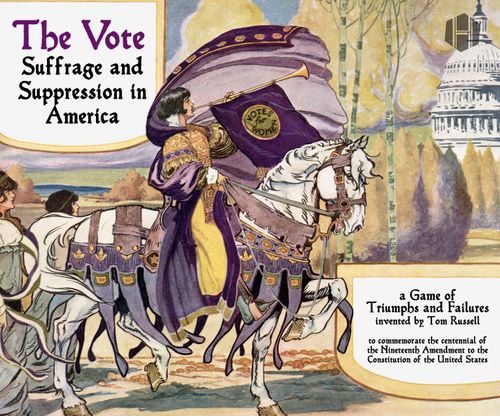
The Vote: Suffrage and Suppression in America
The Vote: Suffrage and Suppression in America Rulebook
Table of Contents
Table of Contents
- 1.1 Factions
- 1.2 Scope
- 2.0 Components
- 3.0 Set-Up
- 4.0 Sequence of Play
- 5.0 Initiative Phase
- 6.0 Player Phases
- 7.0 Public Opinion Actions
- 8.0 Organization Action
- 9.0 Suppression Action
- 10.0 Law Action
- 11.0 Special Events
- 12.0 Discard Action
- 13.0 Passing Federal Laws
- 14.0 Turn End Phase
- Quick Reference: Actions
1.1 Factions
This is a game for two players, each representing an abstract idea. Equality pursues a more democratic society, primarily through the extension of the right to vote, but also through the transformation of the Senate into an elected and representative body. Supremacy seeks a less democratic society, in which rights are largely restricted to white men. Between the two is a third non-player faction, Apathy. Apathy isn't committed one way or the other, and must be radicalized by Equality if the latter is to achieve its goals. Supremacy doesn't have any such impetus, because so long as there isn't widespread support for Equality, it continues to get its way.
1.2 Scope
Woman suffrage was by no means a uniquely American struggle; indeed, the same battles were fought in other democracies during the same period. Organizations such as the International Woman Suffrage Alliance coordinated and supported these efforts worldwide. America was not the first major nation to extend the franchise to women; that was New Zealand, in 1893. Nor was it close to the last; for example, Switzerland didn't grant federal voting rights to women until 1971, and in one canton voting at the local level remained illegal until 1991.
Any of these movements could make for a compelling simulation game, as could a game with an international scope. I chose to focus on the American story partially because it is the political system I am most familiar with (an accident of birth), partially because it hinges on a tension between federal and local laws and governments that I find interesting, and partially because it - like most American stories - is a blend of triumph and failure, idealism and cynicism.
The game begins just after the Civil War - when the ideas of woman and minority suffrage were considered radical. (So radical, in fact, that before the war many abolitionists felt the push for women's rights would alienate too many people, and make abolition more difficult to achieve.) The game ends in the early twentieth century - long before desegregation and the Voting Rights Act brought an end to the Jim Crow era, and before the repeal of a number of anti-Asian and anti-indigenous laws.
Like my earlier game, This Guilty Land, this is a game about broken systems - systems that by design benefit certain people and not others. At the time of its passing, the nineteenth amendment essentially only guaranteed voting rights for white women. It would be another twenty-three years before Chinese Americans were granted citizenship and the right to vote; twenty-eight years before these same rights were extended to all indigenous peoples; forty-five years before the Voting Rights Act did the same for Black Americans - to the degree that it did.
Therefore any victory achieved by Equality during the span of the game is of necessity incomplete. Indeed, today, with voter suppression and disenfranchisement on the rise, it remains incomplete and inequitable. That's why this is a game about the suffrage movement in America, rather than internationally. It isn't intended to be celebratory, or even educational (in the sense of teaching you about people, places, and events). Its purpose is anger.
2.0 Components
The game is played with a mapsheet, 88 counters, 24 wooden discs, 36 cards, and this rulebook. A playbook is also provided.
2.1 Mapsheet
The United States is abstracted into six groups, called Regions.
A. Men Voter Support Boxes, B. Women Voter Support Boxes, C. Congress Control and Local Laws Display
Each Region has a series of Support Boxes, each of which may hold one marker representing support for Equality, Supremacy, or Apathy. The Support Boxes for a Region are divided into Men (top row) and Women (bottom row); only the Men boxes begin the game in play.
Each Region further has a certain number of Congress Control Points, which is used to reflect control and influence within the federal government. Each Region has its own Local Laws Display; a wooden disc is placed on the requisite space of the display to indicate that a given Local Law has passed.
The map is home to several tracks:
- Each player has a track used to denote their Organizational Capacity (Org). This directly impacts a player's ability to plan, respond, and mobilize.
- Each player has a track used to track their Political Will (PW). This is the currency of the game, expended and accumulated as players take Actions. Note that this track maxes out at 15; players cannot earn PW in excess of this.
- A single Victory Track is used to track each player's Victory Points (VP). The maximum number of VP that a player can score is 75.
2.2 Counters
The counters indicate Support and Congress Control.
Support Markers
Each player has 39 double-sided Support Markers. One side represents full Support for the player's cause, indicated by a sunflower (Equality) or star (Supremacy). The reverse represents Apathy, with Blue Apathy "leaning" toward Equality, and Red Apathy toward Supremacy. These Markers are piece-limited; if all of a player's Support Markers are in use, they cannot place more.
Congress Control Markers
These are held by a player to indicate control of the Congress Control Points for a given Region.
2.3 Wood
There are twenty-four wooden discs: 3 blue, 3 red, and 18 purple. A wooden disc of a player's color is used to track their Org Capacity, Political Will, and Victory Points. The eighteen purple discs are used to indicate passage of Laws in a Region.
2.4 Cards
PW Cost (upper left): The cost of the card. The color of the circle indicates whether it is an Equality (blue) or Supremacy (red) card. An asterisk indicates that when the card is played, it must be the Last Action (6.0) a player takes on their turn.
Passive Ability (upper right): Icon indicating the card's passive ability, if any (see 14.4).
Prelude/Special: Indicates how the card enters the game.
Name (below image): The name of the card.
Type (below name): The card's type, which dictates how the card functions. This is also expressed through its associated Action icons. These Actions will often earn PW for one's opponent; the PW earned is indicated within the iconography, in the opponent's color. (Exception: Special Cards will indicate the PW earned beneath the Special indicator.)
Cards generally begin the game in a face-down Deck, and are drawn face up into an Events Display that is public information for both players. Some cards may be taken into a player's face-up Reserve; each player's Reserve may hold cards equal to their Org. Some cards may be permanently Removed from the game after being played, while others may be Discarded upon use and will reenter the Deck later. Discards may be freely examined by both players, but only after the first time the Discards have been shuffled back into the Deck.
3.0 Set-Up
3.1 Marker Set-Up
The game begins with 34 Support Boxes in play; these have a set-up alignment printed on the map. Each player places their Markers within a Region on the indicated Boxes, with the indicated side face up. The remaining Markers form a Pool and are kept within reach of that player.
Give all six Congress Control Markers to Supremacy.
Each player places a wooden disc of their color on the "2" space of their Org track, and on the zero spaces of their PW Track and the VP Track. Place the purple wooden discs within reach of Equality.
3.2 Deck Construction
Separate all Prelude (1-12) and all Special cards (33-36) from the deck before shuffling the remaining cards.
Place Supreme Courts (33) face down, and deal nine cards from the deck face down on top of it. Flip this pile of ten cards face up, careful not to reveal the cards now underneath Supreme Courts, forming the Discard Pile. The contents of the Discard Pile become public information only after the first time that pile is reshuffled into the Deck.
Place Silent Sentinels (34), Seventeenth Amendment (35), and Nineteenth Amendment (36) to one side of the map. Silent Sentinels will enter the deck later (8.0), while the two Amendments remain outside the deck (11.3).
Place the remaining eleven card Deck face-down. Shuffle the Prelude cards, and place those twelve cards on top of the Deck.
One player (it doesn't matter whom) draws a card from the top of the Deck. Place it face up off the side of the mapsheet, creating the Events Display. If it is an Equality card, place it closer to the Equality player; if it is Supremacy, closer to Supremacy. Repeat this process until there are at least four cards for each Faction. This may result in one of the players having five or six cards.
Each player immediately takes PW equal to their highest-valued PW card in the Events Display. (Note that the Amendment cards are not part of the Display.) The player with the most PW (Equality if tied) chooses who will be First Player.
4.0 Sequence of Play
The game is played over a series of Game Turns, until a Game End Trigger occurs. Each Game Turn consists of the following Phases, performed in the following order:
- Initiative Phase (skip during First Turn)
- First Player Phase
- Second Player Phase
- End Turn Phase
Initiative Phase. Cards are drawn as needed for the Events Display, and PW is awarded accordingly. The player with the most PW chooses who is the First Player.
First Player Phase. The First Player performs one or more Actions, resolving each in full (including any interruptions by the Second Player) before moving to the next, expending PW as required. When the First Player is unable to take any further Actions - or no longer wishes to do so - the First Player Phase ends.
Second Player Phase. The Second Player now performs one or more Actions in the same fashion as the First Player above.
End Turn Phase. First, players check to see if the game has ended. Congress Control is adjudicated. The deck is reshuffled if exhausted. Then, players resolve Passive Abilities for face-up cards in their Reserves.
5.0 Initiative Phase
Both players check to see if the number of their cards currently in the Events Display is less than their Org. If so, one player (it doesn't matter who) draws cards from the Deck and places them in the Events Display one at a time, placing Equality cards nearer Equality and Supremacy cards nearer Supremacy, until both players have a number of cards in the Events Display at least equal to their Org. If the Deck is exhausted, no further cards are drawn, even if a player does not have their allotted number of cards in the Events Display.
Example: Both players have an Org of 3. Equality has two cards in the Display, and Supremacy has one; therefore, cards must be drawn until Equality has at least one more card, and Supremacy at least two. The first card drawn is Woman Suffrage, an Equality card. Then, Ridicule is drawn for Supremacy. While Equality now has three cards in the Display, Supremacy has only two, and must keep drawing until they get another card. Unfortunately, the next card drawn is Alice Paul, an Equality card. It is followed by The West (Equality), Vindication of the Rights of Women (Equality), Middle Atlantic (Equality), and Gerrymandering (Supremacy). That gives Equality six cards to Supremacy's three.
Each player gains PW equal to the PW cost of their highest-valued card in the Events Display, adding this to any PW they may have stored or earned from the preceding turn. The player with the most PW chooses who will be the First Player; if tied, Equality chooses.
6.0 Player Phases
Each Player Phase consists of a series of Actions. The acting player selects an Action and completely resolves it, including any opposition from the enemy, before taking the next Action. A player may choose to perform zero Actions though it is usually not beneficial for them to do so.
Each Action generally requires the selection of a card from the Events Display or the player's Reserve, and the expenditure of PW. Each Action generally results in the accumulation of PW by their opponent, though there are exceptions. No player may have more than 15 PW; any gained in excess of 15 is lost.
The Player Phase ends when the player either cannot take any further Actions, or chooses not to. At the end of the Player Phase, the acting player (only) must discard any PW in excess of their Org.
The Actions available to the players are as follows:
- Public Opinion Actions (7.0)
- Radicalize (7.1)
- Persuade (7.2)
- Reaction: Block (7.3)
- Bonus Actions (7.4)
- Organization Action (8.0) *
- Suppression Action (9.0) - Supremacy only
- Law Action (10.0) - Equality only
- Using a Law Card (10.1)
- Using a Region Card (10.2)
- Reaction: Suppress (10.3, Supremacy only)
- Bonus Actions (10.4)
- Special Event Action (11.0) *
- Supreme Courts (11.1, Supremacy only)
- Silent Sentinels (11.2, Equality only)
- Amendments (11.3, Equality only)
- Discard Action (12.0) *
- From the Events Display (12.1)
- From the Reserve (12.2)
- Passing Federal Laws (13.0) *
Actions indicated with an asterisk must be the Last Action that the Player takes during their Phase. You cannot take two "Last" Actions in a Phase, only one.
7.0 Public Opinion Actions
A Public Opinion Action seeks to shift and radicalize the populace toward embracing one's cause. A Public Opinion card is required to take this Action.
Public Opinion cards from the Events Display are used to Radicalize. Public Opinion cards played from the Reserve are used to Persuade, and to Block your opponent's Public Opinion Actions. A Region card in a player's Reserve may also be used to Block, or to take Bonus Public Opinion Actions.
All Bonus Actions are announced before any Actions, including the original Action, are Blocked or resolved.
7.1 Radicalize
The Radicalize Action flips aligned Apathy Markers (blue for Equality, red for Supremacy) to that Faction's side. The maximum number of Markers that can be flipped is equal to the card's PW cost (+1 if Municipal Elections has been passed for that Region). The Action must be performed in a single Region of the player's choice. The PW cost on the card must be paid, and the card taken from the Events Display. The opposing player may Block (7.3) to prevent one or more Markers from being flipped; the acting player may Counter the Block (7.3) to negate it.
Upon resolving the Action, the acting player may - but is not required to - place the card directly into their Reserve, provided their Org allows this. (Remember, each player may have cards in their Reserve equal to their Org.) Otherwise, the card is Discarded.
After resolving the Action, and any Bonus Actions, the opposing player earns 2 PW (total, regardless of the number of Bonus Actions).
A Bonus Action (7.4) may be Blocked, and that Block may be Countered.
7.2 Persuade
The Persuade Action targets markers of your opponent's color. Both players may use this Action to replace opposing-aligned Apathy Markers with aligned Apathy Markers. Equality (only) may additionally use this Action to flip a Supremacy Marker to its Apathy side.
To take this Action, the acting player pays the PW cost of a face-up Public Opinion card in their Reserve. The number of markers to be flipped or replaced is equal to the number of face-up Public Opinion cards (including the card being used) in the player's Reserve (+1 if Municipal Elections has passed for that Region). The Action targets markers in a single Region. Once the Action is completed, the card is flipped face-down. The opposing player may Block (7.3) to prevent one or more Markers from being replaced or flipped; the acting player may Counter the Block (7.3) to negate it.
After resolving the Action, and any Bonus Actions, the opposing player earns 2 PW (total, regardless of the number of Bonus Actions).
Women Voters: If Woman Suffrage is passed for a Region, Equality's Persuade Actions in that Region cannot target Men Voter Support Boxes until they have flipped all Women Voter Support Markers from Red to Blue.
7.3 Block
If the opposing player has a face-up Public Opinion or Region card in Reserve, they may attempt to Block the Public Opinion Action. The use of one such Public Opinion or Region card in Reserve will prevent the flipping or replacement of Markers in a single Region, with the number of Markers equal to the PW cost of the card being used. If using a Region card, it must match the Region being targeted by the Action. There is no PW expenditure for Blocking, but the card is flipped face down.
The decision as to whether or not the opposing player will Block, and where, is made after the acting player has announced all Bonus Actions for the Public Opinion Action being performed.
If the opposing player Blocks, the acting player can use a face-up Public Opinion or Region card from their Reserve to Counter the Block, negating the effect. Both the card used to Block and the card used to Counter are flipped face-down. To use a Region card, it must match the Region in which the Action is taking place.
7.4 Bonus Action
If the acting player is performing a Radicalize or Persuade Action, and has a face-up Region card in Reserve, they can flip that Region card face-down to perform the same Action again as a Bonus Action in the indicated Region. It cannot be the same Region as the initial Action. The strength of the Bonus Action is identical to the strength of the original Action. For example, if the original Action targeted a maximum of 3 markers, the Bonus Action does the same. If a player has multiple Region cards in Reserve, each for different Regions, they can take multiple Bonus Actions, performing them sequentially. As noted in 7.3, a Bonus Action can be Blocked, and that Block may be countered. There is no PW expenditure for performing a Bonus Action.
7.5 Amendments & Suppression
Note that in order to take an Amendment Action, a face-up Public Opinion card in the player's Reserve must be discarded and removed permanently from the game. The same must be done in order to take a Suppression Action using a Suppression card (but not a Region card).
8.0 Organization Action
Organizations are used to amplify your efforts and increase their effectiveness. A key element of the Organization Action is that it must be the last Action that a player takes during their Player Phase, and that it results in the expenditure of all PW, regardless of Org Capacity. They must however be able to pay the full PW cost of the card. An Organization card, taken from the Events Display, is required to take an Organization Action. The opposing player earns 5 PW.
There are three steps to performing an Organization Action.
- First, the player scores VP: Supremacy scores 1 VP for each Region in which there are more red markers than blue (a Region does not score if tied). Equality scores 1 VP for each Law in place.
- Second, the player increases their Org Capacity, flipping all their face-down cards in their Reserve face-up.
- Third, the player Discards the Organization Card. If it is Equality's Org card, and this play increased their Org from 4 to 5, Equality adds Silent Sentinels to the Discard Pile.
Note: this means that the Organization Card may eventually reenter the Deck, and that each player will potentially have one opportunity to score for each time the Deck is cycled.
9.0 Suppression Action
Voter suppression and disenfranchisement are key tools for maintaining minority rule. The Suppression Action takes a Suppression or Region card from the Events Display and places it in Supremacy's Reserve (provided there is enough room in the Reserve to do this). Supremacy pays the PW cost of the card, and Equality earns 2 PW.
If the Action uses a Suppression card, Supremacy must permanently Remove a face-up Public Opinion card from their Reserve, and the card is placed in Reserve face-down. If the Action uses a Region card, it enters the Reserve face-up, and no card is Discarded to pay for it.
Once in Reserve and face-up, Suppression and Region cards can be used to React to Law and Amendment Actions. Region cards may also be used to React to Public Opinion Actions.
Note that Supremacy may be required to react by Suppressing votes (10.3). Also note that if Equality has a Region card in their Reserve, they can amplify the effectiveness of a Law Action through a Bonus Action (10.4).
10.0 Law Action
All politics are local politics. Women secured the right to vote in Presidential elections in twenty-three states prior to passage of the Nineteenth Amendment. The Seventeenth Amendment, resulting in the direct election of the Senate, was forced upon the House and Senate when thirty-one states passed acts calling for it, and in some of those states, Senators were being "directly" elected through the use of primaries that then instructed the state legislatures how to vote. These victories at the state level are what make federal victories possible.
A Law Action requires either a Law card or Region card from the Events Display. Equality as the acting player must pay the PW cost of the card. This will result in a vote in a specific Region on a specific type of Law. Count the number of Equality Support Markers in the chosen Region (not Blue Apathy), subtracting any votes Suppressed (10.3). This is the number of Votes that Equality has.
If the final Vote total for Equality comprises more than half of the total markers in the Region, the chosen Law passes. For example, there are five total markers in the West (nine if Woman Suffrage has been passed); to pass a Law there, Equality needs at least three (or five) unsuppressed Votes.
Place a purple disc on the appropriate Law space for that Region. Then, Equality scores VP equal to the number of wooden discs presently in that Region (including the one for the Law just passed). After resolving the Action, and any Bonus Actions, Supremacy earns 4 PW (total, regardless of the number of Bonus Actions).
10.1 Using a Law Card
When a Law Card is used to take this Action, it must be for the type of Law indicated on the card (if "Any Law", it's Equality's choice); Equality chooses the Region. Once played, the card is Discarded.
10.2 Using a Region Card
When a Region Card is used from the Display to take this Action, it must be for the Region indicated on the card; Equality chooses the Law. Once played, the card is either Discarded or taken face-up into Equality's Reserve (provided their Org allows for this), regardless of the outcome of the vote.
10.3 Suppressing Votes
When Equality takes a Law Action, Supremacy is required to attempt to Suppress the Vote by flipping face-up Suppression and/or Region cards in their Reserve face-down. Each card that is flipped reduces Equality's votes in that Region by one (exception: Upper South and Deep South Region cards reduce votes by two). Region cards may only be used for the Region that matches the card.
After Equality has announced all Bonus Actions (10.4) for the Law Action being performed, but before any of them are resolved, Supremacy must attempt to Suppress votes. Supremacy resolves this for each Region one at a time, in any order of their choosing.
When resolving a Region, Supremacy must attempt to Suppress the exact number of Votes required to prevent passage of the Law, and must not Suppress Votes in excess of that if possible. For example, if Equality is ahead by two Votes in a Region, and Supremacy can Suppress three Votes in that Region, Supremacy must Suppress two votes but not three. If Supremacy does not have sufficient cards to Suppress the number of required Votes, they must Suppress what they can, exhausting any valid cards for that Region. For example, if Equality is ahead by two Votes in a Region, and Supremacy has a valid card remaining that can Suppress one Vote in that Region, Supremacy must use that card, even though it will not prevent passage of the Law. Note again that Supremacy chooses the order in which each Region in which the Law Action is taking place is resolved; this choice is not trivial.
10.4 Bonus Actions
If Equality is performing a Law Action, and has a face-up Region card in their Reserve, they can flip that Region card face-down to attempt passage of the same law as a Bonus Action in the indicated Region. Naturally, it cannot be the same Region as the initial Action. If Equality has multiple Region cards in Reserve, they can take multiple Bonus Actions. As noted in 10.3, votes for a Bonus Action can be Suppressed. There is no PW expenditure for performing a Bonus Action.
10.5 Laws and Their Effects
There are three types of Laws.
- Municipal Elections: Woman suffrage at the local level. This might also represent school board elections, or even simply the conferral of property rights to women. Once passed, Equality's Radicalize and Persuade Actions performed in the Region get +1.
- Direct Election: Direct Election of the Senate. Alters how Congress Control Points for the Region are apportioned during the End Turn Phase.
- Woman Suffrage: The right to vote at the federal level. When passed for a Region, Red Apathy Markers are added to the Women Voter Support Boxes. (If there are insufficient Red Apathy Markers remaining, place Blue Apathy instead.)
11.0 Special Events
There are four Special Event cards: one for Supremacy, and three for Equality. These function somewhat differently, but in all cases, using a Special Event must be the last Action that a player takes during their Player Phase, and it results in the expenditure of all PW, regardless of Org Capacity. The opposing player earns 6 PW.
11.1 Supreme Courts
This card begins the game in the Discard pile. When played from the Display, this removes one Law token from one Region. If it is the Woman Suffrage Law, the Women Voter Support Boxes in that Region are cleared of Support Markers.
Exception: if the Amendment for that Law has been ratified, that Law may not be targeted by the card.
When the Supreme Courts card is played, all Discards are reshuffled into the Deck. Then, the Supreme Courts card is placed in the Discard pile.
11.2 Silent Sentinels
This card enters the Discard pile when Equality brings their Org Capacity to 5. When played from the Display, Equality scores 1 VP for each Law marker. They then flip all Blue Apathy markers to their Equality side and refresh their Reserve. Equality may then Remove any number of blue cards from their Reserve. (They may not Remove Amendments.) All discards are then shuffled into the deck, and the Silent Sentinels card permanently removed from the game.
11.3 Amendments
The Seventeenth Amendment and The Nineteenth Amendment cards are never part of the Display, but are always available to Equality provided they have Congress Control. These are key events for Equality - without them, they cannot win the game!
Using this event attempts passage of the indicated Amendment, and requires both Congress Control and the permanent Removal of a face-up Public Opinion card from Equality's Reserve. Note: Congress Control changes during the Turn End Phase, not during a player turn.
Then, in any order Equality desires, check each Region for Ratification.
- If the corresponding Law (Direct Election for the Seventeenth Amendment and Woman Suffrage for the Nineteenth) is already in effect for the Region, it Ratifies automatically.
- If the corresponding Law is not already in effect, a vote is taken as if passing a Law. Note: Supremacy may be required to Suppress votes. If the vote passes, it is Ratified - but do not place a Law marker or score any VP yet!
Total the Congress Control Points for each Region in which the Amendment is Ratified. If the total is 60 or more, the Amendment is passed:
- Place a disc for that Law in each Region that does not have one - even those Regions where it failed to Ratify (as it is a Constitutional Amendment, they are still subject to it). Equality scores just as they would when playing an Org card: 1 VP per Law marker.
- Place the Amendment card into Equality's Reserve.
- Refresh the Reserves for both players.
- Reshuffle the Discards into the Deck.
- Finally, Supremacy earns 6 PW.
If the Amendment fails to pass, the Special Event card remains at the side of the map, no discs are placed, no points are scored, and the Reserves are not Refreshed. Supremacy still earns 6 PW.
12.0 Discard Action
The Discard Action allows the acting player to discard cards from the Events Display or Remove one card from their Reserve. A key element of the Discard Action is that it must be the last Action that a player takes during their Player Phase, and that it results in the expenditure of all PW, regardless of Org Capacity. The player must have at least 1 PW in order to take the Discard Action.
12.1 Discarding from Event Display
The player may Discard any of their own cards from the Events Display of a single type. That is, you may Discard one or more Public Opinion cards, or one or more Law cards, but you cannot Discard both types of cards.
12.2 Remove from Reserve
The player may Remove any one card (face-up or face-down) from their Reserve. Special Events (i.e., the Amendments) cannot be Discarded once added to the Reserve.
13.0 Passing Federal Laws
A player who has Congress Control may spend PW to purchase VP by passing Federal Laws. A key element of this Action is that it must be the last Action that a player takes during their Player Phase, and that it results in the expenditure of all PW, regardless of Org Capacity. The number of VP scored depends on the number of PW spent:
- 1-5 PW: 1 VP.
- 6-14 PW: 2 VP.
- 15 PW: 3 VP.
14.0 Turn End Phase
During the Turn End Phase, the players will perform the following steps in order:
- Check for Game End
- Determine Congress Control
- Check for Reshuffle
- Resolve Passive Abilities
14.1 Check for Game End
During this step, check the following priorities in order:
- If Equality has passed both Amendments, and their score is equal to or greater than Supremacy's, Equality wins.
- If Equality has not won the game, and Supremacy has 75 VP, Supremacy wins.
- If neither case applies, the game continues.
14.2 Determine Congress Control
If a Region does not have Direct Election in effect, then Supremacy gets the Congress Control Points for that Region. Easy-peasy.
If a Region does have Direct Election in effect, compare the number of blue markers (Equality plus Blue Apathy) to the number of red markers (Supremacy plus Red Apathy). If there are more blue markers, Equality gets the Congress Control Points for that Region. Otherwise, including if there is a tie, Supremacy gets the Congress Control Points.
The player with the most Congress Control Points has control of Congress for the next Game Turn. That player may pass Federal Laws (cashing in PW for VP, 13.0), and if Equality is that player, they may attempt passage of an Amendment (11.3).
14.3 Check for Reshuffle
If there are no cards remaining in the deck, shuffle all Discards into the Deck. When this happens,
- Both players refresh their Reserves.
- Both players score as if they had played an Org card (i.e., Supremacy scores 1 VP per Region with more red markers, and Equality 1 VP per Law in play).
14.4 Resolve Passive Abilities
Each player resolves the Passive Abilities of the face-up cards in their Reserve in the following order:
- Scoring Ability (Suppression)
- Conditional Scoring Ability (Region)
- Refresh Ability (Public Opinion/Region)
Note that face-down cards provide no benefit.
Scoring Ability. Supremacy scores 1 VP for each of their face-up Suppression cards. Note that this differs from scoring for Organization Actions and reshuffling.
Conditional Scoring Ability. Equality scores 1 VP for each of their face-up Region cards for which all three Laws have been passed. If zero, one, or two Laws have been passed, the Region card has no passive benefit. Note that this differs from scoring for Organization Actions and reshuffling.
Refresh Ability. For each face-up Public Opinion card (and Region cards, for Supremacy only) in the player's Reserve, they may flip one face-down card from their Reserve to its face-up side. Note that the Passive Ability of these newly-flipped cards will not trigger at this time. Usually this can be resolved simultaneously, but if players feel that their decision will depend on what the other player chooses to Refresh, Equality Refreshes their cards first, then Supremacy.
Quick Reference: Actions
The rulebook's final page is a one-page Actions summary chart, transcribed below in the order printed. In the printed chart, the Discard (Last Action) entry appears twice with identical text; it is reproduced as printed.
Public Opinion
- (7.1) Radicalize: Flip aligned Apathy up to PW cost in a single Region. May flip Region cards from Reserve to repeat action there. May take original card into Reserve or Discard.
- (7.2) Persuade: Replace enemy Apathy with aligned Apathy (Equality may also flip Supremacy to Red Apathy), equal to number of face-up Public Opinion cards in Reserve, then flip this card face-down. May flip Region cards to repeat action there. Equality may not Persuade Men Voters in Region until all Women Voters are blue.
- (7.3) Blocking: Opponent may flip Public Opinion or Region card from Reserve to Block an action in a Region; you may flip a card in response to Counter.
Public Opinion cards may be Removed from Reserve to place Suppression (Supremacy) or to attempt passage of an Amendment (Equality).
Organization (Last Action)
- (8.0) Organization: Score VP (Supremacy, 1 VP per Region where red dominates; Equality, 1 VP per Law). Refresh all cards in your Reserve. Increase Org Capacity. If Equality's Org is now 5, add Silent Sentinels to Discard Pile. Discard Organization card.
Suppression (Supremacy Only)
- (9.0) Take into Reserve a Region (face-up) or Suppression (face-down) card; if the latter, must Remove a Public Opinion card from Reserve.
Law (Equality Only)
- (10.0) Law: Attempt passage of a Law in a single Region. May flip Region cards from Reserve to repeat action there. Equality has Votes equal to Equality markers, reduced by Votes Suppressed by Supremacy (flipping Region or Suppression cards; Supremacy must Suppress Votes if they can, but can only Suppress the number of Votes needed to prevent passage). If final Vote tally is at least one plus half of all in-play markers, Law passes: Equality scores 1 VP per marker in Region. Law card is then Discarded.
- Municipal Elections: Equality PO Actions in Region get +1.
- Direct Election: If blue markers predominate, Equality gets Congress Control for Region.
- Woman Suffrage: Red Apathy added to Women Voter Support Boxes.
Discard (Last Action)
- (12.1) Discard: Discard from Display one or more of your cards of a single type.
- (12.1) Discard: Discard from Display one or more of your cards of a single type.
Federal Laws (Last Action)
- (13.0) Pass Federal Law: Player with Congress Control only. Spend all remaining PW to buy VP (1-5 PW: 1 VP, 6-14 PW: 2 VP, 15 PW: 3 VP).
Sequence of Play
- Initiative Phase: Draw cards if triggered, award PW. Player with most PW (Equality if tied) chooses who is First Player.
- Player Phases: First Player takes Actions until they pass. PW in excess of Org Capacity is discarded. Then, Second Player does the same.
- End Turn Phase: Check for Game End, determine Congress Control, check for Reshuffle (if so, both players refresh Reserves and perform Org scoring), resolve Passive Abilities.
Game End
- Equality wins if they have passed both Amendments and their score is equal to or greater than Supremacy. If Equality has not won, and Supremacy has 75 VP, Supremacy wins.
Passive Abilities
- Scoring: Score 1 VP (Suppression).
- Conditional Scoring: Score 1 VP if all 3 Laws passed (Equality's Region).
- Refresh: Flip one card face-up (Public Opinion; Supremacy's Region).