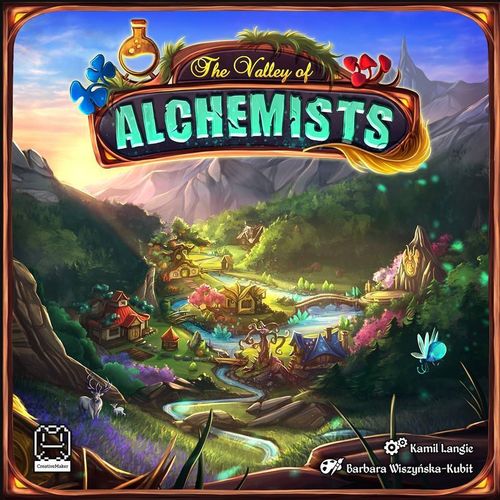
The Valley of Alchemists
The Valley of Alchemists Rulebook
Table of Contents
Table of Contents
Components
- 4 player boards in 4 colors
- 4 elixir chest boards
- 4 resource boards
- Rulebook
- 24 special action tokens, 4 of each type: change of shape, change of color, change of level, decoctions transformation, rearranging the elixirs, protection from event card
- 50 experience points markers: 10 worth 3 points, 10 worth 4 points, 10 worth 5 points, 5 worth 7 points, 5 worth 8 points, 5 worth 9 points, 5 worth 12 points
- 84 elixir cards
- 72 decoction markers: 12 blue, 12 red, 12 yellow, 12 orange, 12 green, 12 purple
- 18 event cards
- 96 ingredient markers: 24 blue, 24 red, 24 yellow, 24 transparent
- 16 player markers, 4 of each color
Elixir Card
An elixir card shows: the Experience Points, the elixir card's skill (bonus), the elixir's colors, the elixir's cost (decoctions and colors amount), the elixir's shape, and the elixir's level.
Player Board
The player board shows: bonuses for selling a line of elixirs, the brewing diagram, available actions, the place for decoctions, the place for ingredients, and the skill tracks.
Goal of the Game
During the game the players collect ingredients, use them to brew decoctions, and turn those into magic elixirs. The player with the most Experience Points (EP) at the end of the game wins. Points are gained over the course of the game as well as once the game has finished (see: The End of the Game section).
Game Setup
Each player receives:
- a player board of a chosen color
- an elixir chest board of the same color
- a resource board of the same color
- 4 player markers in the same color
- 6 special actions tokens, 1 of each kind
- 24 ingredient markers (6 of each color)
- 18 decoction markers (3 of each color)
The Alchemist's Tip: If someone took your favorite color, you're out of luck – better be faster next time!
Place the player board and special action markers in front of you. Place four player markers on the first spaces of the skill tracks on your player board. These statistics describe your skill levels when collecting the ingredients for your decoctions.
Put the elixir chest board on the right side of your player board. Put the resource board on the left side of your player board, next place the ingredient and decoction markers in the appropriate spaces.
Shuffle the elixir cards, then draw a number of them, based on the number of players:
- for a 2-player game: 34 elixir cards (+ optional 6 event cards)
- for a 3-player game: 46 elixir cards (+ optional 9 event cards)
- for a 4-player game: 58 elixir cards (+ optional 12 event cards)
Return the unused cards to the box – you will not need them. Place the remaining cards in a face-down pile in the middle of the table, so that all players can easily reach them. Then deal 10 cards from this pile, placing them face up in 2 rows of 5 cards each.
The oldest and most experienced Alchemist is the first player. Starting from him and continuing in a clockwise direction each player has to allocate two points on their skill tracks to improve their statistics. Players can add two points on one skill track or split the points on two different tracks of their choice. Players move the chosen marker(s) on the respective skills track(s) by one space to the right, for each point. As a result, players will start the game with different levels of their skills.
Make Experience Point markers accessible to all players. You are ready to start the game!
Play Overview
The game is made up of a series of turns, played one by one by each player in a clockwise direction.
Player turn description: On their turn, a player can perform any 2 actions out of the 5 available ones; the chosen actions can be carried out in any order and combination. The same action type can be performed twice.
Actions
Actions available in the game:
- Collecting ingredients
- Brewing decoctions
- Making elixirs
- Rearranging elixirs
- Selling a line of elixirs
1. Collecting ingredients
To perform this action, a player takes chosen ingredients of two different colors from the resource board. The player can take as many ingredients of a given color as indicated by the number where the marker on the corresponding skill track is.
The collected ingredients are placed on the player board.
A player can never have more than 6 ingredients of a given color on their player board.
There are four basic ingredients in the game: yellow, red, blue, and transparent – water. Note that water, although has no color, is also considered as ingredient.
The Alchemist's Tip: The higher the statistic of a given ingredient, the more ingredients of this specific color you will be allowed to take.
Example: At the beginning of his turn, the red player uses the first action to collect 1 yellow ingredient and 2 water crystals (according to the statistics on his skill tracks).
2. Brewing decoctions
With this action, a player can exchange stored ingredients for specific decoctions which will later be used to make elixirs.
To brew a decoction, a player must have ingredients of the right color. A brewing diagram can be found on the left side of the player Board. The number of decoctions that can be brewed in a single action is not limited.
There are 6 colors of decoctions in the game:
- 3 primary colors: yellow, red, blue, and
- 3 secondary colors: orange, green, purple.
The latter can be obtained by mixing primary colors. Note that you need water to brew decoctions of any color.
The Alchemist's Tip: 2 ingredients + water = a decoction. The more ingredients you have the more decoctions you will be able to make within a single action.
To brew a decoction, a player moves the right color ingredients, used for brewing, from their player board to their resource board. He then takes the right decoctions from the resource board and places them on their player board. A player can never have more than 3 decoctions of the same color on their player board.
Example: The player wants to brew a green decoction. He already has enough ingredients. The player discards a total of 1x blue ingredient, 1x yellow ingredient, 1x water and receives 1 green decoction, which then he moves to his player board.
3. Making elixirs
For this action, players can replace the decoctions they have for elixirs which are worth Experience Points. Obtaining each elixir requires specific decoctions. This cost is provided in the bottom right corner of the card.
The Alchemist's Tip: The more decoctions you have the more elixirs you will be able to make within a single action. When deciding which elixir to make consider both its cost and the bonuses it provides.
The number of elixirs a player can make in a single action is not limited. Only a face-up elixir, one that is visible in either of the two rows of displayed cards, can be made.
To make an elixir players discard the right decoctions from their player board and move them back on their ingredient board. Then, they take the corresponding elixir card and place it in their elixir chest board, in the place of their choice.
The Alchemist's Tip: Remember each chest has 3 shelves and each shelf can only fit 3 items.
Think before you place an elixir into the chest! Changing the position of an elixir uses up a valuable action. Keep your alchemist's chest tidy!
Once an elixir has been made, the player immediately receives a bonus: the relevant statistics on their skill tracks are increased. Information about the reward is provided in the upper left corner of the card.
The player marks the bonus by moving the marker(s) on the corresponding track(s) one space to the right. Note that some more complex elixir cards do not have this bonus, but instead they are worth more points at the end of the game.
Each elixir provides Experience Points at the end of the game. This is indicated by the number in the upper right corner of a card.
At the end of the turn, players draw new cards from the elixir deck and place them in the empty spaces, so that at the start of each turn a player has 10 cards to choose from (2 rows of 5 cards). If the last elixir card is drawn this way, the end of the game is triggered.
4. Rearranging elixirs
During this action, a player can rearrange the elixirs in their elixir chest board in one of two ways.
- A player can move any one elixir to an empty space in the chest, OR
- A player can swap places of any two elixirs.
5. Selling a line of elixirs
This is the most important action in the game. Players use it to sell elixirs in order to gain precious Experience Points. In a single action, you can sell only 3 elixirs in one line (horizontal, vertical, or diagonal).
You cannot sell elixirs that do not form one line or that form an incomplete line.
Point to the line you want to sell and sum up the bonuses. Bonus points are awarded for the elixirs of the same:
- color
- shape
- level
The elixir level is the number of decoctions needed to make it (the symbol in the bottom right corner of the card).
If an elixir is two-color and each color forms a line, then both colors score points.
The multi-color elixir is a wild card – the player decides which color, shape, and level it has to gain the most points.
The Alchemist's Tip: If a player creates a line out of 3 jokers, the points for selling such a line sum up as follows: 5 EP for the same shape, 3 EP for the same level, 24 EP for 6 same colored lines.
The scoring diagram for a line of elixirs is provided below.
- If all elixirs in line have the same bottle shape, the player gains 5 bonus points.
- If all elixirs in line have the same color, the player gains 4 bonus points.
- If all elixirs in line have the same level, the player gains 3 bonus points.
Note that you can gain multiple bonuses when selling one line of elixirs.
Add all the bonus points you have gained and take as many Experience Points markers from the general supply. Place both the obtained Experience Points markers and the sold elixir cards next to your player board. (you are going to need them at the end of the game to sum up the Experience Points and see who the winner is)
Example: At the beginning of his turn, the red player has 5 elixirs in his chest. He uses his first action to make a two-colored (red-orange) elixir in a square bottle that he puts in the bottom right slot of his chest. As his second action, he wants to sell a line of three elixirs. He can choose between the horizontal row A or the diagonal row B. Option A pays less so he decides to sell line B, but first he uses the "Change of Shape" Special Token and changes a square bottle into a triangular one. This way he receives 12 points for selling the elixirs: 5 points for the identical bottle shapes, 4 points for the same color, 3 points for the elixir level. He immediately takes the achieved bonus points as the Experience Points markers. Next, the player takes the sold elixirs and places them face down next to his player board. At the end of his round, the player has 3 unsold elixirs in his elixir chest board.
Special Actions
The special action is free and does not count towards the limit of your regular actions. Each player has only 6 special markers, 1 of each type. You can use more than one special marker on your turn, but no more than one per elixir.
There are six types of special actions:
"Change of shape"
Place this marker on a chosen elixir in your chest. This elixir changes its shape. Name the shape of the changed elixir when you score for selling a line of elixirs. This way you can earn more points. After it has been used, discard the marker to the box.
"Change of color"
Place this marker on a chosen elixir in your chest. This elixir changes its color. Name the color of the changed elixir when you score for selling a line of elixirs. You are only allowed to change one color. This way you can earn more points. After it has been used, discard the marker to the box.
"Change of level"
Place this marker on a chosen elixir in your chest. This elixir changes its level to a higher or lower than indicated on the card. Name the level of the changed elixir when you score for selling a line of elixirs. This way you can earn more points. When you change the level of an elixir, its color remains the same. After it has been used, discard the marker to the box.
"Decoction transformation"
Use this marker to change any number of decoction of one color to the same number of decoction of a different color (a 1:1 exchange). Put the decoctions whose color you want to change on the marker. This is the only situation when a player can have more than 3 decoctions of a given color on his board. After it has been used, discard the marker to the box.
"Rearranging the elixirs"
Use this marker and perform a free Elixir rearrangement action. After it has been used, discard the marker to the box.
"Protection from event card"
Use this marker to protect against the effect of the selected event card. This marker only protects the person who used it (except for the event card which shuffles all elixir cards on the board into deck and draws 10 new cards, in this situation the effect is stopped completely by one player). After it has been used, discard the marker to the box.
Event Cards
Event cards are an optional game mode. After dealing 10 elixir cards, shuffle the appropriate number of event cards (number of players x 3) into the elixir deck. When you refill elixir cards on the table and you draw an event card execute its effect, then discard it and draw a next card until there are only elixir cards on the table.
Available event cards:
- Each player discards one elixir of his choice from his chest.
- Each player performs only one action instead of two in their next turn.
- Each player changes any elixir from his chest for another one randomly drawn from the elixir deck. The elixir cards discarded by players are shuffled back into the deck. The effect of this card only takes place if a player has at least one elixir in his chest.
- Shuffle all elixir cards available on the table, and then draw 10 new ones. If new event cards appear on the table during this action, skip their effects and add cards until 10 elixir cards are available on the table (unless this is not possible due to too few cards in the deck). Shuffle event cards whose effects did not work due to this operation back into the elixir deck.
- Each player discards 2 ingredient markers of a given type.
- Each player discards 1 decoction marker of a given type.
- Each player moves the player marker one space to the left on the given skill track.
End of the Game
The end of the game is triggered when the elixir deck is exhausted.
Remaining players finish current round, so that each has taken the same number of turns.
Next, you calculate your Experience Points.
Add up the Experience Points (EP) scored for the following:
- the EP on the sold elixir cards
- the Experience Points markers
- the elixir cards EP from the elixir chest board. Each elixir in the chest is worth as much as indicated by the number on the card (no bonuses are added)
- the EP gained for the decoctions on the player's board. Each pair of unused decoctions on the player board is worth 1 EP.
The player who gets the most Experience Points becomes the winner and is declared the Alchemist of the Year! If there is a tie the tied player who made the most elixirs wins. If there is still a tie, check the number of decoctions and then ingredients the tied players have. If the tie persists, the players share the victory.
Single Player Mode
Set up the game as follows:
Give the player components only for yourself.
Prepare a deck consisting of 35 random elixir cards.
Deal 10 elixir cards the way you do in the standard game. Then add 3 event cards to the deck and shuffle. You are ready for a solo game!
The player performs his action in turns with a virtual opponent. The player performs actions in the same way as in the standard game. In the turn of the virtual player, the card in the upper left corner is discarded, and then all cards are moved to the top left corner, as shown in the picture. The cards discarded this way form the virtual opponent's stack.
When a card is discarded (as a virtual player's action), or it has been bought, first the whole row is moved to the left-upper corner, and then we fill up to 10 elixir cards on the table. Event cards work immediately after drawing and the effect applies only to the player.
End of the game
The game ends when the last card is drawn. The player plays his one last turn.
Points and victory conditions
The player scores points in the standard way (value on the cards + bonus for the markers + bonus for decoctions). The points of the virtual opponent are calculated as double the value of cards on the virtual opponent's stacks. In order to win the player has to score more points than the virtual opponent.