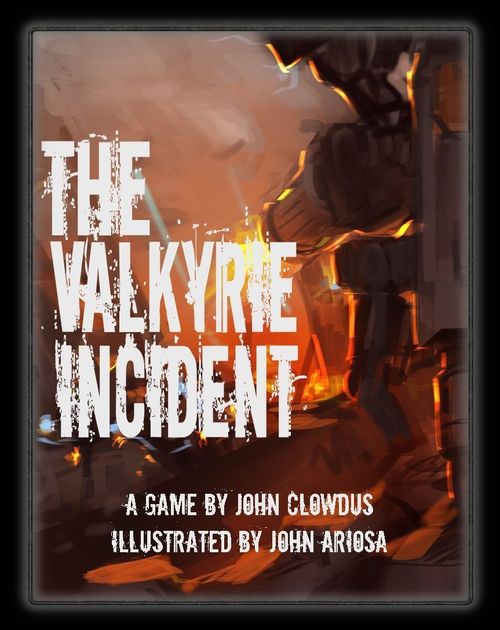
The Valkyrie Incident
The Valkyrie Incident Rulebook
Table of Contents
Table of Contents
The Valkyrie Incident
The Valkyrie Incident takes place during this time of war. The game is played over a series of 3 Engagements (or rounds). Each Engagement is broken into two phases: a Draft Phase, where each player receives a Draft turn to gain new cards for his deck, and a War Phase, where players use the cards they have drafted or recruited into their decks to battle over Locations.
The Valkyrie Incident offers a unique blend of deck building and two player area control. The player with the most points at the end of the game (determined by Incident Cards obtained and Victory Cards earned) wins the game.
Set Up
Set the 5 Location and 5 Emblem cards to the side of the play area. Shuffle together the Incident cards and deal 5 to each player. Using whatever method the players see fit, an Alpha Player is chosen. The other player is referred to as the Omega Player.
Each player then selects 1 card from his hand, places the selected card face down in front of him, and passes the remaining cards to the other player. This continues until each player has 5 face down cards.
Repeat the entire above process 2 additional times. Each player should end up with 15 face down cards. These 15 cards are shuffled together and placed in his play area, forming his Deck. While not important until after the game begins, in addition to having a Deck, each player also has a Pile. This is the player's discard pile, and as he uses cards, they go to his Pile. If a player ever runs out of cards to draw from his Deck, he MAY NOT automatically reshuffle his Pile into his Deck!
NOTE: During Set Up, prior to shuffling, a player may look at his selected, face down cards at any time!
The remaining 60 Incident cards are moved to the middle of the play area, forming the Incident Deck. The top card of the Incident Deck is placed face up to the left of the Incident Deck, forming the Wreckage.
Emblem Selection
Each player, beginning with the Omega Player, chooses 1 Emblem card from the side of the play area and places it face up in his play area.
After each player has selected an Emblem card, the remaining Emblem cards are placed to the side of the play area alongside the 5 Location cards. The game now begins, with the Alpha player as the Start Player for the first Engagement.
Card Types
Incident Cards
Throughout the course of the game, players will Recruit or Draft (add to their deck) and play Incident cards in a variety of ways. There are 4 different types of Incident Cards: Valkyrie, Cogdrives, Actions, and Assaults.
All Incident cards contain this information: Clan Emblem, Card Name, Incident Type, Ability Phase, Ability Text, Draft Cost, Strength.
Clan Emblem: There are 5 different Clan Emblems. Each Incident card has 1 Clan Emblem on it.
Incident Type: This indicates the card's Incident type: either War or Draft.
Ability Phase and Text: Each Incident card has an Ability. Some abilities can be used during the player's Draft turn, while others can only be used during the War phase. The appropriate phase is indicated on the card.
Draft Cost: This is the number of cards a player must discard from his hand to Draft this card from the Barracks.
Strength: The Incident card's Strength, used to determine who wins a Conflict.
The terms presented in this section are covered in greater detail later in the rules.
Valkyrie Cards (30 Cards): Valkyrie cards represent powerful warriors with an ability which may be used during the player's Draft turn.
Action Cards (25 Cards): Action cards offer the player a chance to use a unique ability during his Draft turn.
Cogdrive Cards (20 Cards): Cogdrives are machines of war and grant players access to an ability which may be used during the War phase.
Assault Cards (15 Cards): Assault cards grant the player powerful abilities that can be used during the War Phase.
Conflict Cards
Conflict Cards are simply face down Incident cards taken from the Incident Deck. When a player wins a Conflict Card, it goes face down beneath his Emblem card. (This is to ensure they stay separated from the cards in his Deck, Pile, and hand.) Conflict Cards that a player acquires are called Victory Cards.
Emblem Cards (5 Cards)
There are 5 different Emblem cards. Emblem cards affect how the cards in a player's deck are scored, indicate the player's Morale requirement, increase the Strength of Incident cards of that Emblem, and grant the player a special ability that can be used once per War.
Location Cards (5 Cards)
Location cards represent where the current War is taking place. There are 5 unique Locations, and each has a unique ability that affects cards played during the War.
Playing the Game
The Valkyrie Incident is played over a series of 3 Engagements. Each Engagement is broken up into 2 Phases: Draft Phase and War Phase. After the 3 Engagements, The Final War occurs, and the game ends. The player with the highest score wins. During the first Engagement, the Alpha Player is the Start player. This rotates each Engagement.
Draft Phase
During the Draft Phase, beginning with the Start Player for the Engagement, each player receives a Draft Turn. During the player's Draft Turn, he has the chance to add new cards to his deck, and use abilities of the Valkyrie and Action cards in his hand.
The Draft Phase is broken down into 4 steps: Draw, Morale Check, Barracks, and Recruit. Once a player has completed all 4 of these steps, his Draft Turn is over.
Draw Step
During the Draw Step, the player has two choices: He may either draw 5 cards or he may shuffle his Pile into his deck and draw 4 cards.
Morale Check
After drawing, the player may perform a Morale Check. To do this, he looks at the Morale Requirements of his Emblem. If he has 3 cards in his hand that match his Emblem's Morale requirement, he may reveal those cards. If he does, he takes the top card of the Incident Deck and adds it to his Victory Cards.
Barracks Step
After the Morale Check, the player fills the Barracks. He places cards from the top of the Incident Deck, one at a time, face up in the Barracks until there are 5 cards in the Barracks.
The second player, during his Barracks step, may wreck any number of cards in the Barracks prior to filling it.
Recruit Step
During the Recruit Step, the player drafts and/or recruits cards from the Barracks and may use the abilities of Action and Valkyrie cards in his hand.
Important Game Terms
Destroy: When a card is "Destroyed," the card is moved to the player's Pile.
Wreck: When a card is "Wrecked," the card is sent to the Wreckage.
Draft: When a card is "Drafted," the card is shuffled into the player's deck.
Recruit: When a card is "Recruited," the card is sent to the player's Pile.
NOTE: Any card ability that contradicts the rules supersedes the rules. NOTE: Any card ability must be followed to the best of the player's ability. NOTE: Cards in the Wreckage are never shuffled back into the Incident Deck.
Drafting
To Draft a card from the Barracks, the player selects the card he wishes to Draft, and discards a number of cards from his hand equal to the selected card's Draft Cost. The drafted card is then shuffled into his deck.
Abilities
The player may use the ability of a Valkyrie or Action card in his hand.
To do this, the player selects a Valkyrie or Action card from his hand, completes the card's ability to the best of his ability, and then moves the used Valkyrie or Action card to his Pile.
During the player's Recruit step, he may draft any number of cards or use as many card abilities as he wishes, he is limited only by the cards in his hand.
NOTE: Cards that are removed from the Barracks (whether they are Drafted, Recruited, or Wrecked) ARE NOT automatically replaced!
Once the Start Player has completed his Recruit step, his Draft Turn is over, and the second player takes a Draft Turn. Once each player has taken a Draft Turn, the Draft Phase ends and the War Phase begins.
NOTE: Any cards remaining in the player's hand may be used during the War Phase.
War Phase
During the War Phase, players will alternate turns playing cards in 4 different Conflicts, attempting to win the Conflicts and the Location.
Any cards remaining in the Barracks are moved to the Wreckage. The top 4 cards of the Incident Deck are placed in the Barracks face down, forming the 4 Conflicts. Each player then draws cards from his Deck until he has 7 cards in his hand. If he is unable to draw cards until he has 7 cards, he draws as many as he can. Finally, the Start Player selects 1 Location Card from the side of the play area and places it in the Barracks. The Start Player for the current Engagement takes the first turn during the War Phase.
Turns in the War Phase are handled a bit differently than they are in the Draft Phase. During the War Phase, players alternate taking turns performing 2 actions.
At the end of the War Phase, the player with the highest combined Strength in each of the Conflicts takes that Conflict card and adds it to his Victory Cards.
In the event that there are no Incident cards remaining to add to the Conflict(s), cards may be taken, at random, from the Wreckage.
War Player Turns
During a player's War turn, he receives 2 Actions. For each Action, he may:
- Play 1 card from his hand on his side of any of the 4 Conflict cards
- Discard a Cogdrive card from his hand to use the discarded card's ability
- Use an Assault ability in his hand
- Discard Action and/or Valkyrie cards from his hand to draw cards
- Use his Emblem's War Ability (once per War Phase)
A player may not perform one of the above mentioned actions more than once during one of his War turns. A player must perform 2 actions during his War turn, if possible.
NOTE: The Start player for each War Phase receives only 1 Action during his first War turn.
Playing a Card to a Conflict
The player chooses a card in his hand and places it on his side of a Conflict, face up. There is no limit to the number of cards a player may have on his side of any Conflict. Playing a card to a Conflict increases the player's Strength for that Conflict.
Using a Cogdrive Ability
The Player may use the ability of a Cogdrive card in his hand. To do this, he reveals the card from his hand, completes the Ability, and then moves the Cogdrive to his Pile.
Using an Assault Ability
The player may use the Ability from an Assault Card in his hand. To do this, he reveals the Assault card from his hand, completes the Ability, and then shuffles the revealed card into the Incident Deck.
Discarding Action/Valkyrie Cards
The player may discard up to 2 Action and/or Valkyrie Cards from his hand (in any combination). He draws 1 card for each card he discards.
Using an Emblem Ability
If the player chooses to use his Emblem's ability, he turns the Emblem sideways, and uses the ability. A player may only use an Emblem's Ability once per War Phase.
Ending The War Phase and Resolving Conflicts
In the event that the player cannot perform 2 different actions during his War turn, the player's turn ends. Each player draws 2 cards from his deck, and each player receives 1 additional turn. After each player receives 1 additional turn, the War Phase ends, and Conflicts are resolved.
Beginning with any Conflict, each player combines the Strength of all cards he has played on his side of the Conflict. The player with the highest Strength value takes the Conflict card and places it face down beneath his Emblem. The card is now a Victory Card. Each player then moves all of his cards on the Conflict to his Pile.
Repeat this process for any remaining Conflicts, one Conflict at a time.
If a tie exists, move all Assault and Action cards from the tied Conflict and compare Strength values once again. If a tie still exists, the Conflict card is moved to the Wreckage and each player moves his cards from that Conflict to his Pile; neither player wins this Conflict.
NOTE: Remember that Emblem cards and the Current Location card may affect the Strength of cards in play!
If a player has won either 3 of the current Conflict cards, or has won more current Conflict cards than the opposing player, he also wins the Current Location, and places it beneath his Emblem. If neither player wins the Current Location, it is returned to the side of the play area, face down, and may not be used again this game. Note that the player does not gain the abilities of any won Location.
Ending the Engagement
At the end of the War Phase, the current Engagement ends. Each player moves any cards remaining in his hand to his Pile and turns his Emblem card right side up. If this was the Third Engagement, the Final War occurs. If not, a new Engagement begins, and the Second player will be the Start player for the next Engagement.
The Final War
The Final War signals the end of The Valkyrie Incident.
The Omega Player is the Start player. The Final War is treated as a normal War Phase, however, each player shuffles his pile into his deck and draws 10 cards at the beginning of the Final War and an additional Conflict card is added (for a total of 5 Conflicts).
When the Final War is resolved, the game ends and scoring occurs.
Scoring
Each player scores: 2 points for each card in his deck that matches his Emblem, 1 point for each other card in his deck, 2 points for each Victory Card, and 1 point for each Won Location card.
The player with the most Victory cards earns an additional 4 points.
The player with the highest score wins the game. In the event of a tie, the player with the most Victory Cards wins the game.
Blitz Game Rules
These rules allow for a faster set up time and faster War phases, and ultimately a quicker game. Please note, using these rules will provide a "lighter" game experience than using the standard rules.
Blitz Set Up
Set the 5 Location and 5 Emblem cards to the side of the play area. Using whatever method the players see fit, an Alpha Player is chosen. The other player is referred to as the Omega Player.
The Omega Player chooses an Emblem card from the side of the play area and places it face up in his play area. This will be the player's Clan Emblem. He then goes through the Incident cards and takes all of the Valkyrie and Cogdrive cards of his Clan Emblem. The Alpha player then chooses an Emblem card and does the same. Players should end up with 10 Incident Cards that match his selected Clan Emblem. Each player then shuffles together his 10 Incident cards, and places them face down in his play area, forming his Deck. Set up then continues as normal.
It is important to note that each Emblem and each starting 10 cards cater to different play style, strategies, and tactics. Some match-ups may be considered "more fair" to the players than others.
The remaining Incident cards are shuffled together and placed face down in the middle of the play area, forming the Incident Deck. The top card of the Incident Deck is revealed and placed to the left of the Incident Deck, forming the Wreckage.
The game now begins, with the Alpha player as the Start Player, and the Omega Player as the Other Player for the Initial Draft and first Engagement.
Initial Draft
The Initial Draft is a special Draft Phase that occurs at the beginning of the game, allowing players to further fortify their decks before the Engagements begin. Each player receives a Draft Turn. After the Initial Draft, the first Engagement begins.
Blitz War Phase
At the beginning of each War Phase, each player draws 5 cards from his Deck. Instead of setting out 4 Conflict cards, only 3 Conflict cards are placed face down. The Start player still selects a Location for the current War. Aside from the rules set forth in the Blitz rules, the War Phase is handled as it is in the standard game.
During a player's War turn, he receives 1 Action. He may use this action to do 1 of the following:
- Play 1 card from his hand on his side of any of the 3 Conflict cards
- Discard a Cogdrive card from his hand to use the discarded card's [ability; the printed text ends here: "to use the discarded card's"]
- Use an Assault card ability in his hand
- Discard a number of Action cards from his hand to draw an equal number of cards, plus 1, use his Emblem's War Ability (Limit once per War) [as printed]
Once he has completed his selected action, his turn ends, and the next player takes a turn.
At the end of a player's turn, if he has no cards remaining in his hand, the other player receives 1 turn, and then the War Phase ends. Conflicts are resolved just as they would be using the normal War Phase rules.
If any player wins 2 or more Conflicts during the War Phase, he also wins the Current Location, and places the Current Location card beneath his Emblem. If no player wins the Current Location, it is returned to the side of the play area, face down, and may not be used again this game. Note that the player does not gain the abilities of the won Location.
There is no Final War when using the Blitz Ruleset, and the game ends at the end of the third Engagement.
The game is scored as it would be under the standard rules.
Please note: A typo exists on one of the cards. The Assault card "Firestorm" has its Incident card type listed as "Conflict." This should say "War."
Rules Ver 1.3. Updated May 17, 2013.