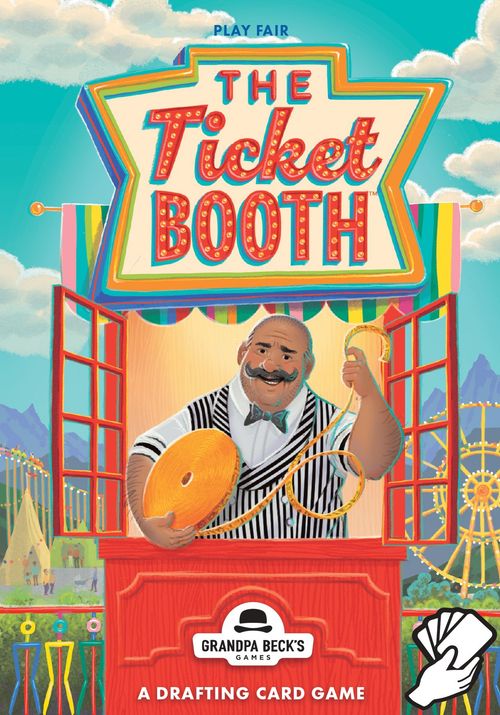
The Ticket Booth
The Ticket Booth Rulebook
Table of Contents
Table of Contents
Objective
Score the most points by collecting the majority of the numbered attractions. Special cards and tickets can also award points. Some special cards can give negative points.
Setup
- Shuffle the cards and deal five pairs, face down, in a circle. Place the player pawn by a pair, then flip all pairs face up. The draw pile is placed in the center of the circle.
- Give five tickets to each player. Return the excess tickets to the box.
Contents: 72 Cards, 1 Player Pawn, 25 Tickets.
Example of Game During Play: the page 2 diagram shows a sample table layout with the player pawn, the draw pile and Player 1's cards and tickets. It is pictorial and is not transcribed here.
Game Play
The oldest player goes first and play continues clockwise. The starting player rotates each round.
Note: There are eleven different attractions in the game. Each is represented by a numbered card. The quantity of each attraction is the number shown on the card (i.e. there are four #4 Pie cards and six #6 Produce cards).
On a Player's Turn
- Choose which pair to collect. The first pair clockwise from the pawn is free. To take a pair further away, they must place a ticket on each pair they would like to skip. If a player has no tickets left, they must take the first pair. For example: If a player chooses to take the pair with the pawn, they will play one ticket on each of the other four pairs.
- Move the pawn to the desired pair.
- Collect the pair of cards along with any tickets on that pair.
- Replace the pair with two new cards from the draw pile.
Cards collected are stored face up in front of each player. Organizing them by number will be helpful in scoring at the end.
For more competetive play, keep collected cards hidden from the other players.
When the draw pile runs out, continue play without filling cards. The pawn stays on the chosen pair's spot. The first pair clockwise from the pawn is still free.
With 2-4 players, the round ends when all cards are gone. With 5 players, the round ends when one pair remains, so everyone gets the same number of turns.
Special Cards
Except for the Piglet Race, special cards are used in scoring at the end of a round.
- Piglet Race: When chosen as part of a pair, collect all tickets currently in the circle.
- Outhouse: Worth -2 points unless a player collects all three Outhouses, then +8 points.
- Ticket Booth: +4 points if this player has the most tickets at the end of the round.
- Demolition Derby: Tickets held at the end of the round do not score. Instead, the player scores 4 points.
Scoring
Choose one player to be the scorekeeper. They will record each player's points on a piece of paper, noting their score for each attraction as it's called out.
- Number Cards:
- The scorekeeper calls out each numbered attraction from lowest to highest. Players score points based on the cards they have:
- The player with the most cards of an attraction scores the value of that card (i.e. five of one #8 attraction scores eight points).
- If two or more players tie for the most, each score half the card's value (i.e. four points for a tied #8 attraction).
- A player who collects all cards of one attraction scores double the card's value (i.e. 16 points for collecting all eight of a #8 attraction).
- The scorekeeper calls out each numbered attraction from lowest to highest. Players score points based on the cards they have:
- Special Cards:
- Outhouse: Scores -2 points each unless a player collects all three, then +8 points total.
- Ticket Booth: +4 points if this player has the most tickets.
- Demolition Derby: +4 points and the player does not score their tickets.
- Tickets: One point for each remaining ticket.
The player with the highest score after three rounds wins! If there is a tie, the tied player with the highest score in the last round wins. If still tied, victory is shared!