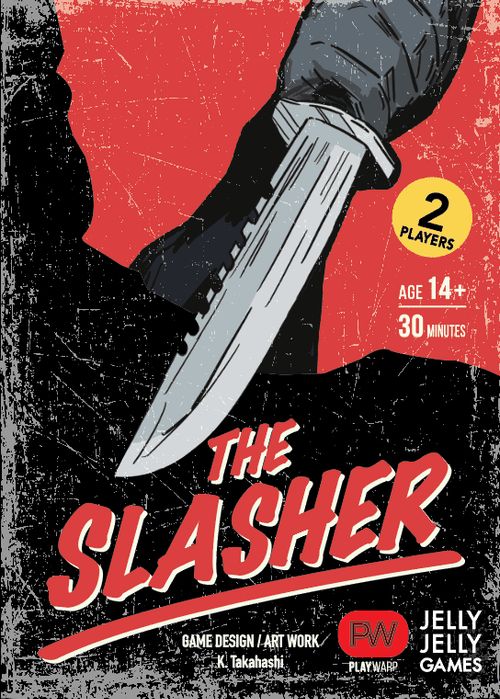
The Slasher
The Slasher Rulebook
Table of Contents
Table of Contents
Components
- 20 Number Cards (5 of each color)
- 7 Area Cards (3 Lv.1 Cards, 3 Lv.2 Cards, 1 Extra Card)
- 3 Trap Tiles
- 4 Player Info Cards (2 Player Cards, 2 Health Cards)
- 13 Item Cards (12 Item Cards, 1 Killer Card)
- 1 Rulebook
- 1 Player Guide
Game Overview
The game proceeds over the course of many rounds until the conditions for either victory or defeat are met. The flow of each round is explained below.
- Play Phase
- Item Phase
- Cleanup Phase
Setup
Setup is shown in the top-right diagram of the rulebook.
① Prepare the Player Info Cards Give each player one player card and one health card, then confirm that each player card is flipped so that the side with the phase order is visible. Place each player card to the right side of each player's health card so that the arrow points to the maximum health value of 7.
② Prepare the Area Cards Return the Extra area card (the Hideaway) to the box—it is only used for higher difficulties. Separate the Lv.1 and Lv.2 area cards into two groups (three of each), shuffle them facedown, then create a deck by placing the Lv.1 cards on top of the Lv.2 cards. This will be called the area deck. Draw the top card of the area deck and place it face up so that the arrow on the card clearly points to one of the players. Keep the orientation consistent, as the area cards will be used to determine the starting player for each round.
③ Prepare the Item Cards Separate the 12 item cards (not counting the killer) into two groups of six, then add the killer to one of them. Shuffle each group facedown, then place the group with the killer on top of the other, forming a deck. This will be called the item deck. Leave some space to the side of the item deck for the discard pile.
④ Prepare the Trap Tiles Make sure each trap tile is face up (open, not clamped shut), and place them to the side of the area deck.
⑤ Distribute the Number Cards Shuffle the 20 number cards facedown and deal eight to each player, forming the hands for the round. Players should hold their hand so that their partner cannot see it. Place the four undealt cards to the side without looking at them, forming the trump deck.
⑥ Decide the Trump Color Reveal the top card of the trump deck. The color of the top card will be the trump color for the round (explained later).
Area Rules
There are additional rules players should follow during the play phase depending on the area card for the current round, as well as an effect that occurs during the subsequent item phase. (Details can be found in the Player Guide.)
If players break an area rule, they must immediately flip over one of the trap tiles. Play continues as usual after this. If players break an area rule again during the same play phase, there is no further effect. Only one trap per round!
Communication Limits
Players may not communicate with each other about the cards in their hand. Only information that is visible to everyone (players' current health, the area rules, item phase effects, etc.) can be discussed.
You can't talk about anything that could be fatal if the killer happened to overhear it!
1. Play Phase
The starting player for the round is designated by the arrow on the current area card. Beginning with the starting player, players will take turns playing one card from their hand by placing it in front of them face up. A pair of played cards is called a "trick."
Players must follow the rules listed below when playing cards:
- The starting player can play any card they want.
- The second player must play a card of the same color as the starting player. If they don't have a card of the same color in their hand, they can play any card they want.
After each player has played a card, the winner of the trick is decided.
Each trick represents a snap decision the players come to as they work to stay away from the killer.
Deciding Tricks
- If both cards are the same color, the card with the higher number wins.
- For cards of different colors, the starting player wins, regardless of the number on the card.
- If there are one or more cards of the trump color, the trump color card with the highest number always wins.
A card of the trump color is always stronger than any other colored card, even the card played by the starting player.
The winner of the trick wins the two cards that were played, placing them face up in front of them so that the numbers on the cards are visible to both players. The winner becomes the starting player for the next trick.
There are eight total tricks per play phase—players continue playing cards until their hand runs out, then move on to the item phase.
Players can nullify red cards by using green cards they won during the play phase—the number of green cards needed to nullify a given red card is displayed on the card itself.
White cards that have turned into red cards (due to the player being at low health) are treated the same as the weakest red cards, adding only 1 additional damage and needing only one green card to offset them.
2. Item Phase
At the beginning of the item phase, players should sort the cards they won during the play phase by color, as each color has a different effect. Each area card also has an effect on the item phase that should be checked and understood before proceeding further. (Details about area card effects can be found in the Player Guide.)
The effect of the white cards won by a player changes based on that player's health at the start of the item phase. Note the diagram on the left side of the health card. Here is a brief overview of which health values correspond to which color:
- 6–7 = Green
- 3–5 = Yellow
- 1–2 = Red
Players with different remaining health values can have their white cards represent different colors. White cards only change color during the item phase—during the play phase they are still treated as white.
Before drawing item cards, players may use any items they currently have. Used item cards are placed in the discard pile adjacent to the item deck. Details for item cards can be found in the Player Guide.
Next, starting with the player designated by the arrow on the current area card, each player will reveal a set of cards from the item deck.
Drawing Item Cards
Each player must reveal (one card at a time) the same number of item cards from the item deck as the number of yellow cards they won during the play phase, only stopping if the killer is drawn or the item deck runs out. If the killer hasn't been revealed, the player may choose to keep one of the revealed item cards, placing it next to their health card. Place all of the unchosen item cards face up in the discard pile.
If the player didn't win any yellow cards during the play phase, they must still reveal one item card from the deck. If the deck runs out before a player can reveal cards, they do not get to reveal any cards during this round.
If the Killer is Drawn
Immediately stop revealing cards. The player who drew the killer should do the following:
① Reduce their health by 1. ② Reduce their health by an additional amount based on the number of knife icons on the red cards they won during the play phase. ③ The player who drew the killer is not allowed to keep any of the revealed item cards. Revealed cards, including the killer, are placed face up in the discard pile.
Players can nullify red cards by using green cards they won during the play phase—the number of green cards needed to nullify a given red card is displayed on the card itself. White cards that have turned into red cards (due to the player being at low health) are treated the same as the weakest red cards, adding only 1 additional damage and needing only one green card to offset them.
If the second player has yet to reveal their set of cards from the item deck (and there are still cards remaining in the deck), that player may go through the process of revealing and acquiring an item card as normal. Players will then move to the cleanup phase.
3. Cleanup Phase
During the cleanup phase, players will prepare for the next round by doing the following:
- If the killer was drawn during the previous item phase, shuffle the discard pile (including the killer) with any remaining cards in the item deck to create a new item deck. If the killer was not drawn, leave the item deck and discard pile as they are.
- Draw a new area card from the area deck and place it on top of the current area card. This will be the new area for the next round. If the area deck runs out, shuffle all of the area cards together to create a new area deck and draw the top card to use for the next round.
- Shuffle all 20 number cards facedown, then distribute them and decide the trump color the same way you did at the beginning of the game.
- Begin the play phase for the next round.
End of the Game
If any of the following conditions are met, the game ends immediately.
Victory: If players get their hands on 4 of the 5 escape items, they successfully escape the campground and live to tell their tale!
Defeat: If either player dies (their health is reduced to 0) or players set off all 3 trap tiles, they fail to escape the campground. Rest in peace.
Difficulty Levels
After beating the game, try adjusting the difficulty for more of a challenge! The preparation and victory conditions change slightly depending on the difficulty level. (Details can be found in the Player Guide.)