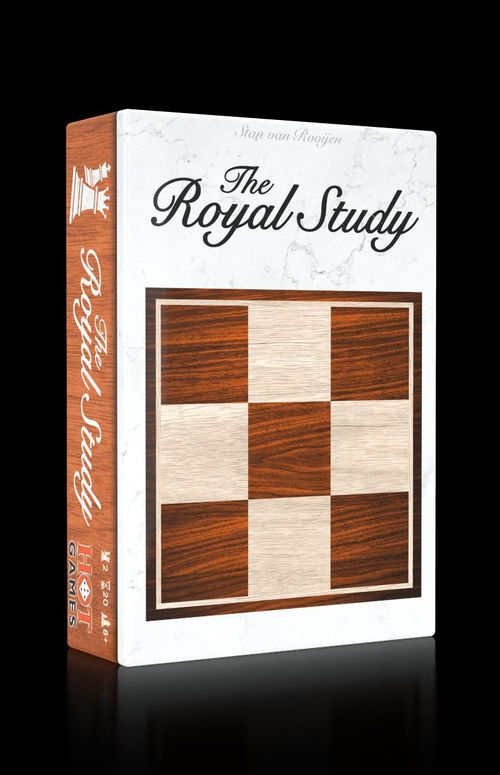
The Royal Study
The Royal Study Rulebook
Table of Contents
Table of Contents
Contents
- 5 Chess Pieces: King, Queen, Rook, Bishop and Knight
- 60 Objective Cards
- Cardholder
- Hourglass
Setup
- Place the box, cardholder, and hourglass on the table between both players.
- Shuffle the objective cards and place them in the cardholder.
- Draw one card from the holder and place it below the game board.
- Position the chess pieces on the box as shown on the card.
- After placing the pieces, lay the card aside.
Gameplay
The Royal Study offers three levels of gameplay. Each level adds complexity, but the goal remains the same: completing the objective card by matching the positions of the pieces on the board with the image on the card. Each level builds on the rules of the previous level.
Level 1
Step 1: Draw the Challenge
A player draws one objective card from the cardholder and places it below the game board.
Step 2: Declare Moves
Both players study the objective card and think about the minimum number of chess moves needed to complete the task. The first player to declare their estimate flips the hourglass to start the timer.
Step 3: Opponent's Decision
While the hourglass runs, the opponent may choose to challenge the estimate by attempting to complete the task in fewer moves.
Step 4: Execute the Plan
If the opponent doesn't respond:
The player who declared their estimate moves the pieces. If they complete the challenge within their stated number of moves, they score a point. Otherwise, the point goes to their opponent.
If the opponent responds:
The opponent moves the pieces. If they complete the challenge in fewer moves than the original estimate, they score a point. Otherwise, the point goes to the original player.
Optional rule: If needed, agree on a time limit for executing the plan.
Example: It takes four moves to complete the challenge card. Knight to top-left, Rook to bottom-right, King to bottom-center, Queen to middle left.
After Scoring a Point:
Leave the chess pieces in their final positions. Draw a new objective card and repeat the process until one player collects six points and wins the game!
Level 2
From this level, when executing the plan you may rotate the objective card, by turning the card 90 degrees (clockwise or counterclockwise). This action costs one move. You may rotate the card twice to turn it 180 degrees, at the cost of two moves.
Level 3
At this level, when executing the plan, you may mirror the objective card by flipping it horizontally or vertically. Each mirroring action costs one move.
Bonus Challenge
This can be played at any level. Draw two instead of one objective card from the card holder. Determine the amount of moves needed to complete both cards. When executing the plan, the player that moves the pieces chooses the order in which to complete the cards. When using a rotate or mirroring action choose of of the two objective cards to mirror or rotate.
Note: the source text reads "choose of of the two objective cards"; transcribed as printed.
Solo/Cooperative
The Royal Study can also be played solo or cooperatively. Work together to solve the objective card(s) and execute the plan. Record the starting position if you wish to retry the challenge or explore alternative solutions with fewer moves.
Chess Moves
This game includes five chess pieces, each with its own movement rules. Chess pieces can only be moved to an empty square. Pieces cannot move through or over other pieces, except for the knight.
King
Moves one square in any horizontal, vertical, or diagonal direction.
Queen
Moves any number of squares in horizontal, vertical, or diagonal directions.
Rook
Moves any number of squares horizontally or vertically.
Bishop
Moves any number of squares diagonally.
The bishop must remain on dark-colored squares.
Knight
Moves two squares horizontally or vertically, then one square sideways and can jump over other pieces.
The knight can't be placed on the middle square.