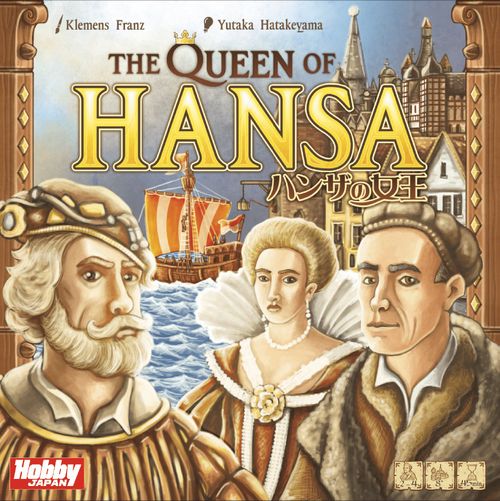
The Queen of Hansa
The Queen of Hansa Rulebook
Table of Contents
Table of Contents
Components
- Trade cards: 60
- Normal cards: 36
- Luxury cards: 24
- (15 cards each for London [red], Bruges [blue], Bergen [yellow], Novgorod [black])
- Round marker: 1
- Start player marker: 1
- Luxury pieces: 24 (6 each of red, blue, yellow, black)
- Summary cards: 4
- Prosperity markers: 4 (1 each of red, blue, yellow, black)
- Bag: 1
- Profit markers: 12 (3 each of green, purple, gray, orange)
- Rulebooks: 4 (Japanese, English, German, French)
- Game board: 1
- Scoring board: 1
Reading a Trade Card
- Affiliation: The color of the number shows which city the trade card belongs to.
- Trade power: Represents the influence over the city the card belongs to. Trade power affects the profit gained.
- Notable person (8 types): At game end, you score for the number of different types, or of the same type, of notable persons. There are 8 types, A to H, with 3 cards each.
- Trade ship: At the end of each round, you can store luxury pieces. It also scores points at game end.
- Luxury mark: A luxury piece is placed on trade cards bearing this mark. Luxury pieces increase influence over a city and increase profit in scoring.
- Player count mark: Shows for how many players the card is used. If you play with that many players or more, use the card. Remove unused cards from the game.
Game Board
Each division of the game board represents a city. Each city has 5 spaces on which trade cards can be placed. Red: London; Blue: Bruges; Yellow: Bergen; Black: Novgorod.
- Harbor: The leftmost 2 spaces of each city. Players can take trade cards from these spaces.
- Sea: The rightmost 3 spaces of each city. Cards here cannot be added to your hand, but as the game progresses the cards placed here move to the harbor and become obtainable. In a 2-player game, the rightmost space is not used.
Scoring Board
- Profit track: Shows each player's current profit. The first profit marker is used on the 1 to 99 table; the second profit marker indicates the hundreds place.
- Prosperity track: Shows the current prosperity of the 4 cities. The higher a city's prosperity, the higher the profit in that city.
- Round track: Shows the current round.
Kontor
Each player's own area in front of them is called the "Kontor". Place trade cards and luxury pieces there. Sort cards and pieces by color and keep them visible to the other players.
Game Setup
Preparing the Game Board
-
Place the game board and scoring board in the center, and place the round marker on "I" of the round track.
-
Referring to the player count marks, remove all trade cards that do not suit the number of players and return them to the box. Remove 4 cards in a 3-player game and 16 cards in a 2-player game.
-
Place the 4 prosperity markers on the "5", the second space from the left of the prosperity track.
-
Divide the trade cards into two stacks, normal cards and luxury cards. Each stack is called a deck. Shuffle each well, face down.
-
From the two decks made in step 4, take the number of cards determined by the number of players, and mix them together well:
- 3 to 4 players: 12 normal cards + 8 luxury cards = 20 cards total
- 2 players: 10 normal cards + 6 luxury cards = 16 cards total
Next, place the mixed cards face up on all the city spaces. In a 2-player game, the rightmost space of each city is not used. Start with the "leftmost space" of the "topmost city (London)" and place the cards in order from left to right.
-
Put the 24 luxury pieces in the bag. Then, without looking inside, draw them one at a time and place them on the luxury cards. Place the pieces following the same order as the placement of trade cards in step 5.
Preparing the Players
- The person who most recently boarded a ship becomes the start player and takes the start player marker. If no one has, decide by any suitable method.
- Each player takes 3 profit markers of a preferred color and 1 summary card. Place 2 profit markers on "0" of the profit track and 1 in the Kontor, as a marker of your color.
- Deal 4 cards face down from the normal deck to each player. Each player looks at the contents and chooses 2 of them to be their hand. The 2 cards not chosen are returned face down to the original deck. After everyone has returned their cards, shuffle the normal deck well.
Object of the Game
Collect trade cards and luxury pieces from prosperous cities in order to earn more profit than the other players. After 3 rounds, the player with the most profit wins.
Flow of the Game
Each round consists of 3 phases: (1) Obtaining Trade Cards, (2) Scoring, (3) Storage and Preparation. After 3 rounds, final scoring is carried out.
(1) Obtaining Trade Cards
Starting with the start player, take turns clockwise. Depending on the number of players, the number of turns per player changes:
- 4 players: 4 turns
- 3 players: 5 turns
- 2 players: 6 turns
On your turn, choose one of the following: Trade with a City, or Attend Parliament.
Trade with a City
Play 1 trade card from your hand face up and place it in your Kontor. Always keep the cards in your Kontor sorted by color so other players can check them.
Choose 1 card from the harbor of the city of the same color as the card you played to your Kontor, and add it to your hand. If that color's city has no cards at all, choose 1 card from any harbor and add it to your hand.
Then move trade cards to the harbor (see Moving Trade Cards to the Harbor).
Attend Parliament
Play 1 trade card from your hand face down and place it in your Kontor. Keep face-down cards separate from face-up cards, and make it so other players can see how many there are.
Choose any 1 prosperity marker and move it 1 space right or left (you cannot choose not to move).
Next, choose 1 card from any harbor and add it to your hand.
Then move trade cards to the harbor (see Moving Trade Cards to the Harbor). You may check the face of the face-down cards in your Kontor at any time, but be careful not to turn them face up.
When you add a luxury card to your hand, place the luxury piece that was on it in your Kontor. Keep luxury pieces together with the trade cards of the same color.
Whichever action you choose, when your turn is complete your hand is always 2 cards. Be careful not to mistakenly place in your Kontor a card that you should add to your hand.
Example: Ann played a trade card of London (red) face up and chose a card from London's harbor. That card was a luxury card, so she added it to her hand and placed the black luxury piece that was on it near the black cards in her Kontor.
Moving Trade Cards to the Harbor
After adding a trade card from the harbor to your hand, if there are cards to the right of the vacated space, move all of them to the left to fill in. If a luxury piece is on a card being moved, move it together with the card.
Changes in Prosperity
If, through moving trade cards to the harbor, the last card placed in the sea of a city moves to the harbor, a change in prosperity occurs in that city. According to the order in which changes in prosperity occurred within that round, each city's prosperity marker moves as in the table:
| Order | Movement |
|---|---|
| 1st | 1 space left (-1) |
| 2nd | 1 space right (+1) |
| 3rd | 2 spaces right (+2) |
| 4th | 3 spaces right (+3) |
Note: The 4th change may not occur.
Final Simultaneous Turn of Round 3
In round 3 only, after everyone has taken their determined number of turns, all players simultaneously place 1 additional trade card, face up or face down, in their Kontor. However, do not Trade with a City (taking a card from the harbor) or Attend Parliament (moving a prosperity marker). The 1 remaining card in hand is removed from the game.
After everyone's turns are finished up to the determined number, proceed to (2) Scoring.
Important: Whichever action you choose, when your turn is complete your hand is always 2 cards. Be careful not to place in your Kontor a card you should add to your hand.
(2) Scoring
All players do this phase simultaneously. Players earn profit based on trade power and the number of luxury pieces.
Profit from Cities
Calculate the influence on each city and score it.
For each city (color), each player calculates the total of "the trade power of face-up trade cards" and "the number of luxury pieces obtained". Face-down trade cards are not counted.
Compare the totals. Up to the top 3 players, in descending order, earn profit by referring to the city's current prosperity. Check the prosperity track; the numbers beneath that city's prosperity marker are the profit.
1st place receives a fixed profit; for 2nd place and below, the calculated total is multiplied by a fixed number. Because of this, the 2nd-place profit often exceeds the 1st-place profit.
If totals are tied, all the applicable players earn the profit of that rank. In that case, the next rank is skipped by the number of duplicated players. That is, if 2 players tie for 1st, the 3rd-place player earns the 3rd-place profit, not the 2nd-place profit.
After earning profit, move your profit marker on the profit track by that amount.
Examples:
- At London scoring, each player's total and income: Ann has 8 (1st) and earns 25 marks. Bob has 7 (2nd) and earns 7 x 3 = 21 marks. Charlie has 6 (3rd) and earns 6 x 2 = 12 marks. Dona has 3 (4th) and earns no profit.
- At Bruges scoring: Ann has 3 (4th), no profit. Bob has 9 (1st), 5 marks. Charlie has 6 (2nd), 6 x 1 = 6 marks. Dona has 4 (3rd), no profit.
- At Bergen scoring: Ann has 7 (1st), 16 marks. Bob has 4 (3rd), 4 x 1 = 4 marks. Charlie has 3 (4th), no profit. Dona has 7 (1st), 16 marks.
Profit from Luxury Goods
Count the number of types (number of colors) of luxury pieces in your Kontor. Earn profit according to the number of types:
| Types | Profit |
|---|---|
| 1 type | 2 marks |
| 2 types | 6 marks |
| 3 types | 12 marks |
| 4 types | 20 marks |
After that, in rounds 1 and 2 proceed to (3) Storage and Preparation; after round 3 proceed to Final Scoring.
(3) Storage and Preparation
Storing Luxury Pieces
Choose a number of luxury pieces equal to the number of face-up trade ships among the cards in your Kontor, and store them. Remove the rest from the game and return them to the box; do not return them to the bag. You may store luxury pieces of a color different from the trade ship. All players choose which pieces to store simultaneously.
Support of Allied Cities
Increase the prosperity of the city with the lowest prosperity by 1: move that city's prosperity marker 1 space to the right. If there are multiple applicable cities, move all of those markers 1 space to the right.
Replenishing Trade Cards
Make a new deck of trade cards to fill the empty spaces in each city. According to the number of players, take cards from the two decks as in the table and mix them well together:
| Players | Normal cards | Luxury cards | Total |
|---|---|---|---|
| 4 | 8 | 8 | 16 |
| 3 | 7 | 8 | 15 |
| 2 | 7 | 5 | 12 |
Next, place cards from the deck you made onto the empty spaces. Start with the "leftmost space" of the "topmost city (London)" and place them in order from left to right.
Note: In a 2-player game, the rightmost space of each city is not used.
After that, without looking, draw luxury pieces from the bag one at a time and place them on the luxury cards. Place the pieces following the same order as the placement of the cards. Place only 1 piece per card. Skip cards that already have a piece on them.
Deciding the Start Player
The player who currently has the least profit decides the next start player and gives them the start player marker. They may name themselves. If multiple players are tied for least profit, among them the player who took a later turn order in this round chooses.
After that, advance the round track marker 1 space and proceed to the next round.
Final Scoring
After (2) Scoring of round 3, proceed to Final Scoring. In Final Scoring, players earn profit in 3 ways.
Influence in Parliament
Each player turns all face-down trade cards in their Kontor face up. Then, regardless of color, total the trade power of all the cards just turned face up. Do not add the number of luxury pieces.
The player with the highest total is 1st and earns the fixed profit of the city with the highest prosperity. The 2nd-place player earns the fixed profit of the city with the 2nd-highest prosperity. 3rd place and below likewise earn profit. If tied, all the applicable players earn the profit of that rank; the next rank is skipped by the number of duplicated players.
From here on, leave all cards in your Kontor face up.
| Trade power rank | Profit |
|---|---|
| 1st | City with 1st-highest prosperity |
| 2nd | City with 2nd-highest prosperity |
| 3rd | City with 3rd-highest prosperity |
| 4th | City with 4th-highest prosperity |
Golden Ship
Each player checks the number of trade ships in their Kontor. Compare the counts: the player with the most is 1st and earns 20 marks, the 2nd-place player earns 10 marks, and the 3rd-place player earns 5 marks. If tied, all the applicable players earn the profit of that rank; the next rank is skipped by the number of duplicated players. This profit cannot be earned unless you have at least 1 trade ship.
| Rank | Profit |
|---|---|
| 1st | 20 marks |
| 2nd | 10 marks |
| 3rd | 5 marks |
Connections with Notable Persons
Number of types of notable persons. Count the number of different types of notable persons in your Kontor. Each player earns profit as in the table:
| Types | 1 | 2 | 3 | 4 | 5 | 6 | 7 | 8 |
|---|---|---|---|---|---|---|---|---|
| Profit (marks) | 2 | 6 | 12 | 20 | 30 | 42 | 56 | 72 |
Number of notable persons of the same type. Next, count the cards of each individual notable person in your Kontor. Each player earns profit according to the number of multiple notable persons of the same type:
| Cards of same type | Profit |
|---|---|
| 2 cards | 6 marks |
| 3 cards | 20 marks |
Example: Ann's Kontor has notable person cards A: 1 card, B: 1 card, D: 2 cards, F: 1 card, G: 3 cards, H: 2 cards. For the number of types, there are 6 types in total (A, B, D, F, G, H), so she earns 42 marks. For notable persons of the same type, D and H have 2 cards each and G has 3 cards, so she earns 6 x 2 = 12 marks for 2 cards x 2 sets, and 20 marks for 3 cards x 1 set, for a total of 32 marks.
Determining the Winner
Add up all of the above profit; the player with the most profit wins. If there are several, the one among them with the most "types of notable persons" wins. If that is also tied, those players share the victory.
Summary Card
- (1) Obtaining Trade Cards: 4 players 4 turns; 3 players 5 turns; 2 players 6 turns. Change in prosperity: 1st: 1 left (-1); 2nd: 1 right (+1); 3rd: 2 right (+2); 4th: 3 right (+3).
- (2) Scoring, profit from luxury goods: 1 type 2 marks; 2 types 6 marks; 3 types 12 marks; 4 types 20 marks.
- (3) Storage and Preparation, replenishing trade cards: 4 players 8 normal + 8 luxury = 16; 3 players 7 normal + 8 luxury = 15; 2 players 7 normal + 5 luxury = 12.
- Final Scoring: Influence in Parliament (1st to 4th place earn the fixed profit of the city with 1st to 4th highest prosperity); Golden Ship (20 / 10 / 5 marks); Notable persons, number of types (2 / 6 / 12 / 20 / 30 / 42 / 56 / 72 marks for 1 to 8 types); same-type notable persons (2 cards 6 marks, 3 cards 20 marks).