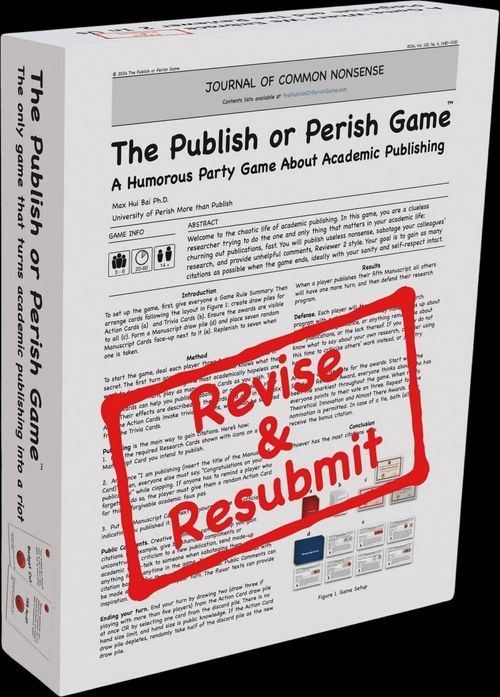
The Publish or Perish Game
The Publish or Perish Game Rulebook
Table of Contents
Table of Contents
Introduction
To set up the game, distribute a Game Rule Summary to each player to review. Arrange the cards as shown in Figure 1: create draw piles for Action Cards (a) and Trivia Cards (b). Ensure that the awards are visible to all players (c). Form a Manuscript draw pile (d) and place a random seven of them face-up next to it (e). Always replenish to seven when one is taken.
Figure 1. Game Setup. For a quicker game, consider setting up eight (instead of seven) face-up Manuscript Cards.
Method
Start the game by dealing each player three Action Cards (a), to be held in secret. The first turn goes to the most cynical player. Or just let the most academically hopeless one go first. On your turn, you may play as many Action Cards as you wish. These cards can help you publish, sabotage, or advance in other ways, with effects described on the cards and in Appendix A. Play them by putting them face-up in a spread-out discard pile. Some Action Cards involve asking trivia questions. Select one from a randomly drawn Trivia Card (b) to use for them.
How to Gain Citations Through Publishing
-
Play all of the required Action Cards as shown by icons on a Manuscript Card you intend to publish (e) into the discard pile. See an example in the Game Rule Summary.
-
Announce, "I am publishing [insert the TITLE of the Manuscript Card]." Then, everyone else must say, "Congratulations on your publication!" while clapping. If anyone has to remind a player who forgets to do so, the forgetful player must give them a random Action Card as a penalty for this unforgivable academic faux pas. There is no need to read out loud anything other than the titles in Manuscript Cards in this game.
-
Place the Manuscript Card next to you, face up, to officially indicate that you have published it. You may publish multiple times in your turn.
Public Comments
Creative comments can also help you gain citations. Every time someone publishes, you can give them backhanded compliments or unconstructive criticism disguised in a Q&A. You can also make up academic trash-talk whenever sabotaging someone. Or say anything amusing anytime. Anything goes. You may receive awards with citation bonuses for these comments when the game ends.
Public Comments can be made at any time, not just on your turn. You can draw inspiration from texts on the cards. Like Reviewer 2, you do not have to read the whole manuscript before criticizing it.
Ending Your Turn
End your turn by drawing two (draw three if playing with more than five players) from the Action Card draw pile at once OR by selecting any one Action Card from the discard pile to keep. There is no limit to hand size, and hand size is public knowledge. If the Action Card draw pile is depleted, randomly take half of the discard pile to form a new draw pile.
Results
When a player publishes their fifth Manuscript, all others will have one more turn before the defense.
Defense
Each player will defend their research program with a one-minute speech. You may make things up about the coherence, significance, or anything remarkable about your publications, or the lack thereof. If you really do not know what to say about your research, consider using this time to criticize others' work instead, or just try harder.
Awards
After everyone's three-minute-long one-minute speech, vote for the awards. Start with the Snarkiest Reviewer Award: everyone considers who has been the snarkiest throughout the game. When ready, everyone points to the person they vote for on a count of three. Repeat for the Theoretical Innovation and Almost There Awards. Voting for yourself is allowed if you truly deserve it or if you have no humility left. In the event of a tie, all tied players receive the bonus citation.
Conclusion
Whoever has the most citations wins.