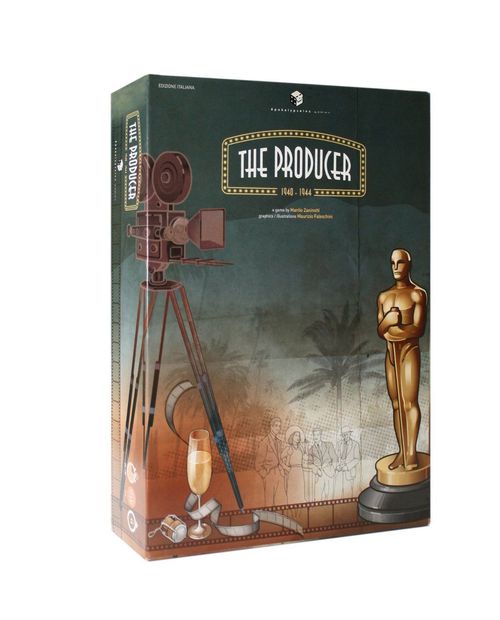
The Producer: 1940-1944
The Producer: 1940-1944 Rulebook
Table of Contents
Table of Contents
What's in the Box
- 1 Handbook
- 1 Central Board
- 4 Player Boards
- 4 Theme Sets (Western, Noir, Swashbuckler, Military), 1 each
- Stage areas: 4 Stage 2, 4 Stage 3
- 4 each of the areas: Editing Room, Make-Up Room, Special Effects, Orchestra
- 50 Script cards (brown), 70 Character cards (green), 80 Event cards (red)
- 98 round tokens: Red "Adult Female" Audience 10; Blue "Adult Male" Audience 15; Golden "Fans" Audience 10; Pink "Girls" Audience 10; Light Blue "Boys" Audience 10; Green "Children" Audience 10; White "Seniors" Audience 10; Oscar 7; Mafia 4; Mortgage 10; Star + / Star - 4; Golden Film reel 1
- 28 squared player chips: Frankenstein 7, CBS Radio 7, Car 7, Worker 7
- 200 money bills: 10.000 (green) 25; 50.000 (brown) 25; 100.000 (blue) 25; 500.000 (red) 25 (the box list prints only these four denominations; the total is 200 bills)
How to Win
The winner is he/she who, at the end of the last year, after the Final Score (pag. 41) stage, has accumulated the most Victory Points.
Game Supplies
1. The Central Board
The Central Board (pag. 8) represents the different locations of Los Angeles that the players can "activate", by positioning over them one of their "Producers" (pag. 12). Every individual location has its box explaining its function.
Details on each location in the game are explained in the "Central Board details" (pag. 8) and in the "Producers Actions on the Central Board" chapter (pag. 24).
2. The Player Board
Each player will have his/her Player Board (pag. 10), representing the inherited lot and upon which the players will have to build their Majors.
Unbuilt Areas (pag. 10): The areas of your lot appearing in sepia hues are yet to be built, but you can already clearly see what their purpose will be. Some of these areas are meant for buildings that are required for the production of a number of movies.
Built Areas (pag. 10): Some areas on your lot are brightly colored, and are the ones that have already been built.
Central Board Details
Scorekeeper Film: At the beginning of the game, each player puts a Producer token on the "0" box of the Scorekeeper Film and moves it every time he/she gains Victory Points.
Producer Tokens (pag. 12): Each player at the beginning of the game gets a set of Producer tokens. These represent his/her closest partners through which he/she will act. Each player can perform a number of actions each year that corresponds to how many available Producer tokens he has (pag. 23).
Tokens (pag. 12): Different kinds of tokens represent different elements of the game (different audiences, votes for the Oscars competition, Mafia affiliation, mortgages, temporary modifiers).
Turn Counter (pag. 12): Shows the current year (pag. 21).
Golden Reel (pag. 12): The reel is placed on the 1940 box on the Turn Counter at the beginning of the game and moved forward every passing year.
Hollywood Boulevard: This area cannot be activated by players. It is used to place Character and Script cards that are yet to be acquired and are available on the market.
Casting (pag. 24): This area can be activated to acquire more than one Character and/or Script card at a time. The player draws a total of 5 cards from the Character and Script decks (at least one from each) and puts them in the Hollywood Boulevard. Then he/she can acquire a maximum of 3 cards among all those present in the Hollywood Boulevard.
Hollywood Party (pag. 24): This area can be activated to acquire at half the price one card from the Hollywood Boulevard. The player who activates this area can also negate any Rumor (pag. 23) or Aggressive Press Campaign (pag. 26) on one of his/her characters.
First National Bank (pag. 25): This area can be activated to mortgage buildings or to extinguish active mortgages by placing a Producer token here. The player who does chooses one or more buildings among those he/she owns and has already built (pag. 29), then receives half of their value from the bank. Every Maintenance Stage he/she will pay 10% of the mortgaged amount. Players can't win the game if they have active mortgages.
CBS Radio (pag. 26): By placing a producer here, a player significantly increases the audience of his/her movies and gains 2 votes for the Oscars competition (pag. 37). The player adds 1 audience star of a color of his/her choice to a movie he/she produces and changes the number of audience tokens that will be extracted.
Genres / Point Conversion Table (pag. 41): This table sums up how to calculate the Victory Points each player gets at the end of the game based on how many different movie genres he/she produces.
Starlight Motel (pag. 26): This area can be activated to start an Aggressive Press Campaign against a character of the opposing team. That character loses 1 star from each of his/her stats until the end of the year.
Cafè Colosimo (pag. 27): This area can be activated only once each year. The player who places a Producer token here becomes a Mafia associate, gains $ 1.000.000, one Mafia token and everything that comes with relating to Mafia.
Oscars Ceremony Stage (pag. 37): This area can't be activated by players. It is used to show nominations for the Oscar competition.
Money (pag. 17): Money used in The Producer.
Cards (pag. 13-16): In The Producer there are 3 card types: Characters, Scripts and Events.
Player Board Details
Stage 1 (starting building): Allows the production of a movie (pag. 31). This area can be activated once a year by placing a Producer token over it in order to produce a movie.
Your Luxurious Office (starting building): This Caravan is the office in which players place all the available Producer tokens at the beginning of every year/game turn (pag. 21). At the beginning of the game it is already built and it can't be activated.
Construction Site (starting building): By placing a Producer token over this area, players can build one of the buildings that aren't available at the beginning of the game (areas of the Player Board in sepia hues) by paying its construction cost.
Tools Storehouse (starting building): This area can't be activated, but it is used for setting aside some Event cards (pag. 22) that let the player activate them in later moments. At the beginning of the game, it is already built.
Stage 2 - Stage 3: Construction cost: $ 500.000 (Stage 2), $ 1.000.000 (Stage 3). Maintenance cost: $ 200.000 (each). These areas are not yet built. In order to do so, the Construction Site must be activated (pag. 29) once for each Stage. Building these stages allows the production (pag. 31) of more than one movie per year (you can produce a movie for every built stage you own during each year). Each stage can be activated once a year by placing a Producer token over it.
Editing Room: Construction cost: $ 300.000. Maintenance cost: $ 200.000. When built, grants a significant increase in quality of the produced movies. A player that has built the Editing Room will always win the draws occurring during the Oscars awarding phase (pag. 37) against players who haven't. This area is always active (no need for activation).
Theme Set: Construction cost: $ 1.000.000. Maintenance cost: $ 200.000. Each player can build one Theme Set (pag. 30). Theme Sets in The Producer are one of a kind, so two different players aren't able to build the same set. These Sets count as a Stage: as such players can activate it by placing a Producer token over it in order to produce a movie (pag. 31).
Make-Up Room: Construction cost: $ 200.000. Maintenance cost: $ 200.000. This area, when built, grants 1 character star to Actors/Actresses playing Supporting Roles in movies that require the use of the Make-Up Room. This area is always active (no need for activation).
Special Effects: Construction cost: $ 500.000. Maintenance cost: $ 200.000. When built, during the Audience/Distribution phase (pag. 33) of movies that require the use of Special Effects, this area allows the substitution of a drawn audience token with an audience token of the player's choice that has been discarded. This area is always active (no need for activation).
Orchestra: Construction cost: $ 500.000. Maintenance cost: $ 200.000. When built, this area adds 1 black (Critics' Judgement) star (pag. 13) to EVERY produced movie. This area is always active (no need for activation).
Starting Buildings: Value: $ 1.000.000. These brightly colored areas have already been built and are available at the beginning of the game. They can be mortgaged all together, gaining half of their value ($ 500.000), by activating the First National Bank (pag. 25) on the Central Board.
Components
3. Producer Tokens
At the beginning of the game, each player receives a set of tokens with a specific design that will identify him/her for the rest of the game. These tokens are seven in the base game, six in the extended version. They represent as many "Producers", the player's closest partners, through which the player will act, and they also represent the number of actions per turn that the player will be able to do (pag. 23).
One of the player's tokens will be positioned in the "0" box of the Scorekeeper Film (pag. 8), while the others will remain available for the player.
Their use is explained in the chapter regarding the Operational Stage (pag. 22).
4. Audience Tokens and Other Tokens
There are various tokens in-game:
- Blue: Adult male Audience
- Red: Adult female Audience
- Pink: "Girls" Audience
- Light Blue: "Boys" Audience
- Green: "Children" Audience
- White: "Seniors" Audience
- Golden: "Fans" Audience
- Oscar: "Vote for the Oscar competition" token
- Flat Cap & Moustache: Mafia token / Mafia Associate
- $: Mortgage token, mortgaged
- Golden Film reel: turn counter token
- Star + / Star -: token marking temporary modifiers over a Script or Character card
5. Script Cards
Script cards represent the movie Scripts that the players will be able to produce. They show:
- the original movie's poster.
- the title of the release.
- the nationality of the production.
- the real year of production.
- the genre of the movie. Some movies belong to more than one genre, and both count towards the amount of Victory Points awarded (pag. 41).
- Critics' judgement for the original movie counted with black colored stars.
- Audience's judgement at the moment of distribution, counted with stars of different colors, dependent on the type of audience the movie will attract (pag. 33).
- Then the cards show the director who shot the movie, followed by the original cast.
The names of some of these Characters are in golden letters and underlined, signaling that these Characters are included among the in-game Character cards (pag. 14), while the others are not. As we'll see further on, this can largely affect the chances a movie has of winning the Academy Awards for Best Picture (pag. 38).
Below the cast are shown a synopsis for the movie along with historical annotations and trivia regarding the movie that don't have direct relevance on the game.
6. Character Cards
There are three main types of Character cards: Actor/Actress, Director and Director/Actor. To produce a movie, as we'll see later, you will need to combine: a Script card, a Director card, an empty Stage available for shooting the movie and at least three Actor/Actress cards (pag. 31).
Actor/Actress Cards
Actor/Actress cards show:
- the Character's picture.
- his/her stage name (often an Actor's real name was very different).
- his/her fame as a Star stated with a value ranging from 0 to 3 golden stars.
- his/her dramatic acting ability stated with a value ranging from 0 to 3 blue stars.
- his/her comedy acting ability stated with a value ranging from 0 to 3 green stars.
- his/her acting ability as a Character Actor stated with a value ranging from 0 to 3 red stars.
- his/her field of specialization (Field) if he/she has one; an actor/actress who is specialized in a specific genre gains 1 additional star in that genre during the Oscars competition (pag. 37) if he acted in a movie of that genre. For example, an actor/actress who is specialized in comedy playing the Star in a comedy will gain 1 green star for the Oscars competition for Best Actor/Actress (pag. 40), while he/she will gain a red star if he/she played a supporting role in the Oscar competition for best Supporting Character (pag. 40).
- biographical notes that could have effects on the game (golden title) or could be unimportant (black title and italic text).
At the bottom of each card are two values:
- The highest amount is the full hiring fee the producer will have to pay when casting and hiring an Actor for his Studios.
- The lowest amount is in brackets and is the halved hiring fee or maintenance fee, the price the player will have to pay during each Maintenance Stage to keep the contract active with the Character or to cast him/her with a reduced fee through connections related with the Hollywood Party (pag. 24) location on the board (pag. 10).
Director Cards
Just like the Actor/Actress cards, the Director Cards show:
- Character's picture.
- name.
- field of specialization (if present); a director who is specialized in a specific genre gains 1 additional star in that genre during the Oscars competition (pag. 37) if he directed a movie of that genre. For example, a director who is specialized in Comedy will gain 1 star for the Oscars competition (pag. 37) if he/she directed a Comedy.
- biographical notes that might be relevant for the game (golden title) or not (black title).
Instead of the three acting values, Director cards state the Character's ability in Directing, stated with a value ranging from 0 to 3 black stars that will add as an active effect to the Critics' value for movies produced by them (pag. 31).
Actor/Director Cards
These Character Cards represent rare and famous Characters who joined their efforts as Directors and as Actors during their careers. Their hiring fees are usually very high and their cards show stats for both their roles as Actors and as Directors (pag. 31).
7. Event Cards
Event Cards show interactions among players, like making another player's Star get drunk at the party for the end of the shooting, or spreading gossip to make another player's star lose favor with the Audience or the Critic.
The cards could also make a player hire professionals, Scriptwriters, costume designers and others to raise the quality of a movie produced. Or again, the cards could be real or fictional Events that can deeply influence the Audience's or the Stars' lives, or can make the movie making industry swing, like the start of WWII, atomic experimentations, the Mafia's involvement and such.
Their use is explained in detail in the chapter on the Operational Stage (pag. 22).
8. Money
Money doesn't grant a player victory, but without Money it's hard to win. Money is the engine for most of our actions. To build new Stages and sets (pag. 29) we'll need Money, to pay our Stars (pag. 21) we'll need a lot of money. Ending a game with a big amount of Money doesn't count much in the way of Victory Points awarded, but running out of Money during the game can slow down a player's progress very much.
In The Producer, Money is expressed in Dollars ($) but the banknotes aren't accurate copies of the ones used at that time because the denominations needed for the game (worth from 10.000 to 1.000.000) didn't exist. So the bills used in-game are fictional.
Preparation
Take from the Character cards' deck (pag. 14) and set aside the following: the "The Lumberjack", "Piano Bar Singer", "Boss' Babe" and "Frank Sinatra" cards. Shuffle the following decks separately and put them beside the Central Board: Event (pag. 16), Character (pag. 14) and Script decks (pag. 13).
Each player takes a Player Board (pag. 10). The players choose among them a Banker. The Banker will, from now on, distribute the game supplies, will collect and distribute the bank's money and will call for a vote during the Oscar competition (pag. 37) according to the rules.
Each player chooses his/her own symbol and receives seven "Producer" tokens (pag. 12) of the same type; places one in the "0" box of the "Scorekeeper Film" of the Central Board (pag. 8), and places the other six ones on his Player Board over the Luxurious Office (pag. 10).
Place the "Turn Counter Reel" on the 1940 box of the Board (pag. 8) to signal the starting year.
Take the Audience tokens: 15 adult males (blue), 10 adult females (red), 10 boys (light blue), 10 girls (pink), 10 children (green), 10 seniors (white), 10 fans (golden) and place them inside an opaque container. They represent the potential Audience going to the movies each year (pag. 12).
The 4 "Mafia" tokens (pag. 12) are placed on the Central Board over the Colosimo Café (pag. 8). Set aside $ 3.000.000: this will be the Mafia money (pag. 27). Set the Vote tokens aside.
The Banker hands out $ 2.000.000 (two million dollars) to each player, placing the remaining money over the "First National Bank" in the Central Board (pag. 8).
The Banker hands out 5 covered Character Cards (pag. 14) to each player. These represent drafts for contracts with 5 Actors or directors that the player will then have the choice of confirming or refusing. The Banker then hands out 5 covered Script cards (pag. 13) to each player.
First Stage
Script Drafting
Not every Script (pag. 13) is as interesting to a player as it would be for another, both for the Characters involved as well as for their potential Audience value, the genre and the necessary buildings needed to produce the movie.
To avoid luck from favoring a player rather than another, the 5 Scripts handed out by the Banker at the beginning of the game will be selected with the following procedure.
Each player selects 1 among the 5 Scripts received and sets it beside his Player Board. The remaining 4 Scripts are passed on to the player to his/her left.
The players select 1 among the 4 Scripts received from the player at his/her right and set it aside along with the first Script chosen, passing on the other 3 Scripts to the player at his/her left.
This goes on until the player at one's right passes on only one Script, and this will be kept by the player who received it, along with the 4 other ones. The 5 Scripts selected with this method will make up the starting supply for each player.
The Scripts of a player which haven't yet been turned into a movie are always secret, and should be kept covered.
Hiring Characters
Once the initial supply of Scripts has been selected, each player can then choose how many and which contract drafts to confirm and which Actors (pag. 14) and Directors (pag. 15) out of the 5 received from the Banker he/she wishes to hire.
The Actors a player has chosen to sign up will have to be paid their full hiring fee and will officially be part of the player's team. They will be positioned visibly (not covered) beside the Player Board (pag. 10). Each player can, at any time, check which Characters are currently hired by another player.
The unconfirmed Characters will immediately become available and will be positioned visibly on the "Hollywood Boulevard" section of the Central Board (pag. 8).
Now you're ready to start the game and begin the first turn.
Maintenance Stage
Game Turns
Each game turn represents a year from 1940 to 1944, each one with the following phases.
ATTENTION!!! The maintenance stage is skipped for the first turn of the game (1940).
Resetting the Boards
The "Golden Reel" token moves forward of one year on the Turn Counter (pag. 8).
Each player collects from the Central Board (pag. 8) his/her Producer tokens and stores them on the Luxurious Office section of their Player Boards (pag. 10).
The Vote tokens (pag. 12) that haven't been used are handed back to the Bank.
Additional bonus stars (pag. 12) or Event cards (pag. 16) whose effect is no longer active are discarded, and the Event cards' deck is reshuffled along with the discarded cards. All Audience tokens (pag. 12) that have not been removed from the game by effect of an Event card are put back into the opaque container.
Paying Maintenance Fees
Each player has to pay to the Bank the maintenance costs for their buildings: $ 200.000 for each building which is not among the starting ones. The player must pay an interest equal to the 10% of the loaned amount if he/she has an active mortgage with the Bank (pag. 25). Then the player must pay his/her Actors' wages.
At the beginning of each year, each Actor receives a payment equal to the amounts in brackets printed on their card (pag. 14). If a player does not have enough money to satisfy these conditions and cannot pay the maintenance fees, he/she has to immediately mortgage one or more of his/her Studios' buildings, enough to cover the expenses. In this case, after activating a mortgage, the player has to put one of their Producer tokens in the First National Bank section of the Central Board (pag. 8), and then a Mortgage token is placed over the mortgaged building(s).
If, even after doing so, the player doesn't have enough money to cover maintenance costs, one or more contracts with Characters on their team will have to be terminated. The player will choose which contracts to terminate and place the Character(s)' cards on the Hollywood Boulevard.
Assigning Event Cards
The Banker retrieves what's left of the Event deck (pag. 16) of cards and hands out 6 cards to each player. Once the deck has been used up, the Banker will reshuffle the used or discarded cards to form a new deck.
Operational Stage
Playing an Event Card
Starting from the player with the fewest points on the Scorekeeper Film (pag. 8) and in ascending order, each player will have to play a card from his hand and take an action with one of their Producers. This action will be repeated until every player has no more Event cards in his/her possession and the game will move on to the Oscar competition (pag. 37).
In the event of a tie in points among players, the one with the least Money in his/her possession will go first. The order established at the beginning of the Operational Stage will be kept for the duration of the entire turn (the current year) and will only be updated according to the new position of players on the Scorekeeper Film at the start of the next year.
During the first year of the game the player who starts is the one who has gone to the movies most recently and then in clockwise order.
Event Card Types
There are mainly two types of Event cards: Actions and Historical Events. Both can be "regular" or "special", the latter will be underlined.
The Action Event Cards have a black title and, on the background, a car's silhouette. Simple Action Event Cards offer less relevant advantages. Special Action Event Cards have stronger effects that can even determine the course of the game.
These are Actions that the player can do on himself/herself and that constitute an advantage for him/her, or they can be played on others and constitute a disadvantage for the opponents. To balance Action Event cards' effects, if a special card is played, the player who used it will NOT be allowed to do the Producer action that would've followed.
The player can, however, decide not to use the special Action Event card and discard it without applying its effects, and doing a Producer action instead.
The Action Event cards that determine a negative effect on any Character are called "Rumors".
The Historical Event Cards have a red title and, on the background, a newspaper page. Historical Event Cards are often twists of fate and will most likely have negative effects on those playing such cards. These are cards recalling real life Historical Events that do not depend on the player's choices but have an influence on the game regardless of (and against) his/her will.
Playing and Discarding Event Cards
Simple Event cards can be either played or discarded. When an Event card is played, apply its effects as written on the card (the text on the card prevails over this general rule). When an Event card is discarded, its effect is not applied.
Special Event cards can be played or discarded as well, but with some exceptions that are meant to balance their important impact on the game:
- special Action Event cards, if played, do NOT allow the player to use a Producer during the turn in which they are played;
- special Historical Event cards CANNOT be discarded.
Examples printed in the handbook:
| Pie Fight (simple Action) | Casting Director (special Action) | Accident on Set (simple Historical) | FBI's Public Enemy (special Historical) | |
|---|---|---|---|---|
| Can I play it? | YES | YES, but I cannot use a Producer token during this turn | YES | YES |
| Can I discard it? | YES | YES | YES | NO |
Using a Producer
At the beginning of the game each player is handed a set of Producer tokens (pag. 12). After playing an Event card, the player has the right to use one of his/her available Producers from the ones currently in the "Luxurious Office" box of their Player Board (pag. 10).
A Producer can be used to activate different areas of the Central Board (pag. 8) or some areas of a player's own Player Board (pag. 10).
Producer Actions on the Central Board (pag. 8)
1. Casting
By placing a Producer in this section of the Board, the player can enlarge his team by hiring new Actors and Directors, and can search new Scripts to produce.
The player will draw 5 cards from the Character (pag. 14) and Script (pag. 13) decks in any combination, the only restriction being that at least one card must be drawn from each deck. Then he/she will reveal the drawn cards and position them on the Hollywood Boulevard (pag. 8) along with the other cards already here. The player will have to choose among all the cards present on the Boulevard and acquire a maximum of 3, paying them their full value (each Script has a full value of $ 100.000). The cards that haven't been bought will remain on the Boulevard.
2. Hollywood Party
By placing a Producer in this section of the Board, the player can entertain relationships with the city's jet set, meeting Actors and producers. The player can hire for half of the hiring fee (the amount in brackets) any one Actor present on the Boulevard (pag. 8) or buy at a halved price one of the Scripts already available on the Boulevard. The player can also decide to cancel the effects of any Rumor (pag. 23) or Aggressive Press Campaign (pag. 26) deriving from negative effects from the Motel location or from an Event card that has been played on one of his/her Actors (Special Historical Events excluded).
3. First National Bank
By placing a Producer in this section of the Board, the player can voluntarily activate a mortgage on one or more of the buildings of his/her Player Board (pag. 10), or fulfill a mortgage that has been activated previously. The player will choose which buildings to mortgage, take a mortgage token for each and position them on the selected buildings.
The Banker will then hand to the player an amount of money which corresponds to half of the acquisition value of the mortgaged assets. The total value of the starting buildings equals $ 1.000.000 (so they will be worth $ 500.000 when mortgaged), and they can be used to activate a mortgage. A mortgaged building or structure can be used normally.
At the start of each turn, during the Maintenance Stage (pag. 21), each player will have to pay the Bank 10% of the mortgaged amount in the form of interests.
To extinguish a mortgage the player will have to use up an action and utilize one of his/her Producer tokens by positioning it over the First National Bank section of the Board to pay out the full amount of the mortgage.
ATTENTION!!! No player can win if at the end of the game they still have active mortgages.
4. CBS Radio
By placing a Producer in this section of the Board, the player can significantly increase the amount of people that will go see one of their movies and gain votes for the Oscar competition (pag. 37). The player will be able to assign an additional Audience star of any color (golden excluded) to a movie that he/she will produce during the current year (pag. 33). He/She will also be able to change the contents of the Audience container that are still available either by putting back inside up to 4 Audience tokens chosen among the ones already drawn but not yet assigned to other players, or by drawing from the container up to 4 tokens of a color of his/her choosing among the ones still available. The choice of the action to take and of the color and quantity of tokens moved must be declared before being done and WITHOUT having checked the available Audience tokens in the container first.
Furthermore the player who chooses to activate this location gains 2 votes that can be used during the Oscars competition.
5. Starlight Motel
By placing a Producer in this section of the Board, the player can send a paparazzo to take compromising pictures of a Character of his/her choosing from another player's team. This action represents an Aggressive Press Campaign.
The Character targeted by this action will lose a star from each of his stats (pag. 14) until the end of the current year.
6. Cafè Colosimo
By placing a Producer in this section of the Board, the player can propose to a known mobster to become partners in crime. This can be an easy way to solve any financial problems. Don Vito will be very happy to put his money on your Studios. He'll give the player $ 1,000,000 (from the Mafia money pool, pag. 18) without asking for any interest during the following years. Furthermore, being a Mafia associate doesn't stop a player from winning the game. The Family will, however, ask big favors of you, and they're offers you can't refuse. Many Historical Event cards (pag. 22) require certain favors from the player and can turn out to be a real ball and chain for his/her progress. However, Mafia also offers certain "services" that allow an associate to play Action Event cards against other players not associated with the Family.
Be careful, though: The FBI is always on the lookout for Mafia associates and the Federals' involvement can cost you a lot.
NOTE!!! Unlike other locations on the Central Board that allow multiple uses during the same year, the Colosimo Café allows entrance to only one producer each year.
Producer Actions on the Player Board (pag. 10)
1. Construction Site
By placing a Producer in this section of the Board, the player can build any new structures inside his/her Studios. To build, it's necessary that the player pays the according cost of construction to the Bank.
Building structures is also a way to earn points. Each building awards a number of Victory Points (VP) to the player for its construction. Completing the construction of all structures available for one's Studios awards an additional bonus to the final points (pag. 41).
The cost for each building, the effect, the Victory Points the construction of it awards to the player and their maintenance costs are as follows:
| Building | Effect | Construction | Maintenance | VP |
|---|---|---|---|---|
| Construction Site | Allows the player to build structures | Starting building | $ 0 | 0 |
| Administration | Inactive Producers | Starting building | $ 0 | 0 |
| Tools Storehouse | Allows the player to set aside certain Action cards | Starting building | $ 0 | 0 |
| Stage 1 | Allows the production of a movie | Starting building | $ 0 | 0 |
| Stage 2 | Allows the production of a second movie | $ 500.000 |
2. Stage 1-2-3
By placing a Producer in one of these areas the player will be able to produce a movie. The movies produced will immediately be distributed and an AUDIENCE phase will begin (pag. 33). Each Stage can be used only once per year.
Theme Set and Genre Movies
In order to be produced, many movies require the use of a Theme Set or for a special structure to be built on a player's Board: Editing Room, Make-Up Room, Orchestra, Special Effects. These movies are called "Genre Movies".
Theme Sets are very elaborated and expensive sets made up with various buildings and structures simulating cities, exotic places, adventure or war scenarios. A director is able to make the audience believe they're seeing an entire foreign city in just a small space of well-placed and well-designed backdrops and supplies. There are four Theme Sets available for the players and each of them will be allowed to build only one: Theme Set Military, Theme Set Western, Theme Set Noir, Theme Set Swashbuckler.
ATTENTION!!! There are four types of Theme Set, but there is just a single copy for each. A player can only build one of the Theme Sets that haven't already been built by other players. The Theme Set counts as a set, a studio, but unlike Studios it can be also used by another player, multiple players at the same time, and more than just once per year for movies in the same genre by the same player.
A Theme Set will always count towards the requirements for the production of a movie. Unlike other Stages, the Theme Set can be used by multiple players during the same year and is the only structure on the Player Board (pag. 10) that can be used by opponents. The player owning a Theme Set CANNOT block another player from using his/her set, but he/she will have to pay the owner of the Theme Set a rent of $ 300.000. Furthermore, each time a player uses the Theme Set built by another player, the owner of the set immediately gains a Victory Point.
3. Producing a Movie
To produce a movie some requirements must be met. The player needs to be in possession of the following:
- a Script card (pag. 13)
- a Director Character card (pag. 15)
- an Actor Character card to use as Leading Actor (pag. 14)
- an Actress Character card to use as Leading Actress (pag. 14)
- 1 to 3 Actor/Actress cards to use as Supporting Actor/Actress (pag. 14)
NOTE: Characters assigned to supporting roles cannot have more than 2 Golden Fame stars. No Actor with 3 Golden stars will accept to be cast in a role other than the lead.
EXCEPTIONS: Movies produced as Kolossals (pag. 32) don't follow this rule and supporting roles CAN be given to Actors/Actresses with 3 Golden stars.
- one Stage of those available on the player's Board (pag. 10)
- the Theme Set if the Script card states it as a requirement. Theme Sets owned by other players can be used
- any special structures if marked as a requirement in the movie card.
Orchestra, Editing Room, Special Effects and Make-Up Room are to be considered as always active once built, and will always give their support to the movie produced. They don't require the positioning of a Producer on their boxes of a Player's Board to be functional once built by a player (pag. 10).
Once produced, a movie immediately goes on to the distribution stage (pag. 33) and it's determined how much of the Audience will go see the movie produced by a player.
Once produced, a movie and the Characters who have worked on it are set aside, waiting for the Oscars competition (pag. 37). A Script card can only be used once. Characters (directors and Actors) who have worked on a movie will not be allowed to take part in another movie for the rest of the current year.
B-Movie
Any movie can be produced with one (and only one) requirement missing, with the exception of an available Stage (pag. 30) which is always required. A movie produced this way will be a B-Movie.
B-Movies will have a reduced Critics value: -1 Critics star (black) (pag. 13). Famous Stars (Actors/Actresses with 3 Golden stars) will not accept to work on a B-Movie and cannot be assigned to these productions.
In order to be allowed to produce 2 or more B-Movies during the same year, the player must've produced at least a regular movie.
B-Movies cannot take part in the Oscars competition (pag. 37). Similarly, Characters involved in a B-Movie cannot run for the Academy Awards for roles done in that movie.
B-Movies do, however, count towards the production of different movie genres for the final score (pag. 41).
Kolossal
Any movie can be produced as a Kolossal. These are extended productions, requiring multiple supplies and resources. To produce a Kolossal, the player will have to use at the same time three sets, choosing from Stages and Theme Sets (pag. 30). This puts a limit to the amount of movies a player can produce during that year, but Kolossals mean great advantages for the player who chooses to employ the necessary structures:
- a Kolossal sees the Audience value written on his Script's card (pag. 13) doubled.
- in a Kolossal there is no limit in the number of Supporting Actors/Actresses that can be cast, and Characters with 3 Golden stars can be cast as Supporting Actors without restrictions (pag. 37).
- producing a Kolossal gives great fame to the player, who immediately earns 1 Victory Point.
- during the Academy Awards, if a Kolossal wins the award for Best Picture, the Victory Points awarded to the player who produced the movie double.
4. Distribution, Audience and Box Office
As soon as a movie is produced (pag. 31) it moves on to the Distribution Stage. The player will now choose whether to assign to a movie any Action Event cards (pag. 22) that have been previously set aside to their Board's Storehouse (pag. 10). The player will also apply positive effects given by advertising (see CBS Radio, pag. 26) and special effects related to the Director/Actor/Actress Characters cast for the movie. Then the Potential Audience that could be interested in the movie will be calculated, and the result will indicate how many Audience tokens (pag. 12) will be drawn from the container making up the pool of viewers.
Audience tokens are drawn as follows:
- 1 for each Audience star on the Script.
- 1 for each Golden star on every Actor/Actress Character, in leading or supporting roles.
- according to the effect explained on Event cards.
- according to the description on the activation of certain areas of the Central Board.
Example: Player A produces "The Mark of Zorro". The Script card shows 4 Audience stars: one red, one blue, one pink and one light blue. This means that the movie will interest a mixed audience. The player assigned Victor Fleming as the director, Tyrone Power as the lead Actor, Linda Darnell as lead Actress and Edward G. Robinson and Judy Garland as supporting Actor and Actress (he/she could have used a third supporting Character but preferred to keep the card aside to use him/her in another movie during the same year). Tyrone Power has 1 Golden star, he could have one more during the War. Linda Darnell has no Golden stars but both Edward G. Robinson and Judy Garland have 2 and 2. Player A used one of his Producer tokens to activate the CBS RADIO location on the Board and gains +1 Audience star of his choosing. He/She chooses a green star to interest the younger audience as well. Lastly he/she decides to use an Action Event card, "Lighting Technician", that he/she had previously set aside and which gives the player an additional +1 light blue star. This means that the player will draw in total 11 Audience tokens from the container.
NOTE!!! Golden stars on Scripts count as having a color of the player's choice that must be chosen before drawing the tokens.
The tokens drawn from the container will be associated with the colors of the stars that have already been calculated.
Example: Player A draws 3 blue tokens (adult males), 2 red tokens (adult females), 1 light blue token (boys), 1 golden token (fans), 2 green tokens (children) and 2 white tokens (seniors). The cards used in the production of the movie stated: 1 blue star, 1 red star, 2 light blue stars, 1 pink star, 5 Golden stars and 1 green star. So the tokens that are initially assigned are the ones dictated by the cards, according to the possibilities of the player, depending on what was drawn: 1 blue token, 1 red token, 1 light blue token, 1 Golden token and 1 green token.
Then chaperones and partners are assigned. Each type of Audience can be paired and bring along to the movies a chaperone or partner of the right kind: an adult male (blue) can bring an adult female (red) and vice versa, a boy (light blue) can bring a girl (pink) and vice versa, a child (green) can be accompanied by an elder (white) but not the other way around.
NOTE!!! Chaperoning a child is the only way to earn white tokens (since they are not included on Character and Script cards), except for cases where some Event cards state otherwise.
Example: The player can then assign chaperones and partners to the tokens that have already been assigned, choosing from the ones that are left among those drawn previously. A red token is paired to the blue one, an additional blue token is paired with the red one, a white token is paired with a green one. The following tokens are left: 1 blue token, 1 green token and 1 white token.
Now the Critics value of the Script card (pag. 13) and the Directing value written on the Director's card (pag. 15) are counted. These values determine the quality of a movie and help in optimizing the audience for it. The sum of the two values indicates how many unassigned tokens can be discarded and redrawn from the audience container. The tokens discarded by doing this are not added back into the container.
Example: "The Mark of Zorro" has a very high Critics' value, equal to 4 black stars. The Director assigned to the movie, Victor Fleming, is a professional and has another 2 black stars. The player could discard and redraw up to 6 tokens, but only 3 remained unassigned, so these are the only ones that will be discarded instead. Player A draws 3 new tokens: 2 pink ones and 1 white. One of the pink tokens is immediately assigned to fill in the position stated on the Script's card that hadn't already been fulfilled while the second pink token is paired with one of the light blue ones previously assigned. The white token can still not be paired or assigned so the player discards it and sets it aside with the other discarded tokens.
NOTE!!! NO more drawings will take place. Critics and Directing values in excess will be lost.
For each Audience token assigned, the movie earns to his PRODUCER $ 200.000 at the Box Office.
Example: Player A has assigned 10 out of the 11 Audience tokens drawn from the container so the total grossing for his movie is $ 2.000.000 for "The Mark of Zorro".
Audience tokens assigned to a movie are kept beside the movie's card until the end of the current year: these viewers have already spent their budget to go to the movies and will not take part to other Audience phases. The tokens that have been discarded during the players' Audience phases, however, will be all set aside together and will only be placed back to the container to make up for a new viewers' pool once all Audience tokens have been removed and there's no one left.
Firing Characters
A player can choose at any time during his/her Operational Stage (pag. 22) to fire one or more of his Characters (pag. 14), and which ones to fire, with the intention of not paying their wages during the next Maintenance Stage (pag. 21).
Characters fired in this way will be placed back to the Hollywood Boulevard (pag. 8) and become available to be hired and cast by other players.
NOTE!!! Characters that have already worked on a movie during the current turn/year cannot be assigned to other movies and thus cannot be fired until the Oscars competition is over.
End of Operational Stage
Once each player has played all of his/her six Event cards, the Operational Stage (pag. 22) ends.
If during the Operational Stage a player runs out of Producer tokens for some reason while still having available Event cards (pag. 16) to play, he/she can use (pag. 23) the Event cards remaining but without doing Producer actions.
If at the end of the Operational Stage a player, despite having played all six Event cards, has some Producer tokens left unused (ex. by effect of special Action Event cards or for having discarded Historical Event cards), the remaining Producer tokens will not be available for further actions, but for each token left the player will receive 2 Vote tokens that can be used during the Oscars competition, to simulate the influence that these professionals couldn't have had over the jet set while not being otherwise busy.
Oscars Competition
The Oscars Competition
Once the Operational Stage is over, it's time for the final stage of the game year: the Oscars competition.
Each player checks how many available Vote tokens (pag. 12) he/she has and lets the other players know the amount. Remember that Vote tokens can be earned by using the CBS RADIO (pag. 26) location of the Central Board (pag. 8) or thanks to the effect of certain Event cards played during the player's turn. Furthermore, each unused Producer in possession of a player is converted into 2 Vote tokens.
Five Academy Awards will be assigned each year. Winning Oscars is the main way a player can earn Victory Points.
- Academy Award for Best Picture: 1 + 1 x each match between Characters cast and original cast VP
- Academy Award for Directing: 2 VP
- Academy Award for Best Actor: 2 VP
- Academy Award for Best Actress: 2 VP
- Academy Award for Best Supporting Actor/Actress: 2 VP
NOTE!!! General rule: in any category, in the event of a tie among the players with the most points, no one wins and the Oscar in that category remains unassigned.
EXCEPTION: If a player has built an Editing Room on his/her Player Board and other players have not, the one in possession of an Editing Room wins.
NOTE!!! General rule: Characters played on a movie that are deceased for some reason or no longer in possession of the player who cast them in a role at the time of the ceremony CAN RUN for the award as if they were still owned by the original player.
Academy Award for Best Picture
Each player selects for the Nomination ONE of the movies produced by him/her during that year and places it on the Academy Award location of the Central Board (pag. 8).
NOTE!!! B-Movies (pag. 32) cannot concur for the awarding of an Oscar.
Then the original cast written on the Script card (pag. 13) is compared with the Character cards (pag. 14) chosen by the player for that movie. All Characters are taken into consideration for the score: Director, Actors, Actresses. In the event of Directors who are also Actors or vice versa (pag. 15), and in the case where the Character is featured in both roles for a movie, he/she will be counted twice towards the score.
The movies with the most matches will win the Academy Award for Best Picture. The player who produced the winning movie will immediately earn as many Victory Points as the matches made among original and player chosen casts. If the winning movie is a Kolossal (pag. 32), the player who produced it will see the Victory Points scored this way DOUBLE.
NOTE!!! In case that the movie produced is a Kolossal, the doubling of Victory Points happens ONLY AFTER the awarding of the Oscar. A Kolossal that hasn't won does NOT double its matches and does NOT benefit from any advantages in case of a tie just for being a Kolossal.
The awarding of the other four Oscars is slightly different.
Academy Award for Directing
Each player selects for the Nomination ONE of the Directors who have worked on a movie produced during that year (pag. 31) and places it on the Oscar Ceremony Stage location of the Central Board (pag. 8).
Then his value in Directing is counted by adding together: (black) Direction stars, effects given by Event cards played during the turn or available in the player's Storehouse (pag. 10) that he/she wishes to activate, location effects, Rumors (pag. 23) or Aggressive Press Campaigns (pag. 26) initiated by other players, and the effects of the Director's special abilities or weaknesses if mentioned on his card (pag. 15).
Example: Player A has produced "The Mark of Zorro", with Victor Fleming as the Director. Fleming was a genius and unlucky director at the same time and died at the apex of his career. To simulate this Event, the player must toss a coin as he/she is producing the movie to see if Fleming will or will not die at the end of the shooting for "The Mark of Zorro". If the coin lands showing "tails", Victor Fleming dies. Player A gets "tails", the Director dies but can still be Nominated for the Academy Award for Directing, and the player chooses to do so. Fleming has 2 black stars in Direction. Player A has played the Event card "The game theory has been developed" during the last turn, and the card's effect is that each Character's features raise by +1 star (with the exception of Golden stars and until) up to a maximum of 3 stars until the end of the year. This makes it so that the Direction value for Fleming increases to 3 stars.
Once each player has counted the total Base Value the chosen Director will have while concurring for the Award, each player can, secretly, draw however many Vote tokens (pag. 12) he/she wants from the total of Vote tokens the player has available, and will hold them in his/her hand in front of him/her.
All the players will reveal at the same time how many Vote tokens they've drawn and the votes spent this way will add up to the Final Value, not to the base value (the one previously calculated). For each Director taking part in the Academy Awards, the player will draw a card from what's left of the Event cards' deck (pag. 16) for each Base Value in Directing (ex. 3 black Direction stars = 3 cards drawn).
In the bottom right corner of Event cards there is an icon depicting 1, 2 or 3 Oscars. Each player sums the Oscars shown on the drawn cards for his/her Director and the Final Value corresponds to: Base Value, Vote tokens spent on the Director, number of Oscars shown on the cards. The Character with the highest value will win the Academy Award for Directing.
The player who wins this competition will earn 2 Victory Points.
Academy Award to: Best Actor, Best Actress, Best Supporting Actor, Best Supporting Actress
The awarding of these three Oscars happens similarly to the Academy Award for Directing, with the only difference that the values players will have to refer to when counting Base Value for an Actor/Actress are those in Acting (not Direction). Nominations and victories will happen in the order here specified and one at a time with the same procedure used for Directors.
For the Academy Award for Best Actor and the one for Best Actress the Acting values are to be taken into consideration, and they are shown with stars corresponding to a Character's ability in a certain genre. The genre of the stars that the players will need to count match with the genre of the movie the Actor/Actress stars in. If they've acted in Dramas or Romance movies, players will have to consider blue stars. For Comedy movies the relevant stars are those in green. If they took part in a Genre Movie (see Theme Sets and Genre Movies) of any kind, players will have to take the Actor/Actress' Character Actor trait, marked with red stars.
The Academy Award for Best Supporting Actor/Actress will always have the players take the value marked in red stars into consideration (Character Actor/Actress trait on the Character's card). As with the Award for Directing, once the Base Value in Acting has been counted and the modifiers depending on certain Event cards (pag. 22), Rumors (pag. 23) or Aggressive Press Campaigns (pag. 26) played added to that value, the player can secretly use his/her remaining Vote tokens, before moving on to drawing Event cards and adding the total Oscar icons found to the Value of a Character.
Vote tokens which haven't been used by the end of the Oscars competition will have to be discarded and returned to the Bank.
Each Academy Award for Actors, Actresses and Supporting Actors/Actresses is worth 2 Victory Points to the player who has won it.
Second Distribution of the Winning Movie for Best Picture (Optional)
See Optional Rules.
At the end of the awarding ceremony for Best Supporting Actor/Actress (or at the end of the second distribution of the winning Movie for Best Picture if you're applying the Optional Rule), a game year ends and a new one begins, with the following Maintenance Stage (pag. 21).
End of Game and Final Score
At the end of the Oscars competition (pag. 37) of 1942 in the base game or of 1944 in the extended game, the game is over and the Final Score is calculated to choose the winner among the players. To determine the winner, add to the Victory Points scored until now during the course of the game the Victory Points that can be awarded depending on certain end game conditions.
Studios Completionist Achievement: 5 VP. Every area on the Player's Board (pag. 10) has been built upon.
Diversified Production Achievement: VP varies. Each player checks the scripts (pag. 13) of the movies produced and counts how many different movie Genres he/she has produced during the game and compares the total amount of genres produced with the table below, earning the according Victory Points.
NOTE!!! If Scripts state that a movie belongs to two genres, like Comedy/Western, both genres count towards the Achievement.
| Genres | 1 | 2 | 3 | 4 | 5 | 6 | 7 | 8 | >9 |
|---|---|---|---|---|---|---|---|---|---|
| Victory Points | 1 | 2 | 4 | 7 | 11 | 16 | 22 | 31 | 39 |
Versatile Tycoon Bonus (Optional): See Optional Rules.
Size Matters Bonus (Optional): See Optional Rules.
NOTE!!! Remember that any player who gets to this stage with mortgages still active CANNOT win the game, no matter the total Victory Points scored. In the event that the player with the most VPs has one or more active mortgages, the second best player gets the victory, and so on.
Optional Rules
The game described up to this point is the base game. It can be shortened, changed or lengthened by applying the Optional Rules below. These rules can be applied on their own or combined according to the players' taste or experience.
Quick Hardcore Game
If you don't have a lot of time or prefer Hardcore management games, we suggest you remove the Event cards' deck from the game and simply be strategic in placing your assets, ignoring each and every reference to Event cards.
No Background, No Questions
To speed up the game, players can agree to simply ignore Characters' backgrounds. Just act.
Flash Start
If you'd like to shorten the time for the Initial Stage, you can skip the drafting of Scripts and the initial purchase of Character cards. Each player will simply have to keep his own five Script cards and five Character cards, assigned at the beginning, and move on to the first Operational Stage. With this option, however, each player only receives $ 1.000.000 from the Bank instead of $ 2.000.000.
Long Game
If, on the other hand, you like the game to evolve more gradually in time you can choose to let the game end in 1944 instead of 1942, playing for two more game years. If you choose this option a game can last well over 2 hours. With this option, however, only 5 Event cards will be handed out to each player, and each player will only have 6 Producers: one for the Scorekeeper Film and 5 for Producer actions during each turn. With this option players also begin with a reduced starting budget of $ 1.000.000.
Trending Genre
Each year the Trending Genre is defined: this is the movie genre that will interest the Audience the most during the following year. The trending genre can be determined by certain Event cards or by checking which genre was the most used in movies produced during the year. A card's effect prevails over the production of movies by players.
When a Genre becomes Trending, each movie produced during the following year belonging to the same category will earn +1 Audience star. The Banker will draw a random token from the Audience container, thus determining the color of the star added by the trend. The color drawn by the Banker will apply to all movies. White or Golden tokens must be put back and the Banker will have to draw another random token.
NOTE!!! If every player produces movies of the same genre during a year, the Trending Genre effect will work in the opposite way, because of the overexposure of the Audience to the genre. This way each movie belonging to that category will lose -2 Audience stars, to be determined in the same way explained above. If the token drawn with this method is of a color not represented in the values of the movie at hand, it will be ignored.
Versatile Tycoon
During the Final Score Stage, each player will add up the totals for: total black stars, total blue stars, total green stars, total red stars for their team's Characters. Out of the four totals, the player will choose the lowest value and add it in the form of Victory Points to his/her own score. This bonus will favor the player who has the most balanced team of Characters when it comes to their abilities.
Second Distribution of the Winning Movie for Best Picture
If you choose to include this rule, right after the awarding ceremony for Best Supporting Actor/Actress, the movie which has won as Best Picture will undergo a new Distribution Stage. Every Audience token remained UNASSIGNED during the game year is placed back into the opaque container and a new Distribution and Box Office Stage will take place with some changes: Only the values for the movie are taken into consideration, ignoring the Golden stars for Actors/Actresses, Direction values for Directors and any effect given by Event cards played during the first Distribution Stage. No new cards can be played, but it's possible for a player to apply positive or negative effects related to locations on the Central Board, provided that such effects haven't already been used up.
Size Matters
Your wallet's, of course... 3 VP. The player with the most Money in his/her possession at the end of the last turn's Academy Awards earns 3 additional Victory Points.
Characterized Characters
Some Characters' cards state the Actor/Actress/Director's field of specialization (Field). This means that that specific Character has specialized in a certain Genre. If the Character is assigned to a movie belonging to the corresponding Genre, he/she gains +1 star to their Acting value during the Oscars competition.