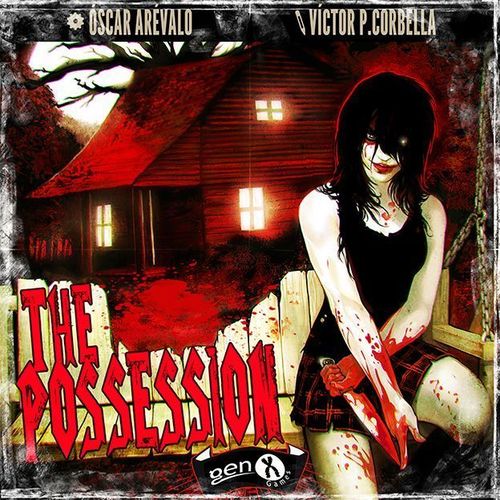
The Possession
The Possession Rulebook
Table of Contents
Table of Contents
Components
- 11 Necronomicon page cards
- 18 Event cards
- 13 House rooms
- 5 Player sheets
- 15 Search cards
- 10 Branch chips and 10 Door chips
- 10 Player and Possessed Player miniatures
- 3 Action dice
- 1 Possession die
- 4 Attic chips
- 4 Basement chips
- 25 Action cubes
- 25 Action chips
- 5 Life markers
- 25 Trophy chips
- 10 Key chips
- 25 Amputated Part chips
Search cards
There are three kinds of search cards: Guns, Basic Equipment and Special Abilities. Players find them in the rooms. Some search cards have a key icon that is used to get into the attic or basement. Each shows its Name, Illustration, Effect, Kind and Key symbol (when it appears).
Rooms
All rooms except the attic (12) and basement (13) have a door by each side, an initiative value, and action symbols (one or more). Some rooms also have windows. Four rooms (the ones with initiative value of 1, 4, 9 and 10) have the altar symbol. Each room shows its basic action symbol and special action symbol, windows, doors and initiative value.
Player sheet cards
These cards are used to keep track of life points, and of damage taken when playing as Possessed. They show Life points, Personal injury and Possessed player actions.
Action chips
Action chips show the number of actions a player has for the current turn. They also indicate the Evil Attraction value.
Necronomicon page cards
Necronomicon page cards are shuffled with the search cards. There are 11 pages. One of them has no number, but the others are numbered from 1 to 10.
Event cards
Event cards unleash situations that affect the players. Some show a branch icon.
Cardboard Player and Possessed Player miniatures
The Player and Possessed Player miniatures are used to move among the rooms. If a player is possessed, they must replace their Player miniature with a Possessed Player miniature, and vice versa.
Attic chips and Basement chips
These are special chips that can be found in the attic and in the basement.
Key chips
Some search cards have a Key icon. A player can discard this card and take one Key chip. Key chips are used to enter the Basement or Attic rooms.
Amputated Part chips
All players start the game unharmed, but when they play as possessed, the other players may attack them and attempt to destroy their bodies. A Possessed Player only dies when they are completely dismembered.
Life markers
They are used to count the life points of each player on each player's sheet card.
Possession die
Possession die is used to determine if a player plays or not as a possessed in each turn.
Action cubes
Action cubes are used to mark the rooms where a player has made an action.
Trophy chips
When a Possessed Player attacks a nonpossessed Player and injures them, the Possessed Player earns one of these chips (no matter the kind of illustration).
Branch's chips
The Possession die is used to determine if a player plays as Possessed or not each turn.
Action dice
Action dice are used for some actions of the game, such as to attack, defend, heal, or to attempt to burn the Necronomicon pages. They have two icons: attack and defense.
Door's chips
Door chips can be blocked or unblocked.
Setting the Game
Each player chooses a character and takes the appropriate Player sheet, a Life marker, and the 2 cardboard miniatures (normal and Possessed), plus the Action chips, the Amputated Part chips and 5 Action cubes appropriate to their color.
Setting up the House's rooms
First, you will make two decks: one for the 1st floor and another one for the ground floor. The Attic, Basement and Stairs cards will not be included.
To build the decks, find the rooms with the value 1, 4, 9 and 10. Take the rooms with value 1 and 4 and place them facedown separately to begin your two decks.
Then, take the rooms with the value 9 and 10, shuffle them, then put one card on each deck. Shuffle the remaining rooms and deal 3 onto each deck to complete them. Choose one deck to represent the 1st floor and the other for the ground floor.
Place your 1st Floor and Ground Floor decks on table as shown in the picture, along with the Basement, Attic and Stairs rooms.
Place a Door chip (by the unblocked side), on the spaces indicated between adjacent room cards. Do not put a door chip in the last wall of the 4 rooms at the ends of each floor.
Shuffle the Attic chips and place them next to the Attic room card. Shuffle the basement chips and place them next to the Basement room card.
Shuffle the Event cards to form a deck, placing it on the table assecable to all players.
Shuffle the Search cards with the numbered Necronomicon pages (do not add the nonnumbered Necronomicon page) to form the Search deck, placing it beside the Event deck.
Each player puts their normal, nonpossessed miniature in the stairs room.
Objective and Ending the Game
The winner is the player who burns the Necronomicon pages in a room with an altar symbol after getting the valid dice result. If, at any time during play, all players are dead or Possessed, the game ends immediately and the winner is the player who has the most Trophy points. If two or more players are tied, all of them are declared winners.
Phases of the Round
A round has five phases:
- Possession roll
- Choosing the action chips
- Resolution of the event cards
- Player turns
- End of the round
Once all these phases are completed, the round ends and starts a new one.
Possession Roll
Each round, every player rolls the Possession die. If a player did not begin their turn Possessed, and the result is in a color line higher than the line of their Life marker, or the die shows the black side, that player will play as Possessed this turn, and replaces their Player miniature with their Possessed miniature. If a player began their turn Possessed and the result of the die roll is in a color line lower than or equal to their Life marker (and they did not get the black side), the player will replace their Possessed Player miniature with the normal Player miniature.
Ex: A player has 13 life points (on the green line on his player sheet). Under this line are the blue, yellow, orange and red line. If, when he rolls the Possession die, it shows the black side, this player plays as possessed this turn.
Ex: Another player, who began the turn Possessed, has 8 life points (yellow line). If this player gets the blue, green or black side in the Possession die, she continues playing as Possessed, since these colors are higher than the line where his life marker is. But, if she gets the yellow, orange or red side in the Possession die, she plays as a normal player using the normal miniature.
A player with zero life points or lower becomes automatically Possessed, and cannot come back to play as a normal player or heal in any way.
Choosing the Action Chips
In this phase, all nonpossessed players choose an action chip from their hands in secret. Once all of them have chosen, they reveal their chips and each player puts the chosen chip in front of themselves.
The Attraction value from the revealed chips is then added, plus 1 point for each Possessed Player in the current round. If the result is equal or higher than the number of players, one event card is drawn affecting the player or players who have the highest attraction value in the action chips revealed in the current round.
If the event card has no objective, it is resolved as stated on the card.
At the end of the round, any players that played an Action chip with a value of 2 (and only 2) return these chips to their hands.
Ex: In a game with 5 players, one of which is Posssessed: The 4 normal players choose their Action chips and reveal them. The chips show these attraction values: 0, 2, 1 and 3. These values are totalled, adding 1 point for the number of Possessed Players (1), making 7. Since this is higher that the number of players, an event card is drawn. The event card affects the player who chose the action chip with an attraction value of 3. If two or more players had chosen an action chip with an attraction value of 3, the event card would have affected all of them.
Event Cards and Branch Chips
If an Event card shows a branch icon and the affected player is in a room with a window, a Branch chip is placed in the room. If the room has no a window, the Branch chip is placed in the closest room with a window. In case there are more than one room with a window at same distance, the player affected by this event chooses the room where the Branch chip is set. The door icons in the two rooms at the ends of each floor (not connected with another room) count as windows for this purpose, and each room can only have one Branch chip. If the room already has a Branch chip, the new Branch chip will be placed in the closest appropriate room without a Branch chip. If an Event card affects more than one player, a Branch chip is placed by each player affected.
When a player crosses or stops in a room with a Branch chip, that player rolls an Action die and loses one Life point for each Wound in the result. Branch ships do not attack the moment that they are placed.
Player Turns
The initiative order to play the round is determined by the room's initiative value, from lower to higher, (starting with number 1 and ending with number 13). If there is a room without a miniature, it is ignored and play continues to the next room (following the room's initiative value).
Players take only one turn per round, so if a player finishes their turn in a room with an initiative value higher than the room they started the turn, they won't play again when the time to play that room comes.
To indicate who has played their turns, each player should rotate the action chip they revealed once they finish. If a player has no action chip (such as when playing as possessed) he or she can indicate that they have played by putting their player miniature in front of themselves.
Ex: It is checked if there are player miniatures in the room with the initiative value of 1. If so, he or she plays their whole turn. Then, it is checked if the room with the value of 2 and so on, until room 13 is checked.
If there is more than one player in a room: The first to play are the nonpossessed players. If there are two or more, the first player to play is the one with more life points. If there is a tie, they both roll 3 action dice and award the first turn to the player with most Wound results. If there is a tie, roll again.
It is the same if there are several possessed players in the same room, but the first one to play is the one with fewer life points. In case of a tie, roll three action dice as in the previous example.
First game round
In the first game round there is no Possession roll. Instead, each player rolls the three action dice. The player to roll the most Wounds on their dice with begin the game Possessed. If there is a tie, these players roll again until there is only one Possessed player. The first Possessed Player receives the unnumbered Necronomicon page.
First round
The starting player is the one to the left of the first Possessed Player, following clockwise. The Possessed Player will be the last.
Turn
On their turn, a player has as many actions as the value of their revealed action chip. When a player has used all their actions their turn ends, and the game continues following the room's initiative order.
The actions that may be taken are:
Move: A player spends one action for each room entered. A player cannot enter the Attic or Basement rooms without a key (see further). If a player moves to the Stairs room, they set their miniature on the far side of the room (the opposite side from the side entered) and can only move in the direction shown on this side of the stairs. If a player wants to move back to another room on the starting floor, they must cross at least one room of the new floor and then come back to the Stairs room, to return to the previous floor.
Ex: The player in the picture wants to move from A room to D room, so he uses 3 action points.
Ex: A player has her miniature in the central room of the first floor and goes to the Stairs room using one action (lower side of the Stairs room). If she wants to come back to the first floor, she cannot use one action and return there, but must go down to the central room on the ground floor using another action; and an additional action to come back to the Stairs room (higher side of the Stairs room) and then, one last action to put her miniature in the central room of the first floor. She used 4 actions.
Block or Unblock Doors: A player can block a door (if it is not blocked) by using one action. If they do, that player flips the door's chip to indicate it is blocked. While the door is blocked, players cannot pass. A player, using one action, can unblock a door. Possessed players cannot block or unblock doors.
Activate A Room: A player, using one action, can activate the basic action of the room they are currently in. In addition to using an action, they must place one of their Action cubes on the room card. If there is already one Action cube from this player in the room (with the color of this player), they cannot activate the room until they take back their cube. A Possessed player cannot activate rooms.
Basic Actions from the Rooms
The rooms can have the following icons:
To search
A player who uses the search action draws a card from the Search deck, and must keep this card a secret card until used. The player may use two actions (but still spends only one Action cube) to draw two cards instead of one. They must then choose only one of them and put it in their hand, and the other one at the bottom of the Search deck. If the search card drawn has a key icon it may be discarded for a Key chip. If the player keeps the card, it cannot be traded for a Key chip later.
The search cards used or discarded during the game do not return to play.
To Rest
When a player plays the rest action they can take back a played Action chip with an action value lower or equal to the value indicated in the room. The player cannot take back the Action chip that they revealed in the current turn.
To Heal
(As printed:) When a player plays the rest action they can take back a played Action chip with an action value lower or equal to the value indicated in the room. The player cannot take back the Action chip that they revealed in the current turn.
To hide
A player can hide in a room with this icon only if they are going to be attacked by a Possessed player. Hiding does not cost an action, but the player must put one Action cube in that room. If the player has no Action cubes left, or if there is already one of their Action cubes in that room, the player cannot hide. If the player hides, they rolls their defense roll as usual, adding 2 to the result of the defense.
Ex: A player is attacked by a Possessed player for 4 wound points. The player who is affected by the attack hides and rolls the three action dice, getting 1 Wound on one die, 2 Wounds on another die, and 1 Shield on the third die. Since he is hidden, he adds 2 shields to the result, so his defense to the attack is 3 and he receives only 1 wound (he loses one life point on his player sheet).
Altar
A player can attempt to burn the Necronomicon pages only in rooms with the altar icon. This costs one action, and the player must put one Action cube on the room card. To attempt to burn the Necronomicon pages, it is necessary to have at least one page, and one Basement or Attic card.
Possessed players cannot activate basic rooms actions or burn Necronomicon pages.
To Burn the Necronomicon Pages
If a player has at least one Necronomicon page and one Attic or Basement chip, they can attempt to burn the page to win the game. The player reveals all the pages that they are going to attempt to burn (the minimum is one) and rolls the three action dice. If the player's roll results in a value equal to or higher than the difficulty value indicated in the room, they cast the expulsion spell, burning the Necronomicon pages and winning the game.
The required value to burn the Necronomicon pages decreases by one for each additional page the player shows (do not count the page used to announce the attempt). In addition, the value decreases by one for every two consecutive pages (both modifiers are added, of additional pages and of consecutive pages). If the roll fails, the player must choose one of the Necronomicon pages that they attempted to burn and discard it.
Ex: A player attempts to burn one Necronomicon page in the room with the initiative value of 1, which has a difficulty of 5 wounds. Since he is attempting with only one page, he needs to get a result of at least 5 wounds to win. He gets 4 wounds, so he fails and he discards the Necronomicon page.
Ex: The same player, in the same room, announces his attempt with the Necronomicon pages numbered with 1, 7 and 8. Since he has two additional pages, he subtracts 2 to the room difficulty (5), and besides, two of these cards are consecutive, so he subtracts another wound. Since needs 3 wounds less to cast the spell, he requires only 2 wounds or more to win.
Ex: The same player, in the same room, announces his attempt with the Necronomicon pages numbered with 3, 4 and 5. This subtracts 2 for the two additional pages and 2 because of the consecutive pages (pages 3 and 4 subtract one, and pages 4 and 5 subtract a second notice page number 4 has two combinations). So, he needs only to get 1 wound to win the game.
Special Actions of the Rooms
Special Actions of rooms can be played at different times in a player's turn, as follows. No player actions are consumed unless specifically stated.
- Recover a cube (dice icon): If a player starts their turn in a room with this icon, and before using any action, they can recover an Action cube from a different room, by rolling one Action die and getting 1 shield. Regardless of the result, that player's turn continues as normal.
- Reroll possession: If player is in a room with this icon, they may reroll their Possession roll for that turn.
- +2 actions (+2A icon): When a player starts their turn in a room with this icon, they can put an Action cube (if there is not an action cube of his color already in the room) to get two more actions to play this turn. This action cannot be played by a Possessed player.
- Search for a weapon: A player who plays the Search basic action in a room with this icon can choose to search as usual or search for a weapon. To do this, the player reveals cards from the Search deck until they find 2 weapons. The player must choose one to keep, returning the other weapon (along with the revealed cards) to the deck and shuffling it. If a player searches for a weapon in this way, they must place an Action cube as usual. NOTE: A player cannot exchange the weapon for a Key chip if found in this way.
- Lower attraction: If a player is in a room with this icon, they subtract 1 from the attraction value of the action card that they are playing this turn.
- Window travel: A player who starts their turn in a room with this icon may use two actions to move their miniature to any other room with a window, continuing play from that room as normal. A Possessed player cannot do this action.
Possessed Players
While Possessed, a player does not spend Action cubes to make their actions. A Possessed player keeps all of their cards (including weapon cards), but cannot use them. A possessed player has 5 possible actions to take on their turn:
- To move: A Possessed player moves as a normal player but cannot block or unblock any doors.
- To move across windows: A Possessed player can use 2 actions to move from one windowed room to any other (both must have a window), continuing their turn as usual
- To break doors: Possessed players cannot move through a blocked door. A Possessed player can use one action to try to break a door (blocked or unblocked). To break an unblocked door, the player rolls 3 action dice and must get a result of 3 wounds or more to break the door. If the door is blocked, the minimum Wounds required to break the door increase to 4. If a door is broken, the Door chip is removed from the game.
- To move one Amputated Part chip of their color: A Possessed player can move the Amputated Part chips that they have lost during the game (see further). The Part moves 1 room per action spent. Amputated Parts cannot move through blocked doors. If an Amputated Part chip enters a room with non-possessed players, the Amputated Part can attack (see further).
- To attack: A Possessed player can only attack nonpossessed players in the same room, and they cannot attack the same player more than once, either with their player miniature or with an Amputated Part of their color. Each attack costs 1 action.
To attack with the miniature, the player rolls 3 Action dice and counts the number of Wounds. The result is the Possessed Attack Value. Then, the attacked player rolls 3 Action dice and counts the shields, subtracting the Possessed Attack Value from their result. The attacked player loses Life points equal to the final number.
Ex: A Possessed player attacks a player. The Possessed player rolls the 3 action dice and gets 4 wounds. The attacked player rolls the action dice and gets 2 shields, so he loses 2 life points, (4-2=2).
To attack with an Amputated Part: In order to attack, an Amputated Part must have moved at least one room in the current turn. The Possessed player rolls 1 action die and counts the Wounds in the result. The attacked player does NOT roll the action dice for defense, and loses Life points equal to the number of Wounds the Possessed player rolled (from 0 to 2).
If the Possessed attacker manages to make the defending player lose at least 1 life point when attacking with his miniature, they (the possessed player) take a Trophy chip (it does not matter what kind of trophy chip, all count as 1 trophy point). If the attacked player loses more than 1 life point, the possessed player only gets 1 trophy point per attack. If the player does not lose any life points in the attack, the possessed player does not take a trophy chip. Attacks with Amputated Parts do not give Trophy chips.
If a Possessed player attacks more than one player during their turn, dealing damage to several, they take 1 trophy chip per player wounded in that turn.
If a Possessed player does not damage at least one player during their turn (by attacking with their miniature or with their Amputated Part chips), the Possessed player loses 2 life points.
Weapons
A player who is about to be attacked can choose to reveal a weapon from their Search cards, placing it on the table in front of themselves (where it remains for the rest of the game until removed or replaced). Combat continues as usual, and when the player rolls their defense roll, they count not only the Shields, but Wounds as well as shown below:
- On a roll of 0 or 1 wounds, nothing happens
- On a roll of 2 wounds, the possessed player loses the left arm.
- On a roll of 3 wounds, the possessed player loses the right arm.
- On a roll of 4 wounds, the possessed player loses the right leg.
- On a roll of 5 wounds, the possessed player loses the left leg.
- On a roll of 6 wounds, the possessed player loses the head.
- On a roll of 7 or more wounds, the possessed player is dismembered and dies, and is removed from the game.
Each player can have 1 weapon card in play. If a player wants to play another weapon, the previous one is discarded and replaced on the table by the new one.
Ex: A possessed player attacks another player. The defender reveals a search card with a weapon (the shovel). The possessed player rolls the 3 action dice and gets 3 wounds. The attacked player rolls the 3 action dice and gets 1 shield on one die, 2 wounds on the second die, and 1 shield on the third die. She gets 2 shields so she subtracts 2 of the 3 wounds, and loses 1 life point. In addition, since the defending player has a weapon in play, the possessed player loses his left arm, as the defending player got 2 wounds on her roll. The possessed player still gets his trophy... But now, all possessed players know that when attacking the player with the shovel they might get a "surprise".
Amputated Parts
When a possessed player loses a Part, the player takes off that Amputated Part chip and puts it in the room where they lost it. From now on, the possessed player can move that Part chip and attack with it. If a non-possessed player comes across a room with an Amputated Part chip on it, they roll 1 action die and lose Life points equal to the number of Wounds in the result. It is important to remember that the wounds inflicted by Amputated Parts do not give Trophy chips to their owner. If a room has more than one Amputated Part chip, the player that enters the room must roll 1 action die per Amputated Part chip. The damage done by Amputated Parts is done in addition to the damage inflicted by Branch chips.
If a Possessed player receives damage to a Part that they have lost previously, they lose the next Part (with the next highest Wound cost). If the possessed player is also missing that Part, they lose the next Part and so on, until one Part is amputated. If the possessed players must remove their head and they have lost it previously, they remove their left arm.
A player who has lost 3 or more Parts or their head, or if a player loses all of their Life points, they must play as a possessed player for the rest of the game. A player who has lost all of their Parts and their head is dismembered and dies, losing the game.
When a possessed player loses 1 leg, they lose 1 action during their turn, when playing as possessed. If the player loses both legs, they lose 2 actions during their turn when playing as possessed.
NOTE: Players only lose actions in this way when playing as possessed.
Ex: A possessed player normally has 5 action points, but since he loses a leg, he must play with only 4 action points while he is possessed.
A possessed player gets additional actions, depending on how many life points he has:
- If he has from 7 to 9 life points, he adds 1 additional action.
- If he has from 4 to 6 life points, he adds 2 additional actions.
- If he has from 1 to 3 life points, he adds 3 additional actions.
- If he has 0 life points, he adds 4 additional actions.
Ex: A possessed player has 7 life points, so he has 5+1=6 actions to play in his turn. If this player has lost both legs, he has 4 actions to play in his turn (5 as normal, + 1 due to his life points, – 2 because he has no legs)
Attic and Basement
A nonpossessed player can enter the Attic and Basement by spending a Key chip. When a player enters one of these rooms, they discard a Key chip and draw a chip at random from the appropriate room (attic or basement). If the chip has an effect that must be immediately resolved, it is revealed and the player resolves the effect. If not, the player keeps it until they decide to use it.
A basement or attic chip, once its effect is resolved or after having been used, remains with the player who got it, since these chips are necessary for attempts to burn the Necronomicon pages.
A player can only draw 1 Basement or Attic chip upon entering the room. If a player wants to have more than 1 chip they must leave the room, get another Key chip, and enter again.
A player can end their turn in these rooms, but a player who starts their turn in the attic or basement must leave as their first action. During their turn they may choose to enter again (with a new Key).
When there are only 2 chips left in the Attic or Basement, and a player must draw a chip, they take one and discard the last one. Once there are no chips left to draw players can enter these rooms, discarding a Key chip, but they do not receive a chip.
The End of the Round
Once all rooms have been checked, and all players have played their turns, the round ends and a new round starts. All players without any available action cubes take back all of their action cubes from the game board so they can use them in the next round. If a player does not have all of them placed, they must play the next turn with the remaining cubes. All players who have played an Action chip with a value of 2 return it to their hand.
Elimination of a Player
If a player loses all of their Parts (both arms, both legs and head) either by accumulating damage or by an attack of value 7 or more, they are eliminated from the game. Their miniature and Amputated Part chips are removed from the game and all of their Trophy chips are discarded.
Variation
To play with more dangerous possessed players, they can use the weapons they have against the non-possessed players.
Players can change the difficulty as they prefer, increasing or decreasing the value to burn the Necronomicon pages.
Additionally, to increase realism, players playing as nonpossessed, can lose 1 action per Amputated Part (until they have only 1 action), since they "wake up" without a leg, or an arm.
Event Cards
- The closest player to a window receives the wounds from 2 action dice. If there are more than 2 players at equal distance from a window (they all are the closest), all of them receive the damage. The effect of this card can affect all players regardless of attraction level.
- The player who draws this card must use it during their next turn during the possession roll phase. If the player gets to play as non-possessed, he must re-roll the possession die. If the player gets to play as possessed (in the first or second roll) they receive 2 additional actions.
- The affected player receives wounds from 1 action die.
- The affected player receives wounds from 2 action dice.
- The affected player receives wounds from 3 action dice.
- All players with one or more search cards roll 1 action die. If they get a blank side, they take one of their search cards at random and shuffle it into the Search deck.
- The affected player loses 1 action for this turn.
- The affected player loses 1 action for this turn, and removes 1 door chip from the room if present.
- The affected player discards an action card from their hand, as if they had played it. It can be recovered.
- This card remains in game. The difficulty to burn the Necronomicon pages increases in 1 for all altars.
- All players show the cards in their hands, and lose Life points equal to the number of Necronomicon pages they have. Players without Necronomicon page cards in their hands gain 2 life points.
- All players in a room with a window icon lose 2 life points.
- Nothing happens.
- The affected player receives wounds from 2 action dice. If the player is in a room with a window icon, they lose 3 life points instead.
- The affected player loses 2 actions for this turn.
Search Cards
- First-aid kit: The player can use 1 action during their turn to discard the first-aid kit card and roll 3 action dice, gaining 1 life point for each shield rolled.
- Axe: Every time the player attacks, they add 1 damage to their attack roll.
- Knife: Every time the player attacks, they can reroll 1 die in their attack roll.
- Pendant: When the player fails the possession roll, they can discard the pendant to overcome it.
- Shotgun: Every time the player attacks, they add 1 damage to their attack roll. They can discard the shotgun to add 2 damages to their attack roll. They must announce that they are going to discard the card before rolling the dice.
- Steal: The player can discard this card and use 1 action to steal a search card at random from the hand of 1 player in the same room, or a search card in play (face-up in front) of the same player.
- Shovel: No special rules
- Whisky bottle: The player can discard this card to get 2 action points for this turn.
- Torch: If the player searches, they can discard the torch and draw 1 more card. They choose one to put into their hand, and puts the other card(s) on the bottom of the Search deck in any order they choose.
- Chainsaw: Every time the player attacks, they add 2 damage to their attack roll.
- Hideout: The player can discard this card when they is about to be attacked to add 2 shields to their defense in all of the attacks they receive this turn.
Attic Chips
- The player who uses this chip adds 3 actions this turn.
- If the player is losing a Part while possessed, they discard this chip to avoid the loss.
- This chip must be used as it is drawn. The player receives wounds from 1 action die and automatically fail the possession roll during the next round. They cannot use the pendant to avoid this effect.
- This chip is a Necronomicon page. The player can choose its number from 1 to 9. They must choose the page number each time they attempt to burn the Necronomicon pages.
Basement Chips
- The player who uses this chip, wins 4 life points.
- The player who uses this chip, reduces the difficulty to burn the Necronomicon pages by 1 during the next attempt to burn them.
- The player receives wounds from 2 action dice.