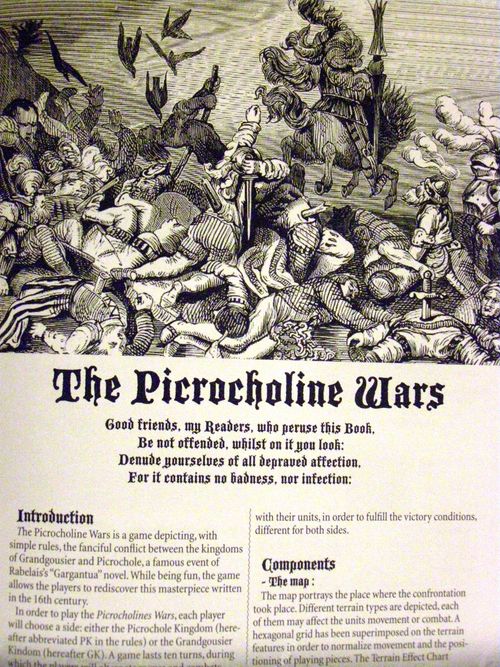
The Picrocholine Wars
The Picrocholine Wars Rulebook
Table of Contents
Table of Contents
Introduction
The Picrocholine Wars is a game depicting, with simple rules, the fanciful conflict between the kingdoms of Grandgousier and Picrochole, a famous event of Rabelais's "Gargantua" novel. While being fun, the game allows the players to rediscover this masterpiece written in the 16th century.
In order to play the Picrocholines Wars, each player will choose a side: either the Picrochole Kingdom (hereafter abbreviated PK in the rules) or the Grandgousier Kindom (hereafter GK). A game lasts ten turns, during which the players will alternate moves and combats with their units, in order to fulfill the victory conditions, different for both sides.
Components
The map
The map portrays the place where the confrontation took place. Different terrain types are depicted, each of them may affect the units movement or combat. A hexagonal grid has been superimposed on the terrain features in order to normalize movement and the positioning of playing pieces. The Terrain Effect Chart specifies for each terrain type their effects on movement and combat.
The units
There are of two different types: troops and leaders.
The troops: The troops represent the fighting forces of both sides. They are subdivided into four types: infantry, cavalry, arquebusier and artillery. The troops are rated by four values:
- The attack factor, this is a measure of the troop's ability to cause losses on an enemy unit.
- The resistance, represented by shields, a measure of the unit's defense ability.
- The range is the distance in hexes over which the unit can attack.
- The movement factor, which allows the unit to move.
The counters representing the units are printed on both sides. The front side represents the units at full strength. The reverse side represents the reduced units, after having suffered losses because of combat.
The leaders: The leaders represent the commanders of the armies or the main characters of the novel. They are defined by two values:
- The skill bonus, represented by swords. This is a measure of the leader's quality to lead troops in combat.
- The movement factor, which allows the unit to move.
The leaders have three game functions:
- They give their skill bonuses to the troops stacked with them when they fight.
- They can automatically reorganize a number of troops equal to their skill, as long as the troops are stacked with them.
- They can use their special ability to affect the the course of the game (see annex I).
Only a few leaders counters have a reverse side (see annex I).
The Markers
The markers are the counters which do not represent troops or leaders. Their use is explained throughout the rules.
The Dice
The players should get two six-sided dice (abbreviated d6) in order to resolve various game functions during play (combats, events...)
Sequence of Play
A game lasts ten turns. Each turn is subdivided into seven phases, which must be played in the exact order below:
- Events Phase (starting on turn 2).
- Picrochole Kingdom (PK) movement phase.
- PK combat phase
- Grandgousier Kingdom (GK) movement phase.
- GK combat phase.
- Mutual reorganization phase (starting on turn 2).
- Gargantuan phase.
1 - Events Phase
Starting on turn 2, each player, with PK first, rolls 2d6 and consults his events table, Choose one die for the tens and one die for the units before rolling, in order to obtain a result between 11 and 66. Unless otherwise specified, a single event can happen more than once during the game. If the current game situation prevents the playing of an event (e.g. Breakout when there's no leader imprisoned), then the dice are not re-rolled and no event takes place.
PK Events
| 2D6 | Event |
|---|---|
| 11-13 | Gambit: The defense value of the hex (including a castle) is not added to the GK troop's resistance occupying the hex during the next PK combat phase of this turn. |
| 14-16 | Bad Weather: Double all the terrain move costs during the whole turn, except for the roads. The rivers cannot be crossed except by bridges. |
| 21-25 | Picrochole's Anger: If Picrochole is in the Roche Clermault castle hex, then the PK player adds +2 to his reinforcements die roll. |
| 26 | Deceit: The units of the GK player cannot move during this turn. |
| 31-33 | Breakout: A captured PK leader returns into play. Place him on any friendly troop. |
| 34 | Treachery: The GK combat phase is cancelled for this turn. |
| 35-43 | Reinforcements: Two eliminated troops are placed on the west edge of the map. |
GK Events
| 2D6 | Event |
|---|---|
| 11-13 | Gambit: The defense value of the hex (including a castle) is not added to the PK troop's resistance occupying the hex during the next GK combat phase of this turn. |
| 14-16 | Bad Weather: Double all the terrain move costs during the whole turn, except for the roads. The rivers cannot be crossed except by bridges. |
| 21-25 | Reinforcements: Two eliminated troops are placed on the east edge of the map. |
| 26 | Cannonball rain (can only be applied after the marker « Engagement » has been played): All the troops adjacent to Gargantua are flipped on their reduced side. The already reduced units are eliminated. |
| 31-33 | Breakout: A captured GK leader returns into play. Place him on any friendly troop. |
| 34 | Joke: There will be two Gargantuan phases this turn. |
| 35-43 | Reinforcements: Two eliminated troops are placed on the eastern edge of the map. |
2 - Movement Phase
2.1 - Each unit has a movement factor expressed in movement points (MP). Each hexagon entered costs a various number of MPs, as stated in the Terrain Effects Chart.
2.2 - During his movement phase, the phasing player can move some, all or none of his units one by one. Each unit can spend none, all or some of his MPs allotment, as the player whishes. A unit must have sufficient MPs to enter a given hex.
2.3 - Stacking - One hex can contain a maximum of three troops and one leader (exception: Grandgousier's hex, see 2.8). It is forbidden for a unit to end his move if this move ends in overstacking situation. There's no limit to the number of units which can cross the same hex during the movement phase, including a hex containing a friendly unit.
2.4 - It is forbidden to cross or end a move in a hex containing an enemy unit. A leader alone in a hex does not prevent the enemy movement. The leader is immediately captured when an enemy troop enters its hex (exception: Gargantua and Frère Jean) and is placed in the corresponding "Cul de Basse-Fosse" box. A leader alone can't enter a hex occupied by an enemy leader alone in its hex.
2.5 - To cross a river via a road does not cost additional MP. If there's no road, the unit must spend 2 additional MPs for the crossing plus the cost of the hex entered. The artillery must use a road to cross a river, it can't cross elsewhere.
2.6 - Road Movement: If a unit makes its movement entirely along a road, it can move 2 additional hexes, still along the road. This bonus is cancelled if the "bad weather" event is in play.
2.7 - PK reduced units movement: at the very start of his movement phase, the PK player MUST move his reduced troops of their maximum movement factor towards his side (West map edge). If this movement ends in an overstacking situation, the unit is moved one hex further towards the western edge. If this movement forces the unit to leave the map or to enter a hex occupied by an enemy unit, then the moving unit is eliminated.
2.8 - Random Movement: various events may force the players to make a random movement for one or more units. The player rolls a first die to determine the random movement direction, as stated by the compass on the map. Then he rolls a second die to determine how many hexes are entered.
2.9 - Grandgousier's Hex: this hex represent the Grandgousier's domain and is considered as a vineyard hex. There's no stacking limit in this hex for the GK player. The PK units are not eligible to enter this hex and can't attack the GK units occupying this hex. The GK units can't attack from this hex (including Gargantua during the movement phase).
Movement example
- The unit in hex "A" can't move into hex "I", because it already contains 3 units (see 2.3 - Stacking).
- It can move in hex "H" for a cost of 3 MPs (swamp)
- It can move into "B" for 1 MP, but not into "C" because it would cost 5 more MPs (3 MPs for the marshes, and 2 MPs to cross the river).
- It can move into "D" for 1 MP, then into "E" for 1 more MP (the road cancels the swamp effect, see the Terrain Effects Chart). Once in "E", it can move into "F" for 1 MP (the road cancels the river effect, see the Terrain Effects Chart). The total MPs cost is 3 MP. If the unit wanted to move from "E" to "G" instead, the cost will be 2 MPs, because the road does not enter in this hex.
Combat example
- The arquebusiers unit in "A" has a 2 hexes range. It can't attack the "B" unit because of the 3 hexes range. It can attack the "C" or "D" unit and decides to attack the "C" unit.
- The player rolls 1D6 and obtains a "3" result.
- He adds the attack factor of the unit (+5) and the skill bonus of the leader stacked with it (+2). Then he substracts the resistance of the target unit (-3). The final result for the attack is "7".
- The attack succeeds, so the "C" unit counter is flipped on its "reduced" side.
- If the same attack was made against the "D" unit, the result should have been the direct elimination of the unit (because it is already on its "reduced" side).
3 - Combat Phase
3.1 - The combat is not mandatory. The phasing player can make as many attacks as he wishes, and does not have to declare all of his attacks before starting the combat resolution, he can wait for the result of a combat before deciding to continue his attacks or not. Only the enemy troops can be attacked, not the leaders alone in their hexes. The leaders alone can never attack (exception: Gargantua, Gymnaste and Frère Jean).
3.2 - Procedure: The phasing player designates one of his troops to engage in combat. Then he designates an enemy troop in range and in the line of sight of the attacking unit.
Exception: An enemy artillery can't be targeted if there is another troop type stacked with the artillery in the hex.
3.2.1 - Range: the range is the distance between the attacking hex (not included) and the target hex (included). So the range is "1" between adjacent units. The troops can only attack the enemy troops which are in a radius less than or equal to their range.
3.2.2 - Line of Sight: In order to be attacked, an enemy unit must also be in the Line of Sight of the attacker. An LOS always exists between two adjacent units. If the range between the attacker and the defender is higher or equal than '2', a Line of Sight exists if an imaginary straight line between the center of the attacker hex and the center of the defender hex does not cross a blocking terrain (woods, village, castle, abbey). A blocking terrain fills-up its hex entirely. If an LOS passes exactly along a hexside of blocking terrain, then the LOS is blocked. The troops, friendly or enemy, never block the LOS. The leaders, friendly or enemy, never block the LOS, except Gargantua.
3.2.3 - To resolve the combat, the attacking player rolls 1d6 then adds the attack factor of his troop and the skill of a leader (the number of swords printed on the leader counter) if there is one stacked with the troop. Then he subtracts the resistance of the enemy unit from this result (the number of shields printed on the counter), the defense value of the hex occupied by the defender, as well as the skill of a leader if there is one stacked with the defender.
- If the result is higher or equal than '6', then the enemy unit suffers a loss.
- If the result is lower than '6', then the attack failed and there is no effect.
In every instance, if a natural '6' is rolled before modification, the attack is an automatic success and the enemy suffers a loss; and if a natural '1' is rolled before modification, the attack automatically fails. So the die must be rolled to resolve every attack.
3.3 - When a full strength troop suffers a loss, it is flipped on its reverse "reduced" side. When a reduced troop suffers a loss, it is eliminated. It is possible for it to resume playing via the "reinforcements" event.
3.4 - Advance After Combat: when a combat ends between two adjacent units, if all the troops in the defender hex are eliminated then the attacker can move the unit (with the leader stacked with it) which causes the elimination of the last enemy troop in the defender hex. If there is an enemy leader in the hex entered, he is immediately captured and placed in the corresponding "Cul de basse fosse" box.
4 - Mutual Reorganization Phase
During this phase, both players will try to bring all their reduced units up to full strength.
4.1 - Automatic Reorganization: Every leader may automatically reorganize a number of troops equal to his skill bonus. All the troops must be stacked with the leader to be automatically reorganized.
4.2 - Conditional Reorganization: the troops which have not been automatically reorganized must pass a test to recover their full strength. For each of the units still reduced, the players, starting with PK, roll a die:
- If the result is lower than the attack factor of the unit (reduced side), then the unit is flipped on its full strength side.
- If the result is equal to the attack factor of the unit (reduced side), then the unit is flipped on its full strength side if it is not adjacent to an enemy troop.
- If the result is higher than the attack factor, then the unit withdraws in a straight line towards the western edge for the PK, or the eastern edge for the GK by a number of hexes equal to the difference between the die roll and the attack factor. If this move forces the unit to enter in a hex occupied by an enemy troop (or Gargantua), it is eliminated. This move can involve the capture of an enemy leader.
5 - Gargantuan Phase
A game concerning Rabelais must include a bit of excessiveness. This phase contributes to add some uncertainty to the game while transcribing in game terms the memorable events of the novel.
During this phase, the GK player must choose one of these two options:
- Roll 1d6. The result corresponds to the game phase which must be played again immediately.
- Choose a "Novel" marker among those available. Then he will be able to play this marker by following the instructions given in the annex II.
If there are no more "Novel" markers available, the GK player must choose the "1" option.
6 - Victory conditions
The victory points (VP) total is calculated at the end of the game.
- A hex is controlled by a player if one of his troops or leaders is present in this hex at game end.
- Each player earns 1 VP per skill bonus for every enemy leader captured or eliminated at the end of the game.
- The PK player earns 3 VP if the "pilgrims" counter is still captured at the end of the game.
- The PK player earns 2 VP per mill's and castle hex under his control at the end of the game.
- The GK player earns 2 VP per hex of vineyards (the Grandgousier's hex does not count), abbey or castle under his control at the end of the game.
- The PK player earns 4 VP by "Novel" marker still unplayed at the end of the game.
- Each player earns 1 VP by village hex under his control at the end of the game.
- Some VPs can also be earned during game via the random events and/or the "Novel" markers. There is a track and VP markers for each players to record the VPs accumulation during game.
The player with the higher VP total at the end of the game is the winner.
Annex I: Leaders and special abilities descriptions
Gargantua
- Gargantua is a leader with more than one special ability:
- He can't be stacked with other troops or leaders.
- He can't be attacked and the enemy troops cannot enter his hex.
- He blocks Lines of Sight.
- Terrain has no meaning for his moves and always spends 1 MP for every hex entered.
- He can enter a hex occupied solely by one PK leader and capture him.
- His counter has a reverse side showing him thirsty.
- Gargantua has no attack factor. When he attacks, he automatically inflicts one loss, except if he rolls a natural '1' (So the die must be rolled anyway).
- Gargantua may attack during his movement phase if he is at a distance less or equal than 3 MPs from a vineyards hex controlled by the GK and if Gargantua is not thirsty. He can then spend 1 MP to attack one adjacent unit and do it again as long he has MPs remaining. If he performs at least one attack during his movement phase, the Gargantua counter is flipped, side thirsty visible, at the end of the movement phase. He can advance after combat (without spending MPs) if one of his attacks has destroyed the last troop of the hex.
- Gargantua can also attack during the combat phase if he's not thirsty. Gargantua is not flipped on his thirsty side after this combat.
- Gargantua can be flipped on his normal side if he ends a movement phase in a vineyards hex and if he has not attacked during his movement phase.
- The units of the GK player with a "G" printed on them cannot move if Gargantua performs an attack during his movement. The GK player must announce his choice at the beginning of his movement phase.
Frère Jean
- If Frère Jean is located in the vineyards hex adjacent to the Abbey, then a PK unit can't automatically enter in the vineyards hex. In order to enter, the unit must move adjacent to the vineyards hex during its movement phase, stop and roll a die. On a 1-4 result, the unit takes a loss and ceases its movement for this turn. On a 5-6 result, the unit enters the hex. Frère Jean is then placed in the Grandgousier's hex and can't exit it as long as Gargantua does not stop his movement in this hex. As long as Frère Jean is alone in the vineyards hex adjacent to the Abbey, the vineyards hex can't be attacked. The only way to capture the hex is during the movement phase by following the above procedure.
- The first time a unit stacked with Frère Jean fails an attack (i.e. no losses inflicted), Frère Jean is automatically captured. This event can only happen once.
- If Frère Jean breaks out with an event, then the PK player must inflicts 4 losses to the units of his choice.
Gymnaste
- Once during a game, Gymnaste may try to attack alone a stack of enemy units. In order to do that, he must be stacked with at least one cavalry unit, ends his movement adjacent to the enemy stack, and the enemy stack must not occupy a castle hex. The GK player rolls a die. On a 1-4 result, the units of the enemy stack are eliminated and if a leader was present in the hex, he is eliminated too. On a 5 or 6 result, Gymnaste is captured.
Picrochole
-
When Picrochole is located in the de la Roche-Clermault Castle hex, the PK player rolls a die at the start of the movement phase:
- 1-2: The PK player receives one unit in reinforcements.
- 3-4: The PK player receives two units in reinforcements.
- 5: The PK player receives three units in reinforcements.
- 6: The PK player eliminates one of his leaders.
The reinforcements, chosen among the eliminated units or the units not deployed at start, enter the map in Lerné and can move immediately.
Toucquedillon
- If Toucquedillon is captured by the GK player, he switches sides. The GK player flips the counter and can place him in a hex occupied by GK troops.
Annex II: "Novel" Markers
1 - Letter from Grandgousier to Gargantua. The leaders Gargantua, Gymnaste and Eudemon as well as the troops with a "G" printed on their counters enter in reinforcements in Chinon three turns after this marker has been played. Example: If the GK player chooses this marker during turn 1, the reinforcements will enter on turn 4 during the movement phase.
2 - The Grandgousier Mediation. This marker must be played immediately when it is chosen. During the next game turn, the GK player combat phase is cancelled and Gargantua can't move if he is in play. This marker can't be played after turn 5.
3 - Gargantua Engaged. This marker can't be chosen while Gargantua has not been involved in at least one combat. This marker can't be played after turn 6. This marker makes possible the use of the "cannonballs rain" event.
4 - Gargantua's Mare. This marker can't be played after turn 7. It can be played only if Gargantua is in play. During this Gargantuan phase, if Gargantua is not adjacent to the Vesle River, then the GK player loses 2 VP. If Gargantua is adjacent to the river, then all the troops from both sides adjacent to the river or located in swamps suffer one loss. The leaders are not affected.
5 - Pilgrims. This marker can't be played after turn 7. The marker is given to the PK player, which then may choose to play it during the movement phase of his choice. When he plays it, he places the marker side "Pilgrims" visible on the Gargantua counter and rolls the dice for a random movement (2.7). Add +2 to the distance die roll. The Pilgrims counter is then next placed in the determinated hex whatever the crossed hexes are. The procedure is repeated at the start of the movement phase of each player, until one of these events happen:
- The pilgrims counter is stacked with a PK troop, after a random movement or a movement of the troop. The pilgrims counter is then considered captured by the PK player.
- The pilgrims counter is stacked with a GK troop, after a random movement or a movement of the troop. The pilgrims counter is then removed from the game.
- The pilgrims counter leaves the map after a random movement. It is removed from the game and the PK player earns 1 VP.
Scenario Setup
- The players choose the side they want to play on. If they don't agree, sides are determinated randomly.
- Each player sets up his troops as stated below.
- Place the turn marker in the 1 box.
- The VPs markers are left to the side by now. They will be placed on the turn track when VPs are scored during the game.
- The "Novel" markers should be left at hand from the GK player.
Picrochole's Kingdom
- 3 hexs west of Lerné: Racquedenard, 2 x 6-1-4, 1 x 4-1-6, 1 x 5-2-4
- Within a 2 hexs radius from Lerné: Picrochole, Toucquedillon, Engoulevent, Trepelu, 7 x 6-1-4, 2 x 5-2-4, 2 x 4-1-6, 2 x 9-3-2, 3 x 6-2-2
- 1 hex west of Cinay: 1x 6-1-4 reduced
- Available for Reinforcements: 1 x 6-1-4, 2 x 5-2-4, 1 x 4-1-6
Grandgousier's Kingdom
- 1 hex east of Seuilly Abbey: Frère Jean
- Cinay, château de la Roche Clermault, château du bois de Vêde: 1x 6-1-4 in each hex
- Chinon: 1x 6-2-2
- Into the 3 hexes north of the Vienne: 4 x 6-1-4, 3 x 5-2-4, 2 x 4-1-6
- Available for Reinforcements: Gargantua, Gymnaste, Eudemon, 3x 6-1-4, 2 x 5-2-4, 1x 4-1-6, 1 x 9-3-2, 1 x 6-2-2 (all these troops are printed with a « G »).