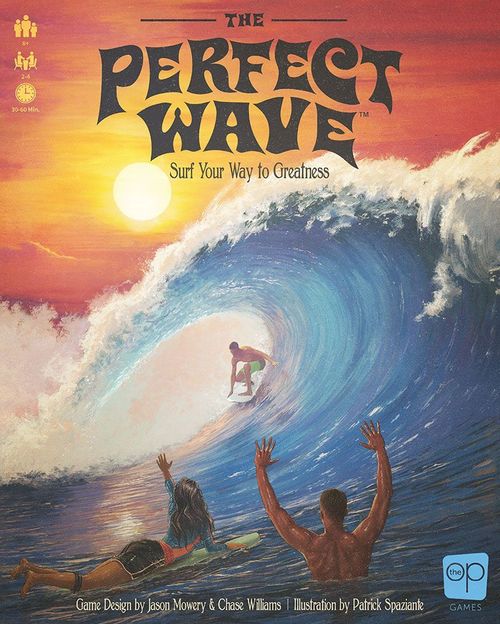
The Perfect Wave
The Perfect Wave Rulebook
Table of Contents
Table of Contents
Components
- 1 Pier board
- 4 Player boards
- 72 Wave cards
- 72 Maneuver cards (Trick cards and Paddle Out cards)
- 30 Goal cards
- 4 Player Aid cards
- 4 Surfer tokens
- 12 Wax tokens
- 2 Surfboard tokens
- 1 First Player standee
Set-Up
-
Give each player a Player board, a Player Aid card, 2 Wax tokens, and a Surfer token. Players place their Surfer token beneath the leftmost card space on their Player board. Player boards should be arranged so that there is room to place cards above the card spaces.
-
Place the Pier board in the center of the table. Put the extra Wax tokens near the Pier board.
-
Prepare the Maneuver deck by separating the Trick cards from the Paddle Out cards. Shuffle the Trick cards. Based on the number of players in the game, remove the following Trick and Paddle Out cards from the game. Return the cards to the box:
- 4 Players: do not remove any cards
- 3 Players: remove 12 Trick cards and 6 Paddle Out cards
- 2 Players: remove 24 Trick cards and 12 Paddle Out cards
Next, deal 2 face down Trick cards to each player. Finally, shuffle the remaining Trick cards and Paddle Out cards together to form the Maneuver Deck. Set the deck to the left of the Pier board.
-
Shuffle the Wave deck and deal 2 face down cards to each player. Set the deck to the left of the Pier board.
-
Shuffle the Goal cards and deal 2 face down to each player. Next, deal 4 face up near the Pier. These are known as the Public Goals. Place the two Surfboard tokens near the Public Goals. Return the remaining Goal cards to the box; they will not be used during the game.
Players may now look at all the cards that have been dealt to them - do not reveal them to the other players. Each player chooses one of their two Goal cards to keep as their Private Goal, returning the other to the box.
-
On the Pier board, deal 4 cards from the Maneuver and Wave deck face up to the empty card spaces to the right of each deck.
-
Give the First Player standee to the player who has most recently been to a beach.
If this is your first time playing, you may choose to play a simplified game by leaving the Goal cards out of the game.
The Player Boards
Your Player board shows 10 spaces for Wave cards. Below each space is a Victory Point value that will be added to your score at the end of the game if a Wave card is in the space (10, 10, 20, 20, 20, 20, 30, 30, 30, 40, from left to right). Trick cards will be played on the table above Wave cards. Your Surfer begins the game in the leftmost Paddle space below the board.
How to Play
1. On Your Turn
On your turn, you have up to 2 Action Points (AP) to spend on turn actions. You may perform the same action twice on a turn or you may choose to end your turn after spending only 1 or 0 AP on turn actions. Unspent AP may never be carried over to a future turn.
1 AP Actions
- Take a Wave card into your hand. You may choose any face up Wave card from the Pier or draw the top card of the Wave deck without revealing it to the other players. Add the card to your hand for future use.
- Take a Wave card and play it. You may choose any face up Wave card from the Pier or draw the top card of the Wave deck without revealing it to other players. Play it immediately face down to a Wave card space on your Player board.
- Take a Maneuver card into your hand. You may choose any face up Maneuver card from the Pier or draw the top card of the Maneuver deck without revealing it to the other players. Add the card to your hand for future use.
- Take a Maneuver card and play it. You may choose any face up Maneuver card from the Pier or draw the top card of the Maneuver deck without revealing it to other players.
- Trick cards are played immediately face down above your Player board.
- Paddle Out cards are played immediately to move your Surfer one Paddle space to the right, then placed in the Maneuver discard pile.
- Play a Wave or Trick card from your hand. Play the card to your Player board, without revealing it to the other players.
- Play a Paddle Out card from your hand. Discard the card after moving your Surfer one Paddle space to the right.
- Move your Surfer. Discard one Wax token to move your Surfer one Paddle space to the right.
- Take a Wave card from the discard pile. Discard one Wax token to search the Wave discard pile for a card of your choice. You must reveal which card you took to the other players. You may play it immediately or add it to your hand. Players may look at the cards in either discard pile at any time, though this action only allows players to take a card from the Wave discard pile.
2 AP Actions
- Activate a Public Goal. Place a Surfboard token from the supply below any Public Goal card (see Public and Private Goal cards). If, during setup, your group chose to not play with Goal cards, ignore this option.
- Gain 1 Wax token from the supply.
Free Action
- Reveal new Wave cards on the Pier. Discard a Wax token to discard all the Wave cards on the Pier and immediately deal 4 new Wave cards face up. Important: You may not discard and deal new Maneuver cards.
2. Playing Wave and Trick Cards
Where you can play Wave and Trick cards on your Player board is determined by the position of your Surfer token. These cards may only be played to an empty Wave or Trick card space directly above your Surfer token, or to any empty space to the right of your Surfer token. This means that as your Surfer paddles out, available card spaces will become fewer and fewer!
When a card is played on or above your Player board, it's placed face down. You may peek at your face down cards at any time, but they should be kept secret from your opponents until Scoring.
So, why paddle out? During Scoring, your Surfer will catch your wave starting with the Wave card in the space directly above them. Then, continuing to the left, they'll surf your wave and perform tricks one card at a time back toward the beach. The more successful Wave and Trick cards you've placed, the more VP you'll score (see Scoring Wave Card VP and Scoring Trick Card VP)! Learn more about Paddling Out below.
Playing Wave Cards
A wave is created when there is a series of adjacent Wave cards on your Player board. Each Wave card shows a number that represents your wave's current size. Your wave's size must stay the same or get smaller as it comes closer to the beach. Therefore, in right to left order, the number on each Wave card must be equal to or less than the number just before it.
Only one Wave card may be played to each Wave card space. It will remain there for the rest of the game (see Scoring Wave Card VP).
At the end of the game, each player will only score a single wave on their Player board. Empty spaces between Wave cards create separate waves.
Example: A successful 5-card wave (1, 4, 7, 7, 10 from left to right) - the wave decreases in size as it approaches the beach.
As you play your Wave cards, you can create Sets and Runs to improve your score. A Set is a group of three or more adjacent Wave cards with the same number. A Run is a group of three or more adjacent Wave cards with consecutive numbers. You can read more about this in the Scoring Set and Run VP section.
Playing Trick Cards
You can make your Surfer perform tricks by playing Trick cards in empty spaces above your Player board. Each Trick card shows a trick and the conditions that, if met, will earn you points during Scoring.
Note: A Trick card may be played above an empty Wave card space, but a Wave card must be placed below it by the Scoring phase to gain the VP shown on the Trick card (see Scoring Trick Card VP).
3. Paddling Out
You may have your Surfer paddle out by either playing a Paddle Out card or by discarding a Wax token. Then, move your Surfer 1 Paddle space to the right. If your Surfer is in the rightmost Paddle space below your Player board, you may not Paddle Out any further.
Important: When Paddling Out, your Surfer token may never move to the left.
4. Public and Private Goal Cards
Throughout the game, you may try to satisfy the requirements of Public and/or Private Goals. If you're successful, you'll gain the VP shown on the Goal card during Scoring.
If this is your first time playing and you chose the simplified setup before the game by skipping step 5, then skip forward to The Pier and End-of-Turn Cleanup section.
Public Goal Cards
During Scoring, the VP shown on an "activated" Public Goal will be earned by each player that meets the requirement of that goal. To activate a Public Goal, you must spend 2 Action Points on your turn and place a Surfboard token below any Public Goal of your choice. Only two Public Goals may be activated per game; once a Surfboard token is assigned to activating a Public Goal, it cannot be moved. Two different Public Goals may be activated by the same player or by different players, but once they have been activated, they cannot be deactivated. Nor can a second Surfboard token be added to an already activated Public Goal.
Why spend two Action Points to activate a Public Goal that any other player can try to score VP from? Because you may find that one (or more) of the possible Public Goals is more likely to benefit you than to benefit your opponents. 50 VP is a lot of points, and if you're sure those points can put you ahead of another player, spending two Action Points just might win you the game!
Example Public Goals (each worth 50 VP):
- Nazare (Portugal): Reveal a higher sum total of your Wave card numbers than any other player.
- Mentawai Islands (Indonesia): Reveal more successful tricks than the player to your right.
- Bells Beach (Australia): Reveal more successful "Combo" Trick cards than any other player.
- Wave Pool (California, USA): Reveal a successful trick above each 20 space on your Player board.
- Puerto Escondido (Mexico): Reveal a wave with more even numbers than any other player.
Private Goal Cards
The Private Goal card each player selected during step 5 in the setup of the game is kept in hand for the entire game. Unlike Public Goals, Private Goals don't need to be activated, they simply each count towards their holder's score at the end of the game if their holder has met that Goal's requirements.
Example Private Goal (50 VP): Sunset Beach (Hawaii, USA): Reveal a Set that is only in the 20 spaces on your Player board.
5. The Pier and End-of-Turn Cleanup
Throughout the game, cards on the Pier that aren't taken by players will slowly wash out to sea! Each row on the Pier board has four card spaces that hold one card. At the end of each player's turn, check the Pier and do the following:
- In each row, if there is a card in the rightmost card space, discard it to the corresponding discard pile.
- In each row, without changing the left-to-right order, slide the remaining cards over to the right to fill in all empty card spaces.
- Deal a new card face up to each empty card space from its respective deck. Important: New cards are only added at the end of a player's turn.
Note: If the last Wave card is drawn, immediately shuffle the Wave discard pile to form a new Wave card deck. If the active player has completed all of their desired turn actions, complete the End-of-Turn Cleanup. Each player will always begin their turn with 4 face up Maneuver and 4 face up Wave cards available on the Pier. If the last Maneuver card is drawn, immediately shuffle the Maneuver discard pile to form a new Maneuver card deck. If the active player has completed all of their desired turn actions, then proceed to the Game End section.
Game End
When the last card is drawn from the Maneuver deck, the game's end has been triggered. The current round will be finished so that all players have an equal number of turns; look to see who has the First Player standee to confirm which player gets the final turn. At any time during the game, players may check the number of cards remaining in the Maneuver or Wave deck.
Scoring
IMPORTANT: After all players have taken their final turn, each player should discard from their Player board any Trick cards that are not above a Wave card, and any Wave and Trick cards that are in card spaces to the right of their Surfer token.
Each player may gain VP in up to 6 different ways:
- Wave Card Victory Points
- Set Victory Points
- Run Victory Points
- Trick Card Victory Points
- Public Goal Victory Points
- Private Goal Victory Points
Starting with the First Player and continuing in turn order, you will reveal the cards you've played throughout the game (as described below) and determine the number of VP gained from Wave cards, Sets, Runs, and Trick cards.
1. Scoring Wave Card Victory Points
Begin by positioning your Surfer so that they can catch your wave. If your Surfer is positioned under a Wave card, no action is taken. However, if your Surfer is under an empty Wave card space on your Player board, you must move your Surfer token left until it is under a Wave card.
Then flip over the face down Wave card directly above your Surfer token, revealing its number. From this card, move left one card space at a time, revealing each Wave card until one of the following happens:
- A number is revealed that is not equal to or less than the previously revealed number. This is known as a wipeout. The card with the higher number should be discarded, along with all Wave and Trick cards above and to the left of it.
- An empty Wave card space is reached. All Wave and Trick cards above and to the left of the empty space should be discarded.
- The Wave card in the leftmost space of the Player board is revealed.
The number of VP shown under each face up Wave card is now added to your final score.
Example: a wave of 1, 3, 4, 7, 8, 10 in the leftmost six spaces gains 100 VP from Wave cards (10+10+20+20+20+20).
2. Scoring Set Victory Points
A Set is a series of at least 3 adjacent, face up Wave cards that all show the same number. It's possible to have more than one Set in your wave. For each Set in your wave, a number of VP are now added to your final score based on the number of cards in the Set:
- 3 card Set = 30 VP
- 4 card Set = 50 VP
- 5 card Set = 80 VP
- 6 card Set = 120 VP
3. Scoring Run Victory Points
A Run is a series of at least 3 adjacent, face up Wave cards that show consecutive numbers. It's possible to have more than one Run in your wave. For each Run in your wave, a number of VP are now added to your final score based on the number of cards in the Run:
- 3 card Run = 20 VP
- 4 card Run = 30 VP
- 5 card Run = 50 VP
- 6+ card Run = 80 VP
Only the first instance of a repeated number can be included in a Run. For example, in the sequence 3, 4, 5, 5, 6, the rightmost 5 doesn't continue the Run containing 3, 4, 5, but rather ends it.
It is possible for a Wave card to be a part of both a Set and a Run. In the example 2, 3, 4, 4, 4, the first three cards form a Run (2, 3, 4) and the group of 4s form a Set. Both the Run and the Set will be scored.
4. Scoring Trick Card Victory Points
Unlike the process for scoring Wave cards, players may score their Trick cards simultaneously. Each player flips all their Trick cards face up, revealing the tricks their Surfer will perform on their wave. For each Trick card revealed, determine if the requirement on the card has been met:
- If the requirement has been met, add the VP on that card to that player's final score.
- If the requirement has not been met, discard that Trick card. No VP are scored for it.
Scoring Snap Trick cards: Only one player will score VP from the Snap trick(s). That player will add a total of 40 VP to their final score (not 40 VP per card)! In the event that two or more players tie for the most Snap Trick cards, no VP are awarded for the trick. (The Snap card reads: "If you reveal the most 'Snap' Trick cards." 40 VP total, not per card.)
5. Scoring Public Goal Card Victory Points
If when setting up the game you chose to include Goal cards, any Public Goal that has a Surfboard token below it is now evaluated. If no Public Goals have been activated, none will be scored for the game.
Important: Each player that meets the requirement on the card adds the number of VP shown to their final score. If no player succeeded, no VP are awarded.
If a Public Goal requires a player to have the "most", "least", "highest", "lowest" (etc.) of something in order to score the VP and multiple players are tied for that criteria, the tied players do NOT gain the VP shown on the card.
6. Scoring Private Goal Card Victory Points
If when setting up the game you chose to include Goal cards, each player reveals their Private Goal card. If your wave and tricks meet the requirement shown on your Private Goal card, you earn the VP shown on that card and add them to your final score.
If a Private Goal requires a player to have the "most", "least", "highest", "lowest" (etc.) of something in order to score the VP and multiple players are tied for that criteria, no VP are awarded.
Final Score
All players now compare their total VP. The player with the highest total is the winner!
Ties: In the case of a tie, the tied player with the highest-numbered Wave card on their Player board is the winner. If there is still a tie, the tied player with the second highest-numbered Wave card on their Player board is the winner, and so on.