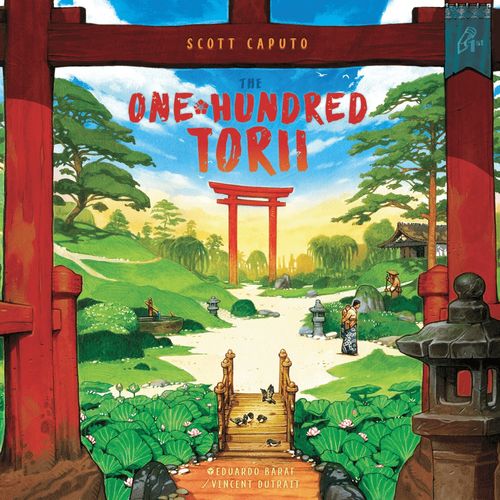
The One Hundred Torii
The One Hundred Torii Rulebook
Table of Contents
Table of Contents
Objective
Earn the most journey points by expanding the garden and walking through as many Torii gates as possible as you move between similar landmarks. Earn additional advantages and points by interacting with characters in the garden such as poets, samurai, gardeners, vendors and geisha.
Maybe you will be first to visit all the landmarks or maybe you will interact with the characters the most.
You'll journey down a different path every time you play!
Components
- Start Tile (x1) and Game Tiles (x42)
- Landmark Tokens (x120)
- Large Landmark Tokens (x24)
- Coin Tokens (x8)
- Poet & Samurai Meeples (x2)
- Info Board (x1) — Note: reverse side and additional info board for three other languages
- Character Tokens (x20) and Enclosure Tokens (x4)
- Achievement Pieces (x10) — All 6 Scoring Achievement (x2), Three 10 Scoring Achievement (x2), Character Achievement (x5), Enclosure Achievement (x1)
Game Setup
-
Put the Start Tile (the one with the red backside) in the middle of the table.
-
Shuffle the remaining 42 Game Tiles, discard the appropriate number of tiles back to the game box (see table below), and give each player 2 tiles face down.
- For 4 players, use 40 Tiles - discard 2
- For 3 players, use 39 Tiles - discard 3
- For 2 players, use 30 Tiles - discard 12
Place the rest of the tiles face down on the side of the table to form the draw pile.
-
Form a pile for each type of Landmark Tokens. Form a pile with Coins and give 2 Coins to each player.
-
Form a pile for each type of Large Landmark Tokens (5 pt face up). There must be as many tokens as players in each pile.
-
Form a pile for each type of Character Tokens (2 pt face up) and for the Enclosure tokens (2 pt face up). There must be as many tokens as players in each pile.
-
Form a pile for each type of Character Achievement Piece (face up) and the Enclosure Achievement Piece (face up). Form a pile for the All 6 Scoring Achievement Pieces and the Three 10 Scoring Achievement Pieces (5 pt face up).
-
Place the Blue Poet Meeple, and the Red Samurai Meeple in reach of all players.
-
Place the Info Board (English side up) in view of all players.
The last player to visit a public garden or park is the starting player.
Gameplay
The One Hundred Torii is a tile placing game played over a series of turns. Each turn the garden expands and the game ends after the last tile is drawn and each player takes one last turn. Players compete to score the most Journey points.
Each Turn, the player takes the following actions (in order):
- GET HELP (1 character, optional)
- EXPAND THE GARDEN
- CLAIM ACHIEVEMENTS (if earned)
- DRAW TILES
1. Get Help
There are five characters in the game which can assist all players.
Each turn, a player may only get help once from a single character.
To get help from a character, a player pays the cost in tokens as shown on the character reference guide and then uses the power of the character. Often the character's power modifies how a player places their tile to the board.
The Characters (see details in the Character Powers section): The Gardener, The Geisha, The Poet, The Samurai, The Vendor.
The character cost may be paid in Coins, in Landmark Tokens, or in any combination of the two. Large Landmark Tokens may never be used to pay the cost. The starting Coins are only used for getting help.
2. Expand the Garden
Each turn, players must place a tile to expand the garden. The player will then always score the placement.
Placing a Tile
On a player's turn, the player chooses one of the tiles from their hand and places it on the table so that it is directly adjacent to a previously placed tile.
Any tile may be placed next to any other tile — there are no restrictions. A tile may connect to any adjacent spot, and may be placed in any rotation.
Earning Landmarks
Every tile has (at least) one Landmark on it. The player scores the shortest path to another matching Landmark. So, the player is trying to find the path that generates the most desired Landmark Tokens. That shortest path may pass through other non-matching Landmarks.
Remember, when counting distances you are counting number of tiles between landmarks, not number of landmarks along the way.
- The player always gains one Landmark Token that matches the Landmark scored.
- If there are multiple paths of the same length that connect the matching Landmarks, the player may choose which path to score.
- If the newly placed tile has multiple Landmarks on it, the player chooses which Landmark to score — the player only scores with one Landmark, whichever they prefer.
Torii Gates
Many of the tiles have colored Torii gates: Red Torii (with a Black top) and Blue Torii (with a Blue top). If the player scores a shortest path that passes through one or more Torii, the player gets the bonus for those gate(s) as follows:
- RED TORII ("+1 MATCHING TOKEN"): For each Red Torii on the path, the player gains another token that matches the Landmark scored this turn.
- BLUE TORII ("+1 NON-MATCHING TOKEN"): For each Blue Torii on the path, the player gains another token of their choice that does not match the Landmark scored this turn. If the player scores a path that passes through multiple Blue Torii, the tokens gained may be the same or different as each other, just as long they don't match the Landmark scored this turn.
It is possible for a player to place a tile where no path to a matching Landmark is possible. This is a legal move, but wouldn't score Landmark Tokens.
Expand the Garden Examples
- Place: A player places the far left tile with the Fountain Landmark on it. Score: There is a path to another Fountain so the player gains 1 Fountain Landmark Token.
- Place: The player places the far left tile with the Lotus Landmark on it. The shortest path to another Lotus Landmark goes through 2 Red Torii and 1 Blue Torii. The shortest path does not go all the way back to the start tile since there is a closer Lotus. Score: The player would receive 1 Lotus token for the path, 2 more Lotus tokens for the Red Torii, and 1 more Landmark Token of their choice that isn't a Lotus.
- Place: The player places the upper left tile with the Stone on it. There are two paths of equal length back to the closest Stone Landmark. The player may choose to score either path. Score: The red line path would yield 2 Stone tokens (1 for the path and 1 for the Red Torii) while the green line would yield 1 Stone token and 1 other token that isn't a Stone (1 for the path and 1 for the Blue Torii).
3. Claim Rewards
After Getting Help and Expanding the garden, the player must claim Landmark, Character Bonus and Achievement tokens.
Landmark Upgrades
As soon as a player has five tokens of a type of Landmark, the 5 tokens must be turned in for one matching 5 point Large Landmark Token.
As soon as a player has five tokens of a Landmark and the 5 point card of that Landmark, the player must turn in the five tokens and flip over the 5 point Large Landmark Token to show the 10 point side. Players may continue to earn and collect tokens for this Landmark after they have flipped to the 10 point side.
One cannot score higher than 10 points for each Landmark. Coin tokens cannot be turned in for scoring Large Landmark Tokens.
Character Bonus
If a player used a character during the Get Help action, either gain a 2 point token of that character, or flip an existing 2 point token of the character previously gained to the 4 point side. Each player may only gain one of these 2 point / 4 point tokens for each character.
Claiming an Achievement Piece
All 6 Scoring Achievement
As soon as a player has at least a 5-point Large Landmark token of all six Landmark types (Bridge, Lotus, Fountain, Lantern, Shrine, and Stone), the player gains the highest value piece of this type (5 or 3). If there are no more achievement pieces of this type left, then the player does not gain this achievement.
Three 10 Scoring Achievement
As soon as a player has at least three 10-point Landmark tokens in any of the six Landmark types (Bridge, Lotus, Fountain, Lantern, Shrine, and Stone), the player gains the highest value piece of this type (5 or 3). If there are no more achievement pieces of this type left, then the player does not gain this achievement.
3rd Time Gaining Help from Same Character
The first player to gain help from the same character a third time, gains the matching 3 point achievement piece of that character. There is only one 3-point achievement piece per character, but players may continue to get help from that character regardless.
Making an Enclosure
When a player encloses part of the garden so that there are no open ends and there are at least 2 Landmarks inside the enclosed garden (matching or non-matching), the player either gains an enclosure token with the 2 point side showing, or the player flips their existing 2 point enclosure token to show the 4 point side. Each player may only gain one of these 2 point / 4 point enclosure tokens.
The first player to make an enclosure a third time, gains the 3 point enclosure achievement piece. There is only one of these achievement pieces.
If a player places a tile and closes two valid paths, it is possible to score the enclosure achievement multiple times in the same turn.
Example: The player places the right tile with the Bridge tile. This creates an enclosed portion of the garden which awards the player an enclosure token. The player also would have scored 3 Bridge tokens during the expand the garden phase.
4. Draw Tiles
After claiming all rewards, the player draws back up to two tiles in their hand (if possible). If the draw pile is empty after drawing, then proceed to Game End and Scoring.
Game End and Scoring
When the last tile is drawn, every player including the player who drew the last tile, gets one more turn.
These turns are played normally, though certain characters like the Geisha or Vendor may be less effective. You may still use the characters to claim rewards.
Final Scoring
When each player has taken their final turn, the players add Journey points from their Large Landmark Tokens, Character Tokens, and Achievement Tokens.
Coins, Small Landmark Tokens and Tiles are not worth Journey points.
Example scoring: Landmark Upgrades (40) + Character Tokens (8) + Achievement Tokens (10) = 58 journey points.
THE PLAYER WITH THE MOST POINTS WINS.
If there is a tie, the player with more leftover Landmark tokens wins. If there is still a tie, the player with the most Achievement tokens wins. If there is still a tie, the tied players enjoy a shared victory.
Characters Powers
Each character provides a unique benefit to the player during the first action of their turn if they choose to pay tokens to Get Help.
Vendor — Cost: 1 token
Discard 1 tile from your hand to the bottom of the draw pile, and then draw 2 tiles (if possible). After playing a tile to the board, do not draw any more tiles this turn.
Samurai — Cost: 1 token
Place the Samurai pawn on the board adjacent to a previously placed tile. No tiles may be played where the Samurai is standing. The Samurai pawn stays at its location until moved by another player. Each time the Samurai is used, the pawn must be moved to a new location.
Play: The player first places the Samurai on the table adjacent to the tile in the bottom row. Then the player places the rightmost tile with the Stone on it. By placing the Samurai, the player has made it harder for other players to take advantage of the path just made.
Score: The player scores the Stone Landmark per normal rules.
Poet — Cost: 3 tokens
Place the Poet Meeple on top of a Landmark on a tile. That Landmark is no longer in play. If a tile has multiple Landmarks on it, the Poet only covers one Landmark. The Poet pawn stays at its location until moved by another player. Each time the Poet is used, the pawn must be moved to a new location.
Play: The player first places the Poet pawn on top of the Bridge Landmark on the start tile and then places their tile, the far right tile with the Bridge on it.
Score: By using the Poet to block the Bridge Landmark, the player has created a very long path that goes through 3 red gates and 2 blue gates which would yield 4 Bridge tokens and 2 tokens that aren't Bridges.
Geisha — Cost: 3 tokens
The player may place both of their tiles this turn, scoring tokens for the second tile only. However, the player may still gain enclosure cards when placing either of their tiles.
Play: The player places the tiles in the upper row on the same turn.
Score: This play yields 3 Bridge tokens.
Gardener — Cost: 3 tokens
The player may place their tile this turn on top of another tile with the following restrictions:
- The start tile may not be covered.
- A tile may not cover a tile that has already been covered.
- The tile where the Poet is standing may not be covered.
Single Player Gameplay
Meet Onatsu, the Pilgrim
Get ready for a one-on-one challenge with Onatsu, the pilgrim. She is an experienced traveler, having come from far away to visit the garden. Will your Journey be even greater than hers?
Objective
Score more Journey points than Onatsu.
Additional Component: Solo Reference Board
Setup
Follow the normal setup rules for 2 players with the following changes:
- Shuffle the tiles and discard 6 tiles back to the box. Only 36 tiles will be used.
- Return the Character Achievement Pieces and the Enclosure Achievement Piece to the box.
- When setting out tokens, all Character Tokens and Enclosure Tokens will be needed.
- Place the Solo Board off to one side.
- Do not give out a starting hand of tiles. For beginner players, start with 2 coin tokens. For intermediate players, 1 coin token. For expert players, 0 coin tokens.
- Onatsu does not receive any starting tokens.
Gameplay
The Single Player Gameplay follows the general flow of the multiplayer game, but has additional actions and requirements on the player during their turn as well as a unique Onatsu's turn.
Your Turn
Draw a hand of three tiles. You must choose one tile to place per normal rules and choose two tiles to give to Onatsu.
Before placing your 1 tile, you may get help from a character as normal except with three modifications:
- You may only hire each character twice during the whole game.
- The Vendor's power is changed to "Return 1 tile of the 3 tiles to the bottom of the deck, and draw 1 new tile."
- The Samurai's cost is changed to 2 tokens and her power is changed to "Place the Samurai pawn on any column on the solo board. For that turn only, Onatsu cannot collect any tiles in that column. Remove the Samurai pawn at the start of the next turn."
Score your placed tile as usual and claim any achievements. Do not refill your hand.
Onatsu's Turn
The two tiles you gave to Onatsu are played next to the solo board according to the following rules:
- The solo board shows six Landmarks representing six columns where tiles are placed.
- A tile is placed in a column so that the column's Landmark matches a Landmark on the tile.
- If a tile has two Landmarks on it, you may choose into which of the two columns the tile is placed. However, once a column has four tiles in it, you must choose the other column if it does not have 4 tiles in it.
- Each column can have at most 4 tiles in it. If a given tile cannot be played into any column, the tile is discarded back into the game box and Onatsu gets no additional actions from that tile even if it has Torii gates on it.
Example: The player draws three tiles and chooses to keep the tile with the Red Torii. The player places that tile normally to earn 2 Lantern tokens. The other two tiles must be given to Onatsu and are placed adjacent to the solo board. The tile with a Lantern on it must be played in the third column showing the Lantern Landmark. The tile with a Lotus and Fountain on it could be played in either the Lotus Landmark column or the Fountain Landmark column.
Scoring Onatsu's Tiles
As soon as Onatsu accumulates two tiles in a particular column, Onatsu receives the 5 point Large Landmark scoring token matching the column's icon.
As soon as Onatsu accumulates four tiles in a particular column, Onatsu's scoring token matching the column's icon is flipped over to the 10 point side.
Example: Onatsu has received two tiles with Fountains on them and therefore, gains the Large Landmark token for Fountains.
Onatsu competes for the All 6 Scoring and Three 10 Scoring achievements and gains the particular achievement when Onatsu has gained the needed scoring tokens.
Additional Actions for Onatsu
As each tile is played next to the solo board on behalf of Onatsu, Onatsu may gain additional actions depending on what is on the tile:
- For each Red Torii on the tile, Onatsu gains a 4 point Character Token that corresponds to the character shown in the same column as the tile on the Solo board. Onatsu may gain multiple character tokens of the same character. For the sixth column, Onatsu gains Enclosure Tokens.
- For each Blue Torii on the tile, Onatsu forces you to discard any two tokens (Landmark or Coin) from your personal supply (if possible). Large Landmark tokens are not discarded.
- If the tile has two Torii on it, in addition to the above mentioned effects, draw 1 more tile and place as another Onatsu tile. For beginner players, ignore any Torii on the newly drawn tile. For intermediate and expert players, resolve any Torii gates on the newly drawn tile per these rules. However, Onatsu may only draw at most 1 additional tile per round.
Example: The player draws three tiles and opts to keep the tile with two Torii gates on it, placing it normally. The remaining tiles are placed adjacent to the solo board. When the tile with the Red Torii is placed, Onatsu gains a character token shown in the same column, which is a Gardener in this case. When the tile with the Blue Torii is placed, Onatsu forces the player to discard two tokens!
Example: The player draws three tiles and opts to keep the Shrine tile with two gates on it. The remaining tiles are placed adjacent to the solo board. When the tile with two Torii gates is placed, Onatsu gets three benefits: gains a character token shown in the same column, which is a Vendor in this case; forces the player to discard two tokens; and gains another tile, which shows a Bridge and two Red Torii. This new tile must also be placed adjacent to the solo board. Onatsu gets two 4 point Character Tokens, which is a Gardener in this case. Onatsu does not get to draw another tile since Onatsu gets at most 1 extra tile per turn.
Game End and Final Scoring
The game ends when the entire deck of tiles is drawn and used.
On the last turn, if you have fewer than three tiles, you may play one tile first and then give any remaining tile(s) to Onatsu, if any. Count up all point values on collected pieces for you and Onatsu.
Highest score wins. If there is a tie, the player with the most Character Tokens & Achievement Pieces wins. If there is still a tie, Onatsu wins.
Learning About Japan
Japan
Japan is an island nation consisting of four main islands and hundreds of smaller ones that lie in the Pacific Ocean to the east of Korea and China, whose northernmost point is just south of Russia, and southernmost point is not far from Taiwan.
The volcanic origins of the land masses mean that tall mountains run down the center backbone of most of the country, leaving relatively little arable land. Since Japan is surrounded by the sea and has countless rivers rushing down from the mountains, water has a strong presence in Japanese culture.
The sub-tropical climate for three quarters of the year makes it easy to have a close relationship with nature, and nature and the changing seasons play a large part in the life and culture of Japan.
Edo Period (1603–1868)
The beginning of the Edo period marked the first stretch of peace in Japan in centuries. Power shifted from feuding warlords to the new political shogunate.
The country was closed to most outsiders, and headquarters were established in what had been until then a small fishing village called Edo. This small town, on a wide, relatively flat plain, would grow into present day Tokyo.
Now that people weren't fighting all the time and having their towns burned down regularly, they could focus on cultural pursuits and technological inventions. Those with money built lavish gardens and patronized artists and poets. Merchants were able to travel around selling their wares and an entire pleasure industry developed featuring geisha as the stars.
On the other hand, it was the beginning of a slow and steady decline for the samurai, who wielded their swords for a living. Life was pretty sweet for about two hundred years, until the combination of increasingly destitute samurai and the arrival of ships from the West set off another political upheaval that would be just as revolutionary as the start of the Edo era.
Gardens
There are many varieties of Japanese gardens: temple gardens, shrine gardens, tea gardens, formal strolling gardens, and gardens for meditation and contemplation.
Larger gardens usually have a sizeable water component like a pond, lake, or waterfall, and most have smaller water features like streams and running water basins as well.
Most are well-known for a particular aspect, like cherry blossoms, maple leaves, or giant bamboo. Gardens in Japan are meant to be enjoyed year-round, and they are often the site of seasonal festivals.
Garden Gates, Arches, Trellises
Larger gardens are often divided into sections for different purposes, with bamboo fences and gates marking off the boundaries of these areas. Fences are often loosely woven so that you can see from one area into the next, and spaces are not visually cut off from each other. Gates can also be loose and airy, or can be made of a solid wall of bamboo strips for privacy. Flowering vines like wisteria and bush clover are very popular in gardens, and pavilions and arched trellises make good use of these trailing blossoms.
Torii
A torii is a structure much like a gate, with two columns and two overhead crosspieces. Some are unpainted wood, some sport a vermillion varnish, and others are made of stone or bronze. Bronze torii take on a blue-green patina as they age, and both bronze and stone torii appear blue in the faint light of morning and evening.
Torii mark the entrances to shrines and are placed along pathways marking the approach to areas where deities are enshrined. They mark the separation between the sacred and the profane, and the torii that line pathways have often been donated as an offering. A torii looks something like a bird perch on purpose, as the legend of their origin goes back to the time when the Sun Goddess Amaterasu hid inside a cave, and a rooster was brought there to try to trick her into thinking there was another sun that had come up so that she would burst out in a jealous rage.
The Japanese characters for torii literally mean "bird + reside."
Garden Objects
Inari Statues
There are thousands of shrines in Japan. Smaller ones are often found in forests, and very large ones tend to have gardens of their own. There are many kami (gods or spirits) in Japan, and foxes are said to be the messengers of one kami called Inari. Foxes themselves can be called Inari, too.
Large stone foxes often guard the entrance to shrines, and tiny fox figurines — sometimes hundreds or thousands of them — adorn shrines and their surroundings.
Arched Bridge
Water is an important garden feature in Japan, and garden bridges are usually beautiful as well as functional. Arched bridges, often vermilion but sometimes a more subdued green, are eye-catching, while flat stone and wood bridges are designed to blend into the landscape. There is a famous scene in Japanese literature where a zig-zag shaped bridge crosses a marshy field of irises, and many gardens still feature such zig-zag bridges in the areas where irises are planted.
Lanterns
Stone lanterns have been used in Japan for centuries, mostly in gardens, temples and shrines, and originally came from China. The design represents the five elements in the same way that a pagoda does, and the shape is similar to gorinto funeral stupas.
The bottom portion represents the earth, the next one water, the next section is where the candle is located and represents fire, followed by air, and finally the top section that points to the sky represents spirit.
Sekimori Ishi
Special stones called sekimori ishi give directions in Japanese gardens. These stones are usually about the size of a grapefruit and are tied with a rope of black hemp in a crosswise pattern. When placed in the middle of a path, they mean "do not enter." They are sometimes used to alert visitors to designated paths, and at other times used for privacy.
As guests to a tea gathering make their way through a garden, these stones can guide them along the correct route to the tea house. After tea guests have traversed a path, such a stone may be placed on that path for privacy, letting other garden guests know that a private function is being held ahead, and that they should not enter.
Tsukubai (Stone Basin) / Water Basin
Water basins are carved of stone. The pipes carrying water and the dippers for scooping water are usually made of bamboo. In gardens on the grounds of temples and shrines, and in tea gardens, washing one's hands at the stone basin is a symbolic purification of the heart.
The basins in tea gardens especially are low to the ground, and the name tsukubai comes from the verb that means to crouch, symbolizing humility through the act of crouching down to purify oneself at the basin.
Characters
The Vendor
The new peace of the Edo period meant that merchants could travel around safely hawking their wares. It also meant that people could be productive in their work, which resulted in money in their pockets. Some vendors had carts, and others traveled from door to door with their goods suspended from the ends of a pole they carried across their shoulders. Some specialized in just one type of thing, and others were sort of one-man traveling department stores.
The Gardener
It takes a tremendous amount of effort to keep a Japanese garden in faultless, manicured condition. Gardeners in Japan spend a lot of time pruning trees and shrubs, sweeping paths, raking dry rock gardens, and even using tweezers to pick out tiny bits of debris from mossy areas. They also spend a lot of time keeping their knives and clippers razor sharp!
The Geisha
"Geisha" means literally "art person" and these ladies were highly trained in the cultural arts, such as traditional dance and music, and had to be sharp and witty with an excellent sense of humor. Their job was to be always beautiful and impeccably dressed and groomed, to be the perfect hostess, and to have faultless manners.
From the outside, they seemed to float on clouds and to have not a care in the world, but in reality, they lived hard lives with no freedom, and were bound to the houses that held their contracts.
The Poet
Most people who were professional poets in Edo Japan lived a very modest life, and although they often had the sponsorship of a political figure, they were almost never well-off. They also tended to have students, but those students generally weren't able to pay much to their teachers. Otherwise, the people who wrote a lot of poetry were either members of the aristocracy or Buddhist monks. Some wandered around, stopping to write a verse here and there along the way, especially at beautiful, famous, scenic spots.
One such poet was Matsuo Basho, who devised the haiku.
The (Lady) Samurai
The Samurai were the top tier of Edo period society, just below the nobles that they served. They were well-educated and got to carry around swords to boot. All was not fun and games, however, and they had to be ready to die in the line of duty at any moment. Near the end of the Edo era, there was a movement to restore the emperor and overthrow the shogunate, and ladies of noble families got into the action and wielded their swords as well, particularly in later years of this period.
References
- Dalby, Liza Crihfield. Geisha. Berkeley: University of California Press, 1983.
- Earle, Joe, and Sadao Hibi. Infinite Spaces: The Art and Wisdom of the Japanese Garden; Based on the Sakuteiki by Tachibana no Toshitsuna. Tokyo: Tuttle, 2013.
- Japan: An Illustrated Encyclopedia. Alan Campbell and David S. Noble, eds. Tokyo: Kodansha, 1993.
- Reader, Ian. Japanese Religions: Past and Present. Honolulu: University of Hawaii Press, 1993.
- Shirahata Yozaburo. Daimyo Gardens. Imoto Chikako and Lynne E. Riggs, trans. Kyoto: International Research Center for Japanese Studies, 2016.
- Tokugawa Tsunenari. The Edo Inheritance. Tokugawa Iehiro, trans. Tokyo: International House of Japan (I-House Press), 2009. (Originally published in Japanese as Edo no idenshi, Tokyo: PHP Kebkyuji, 2007.)
About the World of The One Hundred Torii
A few years ago, I started getting interested in Japanese woodblock printing from the beginning of the 20th century, and it soon became a passion. I did some research, and could closely study the works of Tsuchiya Koitsu, Kawase Hasui, Shiro Kasamatsu, Hiroshi Yoshida, his son Toshi Yoshida, and many others. These were unlimited teaching and inspiration sources, showing an impressive artistic and technical mastery.
I already illustrated some Japanese-themed books or games. However, I never had a chance to paint this particular aspect of the Japanese culture, which is closer to the all-day life, and encompasses tradition, beliefs, and symbolism.
My work on The One Hundred Torii became a tribute to these great artists who influenced me and considerably enriched my imagination and my universe.
As usual, I have been working with many sources, as if I were preparing a "docufiction", to make sure that the game looks authentic, alive, and exotic.
The first steps that I did when working on the illustrations were admirably completed by Lisa's thorough research. The information and explanations that we found give another dimension to the game, close to reality, and perfectly in resonance with Japanese culture and history. Such authenticity and precision make the game fresh and to the point, both in form and content, amplifying ambience and immersion in the theme.
I still (and always) work in a "traditional" manner: pencils, brushes and painting on paper. This artistic approach allows me to enhance many details in the objects, characters, landscapes, using strong and vibrant colors, creating a peaceful and poetic atmosphere.
Painting The One Hundred Torii was a very positive and educational experience. We took extra care to elaborate the game and its cultural echo, and we hope that your eyes and your wits will appreciate this walk in these Japanese gardens!
The One Hundred Torii Team
- Game Design & Poetry: Scott Caputo
- Illustration & Graphic Design: Vincent Dutrait
- Game Production & Development: Eduardo Baraf
- Japan History & Culture Consultant: Lisa Wilcut
- Additional Cultural Review: Akemi Toya, Junko Matsuura, Ryosuke Matsuura, Hiro Maegawa, Chris Riedl
Special Thanks to Andrea Emmes, our incredible Kickstarter backers, the amazing board game community, and our loving families. Edo would also like to thank Jamey Stegmaier and the rest of KCJS 13 - Natsukashii!
Playtesters: Melissa Caputo, JT Mudge, Jodie Mudge, Steve Caputo, Sharon Caputo, Brian Saunders, Suzanne Hom, Anthony Hom, Ernie Lafky, Tim Isaacson, Jon Leupp, Colin Ferris, Michael Shorrock, Brian Hurrell, Dave Ball, Dedan Anderson, Jennifer Bautista, Ben Parisi, Nick Brown, Teale Fristoe, Stephen Edwards, Babak Namaziyan, and Robert Weaver.
PencilFirstGames.com
©2019 Pencil First Games, LLC. All rights reserved worldwide.