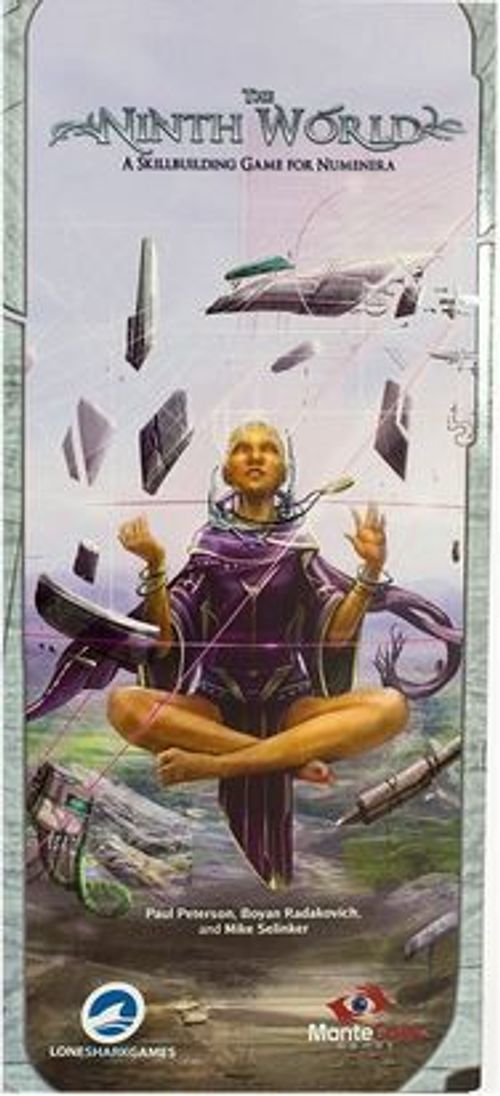
The Ninth World: A Skillbuilding Game for Numenera
The Ninth World: A Skillbuilding Game for Numenera Rulebook
Table of Contents
Table of Contents
Components
This set is the Ninth World Base Box. Its components are marked with the Base Set symbol. The Base Set contains:
- 12 hero tableaus
- 45 region cards
- 48 town cards
- 60 wilderness cards
- 120 skill cards
- 50 power/wound cards
- 1 co-op thresholds/phase order card
- 5 bid shields
- 2 dice
- 1 round marker
- 1 threshold token
- 50 hero tokens
- 36 quest tokens
- 1 monolith
- 1 valor board
- 1 rulebook
Other sets are called expansions, and their components are marked with their expansion symbols.
Cards
Skill Cards
The skill cards represent the skills each hero has. Each hero always has exactly five skill cards that represent their hero's abilities out of six types: the phase skills of Scout (blue), Tinker (green), Charm (yellow), Combat (red), and Focus (purple), as well as generic Effort (gray). Each skill other than Effort has four ranks from 1 to 4. Skills are used to scout cards, bid for cards in the town and wilderness, and advance skills.
Town and Wilderness Cards
The town and wilderness cards represent creatures, cyphers, and quests you find in the region's nearby towns and far-flung wilderness. Cards from the town deck are typically low-risk, low-reward, while cards from the wilderness deck are typically high-risk, high-reward.
Region Cards
The region cards represent where you are exploring in the Ninth World. They are assembled to form the path the heroes will explore during the rounds of the game. Each region shows which rounds it is visited; for example, a region might be visited on rounds 2 and 9. Some regions have special region powers.
Power Cards
The power cards are special powers your hero may gain. On the opposite side are wound cards, representing damage your heroes may suffer on their adventures; in co-op mode, they also represent damage the town may suffer.
Physical Pieces
Co-Op Thresholds/Phase Order Card
The co-op thresholds card is used when you play a cooperative or solo game. It describes how many points the heroes need to move on to new rounds. On the opposite side is the phase order card, describing the sequence of play in a game round.
Hero Tableaus
The hero tableau is your character for the game.
Valor Board
The valor board is where you track how much valor you achieve.
Bid Shields
The bid shield is used to hide your bid cards from other heroes.
Hero Tokens
The hero tokens indicate what the heroes have marked and whether they've used a power on their tableau.
Threshold Token
The threshold token is used in co-op mode to track the valor each hero needs.
Round Marker
The round marker indicates what round you are playing.
Dice
The dice determine outcomes of chance. Each has two sides with good results, two sides with neutral results, and two sides with bad results.
Quest Tokens
The quest tokens mark progress on incomplete quests.
Monolith
The monolith is passed from hero to hero. The monolith will be used when there is a tie. If heroes ever must do something that requires an order, and the order is not specified, start with the monolith owner and proceed clockwise.
Valor
Valor is the measure of victory in the game. When you see a symbol like the one at the right, it means that you gain that much Valor when you claim the card. (Some cards have different colored symbols indicating the phase in which you claim those points.)
Setup
Decide if you will play in competitive mode, cooperative mode, or solo mode. This section describes competitive mode. Cooperative and solo mode are described at the end of the rules.
Arrange Your Travels
Choose or randomly determine an area to explore, and arrange its region cards, starting with the starting region, the card with the words "Round 1." If the Round 1 region card has a power on it, this power is an ambient power that is in effect for the entire game.
Starting Regions in the Steadfast:
- Ancuan
- Draolis
- Iscobal
- Malevich
- Milave
- Navarene
- The Pytharon Empire
- The Sea Kingdom of Ghan
- Thaemor
Lay out the path through the area. Using the region cards from the chosen area, lay out the cards vertically, with the Round 1 region card at the top, then round 2 & 9 card, round 3 & 8 card, round 4 & 7 card, and round 5 & 6 card in order. These cards track rounds and describe additional powers that occur during each specific round.
The rulebook's illustrated example of a laid-out path (Ancuan, Aras Island, Scorpion's Reach, Kaparin, Glavis, shown top to bottom) prints these region powers:
- Ancuan: Round 1 – Play normally.
- Aras Island: Round 2 – Rage of Blood: Decrease the cost to claim creatures by 1, but not below 1. Round 9 – Play normally.
- Scorpion's Reach: Round 3 – Play normally. Round 8 – Pirate Raids: On arrival, each unwounded hero gains a wound.
- Kaparin: Round 4 – Redfleet Honor: If a creature is in the town, heroes cannot claim wilderness cards, but can scout and mark them. Round 7 – Play normally.
- Glavis: Round 5 – Play normally. Round 6 – Vanishing Tributes: In the Tinker phase, each hero may discard a cypher to add skill points equal to its cost.
Place the round marker on the starting region card.
Decide your game's length. The game length must be decided before a hero takes the first turn. Choose either a standard game, which lasts for nine rounds, or a quick game, which lasts only five rounds. At the end of the last round, the game ends.
Unfurl the valor board.
Shuffle the town deck and the wilderness deck, and place them on either side of the path. Deal out five town cards faceup next to the town deck, but do not put out any wilderness cards.
Organize the skill cards and power cards off to the side. Build one faceup stack for each card type. The skill cards should be ordered by rank within each stack, with rank 1 on top. Shuffle the power cards.
Choose Your Heroes
Each player chooses a hero, taking their tableau and bid shield. Your hero is described in three parts: an adjective (such as "Learned") that defines one of their starting skills, a noun (such as "Nano") that defines a second starting skill and describes the use of their hero token, and a verb phrase (such as "Who Rides the Lightning") that gives them one unique power.
(Optional) Set your powers. Advanced players may wish to modify their powers. If you use this rule, deal two power cards to each hero from the power deck. You may choose to cover your power with one of these power cards or keep the one on the tableau; shuffle any remaining powers back into the power deck.
Give each hero their initial skill cards. Each hero takes the two rank 1 skill cards representing their starting skills, plus three Effort 1 cards.
Give each hero their hero tokens. Each hero puts one of their tokens on the middle power on their tableau, and one on the 0 space on the valor board. Set your other tokens aside your tableau.
Give a random hero the monolith. The monolith owner will change at the end of every round.
Gameplay
Primary Objective
Players gain Valor points by bidding their skills and claiming creatures, cyphers, and quests from the town and wilderness, and by advancing their skills. At the end of a competitive game, the hero with the most Valor wins.
Round Rules
The game is played in rounds: nine in a standard game or five in a quick game. Each round has a round start, five skill phases, and a round end. Some regions have a region power that activates on a specific round, but an ambient power is active the entire game.
Start of a Round
Begin the round by applying any power listed on the region card for this round; any power that happens "on arrival" happens right now. Each round has five phases which are described in the Phase Rules. While each phase may have special conditions or rules, each will follow these basic steps:
Start of a Skill Phase
Choose your bids. Choose which skill cards, if any, in your hand to bid from behind your bid shield. Then place your bid in front of you, covering your bid with your shield to not reveal the amount of skill cards to other heroes. If you choose to bid 0, you still put your shield in front of you as if cards were hidden there. You may bid between 0 and the number of skill cards currently in your hand. You may bid any card in any phase; however, if you bid a card out-of-phase (that is, not in the phase it is named after), it only counts as an Effort 1 bid.
Once every hero has committed a bid, reveal your bids simultaneously. If all heroes bid 0, skip the phase unless a region power tells you otherwise.
If you bid at least 1, you may also play powers from your hero or cards you've claimed if they happen at the start of the phase; similarly, start-of-phase powers from regions and other cards happen now. You may also play powers that affect your bid (such as "Discard to add 1 Focus point"). If a power adds skill points, it can only be played at this time; you can't add skill points later in the phase. If you don't bid at least 1, you cannot play cards or powers in this phase. Each power can only be used once per phase, unless it says it happens whenever something else happens.
Bid powers are played in reverse order of the initial bid; the hero that bid the lowest initial bid has the option to play their bid powers first, then the hero with the second lowest bid, then the hero with the third lowest bid, and so on until the hero with the highest bid has declared the powers they will use.
One bid power every hero has is their hero token. Once this token is spent, it cannot be used again unless a power returns the hero token to the card.
Bidding Values
These are the values of each hero's total bid:
- Each Effort card played is 1 point.
- Each ranked skill card played out of its phase is 1 point.
- Each ranked skill card played in its phase is equal to an amount of points equal to its rank.
If a power adds skill points, those points have no phase. If it adds specific points relating to a phase, such as Tinker points, those points are of that phase.
Example: In this 5-hero game, it is the Tinker phase, and Selis has the monolith. However, Selis only has a bid of 0, so they do not get any skill points this phase. Branoc Aur and Qbrys both bid 3: Branoc Aur has 3 points from their Tinker 3, and Qbrys has 1 point from the Tinker 1, 1 point from the Scout 2 (since it is played out of phase), and 1 point for the Effort 1. But they are not tied. Branoc Aur has 3 Tinker points because of their Tinker 3 card, whereas Qbrys has 1 Tinker point from their Tinker 1. This means Branoc Aur will act first and Qbrys will act second. Kwaidyno and Rorke both bid 2 with no Tinker points, since Kwaidyno's Charm 1 and Rorke's Focus 1 are both played out of phase. So now the tie is broken by who is closest clockwise to the monolith owner. Kwaidyno is closest, so will act third, and Rorke will act fourth in this phase.
Mid-Phase
Perform phase actions and powers in order of highest to lowest total bid. Use this priority order:
- Highest total bid value, then
- Most points in the skill matching the current phase, then
- Position of tied players starting with the monolith owner and proceeding clockwise.
Each hero performs all of their actions before moving onto the next hero. As with bid powers, each phase power can only be used once per phase.
Convert your bid to skill points on a 1-1 ratio. You now have skill points to spend this phase.
- In the Scout phase, you can draw and mark cards in the wilderness.
- In the Tinker phase, Charm phase, and Combat phase, you can choose either the town or the wilderness to claim cards from, but not both. In these phases, spend your skill points to claim cyphers in Tinker, quests in Charm, and creatures in Combat; the cost is noted in the upper left corner of the card. In the town, you may claim any faceup cards on your turn. In the wilderness, you may only claim faceup cards that you have previously marked. Unless you are told to claim a card for free, the cost to claim a card can never be less than 1, no matter what reduces its cost. When you claim a card, you will either discard it into either its appropriate town or wilderness discard pile or display it in front of you, depending on what type of card it is.
- In the Focus phase, you can use skill points to advance a skill card.
Place any spent skill cards faceup on your hero. They cannot be used for the rest of the round.
Gain the Valor listed in the bottom right corner of each card you claimed and follow any phase rules for that card. When you discard a card that you previously claimed, you do not remove the Valor you gained.
End of a Phase
Convert any skill points you bid but did not spend into Valor on a 1-1 ratio. You may always spend your skill points to gain Valor in this way.
When all heroes have spent all their skill points, end the phase and begin the next phase. If there are no more phases, end the round.
End of a Round
At the end of each round, go through these steps in order:
- Return any spent skill cards to your hand.
- Reset the town by drawing cards faceup from the town deck until it has five cards. If there are five or more cards in town, no new cards are added.
- Activate any power that happens "on departure."
- Move the round marker to the next numbered space on a region card.
- The monolith owner passes the monolith to a different hero with the lowest Valor. If there is a tie for who gets the monolith, it goes to the tied hero closest to the left of the monolith owner.
- Begin the next round. If there are no more rounds, end the game.
End of the Game
At the end of the game, score your Valor. For each wound card you have, subtract 5 Valor from your final score. The hero with the highest Valor is the winner. In case of a tie, the tied hero closest to the monolith wins.
Actions
You might do any number of things with a card; these are called actions. Some of the actions are:
- Advance: Replace it with the next ranked card in its skill.
- Claim: Take it from the town or the wilderness and do whatever the phase requires with it.
- Complete: Put one of your markers on a displayed quest to track how many times you have fulfilled the goal. After completing the last tier, discard the card.
- Discard: Put it in either the discard pile for the town or wilderness, or your own skill card discard pile.
- Display: Put it in front of you.
- Draw: Pull it from the deck or discard pile. If it's a skill card, put it in your hand. If not, put it in play.
- Look: Examine it and put it back where it came from, in the order it came from there.
- Mark: Put one of your markers on a card you plan to claim.
- Move: Take it from a place and put it elsewhere.
- Play: Put it on the table and activate it.
- Replace: Swap it for another card.
- Shuffle: Mix it into a deck.
- Turn: Turn it sideways.
Skill Phase Rules
I. Scout Phase
In the Scout phase, you may investigate reports of creatures, cyphers, and quests in the wilderness outside of town by marking them. You can do any number of these two actions, in any order.
Marking Wilderness Cards
If there are wilderness cards faceup from the previous round, you may spend one Scout point to place your token upon each one you choose to mark. You may mark the same card that someone else has already marked, unless the card is sideways.
Drawing Wilderness Cards
You may spend one Scout point per card to draw wilderness cards from the wilderness deck and immediately mark them. Put them faceup near any other faceup wilderness cards, turned sideways to indicate that they cannot be marked until the next round by any hero other than you. At the end of the phase, turn them to the correct orientation.
Prize Cards
When you draw this blue-bordered card type, you gain its Valor (this counts as marking it and then immediately removing the marker). A prize may require you to display it until you use it; otherwise, discard it immediately.
Example: During the Scout phase, Branoc Aur bids 3 and Selis bids 1. Branoc Aur marks the wilderness quest Wake the Queen, which Selis had already marked on a previous round. Branoc Aur then scouts two new wilderness cards (the creature Callerail and the cypher Heliolithic Halo), placing their hero token on each card and turning them sideways. Selis may scout once, but must scout a new wilderness card because they cannot mark Branoc Aur's new cards. They draw the prize Shins from the deck, gain 2 Valor points, and discard it immediately.
II. Tinker Phase
In the Tinker phase, you may claim age-old cyphers (green cards). When you claim a cypher, gain its Valor points and display the card in front of you until its power is fulfilled.
Using A Cypher's Power
Cyphers—the "numenera" of the Ninth World—are often highly unstable. If a cypher has a power, you may activate it when the conditions of the power are met. In a specific phase or under a specific circumstance, each may have a requirement to play it.
- You might have to discard the cypher to use its power. If you do, you can't discard it to complete a tier of a quest. You do not lose the cypher's Valor when you discard it.
- You might have to roll a die when you use it. The roll's result might be positive, neutral, or negative. If a result is not listed, nothing happens.
- You might have to not do something to use its power, such as not claiming a card in a phase.
- Or it might do something else entirely. Regardless, you never have to use a cypher's power unless you want to, but if you do, you must live with the results.
Example: During the Tinker phase, Rorke bids 5 and Kwaidyno bids 3. Rorke could claim the 5-cost Aetherscope in the wilderness, but chooses to claim the 3-cost Mind Jewel in the town to deny Kwaidyno a cypher. Rorke earns 4 Valor for claiming the card and 2 Valor for the overspend, and displays the Aetherscope for a later phase. Kwaidyno can only convert their bid to score 3 Valor, since there are no cyphers left that cost 3 or less. On the plus side, after claiming nothing, Kwaidyno can use their Hard Light Cutter's power to gain 1 additional Valor.
III. Charm Phase
In the Charm phase, you claim quests (yellow cards) given to you by denizens of the land. When you claim a quest, gain its initial Valor shown in the lower right corner and display the card in front of you until the quest is completed.
Completing Quests
Above its initial Valor, each quest has one or more circular tiers; you start with the bottom tier and track progress with quest tokens. When you put a quest token on the quest card, gain the Valor points in the tier you are completing; for example, if there is one token on the card and at least two tiers, put a second token on the card to show you have completed the second tier of the quest and gain the Valor. When there are a number of tokens on the card equal to the number of tiers, you gain the final tier's Valor, complete the quest, and discard the card and any quest tokens on it. Any powers on quests must be activated at the time of completing the quest.
Types of Quests
There are five types of quests with special conditions that must be met for completion.
- Scout Quests – When you mark a wilderness card under specific circumstances, you may put a token on this quest.
- Tinker Quests – To put a token on this quest, discard one of your displayed cyphers. You cannot discard a cypher for its power and use it to help complete a quest at the same time.
- Charm Quests – When you complete another quest, you may put a token on this quest.
- Combat Quests – When you claim a creature, you may put a token on this quest.
- Focus Quests – When you advance a skill, you may put a token on this quest.
Example: During the Charm phase, Qbrys and Selis both bid 4, with the tie broken by Qbrys's Charm 2 card. Qbrys claims the 1-cost tinker quest Scrap for Parts, scoring 1 Valor immediately, then discards 3 cyphers to complete that quest, gaining 1, 1, and 2 Valor for the respective cyphers. Qbrys also recently claimed the charm quest Serve the Amber Pope, and since the tinker quest was completed, Qbrys puts a quest token on the card for the lowest tier on that quest to signify partial progress, scoring 2 Valor. Qbrys then converts the rest of their bid to 3 Valor. Selis claims and displays the 2-cost scout quest Explore the Heights, gaining 2 Valor for the quest plus 2 more after converting the remaining bid.
IV. Combat Phase
In the Combat phase, you battle creatures (red cards) that rampage through the countryside. When you claim a creature, gain its Valor points and activate the creature's power immediately, then discard the card unless the card says otherwise. Some creatures may wound you (see Power Cards and Wounds).
Example: During the Combat phase, Kwaidyno bids 8 and Rorke bids 6. Kwaidyno claims the 5-cost Jiraskar and the 3-cost Ellnoica in the wilderness, gaining 12 Valor, plus 1 because the Who Controls Beasts power gives a bonus of 1 when claiming a creature with a cost of 4 or more. Kwaidyno then looks at the creatures' powers. The Jiraskar requires Kwaidyno to gain a wound and cover up their power with it. The Ellnoica's power is to give its claimer 1 additional Valor for each point of their Focus, which in Kwaidyno's case is 2. Rorke earns a total of 9 Valor for claiming the Queb in town and converting the rest of their bid to Valor, but the Queb's power gives Rorke a wound.
Power Cards and Wounds
Two types of cards can cover your hero's power (the one that begins with "who") during the game. If you are told to gain a power card, draw one at random from the power deck and cover the bottom power on your hero tableau. That change is permanent until something else changes the power.
Wounds stop you from using your power, and subtract from your final Valor score. When you gain a wound, cover your bottom power (even if it is a power card) with a wound card; you may not use the power until the wound is healed by another card or by spending a bid of 2 in the Focus phase to heal it. Put any healed wounds back in the wound deck. If you gain a wound while you already have one, put another wound card over your previous wound card; you must heal each wound separately.
V. Focus Phase
In the Focus phase, you may advance one—and only one—of your skills by replacing its current skill card with the next highest value card of that skill. The skill card can be advanced whether it is in your hand or was spent earlier in the round. You may still advance a card in this phase if it advanced in a previous phase this round.
Example: During the Focus phase, Rorke, Selis, and Branoc Aur all bid 2; no one bids any Focus cards, so Rorke, who has the monolith, goes first. Rorke decides to spend 1 skill point to advance an Effort card into a Tinker 1, converting their remaining skill point into 1 Valor. Selis decides to advance a Scout 1 to a Scout 2, using all their skill points to do so. Branoc Aur spends both points to heal a wound.
Advancing a Skill
Each hero always has exactly five skill cards that represent their hero's abilities. You can never have more than one of each type of skill card, except for Effort. For example, you cannot have a Combat 2 and a Combat 1, but you can have two Effort 1s.
To advance a skill card, spend a number of skill points equal to the next rank of the skill. For example, to advance Charm 2 to Charm 3, you must spend 3 skill points. A skill can only be advanced by one rank per phase. No skill can be advanced beyond rank 4.
When you advance a skill, gain the 2 Valor shown for claiming the new skill card. You do not do this with the skill cards you gain at the start of the game, just with ones you advance.
If you advance all five of your skill cards to at least rank 1 and none are Effort, also gain 5 Valor; this occurs again when you advance them all to at least rank 2, then at least rank 3, then rank 4. For example, if you advance Charm 1 to Charm 2, and your Scout, Tinker, Combat, and Focus skills already are all rank 2, gain 2 Valor for advancing Charm and 5 Valor for having all five cards at the same rank, for a total of 7 Valor.
Advancing Effort
To advance Effort, spend 1 skill point and replace an Effort 1 with a rank 1 skill card. This counts as your advanced skill card this phase. Rank 1 skill cards provide 1 skill point, but help break ties and allow access to higher skill ranks.
Healing Wounds
You may spend 2 skill points to remove a wound from your hero. You may do this for multiple wounds at once, but only for your wounds. You may heal whether or not you advance a skill.
VI. Threshold Phase
The threshold phase is a new phase that takes place after the Focus phase and before the end of the round. In this phase, the cards left in the wilderness work against you. The steps below happen in order.
Cyphers Inflate the Economy
For each cypher in the wilderness, move the threshold token up 1 point. This is a permanent increase to the amount of Valor you must have at the end of the rounds in which you check thresholds.
Creatures Attack the Town
Roll one die for each wilderness creature with a cost of 4 or less, and two dice for each creature with a cost of 5 or more. For each creature whose dice show at least one bad result, place one wound card on the farthest unwounded slot from the town deck; discard any card that may be in it. Wounded town slots do not refill each round. If at any time all town slots are wounded, the heroes lose.
Quests Populate the Wilderness
Total the number of heroes in the game and the number of incomplete quests in the wilderness. Draw that many cards from the wilderness deck and put them in the wilderness. If a prize is placed into the wilderness, the monolith owner claims it immediately and it is replaced with another card from the wilderness deck.
Crossing the Threshold
If it is round 3, 6, or 9, check to see if the adventure can continue. Check the position of the threshold token to see if the heroes have met their score goals. This happens at the end of rounds 3 and 5 in a quick game.
Example: At the start of the game, the cypher Tinker Golem shows up in the wilderness. The heroes do not claim it, so the threshold token moves up by 1. In round 2, they fail again to claim it. The threshold token again moves up by 1. In round 3, the cypher Machine in the Wall comes out and they fail to claim either of them. The threshold token moves up by 2. At the end of round 3's threshold phase, the heroes check their scores. They must each have 19 points to avoid losing, instead of the normal 15. They do, so they move the threshold token to 44 and keep playing.
Cooperative and Solo Mode
The Ninth World may also be played in cooperative or solo mode. In co-op mode, everyone works together to protect the town from the dangers in the wilderness, coordinating your skills together and succeeding or failing as a team. In solo mode, you are the only one in your party, facing the world's challenges alone. If you survive for nine rounds (or five in a quick game), you will become heroes of legend!
Setup Changes
When you set up the town deck and the wilderness deck, deal out five town cards, then deal out wilderness cards equal to the number of heroes. If you draw any prizes, the monolith owner claims them, then continue drawing until there are the correct number of wilderness cards.
Place the co-op thresholds card next to the round 1 region card. Place the threshold token at 15 on the valor board.
If you are playing solo, take the monolith; you always are its owner. Choose three hero tableaus other than your own to be your allies. Put these hero tableaus next to your own.
Gameplay Changes
Your interactions in the wilderness are different in co-op mode. Each round, you will deal out a number of cards from the wilderness deck equal to the number of players. For example, in a 4-player game, you will always add four more cards to the wilderness, even if there are already four cards there. These cards act against you. You must try to claim the cards before they attack and wound the town.
Bidding Changes
You still determine how many skill points to spend each phase, and still may only choose to spend points in the town or wilderness (but not both). However, bids are not hidden. When you and other heroes act in the town or wilderness, you may pool your bids to claim cards and divide them as you see fit. Any points applied against the same card counts as though there were a single bid against it. All heroes spending points on a wilderness card must have scouted it, and only one hero may claim it and receive Valor. Bids cannot be pooled in the Scout and Focus phases.
If you are playing solo, you may discard one of your allies' hero tableaus to add 2 to a bid in a phase matching either of the hero's two starting skills. Once you discard an ally, it is no longer available for the rest of the game. Note that an ally cannot do anything on its own; it is not considered a hero except for powers like Who Forges a Bond, which copies another hero's power.
Phase Changes
At the beginning of each phase, you do not need to hide your bids from the other players, but mid-phase bid order still applies. The five phases still happen in the same order, with a new sixth phase happening last.
Quest Changes
Wilderness quests cannot be claimed unless they are completed. Once you mark a quest, you may begin to complete each tier. Once the last tier is complete, any heroes that have marked the quest may pay the cost for one of them to claim it in the Charm phase.
Example: Qbrys has marked the combat quest Bring Back Pelts in the wilderness, and Selis has marked the combat quest Hunt Abhumans. The first has one Qbrys token indicating a creature has been claimed and applied to this quest earlier. Selis, Branoc Aur, and Kwaidyno combine their combat bids against the creature Cragworm, and must decide which will claim it. Selis claims the creature and gains its Valor, and can only apply it to the quest that they have marked; Qbrys's quest is not available, since Qbrys did not claim the creature. If Branoc Aur or Kwaidyno had claimed the creature, it could not have been applied to either quest.
Scoring Changes
You must not only protect the town; you must also gain Valor to win. At the end of every third round (or round 3 or 5 in a quick game), compare each hero's score (including subtracting 5 Valor for each wound) to the threshold token's position on the valor board. The values for these are 15 Valor after round 3, 40 Valor after round 6 (or round 5 in a quick game), and 75 Valor after round 9. Remember that the number of Valor you must have increases when you leave cyphers in the wilderness in the threshold phase.
If any hero cannot meet the threshold when scoring is checked, the game ends and you lose.
End of the Game Changes
You win if the town has at least one unwounded slot left at the end of nine rounds (or five rounds in a quick game) and every threshold scoring goal was met along the way.
If all the town slots are wounded at any time or you cannot meet a threshold scoring goal at the end of a specified co-op scoring phase, the game ends and you lose.
Adding Expansions
This box set covers the nine kingdoms of the Steadfast, but there is much more to the Ninth World. You can add expansions to the game by exploring their regions and shuffling in their town and wilderness cards. You might adventure into the Beyond, go through the Great Reach, or plunge into the Deep.
Expansion regions introduce ambient powers, which are region powers that are in effect the entire game. An ambient power might change specific phases, modify costs, enable actions that don't exist elsewhere, or any number of other strange effects.
You can also play with the Ninth World Playmap, a double-sided game aid. On one side is a playmat to hold your region, skill, and power cards. On the other is a map of the Steadfast and all the regions in the base game. You can note your victories on the map and leave your mark on the Ninth World!