The NetHack Board Game: Gnomish Mines Expansion
Official rulebook: The Game Crafter, LLC · PDF
The NetHack Board Game: Gnomish Mines Expansion Rulebook
Table of Contents
Table of Contents
Contents
- One expansion game board
- One deck of 20 encounter cards
- 24 gem tokens (in colored sets of three)
- One deck of 10 "gemstone / worthless glass" cards (5 "gemstone", 5 "worthless glass")
- These rules
Setup
- Set up the base game as usual.
- Shuffle the encounter cards ("Mines deck") and place it with the other encounter card decks.
- Shuffle the "gemstone/worthless glass" cards, and place them face down somewhere convenient.
- Place the gem tokens where players easily see and reach them. Use 16 gem tokens (eight colored pairs) for a 2 player game, and all 24 gem tokens for a 4 player game. For a 3 player game, you may use either 16 gem tokens or 24 gem tokens; using 24 gem tokens will add more gem-related action to the game.
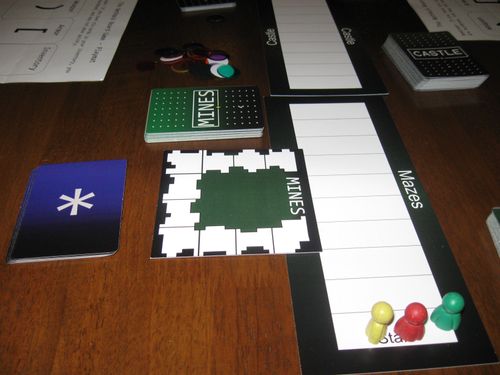
- Connect the Mines expansion board to the track on the Mazes game board. The specific location for the Mines board in the Mazes is up to the players or can be chosen randomly by rolling one die (place the Mines board with its track starting at square 2 of the Mazes board if you roll 1-2, square 3 if you roll 3-4, square 4 if you roll 5-6, square 5 if you roll 7-8, and square 6 if you roll 9-0).
[Figure not reproduced: the setup diagram shows the Mines board connected to the Mazes, Castle and Gehennom boards, with labelled areas for the Mines deck, Mines discard, gem tokens, gem/glass deck, and the Mazes, Castle and Gehennom decks and discard piles.]
Entering the Mines
When a player reaches one of the Maze squares that links with the Mines board, s/he may choose to enter the Mines, using the usual rules for movement and encounters. As usual, if the Mines deck runs out, shuffle the Mines discard pile back into the deck. Entering the Mines is optional.
Obtaining Gems
Encounters in the mines can result in the player obtaining gems in one of three ways:
- If the encounter is a gemstone item card, the player takes the colored gem token for the gemstone named on the card and discards the card. If that gem token is not available, the player does not receive a gem, but should still discard the card.
- Whenever the player defeats two monsters in a row in the Mines (without losing an encounter to monster in between), the player may take any available gem token. A good way to keep track of this is for players to discard the first defeated monster in front of them rather than in the Mines discard pile. After the next monster encounter, there will either be two defeated monsters, in which case both cards can be put in the Mines discard pile and a gem token taken, or the player will have lost, in which case the single defeated monster can be returned to the Mines discard pile.
- If the player manages to move from one end of the Mines to the other, s/he may take any available gem token on the turn in which s/he moves out of the Mines and back to the Mazes.
Gems obtained should be stacked in front of each player.
Using Gemstones
Gem tokens obtained in the Mines may be used in any other section of the board, but may not be used while in the Mines. Other than this restriction, gems may be played at any time, during any player's turn. After being played, gem tokens are discarded and no longer may be used in play.
Whenever a player attempts to use a gem token of a particular color for the first time, turn over the next card in the "gemstone/worthless glass" deck and lay the token on the card. This determines whether (all) gems of that color are valuable or worthless during this game. If the gem is worthless glass, it has no effect, and any remaining tokens of that color can be discarded by both players. If the gem is valuable, the player may use it for one of four effects:
- Luck: The gem must be played immediately after a die roll by any player. If the player using the gem just rolled the die, s/he may redo the roll. If another player just rolled the die, s/he must redo the roll. Thus, a valuable gem may be used either to ameliorate a bad roll or to force another player to have to make a second roll.
- Bribery: The gem must be played immediately after encountering a Demon Monster. The demon accepts the gemstone as a bribe and leaves the player alone (that is, the demon is immediately defeated.)
- Shopping: The gem must be played at any time. The player using the gem may take any item from the discard pile for their area of the board into their inventory (possibly discarding a different item from their inventory to make room).
- Bidding: The gem must be played immediately after another player encounters an item. If the other player does not also use a valuable gem to match the bid, the item goes instead to the player who played the gem. If the other player does use one of their own gems to match, the initiating player may continue to play gems (requiring the defending player to match or give up the item) or may give up the auction and allow the defending player to keep the item. If an unknown gem is used by either player, and is found to be worthless glass, the auction ends immediately, and the player with the worthless glass loses. After an auction, all gem tokens involved in the auction are discarded.
Although a player will normally know which gemstone effect they plan to use when they play their gem token, the choice does not have to be announced until after the gem is determined to be valuable or worthless, if it's the first time a gem of that color has been played.