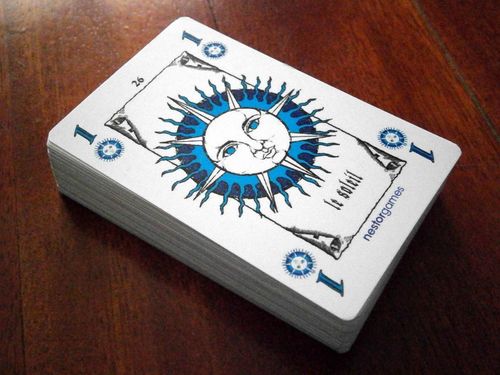
The Mystique Deck
The Mystique Deck Rulebook
Table of Contents
Table of Contents
Introduction
The Mystique Deck is a pack of 60 cards designed by Néstor Romeral Andrés that is special for a number of reasons. For one thing, each card has three primary attributes (a regular poker deck or tarot deck has just two):
- Colour: yellow, red, or blue.
- Suit: moons, suns, arms, or crowns.
- Number: 1 – 5.
Furthermore, each card is identified by a unique card number (1 – 60).
As in a traditional poker deck, the 1 of each colour/suit combination is also known as the ace of the coloured suit. The 5 of each colour/suit combo is depicted with the coloured suit in an open palm, and thus is also known as the palm of the coloured suit.
So, the following are a few examples of cards:
- Card number 53 is the three of red crowns.
- Card number 26 is the one of blue suns, which is sometimes called the ace of blue suns.
- Card number 35 is the five of yellow arms, which is sometimes called the palm of yellow arms.
The suits also have thematic grouping: Heaven refers to the suns and moons; Earth refers to the arms and crowns. These small hints at theming can serve as an inspiration or framework for game design, card tricks, or whatever you like. It is also worth mentioning that The Mystique Deck is available with either a silver back or a gold back, which also expands the possibilities.
Slice It Any Way You Like
The anatomy of The Mystique Deck makes it very easy to "carve up" in plenty of different ways. Right off the bat, one can tell that each of the three colours has 20 cards in it (60 ÷ 3 = 20), each of the four suits has 15 cards, and each of the five numbers has 12 cards bearing it. Of course, Heaven and Earth each have 30 cards, since each one comprises two suits. These facts are interesting enough, themselves, but they also hint at another great trait of this deck.
Because the deck has 60 cards, the cards can be divided evenly between two players, three players, four players, five players, or six players. This makes it instantly compatible with the most common groups of players, without needing to omit cards from the deck. One must acknowledge that plenty of games hinge on having a little hidden information by removing cards from the deck, but having eight more cards than a poker deck means that you feel the pinch of missing cards just a little less, as well.
Compatibility with Other Game Systems
Conveniently, The Mystique Deck uses the same four suits as a standard piecepack and a standard hexpack, both of whose tile values range from 0 – 5. One game that takes advantage of this compatibility is Nathan Morse's Rummy Runners. The recommended dimensions of the piecepack make it specifically compatible with Looney Pyramids, available in myriad colours (including, of course, yellow, red, and blue), and whose pip values range from 1 – 3. Looney Pyramids can be used to infuse notions like directionality into your Mystique Deck game.
Similarly, nestorgames' own Nestortiles are also available in numerous colours, and have pip values from 1 – 6. These can even be constructed into 3D objects, providing some really intriguing possibilities.
The colours of The Mystique Deck match three of the six player colours in Esagek, providing interesting possibilities for 1-, 2-, or 3-player Esagek games — and that's without even getting creative. Martin Grider's Six D Six has yellow, red, and blue as half of its colours (in fact, its colours nearly match Esagek's). The red and blue cards could be correlated to units in Realm. The card numbers can be matched to the spaces around the Stonehenge board, half of whose colours, again, match The Mystique Deck. …just to mention a few….
Let's Play!
This book features 12+1 games designed exclusively for The Mystique Deck. There are numerous other designs out there, some of which use other equipment (such as Rummy Runners), but this book focuses on games that don't really require anything extra. Unless otherwise stated, all the following games use one Mystique Deck only.
Grab some friends and The Mystique Deck, and have some fun!
Mystique
Players 2–6 · gears 3 · 30 minutes. Can also be played in couples (4 or 6 players).
The spellcaster is a special breed, for she must be able to understand and manipulate the numerous dimensions of magic. Even a commoner comprehends the notion of magnitude. Those aware of mystical concepts grasp that there are colours of magic, even if they are unable to perceive these colours themselves. Those conversant with the intrigues of the court understand the tenuous balance between sovereign power and war; similarly, those who study the skies are familiar with the power that the sun and the moon hold over humanity. But only the spellcaster can bind these notions together into powerful bolts of energy. Unfortunately, with the ability to command such energy comes an ineffable urge for dominance. Thus, the few spellcasters that roam the planet inevitably find one another, and the sparks start flying: Spell! Deflection! Counterspell! ...until one is clearly superior among them... at least until their next encounter....
Mystique is a climbing game for 2 to 6 players that can be also played in couples (4 or 6 players). In Mystique, the players are spellcasters in combat.
Goal
Have the fewest burns at the end of the skirmish.
Setup
If you are playing a 2-player game, set aside 20 random cards face-down. They're not used during the game. Use 2 decks (gold and silver) for games with more than 4 players.
Each player draws a random card. The player who drew the card with the highest card number (1 to 60) is the dealer. This player returns these cards to the deck, then shuffles the deck. The player on her left makes a cut. Then the dealer deals the maximum number of cards out to the players face-down, such that each player receives the same number of cards (even the dealer). Each player takes her cards, and doesn't show them to the other players. Set aside the remaining cards face-down (if any). They're not used during the game.
The player on the right of the dealer starts and she's called the "spellcaster".
Play
The game is played in anticlockwise order.
The spellcaster opens the round by casting a spell: She chooses up to 5 cards from her hand that have an attribute in common:
- They all have the same number.
- They all have the same suit.
- They all have the same colour.
Then announces the number of cards she's chosen and what they have in common, as she places them face-up on the table.
Examples of openings:
- "Three crowns" (of any colours and numbers)
- "Two ones" (of any colours and suits)
- "Five reds" (of any suits and numbers)
The following player must either:
-
Cast an equal or stronger spell of the same type as the previous player's spell (i.e. the same number of cards — or more — with the same common attribute she announced). Pass the turn to the next player.
or
-
Take all the cards that have been played during this spellcasting, and place them face-down in a pile next to him. These are his burns. This ends the round. He becomes the new 'spellcaster' and opens a new round.
Example:
Alejandro opened with three crowns. Brenna plays five crowns. Cedric plays six crowns. Didier can't possibly have more than one crown in his hand (there are only fifteen in the deck!), so he must gather the fourteen crowns played as burns. The good news is that Didier is the new spellcaster, and gets to open with any spell he likes.
The round continues in this fashion until one of the players takes all cards that have been played during this spellcasting, and opens a new round. Subsequent rounds play out the same way.
If it's a spellcaster's turn to open a new round and the spellcaster has no cards left in her hand, the skirmish ends. All players place their remaining cards face-down in their burns piles.
Note that the skirmish doesn't end just because a player empties her hand: In order for the skirmish to end, the spellcaster must be unable to open a new round, due to an empty hand.
When the skirmish ends, each player counts the number of cards on her burns pile. The player with the fewest burns wins the skirmish. Ties are possible.
Game End
The game can be played to the best of 3 or 5 skirmishes.
Optional Rules
I recommend applying all these rules at once, but you can use them separately, if you prefer.
Aces Scoring
At the end of the skirmish, aces count as 5 burns instead of just 1.
Spell Deflection
On a player's turn, she can deflect a previous player's spell by playing a solitary five (open palm) that shares the common attribute announced. Palms can deflect colour or suit, but not number. The deflecting player passes the turn to the next player on her right. She does this by showing her palm to the next player, as if deflecting the spell to that player. This can be done several times during the same round.
Example:
Alejandro opens with 3 suns. Brenna plays 4 suns. Cedric plays a palm of suns to deflect, passing the turn forward to Didier. Didier plays another palm of suns to deflect, passing the turn to Alejandro. Alejandro can neither play 4 or more suns, nor deflect with a palm of suns, so he takes all nine cards that were played. He's now the new spellcaster.
Note that fives can still be used as openings (Example: Alejandro opens with 3 fives).
Partnerships: Rules for 2 or 3 Couples
Play as usual, but couples sit facing each other, and then add up their scores. Two couples is the best way to play Mystique.
Mystique Pillars
Players 2–6 · gears 2 · 15 minutes.
Players compete to play all the cards from their hands onto four growing pillars of cards. The game is played in two phases:
- Open draft phase, in which everyone gets to see who drafts what.
- Pillar building phase, in which everyone takes turns either:
- …playing a card onto a pillar by matching two attributes with the topmost card of that pillar, or…
- …drawing the top card from any pillar.
Setup
Shuffle the cards; split the deck into four face-up stacks of roughly equal size, in reach of all players.
Choose a starting player.
Play
Phase 1: Drawing
In this phase, each player will end up with 8 cards in her hand after 8 draws.
Beginning with the starting player and continuing clockwise, each player draws one card from the pillar of her choice. If a pillar runs out, split another pillar into two.
Once each player has 8 cards, continue to the next phase of the game.
Phase 2: Building
The four face-up stacks are now the foundations of the pillars. The original starting player goes first in this phase.
On your turn, do precisely one of the following:
- Play a card onto a pillar by matching two attributes with the topmost card of that pillar.
- Draw the top card from a pillar.
Game End
The game ends immediately when one player has built all of her cards onto pillars. That player is the winner.
Mystique Chain
Players 2 · gears 1 · 10 minutes.
Find cards that share exactly one attribute with the card taken before, so you don't "break" the Mystique Chain.
Goal
Make it so your opponent can't continue the chain!
Setup
Shuffle the deck, then reveal 30 of the cards, face-up. Spread them out on the table so all are visible. This is the pool.
Each player draws a card from the deck.
The player whose card has a lower card number puts it face-up on the table to form a discard pile, then flips the rest of the deck (28 cards) face-up onto the new discard pile.
The other player plays her card onto the discard pile, then declares one of the attributes (suit, colour, number) for the other player to follow. Just this once, it must be an attribute for which there is a card in the pool that matches exactly.
Example: 2 of yellow crowns could be followed by any 2, any yellow, or any crowns. If there are no crowns in the pool, you couldn't choose the suit as the attribute for your opponent to follow.
Play
On your turn, find a card in the pool that matches the declared attribute of the card your opponent just played. Play it onto the discard, and announce one of its attributes that your opponent must follow. Remember, you are trying to choose an attribute your opponent cannot follow: The setup was the friendly exception.
Game End
If you cannot find a card in the pool that matches the declared attribute of the card your opponent just played, you lose the game!
Mystique Energy
Players 2–6 · gears 2 · 30 minutes.
Each player has a secret alignment with three Energy attributes, and is tasked with keeping these three attributes under strict control. The only thing that matters to you is keeping your three Energy attributes subdued, as the Energy spreads across the world!
Goal
Keep each of your three secret attributes as sparse as possible.
Setup
Shuffle the deck and place it face-down on the table. Each player then draws a card. Without showing it to the other players, look at it, then place it face-down before you. This is your energy card and you can look at it during play. Each player then draws another card. This is your playing card.
Play
The playfield is an imaginary hexagonal grid, like depicted below (diagram omitted); however, the playfield has no borders, and can grow as large as necessary.
On your turn, place your playing card face-up, adjacent to two others in the imaginary grid above; then draw a new playing card from the deck. (Of course, the first player simply places a card on the table, and then the second player plays adjacent to the one card; but all plays after that must be adjacent to two cards.)
Game End
The game ends when the last playing card has been placed on the table. Tally your score as follows:
Count the cards in the largest connected group of cards matching the colour of your energy card.
Count the cards in the largest connected group of cards matching the suit of your energy card.
Count the cards in the largest connected group of cards matching the number of your energy card.
Finally, multiply these three values together. The player with the lowest value wins. In case of a tie, the player among those tied who played her final card first wins.
Example:
12 cards have been played so far. Ann's energy card is a palm of blue crowns. The larger group of blue has 5 cards, the larger group of crowns has 3 cards and the larger group of palms has 1 card, for a score of 5×3×1=15.
Battle for the Suns
Players 2–4 · gears 3 · 30 minutes.
Bid in the blinding sunlight for control of the suns as they roll over the horizon.
Goal
Have the highest total value in suns at the end of the game.
Setup
Separate the deck into two decks: one with all 15 suns (the horizon), and the other with the rest of the cards (the deck).
Shuffle the horizon.
Shuffle the deck, and deal 5 cards from it to each player.
Play
The Sun Rises.
Start the round by flipping the top sun card from the horizon face-up.
Cumulative Bidding
Now there will be three rounds of bidding single cards. Your bid is the total of your one, two, or three bids, depending on when you stop bidding.
Card Values
Each card you bid will have a face value (1–5), but it will receive a bonus +1 if it matches the colour or number of the current sun. This means that a card can be valued up to 7 if it matches both the colour and number of the current sun.
Bidding Round (3×)
You must bid in the first round, but may choose to stop after that.
- In the second or third bidding round, decide whether you will bid an additional card from your hand. You are allowed to discuss this, and to bluff. If you decide not to commit any more cards to your bid, your total bid still stands, but you cannot add more later, while vying for this same sun.
- Each player still bidding (everyone, in the first bidding round) selects a card from her hand, and places it face-down.
- Once each player has selected a card, everyone simultaneously reveals them.
- If nobody reveals a card, or this is the end of the third bidding round, it's time to award the sun to the highest bidder.
Awarding the Sun
If a player has the single highest total bid (whether one, two, or three cards), she wins that sun and adds it to her scoring pile. If several people tie with the highest total bid, the sun sets before they can resolve their differences. Remove that sun from the game; nobody gets it.
A Good Night's Sleep
- Put all the bid cards into a discard pile.
- Each player draws enough cards (1–3) from the deck to fill her hand back to 5 cards. Note: If the deck runs out, shuffle the discards to create a new deck.
- Start a new round with The Sun Rises.
Game End
The game is over when the horizon is empty, and the last sun card has been either won, or removed from the game due to a tie. Add up the face values (1–5) of the sun cards in your score pile. Whoever has the highest total wins. If there's a tie for the win, play again!
Mystique Domination
Players 2+2 · gears 4 · 30 minutes.
In this partnership climbing game, the playable patterns are always single-color, and suits are completely irrelevant. There are two simple patterns, with no exceptions or "bombs", which makes this a very straightforward introduction to climbing games.
Goal
Be the team with more points when a team reaches 100.
Setup
Sit in a circle, teammates opposite each other. Deal out all the cards, 15 to each player. Each player simultaneously chooses 3 cards from her hand, and gives them face-down to her teammate, who adds them to his own hand.
Play
The player with the 1 of yellow suns begins by leading (but need not lead that particular card).
To lead, play a legal pattern face-up to a play pile in the centre of the table.
Legal Patterns
The cards' suits are never considered when forming patterns; however patterns are always single-colour. The two legal patterns are as follows:
- n-of-a-kind
- numerical sequence of any length
Therefore, a single card is actually both pattern types; however, this doesn't matter, as you will see when you learn to "follow" in the Trick. For beginners, it may be helpful to announce the total of the values of the cards you play. For example, when playing 2 with 3, announce "five blue". When playing all four blue 5s (you should be so lucky), announce "twenty blue".
Trick
Play proceeds to the left, and each subsequent player must either pass, or "follow". To follow, play any legal pattern of cards to the play pile. The card(s) must be the same colour as the card(s) led, and the total value must be higher than the previous play; however, unlike most climbing games, the pattern does not need to be the same!
Example:
(The printed examples show the cards as suit icons; they are given here by colour and number, since suits play no part in this game's patterns.)
If the previous play was a red 4, you may play a red 5, or a red 2 + red 3, or a red 4 + red 4 + red 4.
You may not play a red 2 (total value is not higher), or a yellow 5 (wrong colour), or a red 2 + red 4 (not a legal combination), or a red 2 + red 2 (total value is not higher).
If all other players pass after a play, the last player who played "wins the trick". She takes the card(s) of her last play from the play pile, and adds them to her team's score pile. She also takes all cards from the play pile that match any of the suits in her last play, and adds them to her team's score pile. (These cards may even have been played in a previous trick, so their colour need not match the colour of the current trick.) Any other cards in the play pile remain to be won by winners of subsequent tricks. She then leads any legal pattern onto the play pile to start the next trick.
Example:
The play pile contains a red 4 and a red 5 from previous tricks, and Alice leads yellow 1 + yellow 2.
Bob plays a yellow 4.
Charlie plays yellow 2 + yellow 2 + yellow 2 (of suns, arms and crowns). Then everybody passes.
Charlie wins the trick and scores the three 2s, the red 5, and the yellow 1. The three moon cards remain in the play pile for the next trick because Charlie's winning play did not contain a moon.
Example:
You play all four 5s. Since there is no way to play a value higher than 20, everybody else passes and you win the trick. Since your winning play contained all four suits, you take the entire contents of the play pile and add it to your score pile.
When a player plays their last card ("goes out"), the round ends immediately. When you go out, take all the cards from the play pile, and from your opponents' hands, and add them to your score pile. Your partner's hand goes into your opponents' score pile.
Then each team scores according to the contents of their score pile:
- 10 points per suit in which they have the majority of cards (that is, 8 or more cards).
- 10 points if they have the majority of cards overall (that is, more than 30). If both teams have exactly 30 cards, the 10 points are awarded to the team whose player went out.
Game End
When one team reaches 100 points, the team with more points wins.
Clique Mystique
Players 2–2 · gears 4 · 30 minutes.
In this tile-laying card game, you will form groups of closely related cards (Cliques), or completely unrelated cards (Motley Crews), in zones of conflict in order to claim stacks and territory. A fun battle with flavours of Qwirkle and Reversi!
Goal
Own the most cards at the end of the game.
Setup
Shuffle the deck. In the centre of the table, deal out nine cards in a 3×3 face-up array, in alternating orientations, leaving enough room for the cards to be rotated, as shown in the random starting position example below (diagram omitted):
Place a coin or a token on the centre card (here, the highlighted 4 of red crowns) to mark the centre of what will become a virtual 7×7 board. Throughout the game, the first player owns the vertical cards (of which there are four after setup), and the second player owns the horizontal ones (of which there are five after setup).
Deal out a hand of 7 cards to each player.
The remaining cards form a face-down deck; place it in reach of both players.
Play
Terms
There are two types of Group: Clique, and Motley Crew.
A Clique is a line of cards with one or two attributes (colour, suit, or number) in common, and exactly one of each value of another attribute. Thus, these are the Cliques:
- All 3 colours of one suit or one number (or both).
- All 4 suits of one colour or one number (or both).
- All 5 numbers of one colour or one suit (or both).
A Motley Crew is a line of 3 cards with no attributes in common, so no two of them match in colour, suit, or number.
Your Turn
On your turn, do precisely one of the following:
- Place a Group.
- Replace part or all of your hand.
- Pass.
Placing a Group
Place one to three cards in an orthogonal or diagonal line on the table in order to form a Group with cards already on the table. The Group must contain both of the following:
- At least one of your cards already on the table
- At least one of your opponent's cards
Each card you put down can be placed either on an unoccupied space, or on top of one of your own cards, but in the Group, at least one of your cards that were already on the table must remain uncovered. Rotate all of your opponent's cards and stacks in the Group so that you now own them.
Besides the main Group that includes all the cards you put down, your play may form "incidental" Groups. As long as they meet conditions (1) and (2) above, rotate all cards and stacks in these incidental Groups so that you now own them. After playing a Group, and doing the appropriate rotation of cards and stacks, replenish your hand to 7 cards from the deck (or as many as possible, if the deck runs out).
Example:
As an illustration, in the starting position above, suppose that you are the first player. You have the 4 of blue crowns and 5 of blue moons in hand, and choose to place them to the left of your 5 of blue arms. This forms a Clique of four Blue cards in all four suits. The 5 of blue arms was there before, and the 1 of blue suns is owned by the other player, so this is a legal move. You rotate the 1 of blue suns, so the playfield now looks like this (diagram omitted).
Now your opponent plays 3 of blue crowns atop her own 2 of red suns, forming a stack of two cards, 5 of blue crowns above that, and 1 of yellow crowns below her 2 of yellow crowns. This forms a Clique of all five numbers in the crowns suit. It's legal because it includes her own 2 from before, and your 4. The resulting position is (diagram omitted).
Note that even though the 5, 5, 1, and 3 form a Clique, it doesn't cause any rotation, because it doesn't include any of her cards from before the move (Criterion 1). For the same reason, even though the 2, 3, and 1 form a Motley Crew, it doesn't cause rotations.
All cards must be placed within the boundaries of the virtual 7×7 board. In other words, cards must not be placed more than three cards above, below, to the left, or to the right of the centre.
Replacing Part or All of Your Hand
Replace as much of your hand as you wish, as follows:
- First, remove all the cards you don't want from your hand, and place them face-down on the table.
- Then, draw the same number (or as many as are left in the deck, if it runs out).
- Finally, shuffle the face-down cards back into the deck.
Passing
Just skip your turn.
Game End
The game ends when both players pass consecutively.
Your score is the number of cards in stacks you own, minus the number of cards left in your hand.
The player with the higher score wins. The tiebreaker is the number of cards in intact Groups that you own (including all cards in the stacks). For the tiebreaker, each card/stack counts once for each intact Group in which it occurs. If a Clique has two attributes constant, it counts twice (Example: the printed example shows three 3s, a Clique with two attributes constant, and it counts twice).
Mystique Circle
Players 2–5 · gears 4 · 30 minutes.
In this trick-taking game, the suits are ranked in a rock-paper-scissors-esque cycle: suns beat moons, which beat crowns, which beat arms, which beat suns, and face value (1–5) breaks ties; all colours are equal, but you must follow the colour led when playing.
The trick winner is re-evaluated with each card played into the trick, which means that in a five-player game, it's possible to go full-circle through the entire suit cycle, such that the fifth player wins the trick with a lower number of the same suit that was led!
Goal
Have the most points when someone reaches 60 points!
Setup
Prepare the deck:
- For 5 players, use a complete deck.
- For 4 players, remove all 1s from the deck.
- For 3 players, remove all 1s and 2s from the deck.
- For 2 players, remove all 1s, 2s, and 3s from the deck.
Randomly determine a dealer. Deal 12 cards to each player to begin a round. Shuffle the deck.
Play
Card Rank
As in most trick-taking games, knowing exactly how each card compares to the others in the current trick is crucial. The suits outrank one another in a cycle:
- Suns > moons > crowns > arms > suns.
- When the suits are the same, highest pip-value wins (e.g. a 2 beats a 1);
- All colours (red, yellow, blue) are considered equal.
Hand / Round
At the start of the hand, each player sets aside, face-down, three cards from their hand as their "hole", leaving each player with a hand of 9 cards. The hole represents a bid as to how many tricks they believe they will win, as follows:
- Any Moon is a bid to win 0 tricks;
- Any Sun is a bid to win 1 trick;
- Any Arm is a bid to win 2 tricks;
- Any Crown is a bid to win 3 tricks.
Example:
If you place a Moon and two Arms in your hole, then you have made a bid to win 0 + 2 × 2 = 4 tricks.
The player to the dealer's left leads to the first trick.
You must always follow colour: Whichever colour is led is the colour of card you must play from your hand into the trick. If you have no cards in your hand matching the colour led, then you must select a card to toss into the trick, but you will be ineligible to win the trick.
The leading player starts with the initiative and is considered to be winning the trick until a player beats her card by playing a higher-valued card into the trick.
Once a player has played a card of matching colour and a higher value, that player is now considered to be winning the trick. Subsequent players must now attempt to beat this new winning player's card.
Example:
The trick is led with the 3 of suns. Now the second player must play a red card from his hand. If he plays a red sun, then it would need to be a 4 or 5 to make him the current trick-winner; but playing any red arm would make him the current trick-winner; any other card played will leave the first player as the current trick-winner. He decides to play the 2 of red arms so he can take charge. Now in order for the third player to become the current trick-winner, she must play a 3, 4, or 5 of arms, or any crown.
Once each player has played or tossed a card, the trick is over. The current trick-winner takes all the cards from the table and sets them aside in a neat stack, distinct from any other tricks she's won.
The player who won the trick will lead the next trick.
Once all 9 tricks have been played out, reveal your hole-bid and compare it to the number of tricks you won.
Tip: Trying to lose a trick can be harder than trying to win it….
Scoring
You score 1 point for each trick you won. If the number of tricks you won this hand matches your hole-bid, then you score a bonus of 20 points.
Game End
Play continues (re-shuffling all the cards, and setting up a new round after each round scores) until one or more players have scored 60 or more points. The role of "dealer" passes to the left between rounds.
The player with the highest score at the end wins the game.
Up and Down
Players 2–6 · gears 2 · 15 minutes.
See who can deplete their personal deck first by following the simple rules for this hilly game: Your card must have colour or suit in common with the last card played. When we're headed uphill, it can be a higher number; when we're headed downhill, it can be lower; however, same-number plays are always legal.
Goal
Be the first to overdraw your deck.
Setup
For 2–3 players use one Mystique Deck. For 4–6 players use two decks.
Shuffle the cards and divide them into equal-height face-down decks, one for each player.
Take the top 4 cards of your deck and place them face-up in front of you. This is your hand.
Play
The player who has the card with the highest card number (1–60) starts by playing this card face-up in the middle of the table to create a pile. If there is a tie (when playing with two decks), the player with the gold card starts.
After playing a card, always refill your hand by placing the top card of your deck face-up next to your other face-up cards.
Starting with the second card, only cards fitting the following criteria can be played:
- The card must have the same colour or suit as the last card played.
- The card's number (1–5) must be higher/lower (alternates during the game) than, or equal to the number of the last card played (at the beginning of the game it must be higher or equal).
If you do not have a card meeting those criteria, you must pass; however, if you can play a card, you must.
If all players have passed consecutively, the direction (higher/lower) changes.
In the rare case that all players still have to pass again, the player who has the card with the highest card number begins, as if you were starting a new game.
Game End
If you need to refill your hand, but can't because you have no more cards in your deck, you win!
Mystique Maze
Players 2–4 · gears 3 · 20 minutes.
The players compete to create a chain of cards that connects two opposite corners of an imaginary 3D rectangular prism. The three dimensions of this maze are the three attributes of the Mystique deck's cards: colour, suit, and number.
Goal
Collect the cards that form a chain that links your two "corner cards".
Setup
Take your corner cards, and place them face-up in front of you:
- Player A gets the Ace of Yellow Suns and the 5 of Blue Arms.
- Player B gets the Ace of Blue Suns and the 5 of Yellow Arms.
- Player C (if any) gets the Ace of Blue Arms and the 5 of Yellow Suns.
- Player D (if any) gets the Ace of Yellow Arms and the 5 of Blue Suns.
The dimensions are connected (and consecutive) in this manner:
- Colour: Yellow ↔ Red ↔ Blue (It doesn't "wrap": Blue is not connected to Yellow)
- Suit: moons ↔ suns ↔ arms ↔ crowns (It doesn't "wrap": Moons are not connected to Crowns)
- Number: 1 ↔ 2 ↔ 3 ↔ 4 ↔ 5 (It doesn't "wrap": 1 is not connected to 5)
Deal each player 8 cards face-down. Place the remaining cards face-down in the centre of the table as the deck.
Play
Play goes anticlockwise.
On your turn, draw the top card of either the deck or the discard pile (face-up pile next to the deck), then discard a card from your hand face-up on the discard pile.
If the deck runs out, reshuffle the discard pile (except for the last discarded card) to make a new deck; the last discarded card remains to seed the discard pile.
Game End
Two cards are said to be connected if they share 2 common attributes and the third attribute is consecutive (see above).
Example: The 2 of Blue Suns is connected to the 2 of Blue Moons, but not to the 2 of Blue Arms.
A player wins the game when, at the end of her turn, the cards in her hand form a chain of connected cards that links her two corner cards.
Chain of Restraints
Players 2–4 · gears 2 · 15 minutes.
Compete to create 4-in-a-row of a single attribute type on a shared, floating 4×4 grid: The playfield is a virtual grid of 4×4, but the location of the grid is not established at first. The card you play constrains the next player's play, which is not allowed to match your card's number, colour, or suit.
Goal
To win, place a card such that it creates 4-in-a-row of a single attribute type (e.g. four reds, or four crowns, or four 4s). The 4-in-a-row can be either orthogonal or diagonal.
Setup
Shuffle the deck, and deal 5 cards to each player.
Play
Play goes clockwise.
On your turn, play one card to the virtual grid: either atop another card, or to an empty space orthogonally adjacent to something in play, but without causing the playfield to become larger than 4×4. The card you play must match neither the number, the colour, nor the suit of the card the previous player played. If you have no such cards, reveal your hand, and all players pass their hands one player to the right until you can play. If, after rotating through all the players, it still is not possible to play, discard your hand, and draw a new hand until you can play. At the end of your turn, draw a card to return your hand size to five cards.
Game End
The game ends if someone completes a 4-in-a-row to win, or if the deck runs out, which ends the game in a draw: Play again to determine a winner.
Mystical Eddies
Players 3–8 · gears 4 · 30 minutes.
In this trick-taking game, the player who leads the trick has to assume she won't win the trick (at least until the hand is running out), because a subsequent player determines the context of the card she leads.
Goal
Win the most tricks over the course of the game.
Play
Hand / Round
- Shuffle all the cards together (including any set aside from the previous round).
- Set aside four cards from the deck unseen.
- Deal the rest of the deck evenly, such that each player receives the same number of cards. (e.g. With 4 players, each player will have a hand of 14 cards; with 5, 11 cards; with 6, 9 cards; with 7, 8 cards; with 8, 7 cards.)
- Set any extras aside with the cards set aside at the beginning of the round.
Card / Trick
- Leader plays a card.
- Second player follows suit, colour, or number (her choice), if possible; otherwise, toss a card.
- Subsequent players must follow whatever was established, if possible; otherwise toss a card.
- If nothing was established, due to tossing a card, this player will be establishing suit, number, or colour.
- If more than one attribute matched (e.g. suit and number), players must follow both attributes.
This game uses the following ranking:
- suit: crowns > arms > suns > moons
- number: 5 > 4 > 3 > 2 > 1
- colour: yellow > red > blue
The trick winner is determined as follows:
- Following suit: Highest number; tie goes to highest colour.
- Following colour: Highest suit; tie goes to highest number.
- Following number: Highest colour; tie goes to highest suit.
- Following suit and colour: Highest number.
- Following suit and number: Highest colour.
- Following colour and number: Highest suit.
If nobody can follow the led card in any way, the person who played it wins the trick.
Round End
At the end of the round, when everyone's hand is empty, each player scores a number of points equal to the number of tricks she won.
Game End
Either play a fixed number of rounds, with the highest cumulative score at the end winning; or to a target score, with the highest cumulative score when someone meets or exceeds the goal winning.
Advanced Scoring Variant: Balance
Each player earns points in three categories:
- Tricks won following suit.
- Tricks won following colour.
- Tricks won following number.
When you win a trick, you earn one point in the appropriate category. If you won a trick that followed two attributes, you earn one point in each of those two categories! Your category with the lowest score is what counts toward winning. If you play to a target score, you should set the target at about ⅕ of what you would for a basic game.
Mystique Guilds
Players 2–4 · gears 2 · 10 minutes.
Mystique Guilds is derived from Nestortiles Duel, by the same designer. In this game, each unique combination of suit + colour is called a guild. Thus, there are 12 guilds (3 colours × 4 suits).
Goal
Control the most guilds when the game ends.
Setup
Shuffle the deck and place it face-down in the middle of the table. This is the Draw Deck. Next to it a (now nonexistent) Discard Deck will be created. Determine the starting player by any peaceful means.
Play
Players take turns anticlockwise until the endgame condition is reached.
On your turn, you must perform precisely one of the following actions:
-
Draw one card from either the Draw Deck or the Discard Deck.
or
-
Buy cards.
How to buy cards:
- Place one of your cards face-up before you. This is the Influence Card.
- Draw up to as many cards from the Draw Deck as the number on your Influence Card.
- Place the Influence Card face-up on the Discard Deck.
It is recommended to play with your hand cards on the table in a face-up tableau, separated into guilds.
Game End
If, at any moment, there are no cards left in the Draw Deck, the game ends.
Each player adds up the values of each guild in her hand/tableau. The player with the highest total value for any given guild controls that guild and scores 1 point (tip: score the 12 guilds one at a time, in order, for clarity). If two or more players have the same total value for a guild, none of them scores for it.
The guild of blue suns is special, and scores 2 points, rather than 1. So there are 13 points available in total.
Ties for first place are broken by the lowest number of cards. If a tie persists, then play again.
Variants
Variant 1: Cards can be bought from both decks.
Variant 2: You can buy cards from another player. Both players must agree on the cards being exchanged. Give the Influence Card to that player, instead of discarding it.