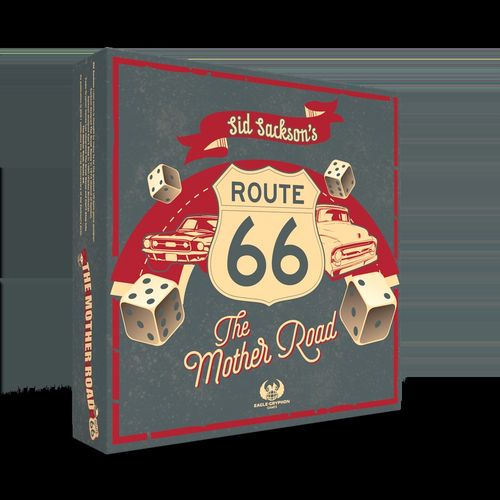
The Mother Road: Route 66
The Mother Road: Route 66 Rulebook
Table of Contents
Table of Contents
The Idea of the Game
Players try to score the most points by winning or placing second in races between segments of Route 66, The Mother Road, from Chicago to Santa Monica. To do this, they roll four dice and form two pairs which determine the segments they may race on during their present turn. Over the course of each turn, players may roll the dice as many times as they wish - provided that they can introduce or move at least one of their cars. If, after rolling the dice, a player is unable to introduce or move at least one of their cars, their turn ends and they lose everything they achieved during that turn. They should have stopped in time … but they didn't. Everybody wants to race along Route 66 just one more time … and then maybe just once more...
Segments and the Goal of the Game
The board has 11 segments shown along Route 66, numbered from 2 to 12. For instance, Segment #2 is designated by mile marker 2 and runs from Chicago to Springfield. This segment consists of 3 road spaces, 2 horizontal road spaces and a third vertical scoring road space which is divided into a 6 and a 3 scoring box. Each segment consists of a varying number of road spaces. The fewer spaces a segment has, the more difficult it is to roll the segment number, and vice versa. Advancing your car to the last scoring road space in a segment, the one bearing the scoring numbers, is the goal. Players try to score the most points in as many segments as possible before a total of 8 segments are completed, which ends the game. The player with the highest total score after the eighth segment is complete WINS.
Set Up
Roll out the game board in the center of the table. Each player chooses a car model (the color of which is now their player color) and takes the 3 cars of that color as well as the 11 cubes of that color. The youngest player (or someone else chosen randomly to be the starting player) takes the 4 dice.
How to Play
The starting player takes the first turn, then play continues in clockwise order. On a player's turn they roll all 4 dice at once. They must then form two pairs of dice with the numbers that they have rolled. The sum of each of these pairs determines the segment(s) in which the player must race during this turn. You may race in a maximum of three segments in any given turn.
First Roll (Fig. 2)
Anna starts. She rolls: blue 2, yellow 3, red 4, black 5.
The following options are possible:
A — blue 2, yellow 3 / red 4, black 5: Anna places her blue car on the first space of the #5 segment (from Lebanon to Tulsa) and another car on the first space of the #9 segment (from Winslow to Seligman).
OR
B — blue 2, red 4 / yellow 3, black 5: Anna places a car on the first space of the #6 segment (from Tulsa to Amarillo) and another car on the first space of the #8 segment (from Albuquerque to Winslow).
OR
C — blue 2, black 5 / yellow 3, red 4: Anna places a car on the #7 segment (from Amarillo to Albuquerque) and then moves it to the second space for the second 7 rolled.
To further clarify:
If a player forms two dice pairs that allows them to introduce (or move) two cars, they may do so. (In Fig. 2 above, option A or B, Anna may introduce either set of new cars this turn.)
However, a player may also deliberately form the two dice pairs so that they are able to introduce or move only one car on a turn (Fig. 2, option C).
If a player has introduced at least one car or moved at least one car, they may choose to stop and keep their progress OR risk that progress and continue playing by rerolling all 4 dice and again forming two dice pairs. After rerolling, they must introduce or move one or two cars (up to a maximum of 3 cars on 3 segments per turn).
Second Roll (Fig. 3)
Anna rolls for the second time on her first turn: blue 1, yellow 1, red 5, black 6.
She now has several options:
A — blue 1, yellow 1 / red 5, black 6: Assuming Anna chose option A or B on her first roll, she could now introduce her third car (the maximum number of cars she can introduce on a turn) on the first space of either segment #2 or segment #11. In this case the other dice pair is ignored. If she chose option C on her first roll, then she could introduce cars on both segments #2 and #11.
OR
B — yellow 1, black 6 / blue 1, red 5: If she chose option B on her first roll, Anna introduces the third car on the first space in segment #7 and moves the car in segment #6 one space further along.
Turns continue until the player either stops voluntarily or is forced to stop because they cannot introduce or move any cars.
Remember, players are restricted to racing a maximum of 3 cars on a maximum of 3 segments on any given turn. If a player stops voluntarily, they replace each of their cars on the game board with a cube of their color, which marks and retains their progress until their next turn. The player will never have more than one cube on any given segment.
If a player is forced to stop, because they were not able to introduce or move a car after rolling the dice, they lose everything they have achieved during this turn and must remove their cars without further consequence. In this case, this player neither places new cubes on the board nor moves any of their previously placed cubes.
At the start of their turn, if the player introduces a car in a segment in which they already have a cube, they place their car on the space further along the route from the space occupied by their cube. If they stop voluntarily later on this turn, they move their previously placed cube along Route 66 to this new space to which the car has advanced, and replace that car with their cube.
Note: When you encounter opponents' cubes on the game board while introducing a car or advancing a car, you simply jump one space ahead of the existing opponents' cube(s) (see Fig. 4).
Third Roll (Fig. 5)
Assume that Anna has chosen Option A on her first roll and Option A on her second roll. She has introduced cars on Segments 2, 5, and 9. Anna now has two options for her third roll:
A — She decides not to continue with a third roll and stops. She replaces her three blue cars with three of her blue cubes.
OR
B — She decides to keep rolling the dice and gets: blue 2, yellow 4, red 4, black 6.
Her turn ends because she cannot introduce a new car (she has already raced three this turn) nor can she move any of her cars on segments 2, 5, or 9. She then removes her three cars from the board and it is the next player's turn.
You always need to think about whether or not you're better off stopping voluntarily before losing everything you've gained during your turn.
Winning a Segment
If a player's car reaches the last space (the one with the scoring boxes) of a segment, they may continue to roll the dice or stop voluntarily. However, they should keep in mind that they cannot move this car any further – even if they roll this number on the dice. (This increases a player's risk of being forced to stop and consequently losing this segment.) Thus, it's probably a very good idea to stop voluntarily. In this case, the player replaces their car with their cube directly on the higher number of the scoring box. If one or more of the other players has arrived at a star space on this segment, the player who is on the more advanced space scores the points for second place (and places a cube on the lesser valued scoring box). If no player has reached a star space, then no points are awarded for second place. All of the other cubes in this segment are then returned to their owners, and a STOP token is placed on this segment. For the rest of the game, no player can place a car in this segment, including the player who has won this segment.
End of Game
When 8 of the 11 segments are awarded (there are now 8 STOP sign tokens on the board) the game ends and the player with the highest total score is the winner. In the case of a tie, the player who was last in turn order among the tied players is the winner.
Variations
#1 – A More Leisurely Drive
For a longer game, play to finish all 11 segments (ten STOP tokens placed) instead of just 8.
#2 – A Faster Gear (Fig. 6)
Players must introduce their cars as soon as possible. It is not possible to deliberately avoid doing this in this variation. At the beginning of their turn, they must form dice pairs in such a way as to introduce or advance two cars, if possible. After this turn, they must introduce (and/or advance) the third car as soon as possible.
Claudia Rolls (Fig. 6): She rolls blue 1, yellow 1, red 4, black 5. Segment 6 has already been won. Claudia has to choose the combination: blue 1, yellow 1 / red 4, black 5 — because with the combination blue 1, red 4 / yellow 1, black 5 she would only be able to introduce a single car. Next, Claudia re-rolls the dice: blue 1, yellow 1, red 3, black 6 — she may not move the two cars in segments 2 and 9, but has to introduce the third car: either in segment 4 or in segment 7, with the combination blue 1, red 3 / yellow 1, black 6.