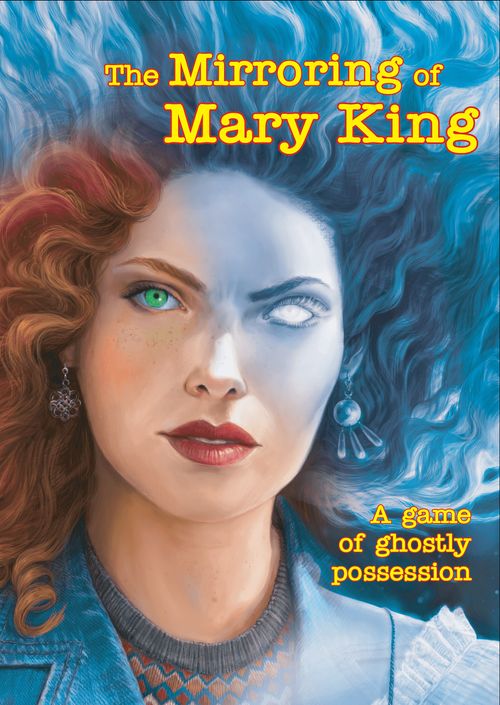
The Mirroring of Mary King
The Mirroring of Mary King Rulebook
Table of Contents
Table of Contents
Preliminaries
Components
The game components include this rule book and:
- 12 Mary King Psyche Tiles
- 1 Game Tracker (neoprene mat)
- 3 Glass Tracker Markers (1 red, 1 blue, 1 yellow)
- 8 Glass Lockdown Markers (black)
- 4 Prerogative Tokens (mortal side and ghost side)
- 60 Common Control Cards (30 mortal, 30 ghost)
- 12 Common Power Cards (6 mortal, 6 ghost)
- 12 Unique Power Cards (6 mortal, 6 ghost)
- 2 Reference Placards
Keywords
- Control Cards — These cards say Control on them and force specific tiles of Mary's psyche to flip.
- Power Cards — These are all the cards that are not control cards. A power card offers a choice of two possible effects.
- Mind — Your mind is your deck of cards.
- Memory — Your memory is your discard pile.
- Ideas — Your ideas are your sideboard.
- Resolve — A card resolves when it delivers its effect.
Table Seating
Players sit next to each other at the table with Mary's tableau upright in front of them. This makes it easier to make sense of the tableau and reinforces that both players are part of the same person.
Game Setup
Step 1: Construct Mary's Psyche
Place the 12 tiles of Mary's psyche on the table in easy reach of both players. Arrange the tiles with their control alternating between the mortal player and the ghost player.
Step 2: Place the Game Tracker
Place the game tracker mat on the table beneath the tableau of Mary's psyche. Put the yellow day counter on Monday.
Step 3: Assemble Your Mind and Ideas
You construct your mind and ideas using the card set for your role. The cards with mortal Mary on the back are for the mortal player; the cards with the ghost on the back are for the ghost player. To construct your mind and ideas:
- Shuffle your set of 30 control cards. Set the top six cards in one stack and the remaining 24 cards in a second stack. Don't look at the cards.
- Shuffle your set of 12 power cards. Put six of those cards on top of each of your two stacks of control cards. Shuffle together the larger 30-card stack of control and power cards. This deck is your mind. Shuffle the smaller 12-card stack of control and power cards. This deck is your ideas.
- Place your mind on the table to one side of the game tracker. Divide your idea deck into three stacks of four cards each and place them along your side of Mary.
Playing the Game
Starting Hand and Maximum Hand Size
Both players draw a hand of five cards from the top of their mind to start the game. There is no maximum hand size.
Turns
Both players get one turn each day. The ghost player takes their turn first each day. Except for specifically noted flash effects, you may play cards only on your turn.
Tracking Turns
At the start of your turn, move the blue idea counter to the left of the Idea Track (A) and the red control counter to the right of the Control Track (B) on the game tracker.
Each time you buy an idea, move the idea counter one space to the right along the Idea Track. This counts how many ideas you've purchased during your turn.
Each time you play a control card, move the control counter one space to the left along the Control Track. This counts how many control cards you've played during your turn.
Tracking Days of the Week
Advance the day counter on the game tracker from the current day of the week to the next day of the week after the mortal player ends their turn.
Taking Your Turn
Your turn consists of four phases executed in order. Your opponent's turn begins after end of turn penalties.
Phase 1: Gather Your Thoughts If you have fewer than five cards in your hand at the start of your turn, you must draw cards from the top of your mind to fill your hand to five cards.
Phase 2: Get New Ideas Take the top card from each of your three stacks of ideas and place it face up next to the stack it came from. If a stack of face up cards is already there, put the card on top of that stack. (You will run out of new ideas on Thursday.)
Phase 3: Buy and Play Cards This is when you buy ideas and play cards. You may only play ideas you buy or cards you have in your hand. You may buy ideas and play cards in any order, and you may buy as many ideas and play as many cards as you want subject to the daily limits noted on the game tracker.
To play a card, place it face up on the table and resolve its effect. After the effect resolves, place the card face up on top of its owner's memory. You are not required to buy ideas or play cards on your turn. When you are finished, announce that you are done to end the phase.
Phase 4: Psychic Turmoil Both players pay their end of turn area control penalty, then the turn ends.
The next player begins their phase 1. Advance the day counter if the mortal's turn just ended.
Daily Card Limits
There are limits to the number of control cards you may play and ideas you may buy on your turn. These limits change each day and are noted on the game tracker. For example, you may buy up to three ideas and play up to three control cards on Wednesday. On Thursday, you may buy up to four ideas but play no more than two control cards.
The number of power cards you may play on your turn is not limited.
Resolving Card Effects
You must fully resolve the effect of a card before you put it into its owner's memory. For example, if you play Restoration to shuffle cards from your memory into your mind, you must complete that process before you put Restoration into your memory.
Cards that are negated or removed from the game do not resolve. Cards that go directly into memory as the result of a discard or buying an idea do not resolve.
Discards
Cards you are forced to discard go face up on top of their owner's memory. You may discard cards from your hand only when allowed to do so or forced to do so by an ability or card effect.
Winning and Losing the Game
There are three game end conditions:
- You win the game immediately if you control all 12 tiles of Mary's psyche.
- You lose the game immediately if you don't have enough cards in your mind to make a required discard, comply with a card effect, pay an area control penalty, or draw your hand up to five cards at the start of your turn. If this happens to both players on the same day, Mary's body dies and both players lose.
- If neither player has won when the mortal player ends their turn on Friday, each player calculates their final game score and the higher score wins. Your score is the number of cards you have remaining in your mind plus a control bonus for the number of tiles of Mary's psyche you control at the end of Friday.
If there is a tie, the player with the largest area of control wins. If there is still a tie, the player who owns the game wins. If neither player owns the game, award the victory to the next person you meet and have fun explaining their victory to them.
Game Mechanisms
Mary's Psyche
Mary's psyche is represented by 12 tiles set in a 4 x 3 grid. Each tile represents a portion of Mary's complete mind. The color and image on a tile designates which player controls it. The color tiles depicting mortal Mary are controlled by the mortal player; the blue tiles depicting the ghost are controlled by the ghost player.
Control Cards
Control cards allow you to flip the tiles of Mary's psyche. Each control card displays a 4 x 3 grid of rectangles with one or more of the rectangles colored red.
When you play a control card, align the card with the 4 x 3 layout of Mary's psyche and flip over all the tiles of Mary's psyche that correspond to a red rectangle on the control card. You must flip over every tile dictated by the control card.
A control card resolves after all the designated tiles of Mary's psyche have been flipped over. Place the control card face up on top of its owner's memory after it resolves.
You may play a control card in either of two orientations: as the card appears as you look at it in your hand or rotated 180 degrees.
Controlling Tiles
When you flip a tile to your color, you gain control of that tile. The mortal player controls the color tiles. They want to eliminate all the blue tiles to ward off the ghost. The ghost player controls the blue tiles. They want to eliminate all the color tiles in order to possess Mary.
Two players can each control the same number of tiles of Mary while having their tiles clustered differently, giving them different areas of control.
Areas of Control
A player's areas of control are blocks of tiles they control that are adjacent to each other and share an edge.
For example, a player might control one area of one tile and one area of five tiles, giving them a largest area of control of five. Their opponent might control two areas of one tile each and one area of four tiles, giving them a largest area of control of four. At the end of each player's turn, both players take note of their largest area of control to determine their opponent's area control penalty.
Area Control Penalty
Both players suffer an area control penalty at the end of each player's turn (i.e., twice each day). The penalty is the number of cards they must discard from their mind and is determined by their opponent's largest area of control.
For example, suppose that at the end of the turn your largest area of control is size four and your opponent's largest area of control is size six. Your opponent would have to discard one card from their mind into their memory, and you would have to discard two cards from your mind into your memory.
Power Cards
Power cards allow you to affect tiles, minds, memories, hands, and ideas. Each power card offers two effects and you must declare which effect you will use when you play the card. For example, if you played Force of Will, you would have to choose whether to flip any one tile (top effect) or flip all the tiles in a row or column of Mary's psyche (bottom effect).
A power card resolves when it fully delivers its chosen effect. Place the card on top of its owner's memory after it resolves.
It bears repeating that there is no limit to the number of power cards you may play on your turn.
Normal and Flash Effects
A power card may deliver a normal effect or a flash effect. The Torment and Forget cards each offer a normal effect and a flash effect. Normal and flash effects differ in when they may be used:
- Normal Effect. You may play a power card for a normal effect only on your turn.
- Flash Effect. You may play a power card for a flash effect at any time, including on your opponent's turn. A flash effect played in response to a normal effect resolves before the normal effect. A flash effect played in response to another flash effect resolves before the first one. Multiple flash effects stack on top of each other and resolve in reverse order.
For example, suppose your opponent hit you for a two-card area of control penalty at the end of their turn. You could use the Torment flash effect to force your opponent to discard those two cards from their mind instead of you. However, your opponent could respond to your Torment with the Forget flash effect to keep your Torment from resolving and remove it from the game. Since their Forget flash effect was in response to your Torment flash effect, their Forget would resolve first.
Recall and Bury Effects
Some power cards will have a recall symbol or a bury symbol on the lower right. The Mirroring card has the recall symbol. The Purgation card has the bury symbol.
- Recall. You may choose to recall a card with the recall icon after it resolves rather than place it on top of your memory. To recall the card, place the top card of your mind on top of your memory and then shuffle the recalled card into your mind. You cannot recall cards that don't resolve. You cannot recall cards played by your opponent.
- Bury. When a card with the bury icon resolves, put it on the bottom of your memory instead of the top. You do not bury cards that don't resolve. You do not bury cards played by your opponent.
Ideas
Your three stacks of face down cards on your side of Mary's psyche are your ideas. Your opponent's ideas are the three stacks of face down cards on their side of Mary.
Current Ideas
Once you begin revealing idea cards, the top card on each face up stack of idea cards is the current idea for that stack. When a new card is added to that stack, the new card becomes the current idea for that stack. When a card is removed from a face up stack of idea cards, the card that was beneath it becomes the current idea for the stack after the action or card effect that revealed it resolves.
Buying Ideas
You may buy ideas only on your turn and you may buy only current ideas. You may buy your own current ideas or your opponent's current ideas. The cost to buy an idea is one card from your mind: you must discard the top card of your mind for each idea you buy.
If you buy one of your own ideas, take that card and put it into your hand.
If you buy one of your opponent's ideas, you must play the card immediately upon purchase.
You may not buy one of your opponent's ideas if you cannot play it immediately. (E.g., you can't buy a control card if you've already reached your limit on control card plays for the day.)
References and Options
Reference Placards
The two reference placards have icon and idea buying guides on one side, and mortal and ghost special abilities on the other. The mortal and ghost abilities are relevant only if you choose to include them in your game.
Desperate Ingenuity allows the mortal to enrich their hand by drawing extra cards from their mind. Haunting Recollection lets the ghost overwrite their current ideas with recently played cards.
Special Abilities (Optional)
We recommend playing the game a few times before you consider adding in the mortal and ghost special abilities. These abilities increase strategic depth but add complexity.
Adding Special Abilities to the Game
The mortal and ghost special abilities are provided on the backs of the reference placards. To add these abilities to your game, place the four prerogative tokens beneath the game tracker during setup and start with two tokens displaying mortal Mary and two tokens displaying the ghost.
Using Special Abilities
You may use your special ability only on your turn. To use it, flip a prerogative token from your face to your opponent's face and then execute your ability's effect. You must be able to flip a prerogative token from your face to your opponent's face each time you want to use your special ability. You may use your special ability as many times as you want if you have the prerogative tokens to activate it.
Remember: every time you use your special ability, you give your opponent another opportunity to use theirs!