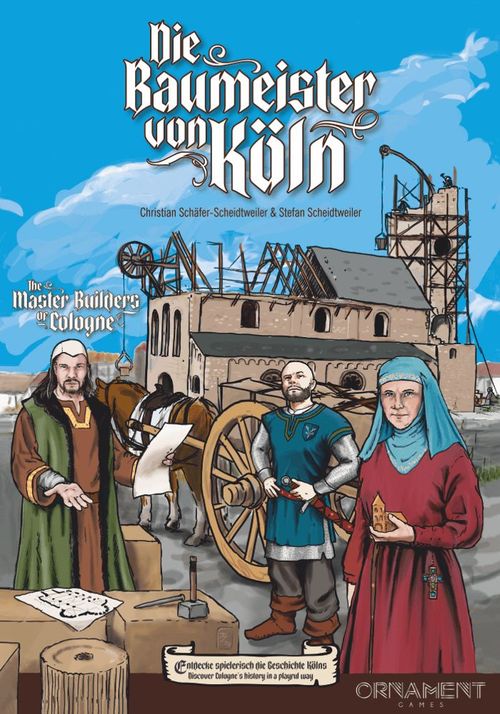
The Master Builders of Cologne
The Master Builders of Cologne Rulebook
Table of Contents
Table of Contents
Game Material
The box contains the following game material:
- 1 game board
- 2 game rule booklets (German / English)
- 1 quick guide: Sequence of play
- 1 information card: Förderverein
- 12 square construction site tiles
- 12 selection cards (light backs)
- 30 encounter cards (dark backs)
- 1 brown building stone die
- 1 black city gate die
- 4 cylindrical hammer markers
- 8 cart tokens: 2 x red, 2 x yellow, 2 x green, 2 x blue
- 50 cubic building stone tokens: 20 x white, 15 x grey, 15 x black
Aim of the Game
The players assume the role of medieval master builders. They compete against each other to be declared Cologne's greatest master builder. For this purpose, they have two carts that they use to transport building stones from the city gates to the church construction sites as efficiently as possible. There they unload them, thus ensuring that construction progresses. A church is completed when the required total number of building stones has been delivered. The fame of completion is awarded to the master builder who has contributed the most points to that church. They are not only credited with the points they delivered themselves, but also with the total value of the building.
End of the Game
The game ends as soon as a master builder is declared the winner by being the first to score (at least) a prescribed number of points. To do this, they must collect construction site tiles and encounter cards with the following total value and lay them down as follows:
- 2 master builders: 35 points
- 3 master builders: 25 points
- 4 master builders: 20 points
The winner, as a matter of honour, gives their competitors, who at this point have made one turn less than themselves, the opportunity to make up for this turn. If they are outscored in points, they must even surrender the victory. If the score is then tied, the game ends in a draw.
Game Preparations
Before the game begins, the game board is laid out in the middle of the table together with the 2 dice. The cards Förderverein and Sequence of play are removed from the card deck. The 30 encounter cards (dark backs) are shuffled and placed face down next to the game board. The 12 square construction site tiles are placed on the ground plans next to the respective churches with the inscribed side facing up.
The 50 building stone tokens are placed together in a supply pile. From this pile, 1 white token is placed in the storage area at each of the 5 city gates I to V (i.e., a total of 5 white tokens is taken from the supply pile).
Every master builder chooses a colour and receives the 2 corresponding cart tokens. In a game with 2 master builders, the first places their carts on each of the 2 dots on the game board marked (1), the second places theirs on the dots marked (2). In a game with 3 or 4 master builders, the dots marked (3) and (4), respectively, are used. These starting positions provide all the master builders with equal opportunities at the start of the game. Any carts in unused colours are put back into the box.
The 12 selection cards (light backs) are shuffled and placed face down in a deck. For selecting the first construction site group: 4 cards are drawn from this deck and 1 hammer (cylindrical marker) is placed on each of the construction site tiles of the churches depicted on them. These 4 selection cards are then removed.
Order of Play
The 2 or 3 square symbols depicted on the construction site tiles indicate which building stones may be delivered to each site. The building stones and points stones are worth 1, 2 or 3 points. The black building stones are not permitted at some of the construction sites. Furthermore, the construction site tiles show the value of points required to complete the church.
Grouping the Construction Sites
Master builders may not begin building on any arbitrary church. The 12 churches are separated into 3 groups of 4 construction sites each. These 3 groups are sequentially released for all players to build. For this purpose, 4 church construction sites at a time are determined by drawing 4 selection cards and marking the corresponding construction site tiles with the 4 hammers. Building stones may only be delivered to construction sites that are marked in this way or on which, as a result, building stones have already been placed. The 4 selection cards are then removed. Marking the first group of construction sites is part of the game preparations (see Game Preparations).
Building
The construction of a church begins when a master builder unloads the first delivery of building stones from one of their carts at any construction site that is marked with a hammer. The hammer is then taken from the construction site tile and placed in the designated area in the upper right corner of the game board. The master builder making the delivery turns the construction site tile over to its coloured side. They then unload the delivery from their cart onto the area in their colour. Each master builder places the building stones they deliver on their designated area on the construction site tile. In this way, the contribution of each master builder to the construction is apparent.
Releasing the Next Group of Churches for Construction
As soon as all 4 hammers have been removed from the construction site tiles and have been placed in the area in the upper right corner of the game board, the 4 churches in the next group can be released. Please note: This does not require the 4 churches from the previous group to be complete, only that construction on all of them has begun. The master builder whose turn it is immediately releases the next 4 construction sites by drawing 4 more selection cards from those remaining, placing the 4 hammers on the corresponding construction site tiles and then removing the 4 selection cards (see Grouping the Construction Sites). The master builder can now start to build on these new construction sites during this turn.
Uncompleted Churches
Building may continue on all churches that have not yet been completed. Thus, more and more opportunities for building are added.
Earn Points by Completing a Church
A church is completed when the exact number of indicated points is reached (between 4 and 8 points). For this purpose, the points of the building stones delivered by all the master builders are totalled. Therefore, the last building stone must be chosen in such a way that it exactly hits and does not exceed the indicated number of points.
The master builder that has contributed the most points to the construction of the church is credited with all the points for that church. Only in the case of a tie will the master builder who has unloaded the last building stone be credited with the points.
Special situation: Several master builders have contributed the same number of points to the construction of a church so far. A further master builder reaches the required total number of points by delivering fewer points. In this case, the master builder who (a) has contributed the most points AND (b) of those had placed the last building stone is the winner.
The master builder credited with these points then takes the construction site tile from the game board and immediately places it on the table in front of them with the name of the church facing up. The other master builders are left empty-handed. It is no longer possible to build here. All the building stones used for the construction of this church are then returned to the supply.
Additional Points with an Abbot or Abbess Card
If the successful master builder has the corresponding abbot or abbess encounter card, they can place it (either immediately or later on) next to the construction site tile they have won and thus score 2 additional points.
Score
The current score can always be determined by totalling the points on the table. Points can be gained by completing churches, by playing abbot or abbess cards and by using archbishop cards (see Encounter Cards, and End of the Game).
Taking Turns
The master builders take turns in a clockwise direction. The player who was the last to work with a hammer begins.
Each turn includes:
- Rolling the dice: Supplying building stones or drawing an encounter card
- Performing actions
Encounter cards may be played at any time during a master builder's own turn.
1. Rolling the Dice
Building stone die: The master builder rolls both dice at the same time. The brown building stone die shows which type of building stone can be supplied to Cologne (white = 1 point | grey = 2 points | black = 3 points). If an X symbol is rolled, no building stone may be delivered.
City gate die: The black city gate die indicates which city gate (I - II - III - IV - V) the building stone with the value just determined can be supplied to. The master builder takes a corresponding building stone from the supply and places it in the storage area in front of the indicated city gate. If all 3 spaces at the gate are already occupied, the new delivery is forfeited.
Encounter card: If the card symbol is rolled, no new building stone can be supplied to Cologne. In this case, the result of the building stone die is irrelevant. The master builder draws an encounter card and looks at it secretly. They can then play it immediately, discard it face down or place it face down on the table in front of them (see Encounter Cards). Each master builder may keep a maximum of 3 encounter cards. Face-up cards that have already been played do not count. If a fourth card is drawn, it can be looked at before 1 of the 4 encounter cards is discarded. Only then may the remaining 3 cards be played.
Insufficient building stones: If there are no more building stones left in the storage areas and the dice result has not generated a new building stone or encounter card, the master builder rolls the dice again until a building stone or an encounter card has been assigned to them.
2. Performing Actions
Each master builder may perform 4 actions during their turn, which they can allocate freely between their 2 carts. They can choose out of 5 different actions. Any action, except that of Moving a cart, ends the turn for the cart involved: After building, loading or unloading and after visiting the Archbishop, the remaining actions must be performed using the other cart or otherwise they will expire.
| Action | Effect |
|---|---|
| Moving a cart | Move 1 cart 1 dot or 1 field further on the game board (see Move Carts through the Streets). Up to 4 times! |
| Building | Deliver 1 building stone to your designated area (in your colour) at a construction site. |
| Loading | Load 1 of the building stones stored at any of the city gates by placing it in the empty cart. Each cart can carry only 1 building stone. Loading any building stone from construction site tiles is forbidden. |
| Unloading | Unload at a city gate 1 building stone that is no longer needed and was previously loaded, providing there is free space in the storage area for it. |
| Visiting the Archbishop | Visit the Archbishop in the Cathedral (Dom), provided you have been invited to do so previously through an encounter card. |
Building, Loading, Unloading and Visiting the Archbishop: These actions end the turn for the cart involved!
Please note: The arrival of a cart at a city gate, a construction site or the Cathedral (Dom) does not include loading or unloading building stones or a visit to the Archbishop. Separate actions are required for each of these!
Move Carts through the Streets
The carts move along the roads from a red dot or field to the next, costing the master builder 1 action each time. If all 4 actions are used up on moving 1 cart, a distance of 4 dots or fields may be covered in 1 turn. It does not matter whether the cart is loaded or empty.
Only 1 cart at a time can occupy the small red dots. That cart then blocks the passage for all other carts, including the second cart of the same colour. Jumping or bypassing carts is not permitted here.
The 12 large circles with no symbol at the centre are the construction site fields that have each been assigned a ground plan drawing. Any number of carts may access the construction site fields, and carts can both stop and pass each other here.
The circle with the crosier at the centre is the Cathedral (Dom) field. Here, too, any number of carts have access. Master builders may not build at the Cathedral, but can visit the Archbishop with a corresponding encounter card (see Encounter Cards).
The 5 large rectangles at the edge of the city are the city gate fields, which also have adequate space for multiple carts. A storage area for 3 building stones is assigned to each of these. They are assigned the Roman numerals I to V; these numerals are also displayed on the city gate die.
The green cart in the centre of the printed example board has these options for moving (if all 4 actions are used for moving it).
Load No Longer Required
Unloading a building stone that has already been loaded and is no longer needed is only possible in the free storage areas of the city gates. Master builders who want to exchange the load on their cart for another building stone must note that both unloading and loading will cost them 1 action each as well as end the turn for that cart.
Action Forfeiture
Actions are forfeited if both carts are no longer allowed to perform actions. The voluntary renunciation of actions is also permitted.
Encounter Cards
If a master builder rolls the card symbol, the top encounter card in the pile must be drawn. After looking at the card, the master builder may then either play it immediately, discard it face down or keep it for later use by placing it face down on the table in front of them. A maximum of 3 encounter cards may be saved for later. Cards that have already been played and are lying face up no longer count. If a fourth card is drawn, the master builder must decide, after looking at it, which of the 4 cards to discard. Only then may the remaining 3 cards be played.
Encounter cards can be played at any time during a master builder's own turn (exception: see Guard). Up to 3 encounter cards can be played in 1 turn. If nothing else is stated, encounter cards are discarded face down after being played. Unwanted encounter cards may also be discarded face down at any time during the turn. When the encounter card pile is finished, the discarded cards are shuffled and used as a new pile.
Abbess of St. Cäcilien, Abbot of Groß St. Martin, Abbess of St. Maria im Kapitol, Abbot of St. Pantaleon
If a master builder completes one of these churches and plays the corresponding abbot or abbess card in their possession, they receive 2 additional points. The card is placed face up next to the matching construction site tile.
Mayor (4 x)
The Mayor grants the master builder the privilege of a complete second turn directly after their first turn. The dice are also rolled again.
Thief (2 x)
A master builder can use this card to draw 1 of the still unplayed cards of a competitor of choice without previously looking at it. Once they have looked at this card, the master builder can either keep it, discard it or play it immediately. If the victim is in possession of a Guard, this card can be used to prevent the theft.
Archbishop (4 x)
The Archbishop of Cologne will grant an audience to a master builder who is in possession of this card and who moves one of their carts into the Cathedral (Dom) field. The Archbishop then gives the master builder 2 additional points. A visit to the Archbishop requires 1 separate action and ends the turn for the cart involved. This card is then placed face up on the table together with the other points of the concerned master builder.
Poisoner (2 x)
A Poisoner can attack and thus weaken another master builder. When the card is placed face up in front of the competitor, the competitor may only perform 2 actions on their next turn rather than the usual 4. If the victim is in possession of a Guard, this card can be used to prevent the attack.
Trader (4 x)
With the help of a Trader, the value of 1 building stone in any of the 5 storage areas at the city gates is increased or decreased by 1 point and the building stone is accordingly exchanged for another from the supply. Thus, the supply of building stones required by a master builder for their own purposes can be adapted. Likewise, a master builder can sabotage a supply that a competitor is wanting to pick up at a city gate. For this, the position of the carts is irrelevant.
Notary (2 x)
Using a Notary, a master builder can secure the exclusive rights to build on a construction site. For this they must have contributed the most points to this construction site so far (even if the points are the same as a competitor's). The notary card is placed face up in front of the master builder together with the selection card of the corresponding church. The church can now be completed calmly and without competition. All the building stones that have already been delivered to this construction site remain there. Using the second notary card at the same construction site by another master builder as well as defending against the attack with a Guard is not permitted.
Saboteur (2 x)
The Saboteur is used to attack another master builder who then misses 1 turn. When a master builder uses this card, they place it face up on the table in front of the victim until the victim's next turn would have taken place. If the victim is in possession of a Guard, this card can be used to avert the sabotage.
Forger of Documents (2 x)
With the help of the Forger, a master builder changes the proportion of possession on a construction site where both they and at least 1 competitor are already working. The position of the carts is irrelevant. This card is used to swap 1 building stone on the construction site tile that has been delivered by the master builder for 1 competitor's stone stored at the site. This is also allowed if the master builder has only just placed their first building stone at the site in the same turn. Defending this action using a Guard is not permitted.
Guard (4 x)
A Guard may be used once to defend against a Thief, a Poisoner or a Saboteur. Both cards are subsequently discarded. This card may not be played during a master builder's own turn.