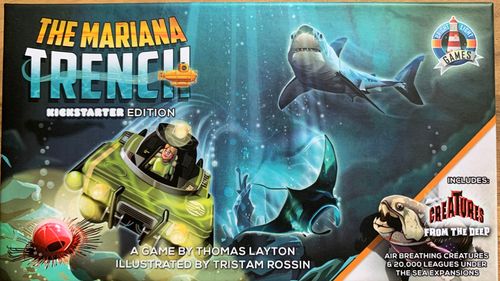
The Mariana Trench
The Mariana Trench Rulebook
Table of Contents
Table of Contents
Contents
Cards:
- 2 Submarine cards
- 1 Research Ship card
- 1 Mariana Trench Floor card
- 16 Research cards
- 3 Oxygen Tank cards
Tokens:
- 8 Research tokens
- 2 Charge tokens
- 6 Popped-Rivet tokens
Setup
- Place the Research Ship card between the two Submarine cards (one Submarine on each side).
- Place 4 Research cards face down between the Research Ship and the Mariana Trench Floor to create the Water Column.
- Shuffle the remaining Research cards to create a draw pile. Place the 3 Oxygen Tank cards at the bottom of this deck in descending order, so that Oxygen Tank 1 is at the very bottom of the deck.
- Place 1 Charge token on each sub.
- Keep the Popped-Rivet tokens and Research tokens as supplies.
Card Anatomy
Submarine card: Charge, Research, Rivets, and (bottom left) Hold size, Depth Range and Sonar.
Research card: Creature Class, Creature Size, and Submarine Upgrades.
Examples of hold icons and upgrade
- Small creature icon
- Large creature icon
- Large hold upgrade
Deep-sea creature classes
Epipelagic, Sharks, Cephalopods, Deep-Sea.
Gameplay
The goal of The Mariana Trench is to score the most research points (RPs) by researching deep-sea creatures at the floor of the trench. The game is played in alternating turns until your submarines run out of oxygen.
The starting player is whoever was last in an ocean or the youngest player.
On your turn, you may:
- Move your Submarine, and then conduct your research in the water column or on the trench floor.
OR
- Recharge your submarine.
Submarine Movement
Movement from one card to the next represents a distance of 1000 Fathoms. At launch your sub can move up to 2000 fathoms (2 cards) on your turn. You will be able to upgrade your submarine to move an additional 1000 fathoms (1 extra card).
You must make all your movement in one direction, and cannot interrupt your movement to take any other action. Unused movement is wasted. Your movement allowance is refreshed at the beginning of your turn.
Research in the Water Column
When researching the water column, reveal the (research) card next to your sub. Each card displays a deep-sea creature and a submarine upgrade. You may:
- Collect the deep-sea creature, or
- Upgrade your Submarine
If you do not collect the creature or upgrade your sub then leave the card face-up, where either player may collect it on a future turn.
Collecting Deep-Sea Creatures
If you have hold capacity you may tuck the research card under your sub (to the right), so that the class and size of the creature shows.
Your sub starts with a small hold, which can carry one small creature. To collect large creatures you must upgrade your hold first.
Delivering Deep-Sea Creatures to the Research Ship
When your sub surfaces, all the creatures carried are offloaded to the research vessel. At the end of the game points are scored for different sets of creatures (see End of Game).
Upgrading Your Submarine
If you do not collect the sea creature then you can upgrade your sub. Tuck the card under your sub (to the left) so that the upgrade is showing. You cannot take the same upgrade twice.
There are three upgrades available for your Submarine:
- Increased Hold: You may now carry 1 large or 2 small creatures.
- Increased Movement: You can now move up to 3000 fathoms (3 cards) up or down.
- Sonar: Use your navigation technology to see what lies ahead. At any time on your turn you may look at an unrevealed card in the space immediately above or below your current position. Return the card to the water column face down.
Note: Research cards that have been used as upgrades do not count as creatures when calculating your end of game score.
Special Cards
Cephalopod Attack!
Some creatures you encounter are dangerous. When a cephalopod is first disturbed (revealed) it will attack your sub, causing it to pop a rivet. Take a rivet token from the supply. Each popped rivet deducts 2RP from your score at the end of the game. -2RP at the end of the game.
If your sub has a charge token then you can stun an attacking Cephalopod with an electric shock. You return the charge token to the supply and take no damage.
If you have capacity in your hold, you may still collect the Cephalopod (if you have available space and a large hold upgrade) or leave the card face up for either player to collect on a future turn. Cephalopods only attack the turn they are revealed.
Oxygen Tanks
When the Oxygen tank cards are revealed this indicates the game is ending. There are 3 cards showing decreasing amounts of oxygen. When the third tank card is added to the water column, the game immediately ends. (see end of game).
Research on the Trench Floor
Each time your sub reaches the trench floor you can conduct valuable scientific research. Take 1 research token from the supply and place it on your submarine. Your sub can only carry one research token at a time. The token is offloaded as soon as you surface beside the research vessel. Research tokens are worth 2RP at the end of the game.
Recharge Your Submarine
When you surface beside the research vessel you may also recharge your sub to protect it from Cephalopod attack. You must spend 1 turn beside the vessel taking no other action. Place a charge token on your sub. Your sub cannot carry more than 1 charge token.
Ending Your Turn
If, on your turn, a Research card was removed from the Water Column, slide all cards down one space (1000 fathoms) toward the Trench Floor. Draw the top Research card from the draw pile, and place it face down in the empty space at the top of the Water Column. The next player may now begin their turn.
End of Game
The game ends immediately when the final Oxygen tank card is revealed. All subs surface and unload any creatures and research tokens they are carrying.
- Research tokens: +2RP
- Popped rivet tokens: -2RP
- Each individual creature can be scored in both a set of different types of creature (a run), and for how many of the same class you collected (a set; see the diagram).
Research Points
| Run | RP | Of a kind | RP |
|---|---|---|---|
| Run of 2 | 2 | 2 of a kind | 2 |
| Run of 3 | 4 | 3 of a kind | 4 |
| Run of 4 | 7 | 4 of a kind | 7 |
2 points per Research collected.
Each creature can be scored once in a set and once in a run (see image). The diagram shows the four classes (Epipelagic, Shark, Cephalopod, Deep-Sea) stacked vertically as a run, and four Epipelagic creatures side by side as an "of a kind".
In the event of a tie, the player with the most Research tokens is the winner. If still tied, the player who collected the most deep-sea creatures is the winner. If still tied, the player with the most Submarine upgrades is the winner. If still tied, play again to determine the winner.
Solo Version
Playing The Mariana Trench solo, you compete against an AI Sub which follows a set of rules.
A.I Submarine
- From the research vessel the AI Sub descends to its max range; reveals the research card; loads it if possible. If the creature is too large or the hold is full then the card is taken as an upgrade. If the upgrade cannot be taken then it remains in place face up.
- When the sub reaches the trench floor it collects a research token.
- Once a research token is collected it will ascend to the research vessel at its maximum movement each turn; it does not reveal or collect any research cards on its ascent.
- When the AI sub surfaces it unloads all creatures and tokens.
- This is repeated until the game ends. The AI sub is not attacked by Cephalopods and does not need charge tokens. If it reveals a Cephalopod it will load it if possible, or leave it face up if not. The Cephalopod has now been disturbed and will not attack another sub on a subsequent turn. The AI sub may upgrade Sonar but does not use it.
Solo End of Game
The game immediately ends when:
- The last Oxygen tank enters the Water Column.
OR
- The AI sub offloads 4 Research tokens.
OR
- Your Submarine pops 2 rivets.
Calculate your score as usual. When calculating the AI's score, do not count any Research tokens it collected.
Subtract the AI's score from your own, and try to get the highest score!
Solo Ranking
| Score | Rank |
|---|---|
| 2-6 | Field Assistant |
| 8-11 | Apprentice Lab Technician |
| 12-16 | Marine Biology Technologist |
| 17-21 | Post-Doctoral Fellow |
| 22+ | Professor of Marine Ecology |