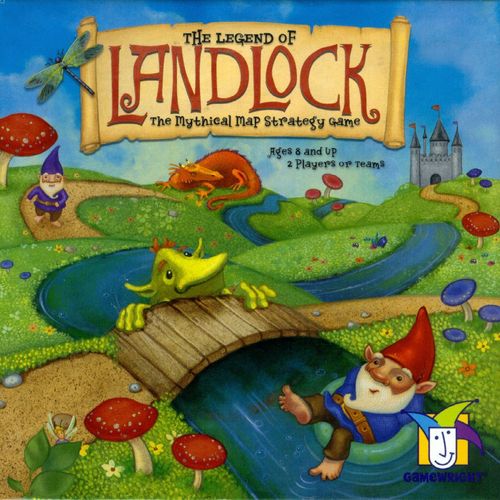
The Legend of Landlock
The Legend of Landlock Rulebook
Table of Contents
Table of Contents
Rules of Play
Contents
40 Map Tiles:
- 17 Streams
- 17 Paths
- 3 Bridges
- 3 Tussocks
1 Score Pad, 1 Pencil
Object
To create a map of Landlock and score the most points.
Points are scored:
- By connecting all four sides of Landlock with a continuous path or stream.
- By creating islands or ponds for your opponent.
- By placing Roaming Gnomes so they face each other.
- By turning over Tussock tiles.
Set-up
Select one player to keep score. Shuffle the map tiles and scatter them face down in the center of the playing area. Determine order of play by taking turns flipping over tiles until one player reveals a tile featuring a Roaming Gnome. That player goes first and chooses whether she wants to be Land or Water. (Land creates paths; Water creates streams.) Re-shuffle and stack the tiles face down either in a loose pile or in several stacks within reach of all players. (Players may draw from anywhere in the loose pile or from the top of any stack.) Whoever goes first draws a tile and places it face up in the middle of the playing area.
Note: In a four-player game, form two teams (two play Land, two play Water). Team members should sit opposite each other and may help figure out the best placement for their tiles. Play rotates clockwise.
Game Play
On your turn, draw a tile and place it face up next to a tile already in play. Tiles must line up squarely and must match up, water to water and land to land.
Notes:
- Landlock can be no longer than six tiles in any direction. Once there are six tiles in a row or column, no tile may be placed beyond that point in any other row or column.
- During your turn, you may explore all of the possible positions for your tile. However, you cannot move it once you place it on the board. Think carefully before you play!
Islands and Ponds
While you are trying to connect paths or streams, you can also block your opponent by creating islands or ponds. (If you're land, you want to create ponds; if you're water, you want to create islands.) At the end of the game, score 4 points for every island or pond you create.
Note: Incomplete islands and ponds touching the edge of the board at the end of the game don't count. Islands and ponds are not limited to four tiles.
Special Tiles
Roaming Gnomes
Several tiles feature a gnome in the corner. If you place one of these tiles next to another so that the gnomes face each other, you score 1 point per facing gnome in your area at the end of the game. Gnomes can be paired up diagonally or side by side. Facing gnomes must be of the same type.
(Illustrated examples: a pair of facing gnomes on Land scores 2 points; three facing gnomes on Water scores 3 points.)
Tussocks
Tussocks have a happy creature in the middle of a grassy patch, as well as part path and stream in each corner. Use them to help build islands or ponds. Score 1 point immediately for turning over a Tussock.
Bridges
The best way to undo an island or pond is to draw a Bridge tile. Bridges join paths and streams and cancel out any island or pond in progress or in play. Here's how you play them:
- The player who draws the Bridge tile gets to remove one tile from the game board and place the bridge where the tile used to be.
- Instead of drawing another tile, the next player must play the tile that was removed.
Exceptions: Players can't remove Tussocks, separate facing Roaming Gnomes, or take a tile from the edge of the game board.
Ending the Game
The game ends when Landlock is a six tile by six tile grid. (Four tiles will be left over.) Score points as follows:
- If you are able to trace a continuous path or stream connecting all four sides of Landlock, score 10 points. If your path or stream connects three sides, score 7 points; if it connects two sides, score 5 points.
Note: Paths and streams that end diagonally in one of the four corner tiles may only be used to count towards one side.
- Land scores four points per pond; Water scores 4 points per island. (Islands connected to a path by a bridge don't count.)
- Land scores 1 point per facing Roaming Gnome on a path; Water scores 1 point per facing Roaming Gnome in a stream.
The player with the most points wins.
Variations
For Younger Players
Disregard the scoring and simply work together to connect all four sides of the game board using any combination of paths and streams.
For Pros
- At the beginning of the game, stack the tiles in four piles, face up. That way, all players can see the options for their turns.
- Tussocks can't be placed at the edge of the game board. For example, if you place a tussock as the 5th tile in the row, the 6th tile must be placed next to the tussock and not on the opposite side. If there's no other place to put the tussock, you must exchange it with another tile on the game board. The next player must then use the tile you exchanged.
Exceptions: A bridge can't be exchanged, and roaming gnome pairs can't be separated.