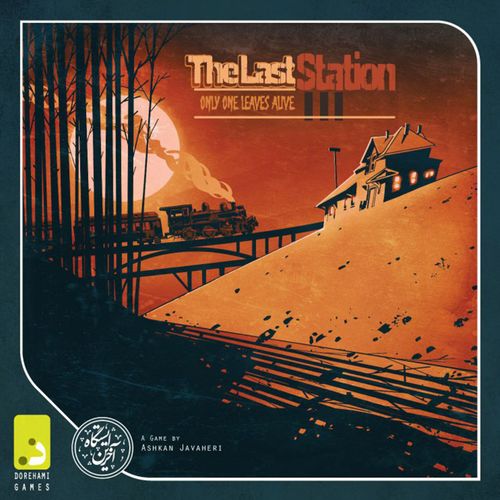
The Last Station
The Last Station Rulebook
Table of Contents
Table of Contents
Game Components
- Character cards: 16
- Party cards (allies and mercenaries): 16
- Event cards: 30
- Duel cards (fist, money and knife): 12
- Poison cards: 4
- Decision maker (DM) token: 1
- Die: 1
- Cubes (5 black, 1 red): 6
- Bag (Russian roulette): 1
Game Setup
- Give each player an envelope.
- Shuffle all the character cards and give each player a character card. Put 3 of the remaining cards aside and the rest, completely out of the game.
For example, in a 12 player game which is the maximum number of players you could play with, you give 12 cards to the players, put 3 cards aside but still in the game, and there will be 1 card remaining which is returned to the box and not used at all.
- Select a number of party cards based on the table 1 (P. 11). Shuffle the selected party cards and deal one party card to each player.
- The players must see their character and party cards, and then put them in their envelopes without showing them to anyone else.
- Put the starting event card (Here we go) between the players. Then shuffle the remaining event cards and put the event deck faced down to the right of the starting event card.
- The first player that arrived or the one who planned playing The Last Station will be the first DM (decision maker). Put the Decision maker token (a red token with a knife) in front of the DM.
The Goal of the Game
- For the allies to try to find each other and at the same time find and eliminate the mercenaries.
- For the mercenaries to stay alive until the last event! Therefor they have to blend in and eliminate the allies.
Each player will have a unique character with different abilities and points, that helps him/her is special strategic ways. Therefor he/she must make decisions very cleverly.
Introduction Phase
After the setup phase and in this part, the mercenaries get to know each other. A player or someone outside the game must moderate this part.
- At first, the moderator announces: "all players close your eyes." Then all players including the moderator, if he is a player, should close their eyes.
- Next the moderator announces: "All the mercenaries except the hidden mercenary open your eyes and see each other". After a few seconds, the moderator says: "everybody close your eyes."
- Now the moderator tells: "All the mercenaries except the hidden, raise your thumbs" and then tells "hidden mercenary open your eyes."
- After a few seconds, the moderator says: "thumbs down and everybody close their eyes."
After this phase, everybody opens their eyes and the game officially starts. This phase will not take longer than a minute, and is the only part of the game where players close their eyes.
Game Flow
After the setup and introduction phase, the main phase begins. This phase always starts with the same event card, "Here We Go". The first DM must read the event and do as it says. After this event is completely resolved, the next round starts. Each round has these steps:
- The DM talks for 30 seconds. Can say anything during this time and no one else can talk.
- The DM draws the top card from the event cards and reads it loud and carefully. After finishing reading, the event begins. You must do exactly as the event tells you to.
- After the event is completely resolved, players vote if they want to hold voting in this round.
- If the majority of players agree, they talk for a couple of minutes. There is no order in talking and players are free to walk around and say whatever they want.
- Players hold voting. The player with the most vote will be eliminated. If players agree not to have voting, the round ends.
- After voting, the round ends and the next round will begin.
- The rounds go on, until 2 players are left.
Game End
If one party is eliminated, the other party is the winner.
If not, the game always ends with the same event card, "And Then There Were Two". When players reach 2, this will be the final round.
DM must read the event and do as it says. The winning conditions are written on this event card.
If a group is completely eliminated from the game before it gets down to 2 players, the other group will be the winner.
In some cases, all players get eliminated and there are no survivors. In this case, the allies win because there's no mercenary alive to help free Marvan.
Character Cards
There are 16 unique characters. The character cards represent your special ability and personality in the game, and do not tell whether you're a good or bad guy. You must not reveal your character card, unless you want to use your special ability. After revealing your card, it will be left faced up in front of you for the rest of the game.
To use your ability as an action, whenever you want to use it during the game, just tell your character and what you want to do to your target. After this you must immediately show your character card.
The cards tell you your main abilities, but characters have advantages and disadvantages against each other. You can read more about the characters at the end of rulebook.
Hint: It is not always the best decision to use your special abilities from the get-go, therefor we have used the term "can" on the cards. meaning that you can use your ability whenever you want.
Party Cards
At the start of the game, players are randomly divide into two sides. The allies (uninformed majority) and the mercenaries (informed minority). All ally cards are the same but there are 3 different kind of mercenary cards:
- 1 special mercenary,
- 1 hidden mercenary, and
- The rest are normal mercenaries.
The different mercenaries are all the same during the game, but have different winning conditions at the end of the game. The hidden knows the other mercenaries but the rest don't know who the hidden mercenary is.
The number of allies and mercenaries depend on the difficulty level you choose, but the number of allies must always be more than mercenaries. For example, in a 12 player game, you could have 1 to 5 mercenaries. The kind of mercenaries you choose also depend on the difficulty. The special mercenary and the hidden mercenary have better winning conditions.
Event Cards
There are a total of 30 event cards. Each game always starts with "Here We Go" and ends with "And Then There Were 2". The rest are drawn each round and determine the mode and challenges you'll have during each round of the game. At the beginning of each round, the DM of that round must draw a new event card and read it aloud to everyone. When it is completely read, the event officially starts.
The top part of the cart is the flavor text and establishes the theme of that event and is addressed to the DM. The bottom part shows the temporary advantages and disadvantages some characters have, during this event.
At the end of some of these conditions you will see (R), which stands for revealed. This means that if your character has been revealed already, it applies to you and if not, you cannot use it.
If two or more characters have the same temporary perk, it is ok to not to reveal your card and just claim that yours is one of them. After all there's no lying because sooner or later your cards will be seen! The reason we put this rule is for characters to be hidden more instead of being revealed easily.
Some event cards have icons on the top. All of the event cards with no blood or star sign must be put in the event deck for every game.
- Blood: These events are imbued with fatalities and bloodshed. You must have at least () of these event cards in your game. (The number is not legible in the source text; the blood icon is missing from the extracted text.)
- Numbers: If you draw an event card and the number of alive players is lower than the number on the card, you must discard it and draw another event card.
- Star: These events need special preparations and, hence they are optional for you to them put in the game.
- X: No one can eliminate the DM or players involved in the event.
The parts and characters written in Blue are intended for the expansion.
Characters
You can take action and use your character's special abilities whenever you want during a round, except if the event card of that round tells you otherwise. All actions take place in front of everyone. This means when you want to use your ability, just say it and do it! Of course after that, you have to show your character card to everyone and your character will be revealed.
Playing with each character requires different strategies. The special abilities are always used against other special abilities, and are not related to the events.
In the following section, special abilities of all characters are listed:
The Bowie
- Can kill a neighbor player once per round.
- Cannot kill the Undying.
- The Doctor can save the player attacked by him/her.
The Coup de Grace
- Once per game can kill a player.
- Cannot kill the Undying.
- He will be killed if he targets the Uzbek.
- The Doctor cannot save the targeted player.
The Doctor
- Once per game can save someone but himself, from a fatal attack.
- Cannot save anyone from the Coup de Grace.
- Can also cure a poisoned player.
- Never gets poisoned.
- Must use his ability under 5 seconds after the fatal attack.
The Fool
- Once per game when targeted by any player, can choose another player to be targeted too.
- If is still alive when it is time to resolve winning conditions, his or her team is the winner.
The Hemlock
- Can chose to use only one of the following abilities:
- Can poison 1 player during the game, whenever she wants to.
- Whenever eliminated, can poison 2 players.
- Can kill herself immediately whenever she wants during the game.
- Cannot poison the Doctor.
- Can poison the Undying.
The Informer
- Once per game can ask an eliminated player's side. The player must tell him secretly.
- The Trustworthy always tells him that he is an ally.
- If he is the DM and the event card reveals cards o, he will be the only one informed. (The source text reads "cards o"; the symbol is reproduced as printed.)
The Mysterious
- Can chose and have any other player's special abilities for 2 rounds.
- If he chooses the Old as a target, he will lose his ability and the Old will gain his special ability.
The Old
- Once per game can neutralize anyone that uses an ability on him.
- Cannot neutralize the Coup de Grace's attack.
- If chosen by the Mysterious, he will neutralize it and also gain the Mysterious' special ability.
- If chosen by the Quiet, he will neutralize it and also gain the special abilities of Quiet's new character.
- If chosen by the Wise, he will neutralize it and the Wise must tell his party to the Old.
The Quiet
- Once per game can neutralize and take a player's special ability, used on him.
- He will have that player's special abilities for the rest of the game.
- Cannot use this ability on the Coup de Grace.
- Cannot use this ability on the Doctor.
The Racketeer
- Once per game can cancel an event.
- Must do it within less than 5 seconds after the event has begun.
- Once per game can disable a player's special abilities, for 1 round only.
The Rogue
- Once per game can choose not to participate in an event.
- Once per game can choose another player to participate in an event, in his place.
- only 5 seconds after the start of an event, to use his abilities.
The Sly
- Once per game can neutralize and kill a player who targets him or her.
- Cannot neutralize and kill the Coup de Grace.
The Trustworthy
- Must always say he's an ally, whenever asked.
- Once per game can have 2 votes in a voting, and also at the same time, no one can vote against him.
The Undying
- Once per game can hold a Duel or Russian Roulette with any player(s) he or she wants to.
- Can resist fatal attacks.
- If poisoned, he or she is no longer resistant and can die by attacks or the poison.
The Uzbek
- Reacts to any attack and kills the attacker in response.
- Cannot attack the Undying.
- The Doctor can save the player that is attacked by him or her.
- Kills only in defense, but if unrevealed, can kill in offense during the last event.
The Wise
- Once per game can ask a player's side. The player must tell him or her secretly.
- If asked, the Trustworthy always tells that he is an ally, regardless of his or her true side.
- Once per game can see one of the 3 cards that are put aside.
Events
After the DM talks for 1 minute, he or she must draw and read the event card loud and clear. During each event, you will face different challenges. Some are fatal, some are informing and some have unique themes. The events determine the mode and theme of each round, and each game is composed of several rounds.
The best advice is to make the best out of the events. Even if they seem to be detrimental If you plan carefully you could benefit from them.
Poison Cards
These 4 cards can be identified by the black and green background and will be in play only if:
- Hemlock is in the game.
- One of the events called the "Supper" is in the game.
Any player that's poisoned must draw a poison card at the beginning of each round. After each round, the poison cards are returned and shuffled. There are a total of 4 poison cards.
Duel
Each participating player receives 6 duel cards (2 of each type: Fist, Knife, and Money). Players must each pick a card and reveal their selected cards at the same time.
- The fist beats the knife.
- The knife beats the money.
- The money beats the fist.
Winner sets the two cards of that set as an indication of winning.
Players must duel with these cards for 5 times. Each time the cards are discarded, therefor at the end of the duel, each player will have 1 card left. Whoever wins more sets out of the 5 sets, is the winner and the loser is eliminated. In case of a tie, both players are eliminated.
Whenever 2 players are tied in a vote for elimination and the DM cannot choose, a duel will determine who will be eliminated.
Decision Maker (DM)
- The player that planned this game session of The Last Station will be the first DM.
- Can talk up to 1 minute at beginning of each round. During this time can also let another player talk.
- Draws and reads the event cards for everyone, and must do as the event tells him to.
- In case of a tie in any vote, can make the final decision. (If he doesn't, a duel or Russia roulette will determine)
- Has until the end of the round to choose the next DM. (If gets eliminated before that, the players vote for the next DM)
Voting
Player hold their hand up and count to 3, after that each player must point to a player. All players must vote. A player that doesn't vote or votes with delay will be eliminated.
There are 4 types of votes in this game:
- After an event is resolved, players vote to decide whether they want to have a voting at the end of the round or not.
- If so, players talk for couple minutes and then hold a vote. The player with the most votes will be eliminated.
- Vote to choose the next DM.
- Some events have voting.
Russian Roulette
3 to 6 players must always participate.
Put the 6 cubes in the bag. The black cubes stand as blanks and the red cube is the bullet. The players must take a cube from inside the bag in clockwise order. Whoever picks the red, will be eliminated. There are 3 different ways for a Russian roulette to happen.
- The Undying uses its special ability.
- Event card.
- More than 2 players are tied in a vote and the DM cannot choose a player.
If it happens by picking its event card, you must obey all the conditions written on it. If it happens in any other way, there are no preconditions.
Table of Party Cards
Number of players, game mode, and the number of allies and mercenaries of each kind.
| Number of Players | Game mode | Allies | Usual Mercenaries | Special Mercenary | Secret Mercenary |
|---|---|---|---|---|---|
| 5 | Normal | 3 | 1 | 1 | 0 |
| 5 | Hard | 3 | 1 | 0 | 1 |
| 5 | Man of the hour | 4 | 0 | 1 | 0 |
| 6 | Easy | 4 | 0 | 1 | 1 |
| 6 |
Source note: the 10-player "Easy" row is printed as 3 allies, 3 usual mercenaries, 0 special and 1 secret mercenary (7 players in total, against 10 seats). It is reproduced as printed; it may be a misprint in the source.
- * For these modes you will need a Moderator, because mercenary can select his character before start of the game.
- ** If desired, you can ask the special and secret mercenary to open their eyes at the same time.