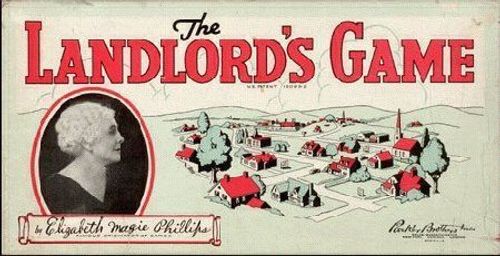
The Landlord's Game
The Landlord's Game Rulebook
Table of Contents
Table of Contents
I. Object
Become the wealthiest player, as measured by cash, cards ($100 each), and houses ($100 each).
"The object of the game is to get as much wealth as possible, and the player who has the most in cash, cards and houses at the end of the game is the winner or millionaire…. The principal thing each player has to do is to look after the collection of his rents, railroad fares and wages."
II. Components
- Board: There are four colors of spaces:
- Green spaces represent private lots available to rent and purchase
- Yellow spaces "represent public utilities owned by private parties"
- Red spaces represent railroad companies
- Blue spaces "represent the absolute Necessities of life"
- Dice: Two six-sided dice
- Player pawns: In four colors
- Cash: Players may use paper cash (Monopoly money works well) or poker chips
- Title cards: Players holding a Title card 'own' its corresponding lot on the board
- Luxury cards: Buy these to gain extra victory points
- Chance cards: Used as in Monopoly
- Education and Professor cards: Used only in the Single-Tax variant
III. Setup
- Place the board in the center of the table.
- Each player selects a colored token and places it on Mother Earth (game start space).
- Select a Treasurer to care for the Public Treasury (bank), and distribute cash as follows:
- 2 players = $600 each
- 3 players = $500 each
- 4 players = $400 each
- Shuffle the Change cards [sic; printed as "Change", meaning the Chance cards] and place in the center of the board.
- Randomly select a player to start, with play proceeding in turns clockwise around the table.
- Distribute starting Title cards:
- Standard method: Shuffle and deal a total of twelve Title cards to players. Each player may buy (from the Public Treasury) any or all of the titles they've been dealt. Place any remainder in the center of the board.
- Original: The player to the left of the moving player acts as Treasurer.
- Suggested optional setup for fast starts:
| Title | Price | Title | Price |
|---|---|---|---|
| Beggarman's Court | 50 | Boomtown | 50 |
| The Bowery | 75 | Fairhope Avenue | 75 |
| Wall Street | 100 | Grand Boulevard | 100 |
| Royal Rusher R. R. | 50 | Shooting Star R. R. | 50 |
| Gee Whiz R. R. | 50 | Slambang Trolley | 50 |
| Lonely Lane | 25 | The Pike | 50 |
| Goat Alley |
IV. Course of Play
On their turn, the moving player rolls the dice and moves their token forward a number of spaces equal to the sum of the two dice.
A. Buying Lots
Landing on an unowned lot (green, red, or yellow) makes it immediately available for sale by auction. The moving player first bids an amount equal to at least the property's value. Each following player must either raise the bid or pass, in which case they may not bid again. Continue until all players pass but the winner, who buys the property at its bid price by paying to Public Treasury and collecting its Title. Players may not bid money they do not have.
B. Renting a Lot
A player landing on a Lot they do not own must (after any auction) pay rent to the player who owns it, or to Public Treasury if unowned. Each house on a lot increases its rent by $10.
C. Special Board Spaces
- #8 Speculation: This lot has a Title card, which is auctioned as others (this player becomes the Broker). A player whose throw would land them on this space may choose instead to pass their turn. Players choosing to play made a speculation roll.
- Moving player pays $10 to Miscellaneous and rolls dice:
- 3 or 4 = $0, and Broker goes to Jail (Title card is lost)
- 5 = $30
- 6 = $40
- 7 = $50
- 8 = $60
- 9 = $70
- 10 = $80
- 11 = $90
- Doubles = $100 (all rewards collected from Miscellaneous)
- Rewarded players pay 10% to Broker or Miscellaneous (if there is no Broker).
- "If a 3 or 4 is thrown the Broker is supposed to be caught in a 'skin game'"
- Moving player pays $10 to Miscellaneous and rolls dice:
- #10 Jail: A player on this space may not move until it "serves its time" by rolling doubles or paying a $50 fine to Public Treasury. Before moving you must choose to pay a fine or roll the dice. The first move from Jail must be to "Shelter" (also #10).
- #20 Poor House: A player who cannot pay expenses or borrow is immediately placed in the Poor House. A player beginning their turn in the Poor House rolls the dice as usual, but must be able to pay the cost of the space in order to leave the Poor House.
- #20 Central Park: No cost to enter or stop.1
D. Mortgaging Properties
- At any time a player may gain cash by mortgaging any number of their properties with the bank. Mortgaged property is placed face down in front of the owning player. Mortgaged properties do not count toward endgame totals.
- Most players will mortgage properties from the bank. Because the bank only lends in $100 increments, players may need to mortgage property valued at more than this; in these instances, no 'change' is made. A player landing on or moving past Mother Earth must pay the bank interest on each property of $5. A property mortgaged to the bank may be un-mortgaged by paying the bank the property's full face value.
- A player may also mortgage a property with another player, on any terms acceptable to both (record these).
E. Special Conditions for Rolling/Moving
- If you throw doubles:
- Jail: A player in Jail may move out of Jail without paying a fine.
- Official Railroad Pass: If moving the total would permit the player's token to turn the next corner, they may add 10 to their die roll.
- Speculating: Win $100 from Public Treasury.
- If you are between the two Chance spaces (22-37) you may move backwards instead of forwards (but not both).
- If you have passed around the board five times and are debt free (there are no mortgages on any of your properties), you may move either forwards or backwards, but may no longer collect wages from passing the Start.
F. Game End and Final Scoring
The game ends after the turn when the first player reaches or passes Mother Earth five times.2 Each Title card and House counts as $100. The player with the most money at the end of the game wins. Do not count mortgaged properties.
"Should any emergency arise which is not covered by the foregoing rules, the matter must be settled among the players. Players may do anything which suggests itself to them provided that what they do does not conflict with the rules, just as a person may be anything he pleases which does not violate the law. He may squeeze to the utmost and the victim has no protection."
V. Additional Rules for Standard Game
A. Monopolies
- 'Municipal Cinch': A player owning both Soakum Lighting System (#) and Slambang Trolley (#) collects $25 instead of $5 rent from any opponent landing on either space.
- 'Monopoly': A player owning two railroads charges $10 fare (instead of $5), a player owning three charges $20, and a player owning four charges $50.
- 'Trust': Two players who own all railroads may charge other players $40 rent, splitting the proceeds (both must agree to the Trust).
B. Improvements
On their turn a player may improve their lots by paying $100 to Miscellaneous for every House purchased (place a house of the player's color on the lot). Each house increases the lot's rent by $10. No more than three houses may be built on a lot.
C. Borrowing from Other Players
All cards in use by the players may be bought, sold, mortgaged or traded at the pleasure of the players. Players may borrow cash from each other on any terms they negotiate (players may wish to record details on paper). Loans may be called in at any time.
"The Landlord's Game is based on present prevailing business methods. This the players can prove for themselves; and they can also prove what must be the logical outcome of such a system, i.e., that the land monopolist has absolute control of the situation…. The remedy is the Single Tax. If the players wish to prove how the application of the Single Tax would benefit everybody by equalizing and opportunities and raising wages, they may at any time during the game put the single tax into operation by a vote of at least two of the players."
VI. Single Tax Rules
At any point in the game, on the vote of 2 or more players the game switches to Single Tax mode, where these rules amend or supplant standard game rules:
A. Pay no taxes on Absolute Necessities (#2, #17, #32).
B. A player unable to afford the cost of a move may instead move to the Natural Opportunity space nearest to (but before) the landing space. Immediately before taking their next turn, the player collects the wages indicted from Miscellaneous, paying indicated rent to Public Treasury. They then roll and move as normal, but may not on this turn use another Natural Opportunity.
Public Treasury
C. Public Treasury begins empty. All money used to purchase lots, and rent on lots, is paid into Public Treasury "to be used for public improvements."
D. Every time $50 accumulates in Public Treasury, Wages (collected on reaching or passing Mother Earth #40) increase by $10. (Players will need a method of recording this.)
Socializing Private Properties
E. When cash in Public Treasury reaches $50, the entire amount is paid to the holder of the Soakum Lighting System (or Miscellaneous if unowned). This is "for the purchase of the plant, which is then owned and operated by the public." Henceforth the lot is free to all players.
F. Upon the next accumulation of $50, complete the same process for (in order): Royal Rusher R.R., Shooting Star RR, Gee Wizz RR, then PDQRR.
G. After all utilities are made public, every $50+ accumulation is treated thus: Place the money in Miscellaneous, and place a Free College card on Lord Blueblood's Estate (which it replaces); the Jail penalty is nullified.
H. A player landing on Free College collects one Education card. Upon collecting four, they exchange their set of four for one Professor card, which is worth $100 for endgame scoring.
Improvements
J. A player stopping on a lot first pays full land rent to Public Treasury (B), then pays $10/house to each respective owner.
K. A moving player may improve any lot by constructing a house on it (not exceeding the lot maximum of three).
VII. Optional Rules
Magie offered these options rules to help speed play.
A. Increasing Property Taxes
When a total of ten houses have been built, taxes (blue spaces) are doubled ($20). When a total of twenty-five houses have been built, taxes are again doubled ($40).
B. Increasing Rents
Rents increase when all lots on any contiguous eighth of the board (i.e., the lots between any Railroad and a corner space) have been improved. When all such lots have at least one house, all rents for those lots are doubled. When at least two houses occupy each, rent doubles again; when at least three houses occupy each, rent doubles yet again.
Footnotes
-
"CENTRAL PARK is supposed to be maintained by public funds, and therefore a player may stop in it without paying anything." ↩
-
"Players may, however, prolong the game at their own pleasure, having no arbitrary stopping point and continuing the game until the convenience or the inclination of the players suggests a cessation. Then they may agree to stop, say, at the next double thrown by any of the players." A later edition called for the game to end after the last player lands on or passes Mother Earth for the fifth time; players already achieving this were free to move in either direction after rolling. ↩