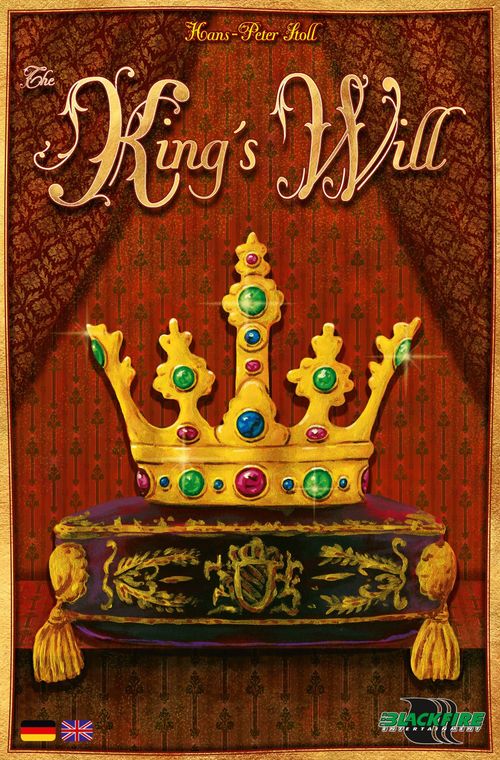
The King's Will
The King's Will Rulebook
Table of Contents
Table of Contents
Goal of the Game
The players try to build their duchies over the course of four rounds. They add terrain, found settlements, construct buildings and get first victory points when they provide voluntary levies for the King's journeys.
Certain cards, the so-called King's Will cards, determine the conditions according to which the players will receive victory points in the final tally.
It is important for the players to gain information about the King's Will as early as possible during the game, because only in this way they can avoid the King's Wrath, if they do not take his will into account.
To get to know the game we suggest a shorter game of three rounds. The small adjustments are explained in the necessary sections of the rules.
Components
Each copy of The King's Will includes:
- 1 the King's Will board
- 1 administrative board
- 1 action board
- 35 settlements (12 hamlets, 10 castles, 8 monasteries, 5 villages)
- 16 resource markers (4 pieces of wood (brown), leather (red), stones (grey), food (yellow))
- 9 action tiles
- 32 marker discs (8 pieces in the player colours white, black, green, blue)
- 4 small warehouses (for resources)
- 4 warehouse expansions
- 16 King's Will cards
- 4 construction costs cards
- 8 travel tiles
- 36 terrain tiles (mountain, forest, meadow, corn field, hill, lake)
- 21 building tiles
- 36 peasants
- 83 victory point tokens
Important Basic Concepts
Terrain
In The King's Will there are different types of terrain, which the players will use to enlarge their duchies.
On corn fields, meadows, forests and mountains players can harvest or exploit resources. Depending on the terrain they get food, leather, wood or stone.
These four terrains each have a foundation space for the four settlements that give certain advantages to the players: hamlet, castle, monastery and village.
On hills and lakes players receive no resources, but can use one or two foundation spaces for settlements.
On all terrains, there is a path in the lower half of the tile, each offering space for two or three peasants.
Players place their own terrain tiles side by side in a row and construct their duchies in this manner. Once placed, terrain tiles within a row may no longer be moved.
The Mood of the People
During the game, each player must pay attention to the mood of his people. Many actions increase or diminish the mood. This is recorded by the player on the mood track.
Each player should avoid letting the mood of their people drop to "-4" during the course of the game. In this case, the player's people revolt. The player loses 1 victory point and must relinquish one of his peasants to put down the rebellion. Then, the player increases the mood of the people again by one to "-3".
Note: If the mood is on "-3" and would have to fall by two levels, or it is "-2" and would have to fall by three levels, decrease them only to "-4". Accordingly, the mood never can increase above "4".
The King's Will
The King's Will cards are the central element of the game. They determine in what manner the players will receive many victory points at the final scoring.
During the course of the game each player commits himself to four cards; he will receive victory points exclusively for fulfilling these cards. The King's Will cards contain the following information:
- The King's Wrath is in the lower part. This is a condition that must be fulfilled by any player, even if he has committed himself to other cards. A player who does not meet the indicated condition loses 2 victory points due to the King's Wrath.
- The King's Will is in the upper part of the card. This relates to the different areas in the duchies of the players and earns them victory points. If a player has chosen a card and he fulfils the condition specified on the card, he receives these victory points.
The different King's Will cards are presented in detail in the glossary.
Game Preparations
A The players place the three boards for actions, administration and the King's Will cards in the middle of the table.
B The players place the action tiles on the action board from left to right in a row as follows. First they place the following four tiles in a fixed order: harvesting, exploiting, enrichment, building, governing, then the King continues his journey, movement, multiplying, conspiring.
The players shuffle the remaining five actions and place them in random order to the right of the first four actions.
In the first game, the two right-most spaces (movement and conspiring related tiles beyond the fixed set) remain empty.
C The players place the terrain tiles sorted in piles next to the boards. The terrain tiles are identical on both sides, to facilitate sorting.
For the first game: The lake tiles are not needed and can be returned to the box.
D The players set up all 21 buildings.
E Below the terrain tiles, the players place the four 'construction costs' cards, as well as the respective wooden pieces and peasants. Next to these, the players place the four expansions for the warehouses, as well as the stock with victory point tokens.
F The players shuffle the eight travel tiles and place four of them face down on the corresponding space of the administrative board. They then reveal the top travel tile. The remaining four travel tiles are not needed and put back in the box (the players should not look at them).
For the first game: Only three rounds are played, so that the players place only three travel tiles face down on the space of the administrative board.
G Each player receives the following:
-
Eight marker discs in the colour of his choice. He puts one disc on each of the starting spaces of the four tracks of the administration board: on the "0" spaces of the mood of the people, education and development tracks, as well as space "2" of the money track. For the time being he places the remaining four marker discs in front of him.
-
A small warehouse (for resources) and resource markers (one each for wood, stone, leather and food). The player starts the game with four resources of his choice, which he marks separately on the respective tracks of the warehouse.
For the first game: Each player starts with the same four resources. They mark 1 wood, 1 leather and 2 food on the tracks of the warehouse. The players start with 0 stones.
-
Four terrain tiles (a meadow, forest, corn field and mountain), as well as two peasants and 1 hamlet. Each player places the terrain tiles next to each other in any order he likes. In addition, he places both peasants and the hamlet on any of his terrain tiles.
Important: the player decides about the placement of the terrain tiles, peasants and hamlet and the choice of resources after receiving the King's Will cards in step H.
For the first game: The players place the terrain tiles as follows from left to right: mountain, forest, meadow, corn field. He places a peasant on the meadow, and the other peasant and the hamlet on the forest.
H One player shuffles all of the King's Will cards. Each player receives 2 cards and looks at them, without showing them to the other players. Each player places one of the cards face down on one of the spaces of the King's Will board thus determining one of the conditions for the final scoring. He returns the other card face down to the box; it will not be used in this game. Now, one player draws more cards from the shuffled pile and places them face down on the remaining spaces of the board in order to provide cards for all eight possible conditions of the final scoring.
For the first game: Only the cards A-L are used (cf. the glossary). The game lasts only three rounds, so that only six King's Will cards are placed on the dark spaces of the board and the two light spaces remain empty.
I Each player receives victory point tokens of a total value of 5, and places them face down in front of himself.
J The players randomly choose a starting player. Now, the game can begin!
Sequence of Play
The King's Will lasts four rounds, in which players each take turns to carry out actions. A round ends as soon as the King continues his journey.
Beginning with the starting player, each player takes his turn by choosing an action tile from the row and placing it temporarily in front of him. The leftmost four actions are disabled and cannot be selected by the players, as is indicated by the chain above these spaces. Thus, the players must choose from the remaining five actions. If a player opts for the right-most of these actions, he will immediately receive one additional victory point (from the stock).
All but one of the action tiles offer the players two different actions. The active player conducts both of these actions once (in any order he chooses) or one of the actions twice. Next all other players (in a clockwise direction) can conduct one of the two actions once.
After completing all the required actions, the active player places the selected action tile on the leftmost empty space in the row and pushes the other action tiles to the right in order to close the gap in the row. Now, the next player in a clockwise direction becomes the active player and selects an action tile.
Example: Marion takes the harvest action and places it in front of her for the time being. After she performs two actions of her choice, the other players follow and conduct one of the indicated actions. Then Marion places the action tile on the leftmost space of the action board.
The following action tiles are available to the players:
Harvesting
Action tilling the fields: The player receives one food for each peasant on his corn fields. He marks them in his warehouse.
Development: Once a player reaches the "3" space on the development track, he will receive an additional food per tilling the fields action.
Action breeding livestock: The player receives one leather for each peasant on his meadows. He marks them in his warehouse.
Development: Once a player reaches the "2" space on the development track, he will receive an additional leather per breeding livestock action.
At the beginning of the game, the warehouse of each player can contain a maximum of four resources of each kind. If a player gets more resources than he can store, any surplus resources will be forfeited.
Example: In her duchy Marion has a peasant on a corn field and two peasants on meadows. She decides to conduct both the tilling the fields and breeding livestock actions once. She receives a food and two leather that she records in her warehouse.
If the player chooses the right-most action, he immediately receives 1 victory point.
Exploiting
Action timber felling: The player receives one wood for each peasant on his forests. He marks them in his warehouse.
Development: Once a player reaches the "1" space on the development track, he will receive an additional wood per timber felling action.
Action stone quarrying: The player receives one stone for each peasant on his mountains. He marks them in his warehouse.
Development: Once a player reaches the "4" space on the development track, he will receive an additional stone per stone quarrying action.
At the beginning of the game, the warehouse of each player can contain a maximum of four resources of each kind. If a player gets more resources than he can store, any surplus resources will be forfeited.
Example: Marion has a peasant on a forest in her duchy. She has already reached the "1" space on the development track. She decides to fell timber twice. She receives a total of four wood, two because of the peasant and two additional wood due to the development. She marks the wood in her warehouse. Because she already had one wood in the warehouse, one wood is forfeited, because she can store only a maximum of four wood in her warehouse.
Enrichment
Action exploring the King's Will: The player looks at a King's Will card, without showing it to the other players.
Action levying taxes: The player gets a coin for each of his peasants. He marks them on the money track. Because of the tax, the mood of his people is decreased by 2. The player marks this on the mood track.
Example: Marion has 4 peasants in her duchy. After looking at a King's Will card she levies taxes as her second action. She receives four coins, but must reduce the mood of her people by 2. Both results are accordingly marked on the money track and the mood of the people track.
Building
Action founding a settlement: For a player to found a settlement, one of his peasants must be on the terrain tile on which the player wants to found a settlement. In addition the terrain tile must have a free foundation space. The player must pay the construction costs of the settlement with resources from his warehouse and must adjust his resource markers accordingly. If the last wooden piece of a settlement was built, the player cannot choose that type of settlement anymore.
Founding a settlement improves the mood of the people. The player marks this on the mood track. The construction costs, the characteristics of the settlements and the change in the mood of the people are explained in the glossary.
Education: If a player has reached the respective space on the education track, he pays 1 resource (of his choice) less for the corresponding settlement.
Action constructing a building: In order to construct a building, the space below a terrain tile must be empty. The player must pay the construction costs of the building with money and resources from his warehouse. The player must adjust his resource markers and the money track accordingly and places the building below one of his landscapes.
Constructing a building changes the mood of the people. The player marks this on the mood track. Construction costs, the characteristics of buildings and the change in the mood of the people are explained in the glossary.
For the first game: The players only pay attention to the costs and victory points of the building. Characteristics of buildings are added from the second game onward.
Example: Marion decides to found a settlement as well as to construct a building in her duchy. A peasant is located on her mountain terrain tile, so she builds a castle on the free site. Because it is her first castle, she takes the warehouse expansion and increases her warehouse for resources. Then she builds the school, which she places below the meadow. She pays the entire construction costs and adjusts the different tracks accordingly.
Governing
Action improving education: The player advances his marker one space on the education track. Improving education increases the mood of the people by 1. The player records this on the mood track.
Improving education reduces the construction costs of the different settlements. The player pays 1 resource (of his choice) less for the corresponding settlement. If a player advances to spaces further up on the track, he still receives the benefits of the earlier spaces. Space "1" applies to hamlets. Space "2" applies to castles, etc. Once a player has reached space "5", he may replace one resource with a resource of his choice when paying for constructing a building.
Action increasing development: The player advances his marker one space on the development track. Increasing the development of his duchy, the player receives an additional resource for each harvest or exploit action. If a player advances to spaces further up on the track, he still receives the benefits of the earlier spaces. Space "1" applies to timber felling. Space "2" applies to breeding livestock, etc. Once a player has reached space "5", he may exchange one resource he just received as part of the harvest or exploit action with another resource of his choice.
Example: Marion initially improves the education of her people by one space and advances her marker disc to the "1" space of the education track. In the future, she has to pay one resource (of her choice) less for the construction of castles and hamlets. She increases the mood of her people by one space to the "-1" space. Then she increases the development of her duchy by one space and places her marker disc on the "2" space. If she breeds livestock or fells timber in the future, she will receive an additional leather or wood each time.
Movement
Action moving peasants: The player moves one of his peasants to up to two steps onto adjacent terrain tiles, or up to two of his peasants one step each onto adjacent terrain tiles. No more than two pawns can be on any terrain tile at the end of the movement.
Exception: If a village has been founded on terrain tile, up to three peasants can be on that tile.
A player may use one step (of a peasant) to add a new terrain tile to his duchy. He chooses any available terrain tile and adds it to the left or right of his duchy. Then he places the peasant on one of the spaces of this new terrain tile. If the last tile of a certain terrain type is placed in a duchy, the player cannot choose this terrain anymore.
Action exchanging resources: The player exchanges a resource in his warehouse for another resource of his choice. He marks this on his warehouse.
Example: Marion moves two of her peasants one step each. The second peasant is breaking new ground and Marion chooses a lake. Then she decides to exchange a leather for a food.
Multiplying
Action offspring: The player receives offspring in a village or in a hamlet. In order to receive offspring in the form of another peasant, the player needs a hamlet or a village on a terrain tile and a peasant. He will then add a second (or third) pawn. If the last peasant is placed on a terrain, the player cannot get another offspring anymore. If there are already two peasants on a terrain tile, there is not enough room for the next generation.
Exception: In a village there can be a maximum of three peasants.
Action multiplying money: The player sells a resource of his choice from his warehouse for 2 coins. He marks this on his warehouse and his money track.
Example: Marion selects receiving offspring twice. Two peasants are on the meadow, so she has not enough space there despite the hamlet. Thus she places a new peasant on the hamlet in the forest and a third peasant on the village by the lake. Thanks to the village, there can be up to three peasants.
Conspiring
Action using a blocked action: The player performs only a single action. He chooses one of the blocked action tiles for it. The other players may not use this action! The player takes the conspiring action tile, performs one of the blocked actions, then places the conspiring action tile to the far left of the row. The action tile of the chosen action stays in the row and is only moved further to the right.
The King Continues His Journey
The players cannot select this action tile. Instead it automatically triggers the end of a game round, once it reaches the right end of the action track.
The King continues his journey across the country and visits his dukes. He demands loyalty and taxes, so that the players conduct the following steps:
Example: The tile the King continues his journey has reached the right end of the action track. During the course of the game turn Marion has looked at the second King's Will card. Now she commits to this card and places one of her remaining marker discs. After the other players also committed to a King's Will card, Marion has to contribute to the compulsory levy. She pays 2 food as required. Since the mood of her people is at "1", she pays 2 coins as a voluntary levy and receives 2 victory points.
1. Committing to the King's Will
Each player must commit himself to a King's Will card and places one of his remaining marker discs above a card. The player who previously chose the last action tile begins. Each player must choose four different King's Will cards over the course of the game and may not place more than one of his marker discs above the same card.
- In 2-3 player games, a maximum of 2 marker discs may be placed above a single King's Will card. The space marked "4" may not be used by the players.
- In a 2 player game, after both players have placed a marker disc, the player who previously had chosen the last action tile places an additional neutral marker disc (of an unused player color) on a King's Will card. The same rule that applies to players also applies to neutral discs: there is a maximum of 1 neutral disc per King's Will card.
- If there are 4 players, three marker discs may be placed on a King's Will card.
2. Compulsory levy and voluntary levy
Now the players perform actions according to the face up travel tile on the administrative board.
- First, each player has to contribute to the compulsory levy. He marks this levy on his warehouse, the money track or removes a peasant if necessary. If a player can only provide one or none of the items required as part of the levy, he retains the single item. Instead he loses 1 victory point and the mood of his people decreases by 1.
- Then, each player, starting with the player who was last to choose an action tile and in a clockwise direction, can receive additional victory points when he contributes to the voluntary levy specified on the travel tile depending on the mood of his people.
Detailed information about the travel tiles can be found in the glossary.
3. Reveal a new travel tile
Finally, the players return the travel tile to the box and reveal the next travel tile. They place the the King continues his journey action tile at the left end of the action track and move the other tiles to the right in order to close the gap.
Now it is the next player's turn and a new game round begins.
End of Game & Final Scoring
A game of The King's Will ends immediately after the fourth time the King continues his journey.
For the first game: The game ends after the third time the King continues his journey.
The players conduct the final scoring in the following order. The King's Will cards with at least one marker disc will be scored. Accordingly the players can set aside those cards where there are no marker discs.
1. The King's Wrath
Each player checks the King's Will cards to see whether he satisfies the condition indicated at the bottom of the card. If this is the case, the player avoids the King's Wrath. If he does not meet the condition, the wrath hits him and he loses 2 victory points.
Example: The mood of Marion's people is at "-2". Thus the King's wrath hits her, and she loses 2 points.
2. The King's Will
The players score all remaining King's Will cards one after the other. To get victory points, a player must have placed one of his marker discs on a card and must also have avoided the King's Wrath. Only then does he get the victory points indicated on the card. Otherwise, the player receives no points at all for the affected card.
3. Buildings
Any player who placed his buildings next to each other in a manner that they show complete victory point symbols, receives the corresponding points now.
Example: Marion has placed three buildings side by side in her duchy. She receives 3 points as a result.
Each player counts his victory points. The player with the most victory points wins the game!
In case of a tie, the tied player sitting next to the original starting player (in counterclockwise direction) wins.
A game by Hans-Peter Stoll. Development: Henning Kröpke, Uli Blennemann. Graphics: Harald Lieske. Layout: Vladimir Krist.
Glossary
Settlements
The players can found up to four different settlements. To do this, they need a terrain with a free foundation space, occupied by at least one peasant. Construction costs have to be paid by them in resources from the warehouse. They mark the change in the mood of the people on the mood track.
| Settlement | Construction costs | Effects |
|---|---|---|
| Hamlet | 1 wood, 1 leather; mood +1 | A hamlet and a peasant are necessary to get another peasant in the offspring action. |
| Castle | 2 wood, 1 stone; mood +2 | During the construction of his first castle, a player receives a warehouse expansion. A player may build additional castles, but he gets no further warehouse expansions. |
| Monastery | 1 wood, 1 stone, 1 leather; mood +3 | The player prevents a King's Wrath for each monastery if he does not meet the required conditions during the final scoring. |
| Village | 1 wood, 2 stone, 1 leather; mood +1 | The player may place up to three peasants on a terrain tile with a village. A village and a peasant are necessary to get another peasant in the offspring action. A hamlet must already be present on the terrain tile. The hamlet will be exchanged for the village and is placed back into the stock. |
Buildings
21 different buildings are available to the players. To construct a building, you need a terrain tile under which no building has been placed so far. The construction costs are paid with resources from the warehouse. You mark the change in the mood of the people on the mood track.
Each building shows one or two halves of a victory point symbol on its sides. If two matching buildings are next to each other, they form a complete victory point symbol. During the final scoring, a player receives the indicated victory points for complete victory point symbols.
Example: Marion has placed three buildings next to each other in a manner that she will receive 3 victory points.
The green buildings
The green buildings improve actions permanently. The player may choose to carry out the actions as indicated on these buildings.
- Building Crane: During the build action founding a settlement, the player may found a settlement on any terrain with a free foundation space even if there is no peasant on that tile.
- Monument: During the King continues his journey action, the player receives 1 victory point before the compulsory levy.
- Inn: During the King continues his journey action, the player may exchange one of the resources demanded in the compulsory levy for a resource of his choice.
- Hospital: During the multiplying action offspring, the player does not require a hamlet or a village to add a new peasant to another peasant.
- Fair: During the enrichment action levying taxes the mood of the people is decreased by only 1 space. A player who owns both the fair and the tithe cellar, can combine both effects.
- Council Hall: During the King continues his journey action, the player may pay a coin instead of one resource that is demanded as part of the compulsory levy.
- Residence: During the King continues his journey action, the player may pay one resource of his choice less than demanded as part of the compulsory levy.
- Barn: During the multiplying action offspring, the player may place a peasant on a terrain tile containing a castle and a peasant.
- School: During the governing action increasing development the mood of the people is increased by 1. The player marks this on the mood track.
- Warehouse: During the two building actions founding a settlement and constructing a building, the player may buy one necessary resource of his choice for a coin when he pays the construction costs.
Example: Marion has a total of five peasants so that she gets six coins. If she had six peasants, she would receive 9 coins.
The orange buildings
The orange buildings allow a player the indicated effect each time a certain action tile was chosen by him or another player. He may perform the effect once after he has conducted the selected actions once or twice.
- Abbey: If the enrichment action tile is chosen, the player receives two coins, if he has at least a monastery.
- Church: If the governing action tile is selected, the player may increase the mood of his people by 1 space by paying a coin.
- Poor House: If the governing action tile is selected, the player receives a food.
- Smithy: If the exploiting action tile is selected, the player may sell one stone for 3 coins. He needs a stone in his warehouse, but he does not have to choose the quarrying action before.
- Bakery: If the harvesting action tile is selected, the player may exchange a food for a resource of his choice. He needs a food in the warehouse, but does not have to conduct the tilling the fields action before.
- Peon house: If the multiply action tile is selected, the player may purchase one peasant for two coins and put him on a terrain tile of his choice.
- Cart: If the movement action tile is selected, the player may move a peasant to an adjacent terrain tile. He may not add a new terrain to his duchy!
- Roadhouse: If the movement action tile is selected, the player receives one coin for every peasant who is on the terrain tile above the roadhouse.
- Tannery: If the harvesting action tile is selected, the player receives one leather, even if he does not choose the breeding livestock action.
- Weekly market: If the exploiting or harvesting action tile is selected, the player may buy a resource of his choice for a coin.
Travel tiles
The travel tiles contain two pieces of information that are relevant at the end of a round when the King continues his journey: the compulsory levy and voluntary levy.
At the bottom is the compulsory levy the King asks of the players at the end of a round when he travels through the country. The King calls for two things, usually these are resources; rarely does he demand a coin or a peasant.
The different voluntary levies, which will grant the players extra victory points, are at the top. Depending on the mood of their people, the players may deliver certain combinations of money and resources up to two times, for which they will receive 1 or 2 victory points. The voluntary levies are placed back into the stock, too.
Example: The mood of Marion's people is "2". Thus, Marion must deliver two coins to get a victory point. If the mood were "3", Marion would be able to deliver 1 food and 1 coin up to two times granting her a victory point for each.
The King's Will cards
The King's Will cards contain two pieces of information: on the one hand the King's Wrath, i.e. the conditions that must be met by the players in order to avoid the loss of 2 victory points, on the other hand the King's Will, for whose fulfilment the players obtain victory points in the final tally.
There are three different ways to get victory points:
- Individual tasks that every player must meet for himself (cards A, B, C, D). The more settlements of a given kind a player has founded, the more victory points he receives.
- Multilevel tasks, where every player has to reach increasingly more difficult levels (cards E, F, K, L, M, O, P). The player receives the victory points for the highest level he has personally reached.
- Comparative tasks, where a player must be better than his fellow players (cards G, H, I, J, N). All players compare the values they have obtained to determine their ranking, but only the players who have placed their marker disc on the corresponding card get the amount of victory points matching their rank. If several players are tied for the same rank, they all get the full number of points for this rank. Players at a lower rank still receive full points corresponding to their rank.
Card A — The King's Wrath: A player can prevent the King's Wrath if he has at least two hamlets in his duchy or a wood in the warehouse (he is not required to surrender the wood). The King's Will: The player receives 2 victory points for each settlement in his duchy.
Card B — The King's Wrath: A player can prevent the King's Wrath if he has at least one castle in his duchy or a stone in his warehouse (he is not required to surrender the stone). The King's Will: The player receives 3 victory points for each castle in his duchy.
Card C — The King's Wrath: A player can prevent the King's Wrath if he has at least a monastery in his duchy or a leather in the warehouse (he does not have to surrender the leather). The King's Will: The player receives 4 victory points for each monastery in his duchy.
Card D — The King's Wrath: The player can prevent the King's Wrath if he has at least a village or two hamlets in his duchy. The King's Will: The player gets 1 victory point for each hamlet and 5 victory points for each village in his duchy.
Card E — The King's Wrath: The player can prevent the King's Wrath if he has reached at least the "2" space on the education track. The King's Will: The player gets 4, 5, 7, or 8 victory points depending on whether he has reached the "3", "4", "5" or "6" space on the education track.
Card F — The King's Wrath: The player can prevent the King's Wrath if he has reached at least the "2" space on the development track. The King's Will: The player gets 4, 5, 7, or 8 victory points depending on whether he has reached the "3", "4", "5" or "6" space on the development track.
Card G — The King's Wrath: The player can prevent the King's Wrath if he has at least 4 peasants. The King's Will: The player gets 5, 7 or 9 victory points depending on how many peasants he has compared to the other players.
Card H — The King's Wrath: The player can prevent the King's Wrath if the mood of his people is at least on the "-1" space. The King's Will: The player gets 5, 7 or 9 victory points depending on how the mood of his people is compared to the mood of the other players' peoples.
Card I — The King's Wrath: The player can prevent the King's Wrath if he has at least 4 coins. The King's Will: The player gets 5, 7 or 9 points depending on how many coins he has compared to the other players.
Card J — The King's Wrath: The player can prevent the King's Wrath if he has at least 5 terrain tiles in his duchy. The King's Will: The player gets 5, 7 or 9 points depending on how many terrain tiles he has in his duchy compared to the other players.
Card K — The King's Wrath: The player can prevent the King's Wrath if he has at least a castle, a monastery or a village in his duchy. The King's Will: The player gets 2, 5, 8 or 10 victory points depending on which settlements he has founded in the specified order.
Card L — The King's Wrath: The player can prevent the King's Wrath if he has at least a food in his warehouse (he does not have to surrender the food). The King's Will: The player gets 2, 5, 8 or 10 victory points depending on how many sets of 1 food and 1 coin he has.
Example: Marion has three food and four coins. Thus, she has three sets and gets 5 victory points.
Card M — The King's Wrath: The player can prevent the King's Wrath if he has at least a lake in his duchy. The King's Will: The player gets 2, 5, 8 or 10 victory points depending on how many peasants are placed on lakes in his duchy.
Example: Marion has 3 peasants on the two lakes in her duchy; thus she gets 5 victory points.
Card N — The King's Wrath: The player can prevent the King's Wrath if he has at least a building in his duchy. The King's Will: The player gets 5, 7 or 9 points depending on how many buildings he owns in his duchy compared to the other players.
Card O — The King's Wrath: The player can prevent the King's Wrath if he has either four coins or a leather in his warehouse (he does not have to surrender the coins or the leather). The King's Will: The player gets 2, 5, 8 or 10 victory points depending on the conditions he complies with in the specified order: four coins, a monastery, a set of four different resources, mood of the people on the "2" space.
Card P — The King's Wrath: The player can prevent the King's Wrath if there is a lake in his duchy or a stone in his warehouse (he does not have to surrender the stone). The King's Will: The player gets 2, 5, 8 or 10 victory points depending on the conditions he complies with in the specified order: a lake in the duchy, a castle, four stones, mood of the people on the "0" space.