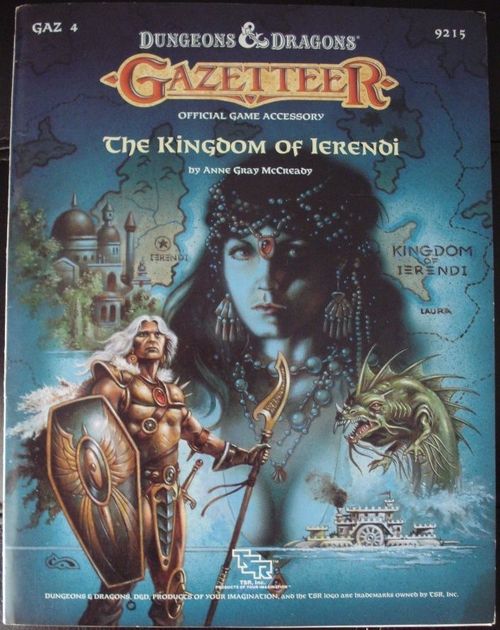
The Kingdom of Ierendi
The Kingdom of Ierendi Rulebook
Table of Contents
Table of Contents
Choosing the Right Ship
| Ship | Abbreviation | Ship Value |
|---|---|---|
| Small Sail Ship | (SmS) | 2 |
| Large Sail Ship | (LgS) | 4 |
| Longship | (Lng) | 3 |
| Small Galley | (SmG) | 3 |
| Large Galley | (LgG) | 5 |
| War Galley | (WrG) | 8 |
Modifiers. Add +1 to the ship's value whenever the following is on board:
- Artillery: standard number of artillery pieces on board (catapults, ballistas, and/or archers).
- Ram: mechanical crushing device or ram mounted at the bow (sail ships and longships not eligible).
- Exceptional Crew: crew and marines on board have an exceptionally high morale or discipline.
- Powerful Magic: high-level PCs/NPCs, low-level spellcaster units on board, and/or some magical enchantment giving an advantage in combat.
It is assumed that all ships come with a standard crew (rowers, sailors, and marines). Feel free to add bonuses (or penalties) to fit the situation. Once the final Ship Value is known, choose the appropriate counter, or the one that comes closest among the countersheet provided in this product. Ships are described in detail in the D&D® Expert set, p. 43.
The color on the counter indicates the nation. On its front, a counter shows the ship's value, its movement per turn in hexes, its name, and its symbol. The back displays the information corresponding to a damaged ship (lower combat value and movement for torn sails, broken masts, casualties among seamen, etc.). The ship's name is replaced by a "Damaged" label.
The Battle
The battle is played in two phases. The two opponents first move their ships in the order described in Movement (see following) and is called the Movement Phase. Combats are then resolved as described in the Combat section. This phase is called the Battle Phase. Combat occurs when two enemy ships enter the same space during their moves.
Movement
One Battle Turn equals one conventional D&D® game turn (60 melee rounds). To find a ship's movement (MV), find its speed in the Expert Rules, p. 43, and divide that by 20, rounding down. That's the number of hexes a ship can move in one Turn. One hex on the map equals 200 feet.
Galleys, armored fireships, and longships move any number of hexes up to their full speed. They rely on a combination of oar and sails and/or magical technology.
Sail ships move from half their movement rate (rounded up) to full speed because they rely on the winds. A sail ship cannot stop, unless it collides with (or attacks) another ship.
Two ships may not occupy the same space, except in combat. If a ship cannot avoid entering a friendly ship's hex, the moving ship stops in the adjacent space. Both parties should make a Combat Check to avoid collision (the ships avoid collision if both parties roll 2d6 under their Ship Value). A failed check causes the ship to be Damaged (see Combat).
A ship may enter an occupied hex only to attack an enemy ship. The moving ship must stop in this hex. It may leave the next turn, if it makes a successful Combat Check (a failed Combat Check constitutes a move).
The top of a counter represents the ship's bow. The ship sails in this direction. Any large ship or war galley can veer 60 degrees (one hex side) up to twice per turn. Fireships and small ships can veer three times per turn. All ships can veer only once per hex. Make sure ships do not change their facing by accident.
A ship that is unable to move at the beginning of its movement turn without colliding into a friendly ship or unwillingly attacking an enemy, may veer once without any further move.
Movement takes place alternately. Roll 1d6 to determine who moves first. Side A moves a ship, then side B moves a ship. The turns alternate until all the ships have moved once. If one side has more ships than the other, the remainder are moved at the end of the Movement Phase. In large battles keep a list of the ships' names (see counters) and check them after each move to avoid confusion.
Stacking
Friendly ships may not occupy the same space unless one of the two was captured in the previous Battle Phase. A captured ship must leave the hex on its next Movement Phase, as soon as a path is free. If an enemy ship attacks before the captured ship moves out of the hex, the attacker chooses which ship is attacked. The remaining ship automatically moves to the hex adjacent to its bow (or the closest empty hex, clockwise, if friendly ships are in the way). This constitutes the remaining ship's move.
Combat
If two enemy ships enter the same space on a map, both players roll 1d6 once, add their Ship Values and compare the scores. Check the result on the following table.
COMBAT RESULT TABLE
| Score Difference | Effects |
|---|---|
| Draw | Both ships are damaged |
| 1-2 pts | Roll again at +1 for the winner. Bonus is cumulative but valid only this turn. |
| 3-4 pts | Loser: ship damaged. Winner: no casualties |
| 5-6 pts | Loser: ship sunk. Winner: ship damaged* |
| 7-8 pts | Loser: ship captured. Winner: ship damaged* |
| 9-10 pts | Loser: ship sunk. Winner: no casualties |
| 11 pts + | Loser: ship captured. Winner: no casualties |
(*) Unless the ship makes a Combat check.
Flip a counter over to its "Damaged" side whenever the results indicate a damaged ship. Damaged ships are sunk when damaged a second time. Replace captured ships with Privateers & Merchantmen of the same strength (grey counters). Two ships surviving a combat are locked in melee. They may break away only after making a Combat Check. Combat otherwise continues on the next Turn.
When a ship enters an enemy-occupied hex through one of the three hexsides on the enemy's stern, the attacker gets a +1 bonus to his attack for this turn only.
Every time one side rolls a 1 and the other a 6, check for an event on the Chance Table. These only are suggestions; ignore them or modify them as desired.
If PCs are on board, the game should be stopped. Meanwhile, the PCs' fight is resolved using normal D&D® game rules. When done, the game proceeds as described.
Morale
A damaged ship must make a Combat Check when sailing into an enemy occupied hex, unless PC commanders/heroes are aboard. If the check fails, the ship stops in the hex adjacent to its target. Captured ships must sail to a friendly port by the most secure route possible.
Recovery
Damaged ships have a 50% casualty rate; all personnel aboard is lost at sea when a ship is sunk. The side holding the area at the end of the battle recovers 50% of its casualties among men. These are wounded and need 1-4 months to heal and return to duty.
Sunken ships have a 10% chance of actually being seriously wrecked and salvageable. The side holding the battle site after the battle may tow salvageable ships with a strong breeze or less (see Expert Rules). Ships can tow one wreck at 1/3 their current speed, rounded down; others must be abandoned.
The winning side may show mercy to the losers and allow them to recover their losses in a similar way. In this case, if the loser fights the winner again within a year, the loser's ships fight at −1. Losing NPCs will have a favorable reaction to winning PCs.
Building Costs
Ships are built at the rate of 150 gp per Hull Point (or HP, see Expert Set), 3 HP per day. For each Armor Class below 9, add 20% to the total. Follow the Expert Rules with regard to adding rams (+1/3 of the cost) and catapults (650 gp with pitch shots). This brings small galleys within a 14,400-25,250 gp range.
A damaged ship has lost 50% of its Hull Points. These can be recovered at half the cost given above, up to a ship's original HP total. If a ship was wrecked, it lost 80% of its HP. These Hull Points require full cost to repair.
To build or repair ships, one must have the appropriate dock facilities, find naval engineers, natural resources like mahogany, oak, or cedar, locate cloth makers for sails, and have the needed financial resources.
Depending on the size of facilities (docks, ship yards and stocks), several ships can be built simultaneously. Some ports may not be able to build ships; they're just a safe haven for supply and protection against bad weather. Here are some suggested values for main ports in the area:
| Location | Total Port Capacity (in Hull Points) | Maximum Dock Size (HP)* | Dry Docks Capacity |
|---|---|---|---|
| Thyatis | 10,000 | 180+ | 50 ships |
| Minrothad | 6,000 | 180 | 25 ships |
| Ierendi | 3,600 | 160 | 20 ships |
| Specularum | 2,880 | 160 | 18 ships |
| Soderfjord, Norrvik, & Zeaburg | 2,250 ea. | 80 ea. | 15 ea. |
| Tel Akbar | 1,960 | 140 | 14 ships |
(*) Ships with more HP than what the docks can accommodate must anchor at the center of the port and use shuttle boats.
[Illustration of a fireship omitted.]
| Vessel | Movement Miles/day | Movement Ft./round | Rowers | Sailers | Marines | HP | AC | Capacity (in cu.) |
|---|---|---|---|---|---|---|---|---|
| Fireship | 60 | 100 | — | 20 | 50 | 200 | 3 | 80,000 |