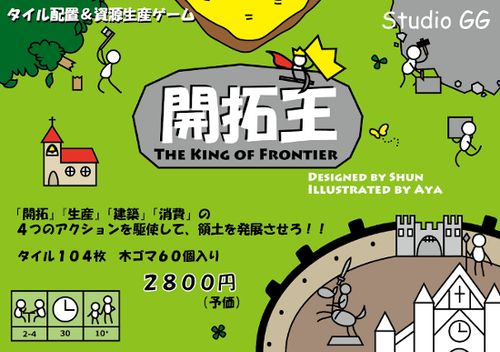
The King of Frontier
The King of Frontier Rulebook
Table of Contents
Table of Contents
Components
- Frontier tiles: 88
- Building tiles: 16
- Resource cubes: 60 (20 of each color)
- Victory point chips: 24 (1 VP: 20 chips, 5 VP: 4 chips)
- Small bags: 2
- Player boards (paper): 4
- Score sheet: 1 pad
- Rulebook: 1 booklet
- Tile list: 1 sheet
Player boards and score sheets can also be downloaded from http://studiogg.doorblog.jp/.
Setup (1)
Preparing the frontier tiles
The number of frontier tiles you use changes depending on how many players are taking part. Each frontier tile is marked with a clover symbol showing the player count it is used at:
- No mark: used with 2 or more players (always used)
- Three-leaf clover: used with 3 or more players
- Four-leaf clover: used with 4 players
If you play again, shuffle the same tiles together and use them again.
Preparing the building tiles
The number of building tiles you use changes depending on the number of players. Shuffle them and randomly choose the tiles to use.
- 2 players: 8 tiles
- 3 players: 12 tiles
- 4 players: 16 tiles (all of them)
If you play again, shuffle all the building tiles together and choose the number of tiles for your player count.
Preparing the victory point chips
The number of victory points worth of chips you use changes depending on the number of players.
- 2 players: 20 points (1 VP: 10 chips, 5 VP: 2 chips)
- 3 players: 30 points (1 VP: 15 chips, 5 VP: 3 chips)
- 4 players: 40 points (all of them)
Setup (2)
Preparing the other components
Use all of the resource cubes. Deal one player board to each player.
Setting up
Once the components are ready, set up the play area. All participating players sit around a table in a circle, and arrange the components you are using as shown below.
Shuffle the frontier tiles well and stack them into several piles (these are called the draw piles). Lay out the building tiles so they are clearly visible (this is called the supply). Gather the resource cubes and victory point chips together in one place (this is called the stock). Spread your player board out in front of you.
Setup is now complete. Let's begin the game!
A Quick Overview of the Game
Each player develops their territory by placing frontier tiles and building tiles on their player board. At the end of the game, the player whose completed territory has earned the most victory points (VP) wins.
Tiles have five kinds of area: City, Forest, Rocky Ground, and Grassland (plus Lake, described with the buildings). Adjacent tiles are placed so that these areas connect to one another. Once a tile has been placed it cannot be repositioned, so place carefully!
You may place a tile at any position on the board you like, but adjacent tiles must always be placed so their areas connect. Frontier tiles and building tiles may be placed facing any direction.
When an area is enclosed it becomes "completed," and only then can you Produce or Consume in it. At the edge of the board, any area may border the edge, but that area remains incomplete.
Discarded tiles are placed face-down at the side of each player's board. Victory point chips a player has earned are kept together at the side of that player's board.
Flow of the Game (1)
Starting the game
First, every player draws 5 frontier tiles from the draw piles and places 3 of them on their board. The 2 tiles they do not place are discarded face-down (set at the side of the board). Discarded tiles can never be used again, but only the player who discarded them may look at them at any time.
The game proceeds with each player taking a turn in clockwise order. Decide who takes the first turn with rock-paper-scissors or similar.
Note: in this game, there are many points where players make selections simultaneously. If you want to play strictly, have players proceed clockwise starting from the active player.
Flow of a turn
On their turn, the active player chooses one of the four actions — Develop, Produce, Build, or Consume — and carries it out.
1) Develop
The active player draws 2 frontier tiles from the draw piles; every other player draws 1. Each then places their tile(s) on their board. If a player does not want to place a tile, they discard it face-down (set at the side of the board).
Note: when the frontier tile draw piles are about to run out, draw in clockwise order starting from the active player.
Note: if there is no draw pile left, you cannot draw a frontier tile. Once the draw piles are gone, the game ends at the end of that turn.
For details on the frontier tiles, see the separate tile list.
Flow of the Game (2)
2) Produce
The active player chooses 2 completed areas; every other player chooses 1. In each chosen area, place the matching resource cube on every empty production space in that area, taking the cubes from the stock. If a player has no completed area, they cannot do anything.
Once a resource has been produced, it cannot be moved except when used for Building or Consuming — keep this in mind.
The resource cube that corresponds to each area is as follows:
- Forest produces Wood
- Rocky Ground produces Stone
- Grain Field produces Wheat
(Production spaces are the square spaces found in Forest, Rocky Ground, and Grain Field areas.)
Note: if you run out of a resource cube, substitute something else and continue play.
3) Build
Every player, in clockwise order starting from the active player, may choose 1 building tile from the supply and place it on their board (a player who does not want to place one may pass).
If you place a building tile, you must pay its building cost in resources. To pay the cost, return the required resource cubes from your board to the stock. (A building you cannot afford cannot be placed.)
The active player may build for one less cost (one less Wood or Stone).
Building costs are shown on the tile (green = Wood, gray = Stone) along with the building's name, its victory points, and its effect.
For details on the building tiles, see the separate tile list.
Flow of the Game (3)
4) Consume
Every player chooses 1 completed City and converts Wheat into VP equal to the number of consumption spaces in that City (this VP is taken as a victory point chip from the stock; the Wheat is returned to the stock).
If the active player gains VP this way, they may gain 1 additional VP.
(Consumption spaces are the square spaces found in a City.)
Note: there are 1 VP chips and 5 VP chips. Five 1 VP chips may be exchanged for a 5 VP chip at any time.
Note: when the stock of victory point chips is about to run out, players take victory point chips in clockwise order starting from the active player.
Note: if there are no victory point chips left, you cannot gain any. Once the stock of victory point chips is gone, the game ends at the end of that turn.
End of the Game
End conditions
If any of the following occurs, the game ends at that turn and scoring is carried out. (Play continues until the end of that turn!)
- The frontier tile draw piles have run out.
- The stock of victory point chips has run out.
- Any player has filled their entire board with tiles.
Victory
Scoring
Total the following victory points (VP); the player with the highest total wins. (In case of a tie, the player who would take a turn later wins.)
Use the score sheet to help with scoring.
- The number of production/consumption spaces in completed areas × 1 VP. (Do not count production/consumption spaces in incomplete areas.)
- Empty spaces on your board × (−2 VP). (If there are 0 empty spaces: 10 VP.) An empty space is a space on the board with no tile placed on it.
- The victory points of buildings and lakes within completed areas. (Buildings in incomplete areas score no victory points. Grassland buildings score their victory points simply by being placed. The score sheet includes a space to record the point value of buildings whose printed value is "?".)
- Victory point chips gained through Consume.