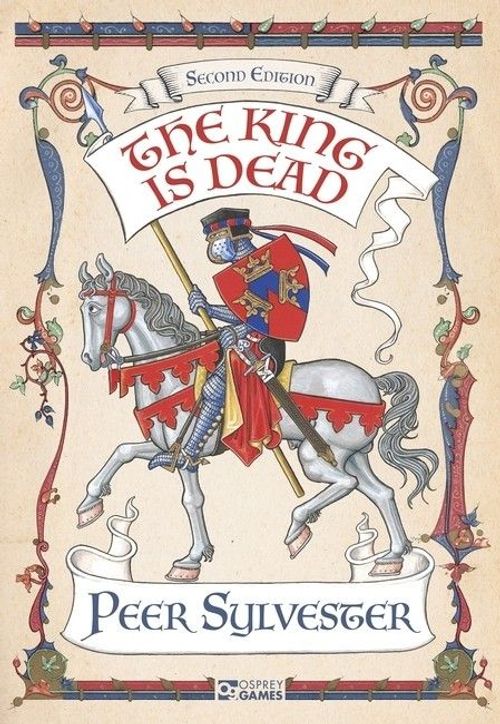
The King Is Dead: Second Edition
The King Is Dead: Second Edition Rulebook
Table of Contents
Table of Contents
Overview
The King is Dead is a game of political upheaval in medieval Britain. Over the course of the game, you will resolve power struggles in the eight regions of the island to determine which faction will prevail and crown the new monarch. Become the preferred candidate of the victorious faction and the kingdom will be yours!
During the game, you will play action cards to manipulate the balance of power across the board. You will have only eight cards throughout the entire game, so choosing when to make your play and when to sit tight will be your key to victory. Act too soon and your opponents will unravel your carefully made plans, but wait too long and the fate of the island will already be sealed.
Whenever you take an action you will summon a follower to your court, increasing your influence with one of the factions. Each follower you take will solidify your claim to be that faction's preferred ruler, but will weaken their ability to win power struggles.
Once each region has been claimed, the faction with the most regions takes control, and the player with the most influence in that faction wins.
Contents
54 Follower cubes
- 18 Scottish followers
- 18 Welsh followers
- 18 English followers
24 Control discs
- 8 Scottish control discs
- 8 Welsh control discs
- 8 English control discs
3 Instability discs
4 Negotiation discs
1 Victory card (double-sided: Invasion / Coronation)
32 Action cards (4 sets of 8)
12 Cunning Action cards (used in the advanced game only — Cunning Actions have the words "before" and "after" their title)
8 Region cards
1 Board, showing:
- A. Regions of Britain
- B. France
- C. Supply
- D. Numbered spaces
Victory card reference
Invasion side
- The winner is the player / team with the highest number of complete sets of followers.
- A set consists of one follower from each faction.
- Tiebreaker: the player who most recently played an action card wins.
Coronation side
- The faction with the highest number of controlled regions is the most powerful. If two factions control the same number of regions, the faction that last won a power struggle is more powerful.
- The player with the most followers of the most powerful faction in court wins.
- Tiebreakers: player with the most followers of the second most powerful faction in court; then the player who first played all their cards wins.
Setup
Board
Place the board in the middle of the table.
Two-player
If you are playing a two-player game, first return two followers of each faction to the box.
Home regions
Place two Scottish followers in Moray, two Welsh followers in Gwynedd, and two English followers in Essex.
Followers
Place all the remaining followers in the cloth bag. Randomly give each player two followers to place in front of them. This is their court.
Randomly place followers in each region so that there are four followers per region. For Moray, Gwynedd, and Essex, this means adding two more followers to the ones you have already placed there.
Place all the remaining followers into the supply.
Return the cloth bag to the box.
Discs
Give each player a negotiation disc.
Place all the control discs in the supply.
Place all the instability discs in France.
Cards
Deal each player the following eight action cards: Scottish Support, Welsh Support, English Support, Negotiate, Manoeuvre, Outmanoeuvre, and two copies of Assemble.
Do not use the cunning action cards.
Shuffle the region cards and deal one face up next to each numbered space on the board.
Place the victory card near the board where it is easily accessible.
Start player
The player who most recently visited a castle is the start player.
Advanced Game
If all players are familiar with the game and agree, you can choose to play the advanced game.
Remove each player's Scottish Support, Welsh Support, and English Support action cards and return them to the box.
Shuffle the cunning action cards and secretly deal each player three cards. Return any unused cunning action cards to the box without looking at them.
How to Play
Turns
Beginning with the start player and moving clockwise, players either take an action or pass. Play keeps going around the table, occasionally interrupted by power struggles, until the game ends.
When you take an action, you play a card from your hand and resolve its effect. After taking an action, you always summon a follower to your court. This is explained in more detail later.
When you pass, you forfeit your turn for one round. When play comes back to you, you may choose to take an action as normal or pass again.
If all the players pass in sequence, you must resolve a power struggle.
Power struggles
To resolve a power struggle, you must find the contested region. To do so, find the face-up region card in the lowest-numbered space around the board. Hence, the first power struggle will be in the region next to the '1' space on the board, the second in the region by the '2' space, and so on.
Check which faction has the most followers in the contested region. Place a control disc for that faction in the region: that faction now controls that region. Then return all the followers in that region to the supply.
If there is a tie between factions or there are no factions present, the region becomes unstable. Place an instability disc in the region. Then return all the followers in that region to the supply. If there are three instability discs on the board, the game will end prematurely with a French invasion.
Finally, flip the region card of the contested region face down. Play now continues as normal, with the next player taking their turn.
Taking actions
Throughout the game, you will take actions to place, move, and remove followers across the board. By doing so, you can influence which faction gains control of each region during a power struggle, shifting the board so it is in your favour.
To take an action, you must play a card from your hand and resolve its effect. The effect of each action card is shown on the next few pages. Your actions do not have to affect the current contested region.
When resolving an action, you can never place or move followers into controlled regions: regions with a control disc or an instability disc. Once a region's power struggle has been resolved, its allegiance is set for the game.
When you have finished resolving an action, place the card face up into a discard pile in front of you, so that only the action you have just taken is visible. You may always look at the other cards in your discard pile, but you cannot examine the discard piles of other players.
Once you have played an action card, you cannot use it again. This means you can take no more than eight actions in each game.
Summoning followers to court
Immediately after taking an action, you must summon a follower to court. To do so, choose any follower in any region and place it in front of you.
You can choose a follower from a region that your action didn't involve. You cannot choose a follower from the supply. It must be from a region.
Summoning a follower to your court strengthens your claim to be a faction's chosen ruler when the game ends, but it may also affect the outcome of the power struggle in that region!
Partial actions
When resolving an action, you must carry out its effect in full if you can. If it is not possible to resolve its effect in full, you must resolve it as far as possible. You may still take an action if you are unable to carry out all or any of its effects. You must still summon a follower to court.
Game End
Trigger
The game ends with either a French invasion or the coronation of the new ruler. Who wins depends on how the game ends.
If all three instability discs are on the board, the game ends immediately with an invasion.
If all eight power struggles are resolved without an invasion, the game ends with a coronation.
Invasion
The French invade Britain, and the leader who can unite the factions to resist the invaders will ultimately claim the throne.
In the case of an invasion, the winner is the player with the highest number of complete sets of followers. A set consists of one follower from each faction.
If there is a tie, the tied player who most recently played an action card wins.
The resistance against the invaders demands a discerning leader!
Coronation
The struggle for power comes to an end, and a new monarch is crowned. The leader with the support of the most powerful faction ascends to the throne.
Place the victory card, Coronation side up, in front of the players. In the spaces indicated on the card, rank the three factions by their power.
The faction with the highest number of controlled regions is the most powerful. If two factions control the same number of regions, the faction that last won a power struggle is more powerful. You can always tell which power struggle occurred last by checking the region cards around the board.
In the case of a coronation, the winner is the player with the most followers of the most powerful faction in court.
If there is a tie, the winner is the tied player with the most followers of the second most powerful faction in court.
If the players are still tied, the player who first played all their action cards wins.
The new monarch needs to be decisive after this time of chaos!
Example: The Welsh are the most powerful faction, so the player with the most Welsh followers in court is declared the winner. If players were tied for the most Welsh followers, the tied player with the most Scottish followers in court would win.
Playing with Four Players
Teamwork
If you are playing with four players, you play in teams of two. The player sitting opposite you is your teammate.
You are not allowed to discuss tactics or strategies with your teammate, and you must not show each other your action cards.
The play is the same as normal, with all players summoning followers to their own courts. The game ends with an invasion or a coronation, but the outcomes are slightly different:
Invasion (four players)
If the game ends in an invasion, combine all the followers in your and your teammate's courts.
In the case of an invasion, the winning team has the highest number of complete sets of followers. A set consists of one follower from each faction.
If there is a tie, the team that last played an action card wins.
Coronation (four players)
If the game ends in a coronation, keep your followers separate from your teammate's followers.
Place the victory card on the table, Coronation side up, and determine the power of the factions as you would in the normal game.
In the case of a coronation, the player with the most followers of the most powerful faction in court wins, and so does their teammate. The uncrowned player becomes the power behind the throne.
If there is a tie, the winner is the tied player with the most followers of the second most powerful faction in court (and their teammate).
If players are still tied, the team who first played all their action cards wins.
The Action Cards
Scottish Support — Place two Scottish followers from the supply into a region that borders a region controlled by the Scots. If there is no control or instability disc in Moray, you may instead place the followers into a region bordering Moray.
You must place both followers into the same region. If there are fewer than two Scottish followers in the supply, place as many followers as you are able to.
Welsh Support — Place two Welsh followers from the supply into a region that borders a region controlled by the Welsh. If there is no control or instability disc in Gwynedd, you may instead place the followers into a region bordering Gwynedd.
You must place both followers into the same region. If there are fewer than two Welsh followers in the supply, place as many followers as you are able to.
English Support — Place two English followers from the supply into a region that borders a region controlled by the English. If there is no control or instability disc in Essex, you may instead place the followers into a region bordering Essex.
You must place both followers into the same region. If there are fewer than two English followers in the supply, place as many followers as you are able to.
Assemble — Place a Scottish follower, a Welsh follower, and an English follower from the supply into any region or regions.
You may place the followers into the same or in different regions. If there are no followers of a particular faction in the supply, don't place a follower of that faction. Still place followers of the other factions if you can.
You start the game with two Assemble cards.
Negotiate — Swap the positions of any two face-up region cards. Place a negotiation disc on one of the cards you swapped.
You cannot swap region cards that are face down or have a negotiation disc on them. If there are fewer than two eligible region cards to swap, this action has no effect.
Manoeuvre — Swap a follower in any region with a follower in any other region.
You may swap followers of the same faction. This will have no effect, but you must still summon a follower to court.
If there is at least one instance where you can make the swap, you must do so. If there is not, this action has no effect.
You cannot use a Manoeuvre action to undo a Manoeuvre action taken by another player, unless at least one other action has been taken since the original Manoeuvre action.
Outmanoeuvre — Swap a follower in any region with two followers in a bordering region.
You may swap followers of the same faction. If there is at least one instance where you can make the swap in full, you must do so. If there is not, you must swap a follower with a single follower in a bordering region. Otherwise, this action has no effect.
You cannot use an Outmanoeuvre action to undo an Outmanoeuvre action taken by another player, unless at least one other action has been taken since the original Outmanoeuvre action.
Cunning Actions
The cunning actions are used in the advanced game only.
Spy — Resolve the effect of an action card that is face up on top of another player's discard pile.
This action counts as an exact copy of the action you have chosen. The normal rules for partial actions apply.
Ambush — Place two Scottish followers from the supply into a region, then return a follower from that region to the supply.
You must resolve all the effects of the action in the same region. The follower you return to the supply may be one of the followers you placed.
If there are fewer than two Scottish followers in the supply, place as many followers as you are able to.
March — Move two followers from a single region to a single bordering region.
You must move both followers to the same region. If there is at least one instance where you can move two followers, you must do so. If there is not, you must move one follower if able. Otherwise, this card has no effect.
Plot — You cannot take this action during the game.
When deciding the winner of the game, reveal this card. It counts as a follower of a faction of your choice.
If the game ends in a coronation and you are tied for support among the two most powerful factions, you win the game. This supersedes the normal tiebreaker (the player who played all their action cards first).
Resist — Place two non-Scottish followers from the supply into any region that borders a region controlled by the Scots. If there is no control or instability disc in Moray, you may instead place the followers into a region bordering Moray.
You must place both followers into the same region. The non-Scottish followers can be of the same or different factions.
Quell — Return a Welsh follower to the supply from any region that borders a region controlled by the Welsh. Then place two followers from the supply into that region. If there is no control or instability disc in Gwynedd, you may instead carry out this action in a region bordering Gwynedd.
You must place both followers into the same region that you took the Welsh follower from. The followers can be of the same or different factions. One or both of the placed followers may also be Welsh.
If there are no Welsh followers in an eligible region, just place two followers from the supply into an eligible region. Otherwise, this action has no effect.
Suppress — Return an English follower to the supply from any region that borders a region controlled by the English. Then return another follower to the supply from that region. Then place a follower from the supply into that region. If there is no control or instability disc in Essex, you may instead carry out this action in a region bordering Essex.
You must place the follower into the same region that you took both the English followers from. The placed follower may also be English.
If there are no English followers in an eligible region, just return another follower to the supply and place a follower from the supply into an eligible region. If there are no followers in an eligible region, just add a follower to an eligible region. Otherwise, this action has no effect.
Aid — Find the faction with the most followers in the supply. Place two followers of that faction into any region.
You must place both followers into the same region. If more than one faction has the same number of followers in the supply, choose one of the tied factions and place two followers of that faction.
Influence — Swap one English follower in any region with two non-English followers in another region.
The non-English followers can be of the same or different factions. If there is at least one instance where you can make the swap in full, you must do so. If there is not, you must swap one English follower with one non-English follower. Otherwise, this action has no effect.
Dispute — Swap a Welsh follower in any region with a non-Welsh follower in another region.
If there is at least one instance where you can make the swap, you must do so. If there is not, this action has no effect.
Edict — Swap two Scottish followers in any region with two non-Scottish followers in a bordering region.
The non-Scottish followers can be of the same or different factions. If there is at least one instance where you can make the swap in full, you must do so. If there is not, you must swap one Scottish follower with two non-Scottish followers or two Scottish followers with one non-Scottish follower. If you cannot do this, you must swap a Scottish follower for a non-Scottish follower. Otherwise, this action has no effect.
Muster — Return a Scottish follower to the supply from any region that borders a region controlled by the Scots. Then place two followers from the supply into that region. If there is no control or instability disc in Moray, you may instead carry out this action in a region bordering Moray.
You must place both followers into the same region that you took the Scottish follower from. The followers can be of the same or different factions. One or both of the placed followers may also be Scottish.
If there are no Scottish followers in an eligible region, just place two followers from the supply into an eligible region. Otherwise, this action has no effect.