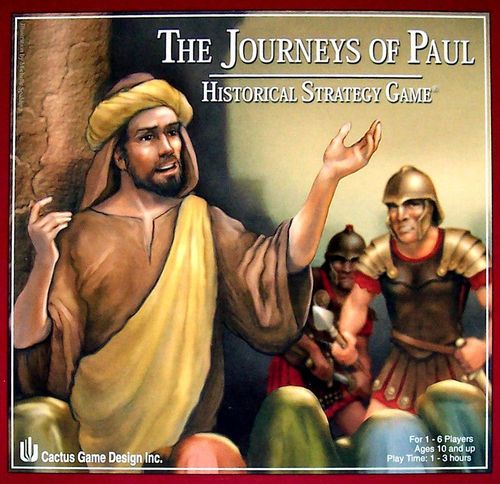
The Journeys of Paul
The Journeys of Paul Rulebook
Table of Contents
Table of Contents
Basic Rules
Summary
Each player starts the journey in Jerusalem. The player who reaches Rome first after establishing 3 Churches wins. The game is a race. Bad events are represented by Event cards. Opportunity and City cards help the player and are kept in hand and played when needed.
Each player moves to a city (circles) and then builds a Church by gathering 7 Cell Groups. It may take several turns to get to a city or to get 7 Cell Groups. Then each player moves to another city and builds a Church until he has 3 Churches. Then the player moves to Rome to win!
Playing Equipment
The Journeys of Paul Historical Strategy Game should contain the following equipment. If any parts are missing, please write for replacement.
- 1 Map
- Deck of 60 Opportunity cards, 6 Reference cards, 4 Information cards listing Paul's journeys
- Deck of 30 City cards, Deck of 50 Event cards
- 6 glass beads (player pieces)
- 6 Panels of Counters: Cell Groups, Churches, Deacons, a Ship
The Map
Spaces
The playing map is divided into spaces. When a player moves, he normally moves 1 to 3 spaces by land or sea in any direction. When traveling by land, the spaces must be touching over the land areas. Some sea areas may be crossed without a ship. These areas are marked with double pointed arrows. Many territories cover both land and sea. If a player is moving by sea, he must stay over the sea.
Cities (circles)
The map includes 30 selected cities in the Roman Empire. These cities are potential sites for Churches. If a player stops in a space with a city, he is considered to be in that city, even if he is off the coast and on a ship.
Jerusalem is the starting point for the game. No Churches may be built in Jerusalem, otherwise it functions as a city of the game.
Pre-established Churches (triangles)
The map also includes 8 cities which already contain Churches which have been established before the start of the game. Players may not build Churches in these cities.
Paul's Journeys (squares)
The map also contains significant cities visited by Paul on his historic journeys. These cities (small squares) are referenced in small print. This information is provided as background and does not influence the play of the game. Be sure not to confuse the cities used in the game with these small, square cities used only for historical information.
The Cards
Opportunity Cards
Opportunity cards simulate information and resources that a player can use. These cards help in building Churches, moving, and by countering certain Event cards. Opportunity cards are discarded face up when used or played. When the deck is depleted, reshuffle the discards.
A player keeps his Opportunity cards in his hand and plays them when needed. (They may be kept face up, if you want, to make it easier to play. It will have little effect on the other players.)
City Cards
There is one City card for each of the 30 cities (circles). Each City card, when played, gives the player 3 additional Cell Groups when he tries to build a Church in that city. (A player is not required to build Churches only in cities for which he holds City cards. He is allowed to build Churches in any city without a Church.) When a City card is used, it is discarded face up in a designated City card discard pile. For the basic game, do not shuffle the cards. They are packaged in the desired order.
Event Cards
Event cards are the obstacles that will slow the player's progress. They are displayed and read for all players to see and hear, and then discarded. Much of the time the event will have little or no effect on the player's action that turn. Other times the event will have a great effect. When all the Event cards have been discarded face up, the discard pile is reshuffled.
Set Up
All players start with their player piece (glass bead) in Jerusalem. Event cards and Opportunity cards should be shuffled separately and placed face down. All players are dealt 2 Opportunity cards.
Player one should be given these 3 City cards: TYRE, ANCYRA, GENUA
Player two should be given these City cards: GAZA, CYRENE, CARTHAGE
Player three should be given these City cards: CAESAREA, PATARA, SIRMIUM
Player four should be given these City cards: ALEXANDRIA, LEPTIS MAGNA, THAPSUS
Player five should be given these City cards: TARSUS, APOLLONIA, PUTEOLI
Player six should be given these City cards: BYZANTIUM, APULUM, AQUILEIA
The counters should be distributed to each player by color.
To Get Started
You should look at your City cards and locate the closest city. On your first turn, move by land toward that city. On each turn move toward that city until you get there. On the next turn, you will state "Build Church" and attempt to gain Cell Groups. (Use your City card and Opportunity cards to help.) On your following turns, you will continue to build the Church until you get 7 Cell Groups which equal a Church. Then move to the next closest city (by land or sea) and repeat the process. After all three Churches are built, move to Rome to win. If a Church is reduced back to Cell Groups, you must decide either to go back to rebuild the Church or start a new Church closer to where you are.
The Player's Turn
A player is selected to take the first turn. Play then proceeds clockwise.
The Turn has four parts: 1. State your action. 2. Draw Event card. 3. Perform action. 4. Draw Opportunity card. (See Reference cards in the Opportunity card deck.)
-
To begin a turn the player must state his intended action for this turn. Choose one of the following options: "Move by Land", "Move by Sea", or "Build Church". (See Ships.)
-
The player draws an Event card, reads it aloud and displays it for all to see, and follows any instructions relating to his stated action (ignore other instructions). The Event card is discarded in an Event card discard pile. An Opportunity card may be played to counter the effect of the Event card if the player chooses, and he has the appropriate Opportunity card.
Only the part of the Event card's explanation that refers to the player's action that turn applies. In other words: if you are moving, the BUILD CHURCH instructions are ignored and do not need to be read. If you are building a Church that turn, the MOVE instructions are ignored.
-
The player carries out his action as stated, unless modified by the Event card. If "Move by Land" was stated, the player may travel zero, one, two, or three land spaces. If "Move by Sea" was stated, the player may travel zero, one, two, or three sea spaces. (The Event card could restrict normal movement.) During this action, the player may choose to play Opportunity cards that enhance his movement, assist in building a Church, or counter Event cards. Any number of Opportunity cards may be played. Any restrictions are specifically stated on the card.
-
At the end of each turn, the player draws one Opportunity card. The card may be played immediately only if it is a Deacon card, otherwise it must be held for use in later turns.
Churches
Building Churches
Building a Church is the procedure for establishing a Church. Churches are made up of 7 Cell Groups. A Cell Group represents a small group of Christians who would like to support a Church. A player will try to gather enough Cell Groups in a city to form a Church.
To establish a Church the player must build up at least 7 Cell Groups in a city. Usually this will take more than one turn. The player must begin the turn in the city where the Church is to be established. To gain Cell Groups the player will need to:
- State "Build Church" at the beginning of the turn.
- Draw an Event card.
- Follow the instructions on the Event card under the BUILD CHURCH section. Normally 2 automatic Cell Groups are gained each turn. Play any Opportunity or City cards that give additional Cell Groups for that city. Cards do not have to be played if the player wishes to keep them. Place the appropriate number of Cell Group counters on the city. If the total number of Cell Groups in that city is 7 or more, replace the Cell Groups with a Church counter. The player may not have both Churches and Cell Groups (of his) in the same city. The player now has an established Church. (You may build more than 3 Churches if desired.)
You gain two (2) Cell Groups automatically in that city each turn in which your action is "Build Church", unless the Event card states differently.
Losing Cell Groups
Cell Groups may be lost during a BUILD CHURCH action as indicated on the Event card. Cell Groups must be removed from the city as required.
Cell Groups may also be lost due to disasters as described by 10 Event cards. If a disaster hits, one Cell Group must be removed. A Church is equal to 7 Cell Groups, therefore a Church is replaced by 6 Cell Groups.
Competition
More than one player is allowed to do a BUILD CHURCH action in the same city until a Church is established. Once a Church is established, no further Cell Groups may be added by any player. If, however, a Church is reduced back to Cell Groups, other players may, again, build Churches.
Deacons
A Deacon is an influential, well-respected member of a Cell Group or Church and is capable of taking care of the members' needs while the missionary is not present. Deacons were used by Paul and the Apostles to take care of the Church while they were away.
A Deacon is obtained by playing a Deacon Opportunity card before the Event card is drawn or at the end of the turn. When a Deacon card is used, the player puts one of his Deacon counters in a city with one or more of his Cell Groups or a Church. The player can place the Deacon whether or not the player is present in that city. The Deacon remains in the city for the rest of the game, or until he is arrested as described by the Event card: Roman Soldiers Make Arrest.
One Deacon in the city will prevent the loss of Cell Groups in that city due to Civil Disorder, Drought, Earthquake, Economic Crisis, Epidemic, Famine, Fire in City, Flood, Member Disunity, or Sinful Members when the Event occurs in the city where the Deacon resides. Deacons may not move.
Ships
To travel by Sea the player must play a Ship Available Opportunity card when he first states his intention to "Move by Sea". As long as the player remains at sea, he may continue to travel by sea. A player may not build a Church when on a ship.
The ship counter should be placed on the map over the sea area with the glass playing piece on top when a player is using a ship. Then the Event card is drawn. When the player moves back onto land, the ship counter is removed. The ship is no longer available, and the player must present a new Ship Available card to move by sea. A player may not move by sea and by land on the same turn. A player must stop when he disembarks from a ship. He must board a ship when he states his action: "Move by Sea".
A Ship Wreck Event automatically lands the ship, thus the ship is no longer available. A Storm only redirects the ship without loss, unless the player wishes to move to land.
A player may disembark only when he is in a coastal territory and only at one of two times during his turn.
- He reaches a coastal territory after moving by sea.
- If the player is on a ship in a coastal territory and the player states "Build Church" or "Move by Land", then the player must immediately disembark before the Event card is drawn.
Advanced Rules
The advanced rules provide much more variability and strategy. The changes are as follows:
City Cards
The City cards should be shuffled, and 5 City cards should be dealt to each player. The players do not have to go to these cities, but it is helpful to use as many City cards as possible without going too far out of the way. Plan the trip as efficiently as possible.
How to Win
Five Churches are required to win instead of three.
To lengthen or shorten the game, the number of Churches to win may be increased or decreased. The number of City cards dealt must be changed accordingly.
Opportunity Cards
A maximum of 7 Opportunity cards may be held at the end of a player's turn. Excess cards must be discarded.
Pre-established Churches and Cards
If a player ends his moving in a space (land or sea) with one of the Pre-established Churches (triangles on map), he may trade in one Opportunity card for a new Opportunity card. The unwanted card should be discarded and the new one drawn. He then draws the usual Opportunity card in part four of his turn.
When the player begins his turn in a space with one of the Pre-established Churches, he does not draw an Event card that turn.
These privileges simulate that the missionary is networking with members of the Church, obtaining new information about believers in other cities, and gathering other helpful information and supplies. Also, members will protect the missionary.
Trading Session
A Trading Session occurs at the beginning of the game and at the end of every round. Only after everyone has had a turn will the second Trading Session occur. It will occur again after every player has had a second turn, and so on.
During a Trading Session players may trade with each other any of their Opportunity cards, City cards, ownership of Cell Groups, or even entire Churches. (Cell Groups and Churches may not be moved.) Any deal is permitted; all agreements must be honored. Trading is allowed only at this time. Cards may change hands only during a Trading Session. A maximum of 7 Opportunity cards may be held at the end of a Trading Session. (Excess Opportunity cards are discarded.)
Strategy
Since The Journeys of Paul is basically a race to see who can establish the Churches quickest, you should make each turn as productive as possible. The object is to play with the greatest efficiency.
It is important to outline your trip at the beginning of the game in order to spend a minimum of time in transit. It is best to use as many City cards as possible without traveling too far out of the way. Deacons should be used to protect Churches that are difficult to return to.
Trading is critical. This is how you can smooth out your trip and compensate for drawing the wrong Opportunity or City cards.
Decisions along the way are important. It might be better, for example, to hold an Opportunity card instead of playing it at the first need, thus saving the card for a later, more crucial time. Everyone will have obstacles; don't worry about small set-backs.
Supplement
Event Card Clarifications
Disaster Cards
There are 10 disaster cards which list three different cities on each card. These Event cards (Civil Disorder, Drought, Earthquake, Economic Crisis, Epidemic, Famine, Fire in City, Flood, Member Disunity, or Sinful Members) have no immediate effect on the player's current action, but may affect cities where he has Cell Groups or a Church.
These disaster cards will affect only the Cell Groups or a Church of the player drawing the Event card. They do not affect other players. Only one city is affected even if more than one city applies to the player. The affected city is the first city listed in which the player has either Cell Groups or a Church. If the player has no Cell Groups or Church in any of the cities, then the card will have no effect. If, however, the disaster does apply to a city in which the player has Cell Groups or a Church, only a residing Deacon can prevent the losing of one Cell Group.
Jailed
The player is arrested and taken to the nearest city. The player may not build a Church this turn and must relocate to the closest city (fewest territories in between, land or sea). A player who is traveling by sea will lose the ship. If the player is already in a city, he must be moved out of that city to another city. Therefore, the player will always relocate. When two cities are equally distant, the player may choose which city. (Jerusalem and Pre-established Churches are included.)
Mobs Run You Out of City
Angry mobs force the player out of the current territory. In this case he moves normally by land or sea regardless of stated action. (A ship is still required to travel by sea and a Ship Available card may be played at this time.) The player may not "Build Church" that turn.
Political Unrest
If the player is in a space with a city (Jerusalem included), he may not move by land or sea this turn. The player who is in a space without any city may not proceed into or through a city space (even by sea), but can move freely in all spaces which do not include cities (circles and triangles).
Opportunity Card Clarifications
Countering
Cards that state that they will counter an Event card will, when played, cancel all effects of that Event card for that turn. (The Opportunity card is then discarded.)
Deacon
When a Deacon card is used, the player will place one of his Deacon counters in a city with one or more of his Cell Groups or Church. A Deacon card may not be played to counter the effects of an Event card after it has been drawn.
Good Weather
A Good Weather card may be used for one of two purposes. The first is to counter any Storm Events. The second is to enhance movement two spaces, land or sea. Only one Good Weather card may be played during a turn and may not be played with a Full Moon card.
Persecution
A Persecution card may be used in any city in which you are building a Church. Multiple cards may be used in one turn.
Ship Available
A Ship Available card is played when a player first declares to move by sea. The ship counter is placed on the map with the playing piece on top, and the Ship Available card is discarded. (The Event card might prevent the player from moving but allow him to remain on his ship. The Event card could relocate his ship instead of allowing him to move normally.)
Inspiration
An Inspiration card may be used in any city in which you are building a Church. Multiple cards may be used in one turn.
Word Has Spread
This card is usable only for one of the three cities listed at the bottom of the card. It will have no effect in other cities.
Example of Play (Advanced Rules)
This is a brief example of what a player might do at the beginning of a game.
During the Set Up you are dealt 2 Opportunity cards: Escape and Word Has Spread [for BYZANTIUM, BRUNDISIUM, and LEPTIS MAGNA]. You are also dealt 5 City cards: 1) ALEXANDRIA, 2) THAPSUS, 3) SINOPE, 4) GAZA and 5) ACTIUM.
After studying these cards and locating the cities on the map, you decide that the efficient route to travel would be through Africa. You have City cards for ALEXANDRIA, THAPSUS, and GAZA, and a Word Has Spread card that can be used in LEPTIS MAGNA. This accounts for 4 of the 5 Churches needed to win.
During the initial trading phase, before turns begin, you try hard to trade ACTIUM or SINOPE for a City card in Africa which will prove helpful in establishing your fifth Church. You are successful and you trade your ACTIUM for a LEPTIS MAGNA City card.
Your game plan: 1) Go first to GAZA by land. Use your City card to help with building the Church. 2) When the Church is established, you will then move by land to ALEXANDRIA. Here you will build a Church. 3) When the Church is established, you will then move by land to CYRENE and, perhaps, you will have drawn a Inspiration and/or Persecution card to help. 4) After you establish a Church in CYRENE, you will proceed to LEPTIS MAGNA. If you have drawn or traded for a Ship Available Opportunity card, you may want to go by sea (two turns in transit). If not, the land route will take three turns, maybe only two if you can play a Good Weather card. You will stay in LEPTIS MAGNA until a Church is established. 5) Then you proceed to THAPSUS and establish your fifth Church. 6) The last leg of the journey will be to Rome. The sea is the only way, so you must have a Ship Available card by then, otherwise you will be stranded.
It is important to remember that your plan may change many times during the course of the game as new opportunities arise or unforeseen calamities strike. Usually your basic plan will remain intact.
Your first turn: 1) You state "Move by Land". 2) You draw Event card: Roman Soldiers Make Arrest (Lose one Deacon of choice). You have no Deacons, so the card has no effect. Discard the Event card. 3) You then move one space to GAZA. 4) You draw an Opportunity card and end your turn.
The Solitaire Game
The Journeys of Paul Historical Strategy Game plays very well solitaire. The player will be playing against the Event cards. The object is to reach Rome with 10 Churches before the Event cards run out (50 turns). When there are no more Event cards to draw, the game is over. The Event cards are not reshuffled.
Because 10 Churches are required to win, the player deals to himself 10 City cards plus the 2 Opportunity cards at the start of the Solitaire Game. (The player will need to use 2 sets of counters.)
Rule Variations for Solitaire
- There is no Trading Session.
- The player may hold any number of Opportunity cards.
- When beginning a turn at a Pre-established Church, the player must draw an Event card, but it will have no effect on the player. Since the Solitaire Game is regulated by the number of Event cards, it is important to count the turn by drawing and discarding the Event card, while ignoring the instructions.
Experienced players can make the Solitaire Game more challenging by removing 10 Event cards at random. This will shorten the game by 10 turns but will still require 10 Churches.
Bible Verses
Many of the Opportunity cards and Event cards include Biblical footnotes. These verses refer to situations similar to those of the cards. It is not meant to imply that the verses describe the exact events occurring in the game. Reading these footnotes will give a better insight into The Journeys of Paul Historical Strategy Game.