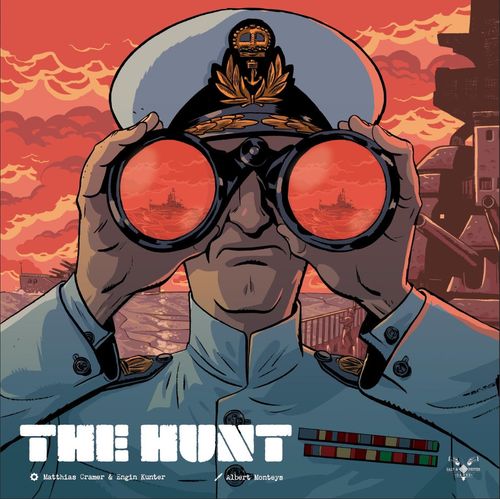
The Hunt
The Hunt Rulebook
Table of Contents
Table of Contents
Goal of the Game
The Hunt is an asymmetrical duel where one player will assume the leadership of the British Royal Navy, while the other player will represent the German Kriegsmarine. Each player has a different goal. To win, the German side must successfully stay hidden from the British and sink five Freight Ships.
Meanwhile, the British must hunt down and engage the Admiral Graf Spee in a final battle. The winner of the battle wins the game. Will the Royal Navy be able to take advantage of their numerical superiority, or will the Kriegsmarine be the ones who, with their cunning and refined strategy, manage to overthrow their rival?
An exciting battle that will define the outcome of the Second World War.
Components
- 1 Game board
- 36 Cards (18 German and 18 British)
- 3 British Force markers (Forces G, H, and K)
- 9 Freight Ship markers
- 2 German Ship markers (Admiral Graf Spee, and Altmark)
- 3 Hint markers (yellow discs)
- 2 German markers (grey discs)
- 6 Damage markers (red discs)
- 1 Bag
- 2 Player aids
- 1 Die
You will also need a sheet of paper and a pencil.
Setup
Markers: Place the German Airplane marker on the "Ready" space of the Airplane track and the Reserve marker on the "0" space of the Reserve track. Set the Hint and Damage markers aside.
Forces: Place all Forces with their side face-up. Place Force G on hex "06". Place Force H and Force K on the spaces marked "H" and "K" on the Strategy track.
Historical Variant: Flip all Force markers to their side.
Freight Ships: Place all 9 Freight Ships in the bag and draw 2. If the second Freight Ship has the same starting position as the first one, place it back into the bag and redraw until there are two different starting positions (34 for Argentina, 23 for Brazil, 29 for South Africa, and 06 for England).
Cards: Each player shuffles their deck and draws 5 cards.
German Ships: The German player can freely choose the starting positions of both ships. They can pick the same starting position of a British Freight Ship, if they wish. Place the Altmark on the board while noting the position of the Admiral Graf Spee on a sheet of paper.
Card Anatomy
- Name of the card.
- Action Point (AP) value of the card. Used if the card is played for Action Points or during the Battle.
- A flag on the side shows that the card Event is only available on that player's deck. If a card doesn't have a flag, then both players have that event on their deck.
- Event types. There are three types of event cards: Hunt Events, Battle Events, and Mandatory Events (see Card Play, below).
- British Intelligence stripe (British cards only).
- Some cards leave play after the Event is played. This does not apply after playing the card for Action Points.
Card Play
The Hunt is a card-driven game. Cards may be played either for the Event or Action Points (AP).
A - Playing the Card as an Event
If you play the card as an Event, all effects in the Event text are executed. The following rules apply to the different Events:
- Hunt Events can only be played during the Card Play phase.
- Some Hunt Events are Reactions, meaning they can only be played for their Event during the opponent's Card Play phase, or after the opponent plays a Reaction card.
- Battle Events can only take place during the Battle phase. In the Hunt phase, Battle Event cards can only be played for their AP.
- Mandatory Events: When you play a card with a Mandatory Event during the Hunt Phase, you are forced to do the Event. Follow the instructions on the card. If you play it during the Battle, the Event is ignored.
Important: If the card states "Remove this card from the game", it is only removed if the Event takes place. This does not apply to cards used for Action Points or if the Event is canceled by the opponent.
B - Playing a Card for its Action Points
If you play a card for its Action Points (AP), you can spend these points for one or more actions. Actions can be performed in any order, but one action has to be finished before taking another one. See German Player Turn for German actions, and British Player Turn for British actions.
Victory Conditions
There are different ways to achieve victory in The Hunt.
With the Freight Ships: The German player immediately achieves victory if they sink five Freight Ships.
The British player immediately achieves victory if they successfully guide five Freight Ships to their destinations (which is unlikely).
With a Battle: If the British player hunts the German player with a successful search, the Battle will be activated. The Battle will trigger the end of the game. The player who takes the least Damage during the Battle is the winner.
Be cautious! Depending on the British Force that participates in the Battle, the Royal Navy usually has the advantage. The German player should avoid Battle at all times, unless they have a very strong hand.
With the Montevideo Card (Historical End): In the 5th duel of the Battle, if the German player plays "Montevideo" and the English player plays "Scuttling in Montevideo", the British player wins the game. If these cards are played in the first 4 duels of the Battle, their events don't take place and only their AP value matters.
Turn Sequence
Starting with the German player, players take turns alternately. The turns of each player are divided into the following phases, unless a Battle begins (see Battle, below):
German Player Turn
- Card play phase
- Redraw card phase
British Player Turn
- Freight Ship phase
- Card play phase
- Redraw phase
German Player Turn
1. Card Play Phase
Play a card for its Event or use its Action Points (AP) instead to take one or more actions. This section covers the different actions that the German player may take when using cards for Action Points, as well as their associated costs.
A. Movement (Cost: 1, 2, or 4 AP)
The German player can move the Admiral Graf Spee and/or the Altmark. It costs 1, 2, or 4 AP to move a marker for 1, 2, or 3 spaces. Each marker can only be moved once per turn.
Exception: the Admiral Graf Spee may move, conduct a search/attack and then move again.
Instead of moving openly on the board, the German player notes the current position of the Admiral Graf Spee on a piece of paper. They must tell the British player how many points they have spent on the action.
Important: The German player is allowed to not conduct the full movement even though they spent the Action Points. For example, the player can announce they're spending AP to move, and then remain in the same space.
Example 1. João plays the "Cat and Mouse Game" card by using its Action Points. He decides to spend 2 AP to move. He announces to the British player that he will use 2 AP on a move action. The Graf Spee is currently on hex 28, and he decides to move to hex 24 because he is allowed to not conduct the full movement. João then takes note of the new position. He still has 1 AP left, so he decides to move the Altmark one hex. He doesn't need to announce it in this case, since Altmark is always on the board.
Note: Bluffing is very important in this game, especially for the German player, who needs to mislead the British player to avoid getting caught.
The Altmark moves normally on the board, it may not be attacked and is always safe.
B. Search and Attack (Cost: 2 AP)
If the Admiral Graf Spee is in the same space as a Freight Ship, the German player may reveal the Admiral Graf Spee's position and spend 2 AP to search for the Freight Ship. A die roll of 5+ is a success and sinks the Freight Ship. If the Airplane is on the "Ready" space, the German player may move it to the "Broken" space to add +2 to the die roll. The German player may only sink one Freight Ship per Search action. If there are two Freight Ships on the same space, the German player chooses which one they want to sink if the search is successful. Only one Search is permitted per turn. The Altmark cannot perform any searches. It is a supply ship.
Example 2. The Admiral Graf Spee is in the same hex as a Freight Ship (hex 20). João plays the "Rules of Prize Warfare" card by using its Action Points. He spends 2 AP to do a search action, so he reveals himself and places the Graf Spee tile on hex 20. Before rolling the die he decides to use the Airplane, so he moves it to the Broken state. This gives him a +2 so he only needs a 3+ to sink the Freight Ship. He gets a '4'. This is a success and he sinks his first ship. He still needs 4 more to win.
C. Repairing the Plane (Cost: 1 AP)
This action is available for the German player only. The German player can try to repair the Airplane if "Broken" by rolling the die. If the result of the die roll is higher than the number of German cards removed from the game so far, the Airplane is repaired and moves to the "Ready" space. Otherwise, the Airplane is moved to the "Destroyed" state. A "Destroyed" Airplane is lost and cannot be repaired. As the game progresses, it will be more difficult to repair the Airplane as there will be more cards removed from the game.
The Airplane track has three states: Ready, Broken, Destroyed.
Example 3. João decides to use the Action Points of the "Kriegsmarine" card. It's a bit risky since he already removed 4 cards during the course of the game, so he needs a 5+ to repair the Airplane. He rolls the die and gets a '1'. Bad luck! The Airplane is destroyed and he won't be able to use it for the remainder of the game.
D. Reserve (Variable Cost)
This action is only available for the German player. The German player may store unspent Action Points in the Reserve. The Reserve cannot store more than 2 Action Points. They may be used as additional AP in a later turn when playing a card for Action Points.
2. Redraw Card Phase
The German player draws cards from their deck until they have 3 cards in their hand. If the Graf Spee is adjacent to the Altmark (or in the same space), they may continue to draw until they have 5 cards in their hand, or they may stop at 3 cards only, in order to mislead the British player. In any case, the German player must clearly announce how many cards they're holding at the end of the turn. When the deck is depleted, shuffle the discarded cards, and build a new one.
Example 4. The Admiral Graf Spee is one hex away from the Altmark at the end of the turn. João has 2 cards in his hand. He could refill his hand up to 5 cards, but this will tell the other player he's in the same space as, or adjacent to, the Altmark. Since he doesn't want to give away any hints, he decides to refill only up to 3 cards. So, he says to his opponent: "I will refill my hand back to 3 cards".
British Player Turn
1. Freight Ship Phase
The British Player moves all Freight Ships on the board 1 space each towards their destination.
If a Freight Ship enters a Destination from the appropriate hex, it is removed from the board and scored for the British player. Destinations may not be entered from any other hex. The connections on the board must be followed.
Then, if there are less than two Freight Ships remaining on the board, take a new one from the bag and place it on its starting position (34 for Argentina, 23 for Brazil, 29 for South Africa, and 06 for England).
Freight Ships can share a space with other Freight Ships, British Forces, or even with the Graf Spee or the Altmark.
2. Card Play Phase
Play a card for its Event or use the Action Points (AP) instead to take actions. This section covers the different actions that the British player may take when using cards for Action Points, as well as their associated costs.
A. Movement (Cost: 1, 2, or 4 AP)
The British player can move one or more Forces. It costs 1, 2, or 4 AP to move a piece for 1, 2, or 3 spaces. Each piece can only be moved once per turn. British Freight Ships are not counted as Forces and cannot be moved using AP.
Example 5. Cecilia plays "Unreliable Technology" card for its Action Points. She decides to spend 4 AP to move Force G from hex 17 to hex 15.
B. Search and Attack (Cost: 1 AP)
A British Force can conduct a search on any space of any of their Forces on the board for 1 AP. The search is successful with a die roll of 5+. Each Force can only search once per turn. A success will cause a Battle if the Admiral Graf Spee is located in the searched space (see Battle, below).
The British player may modify its rolls by using the British Intelligence action (see below).
Example 6. Cecilia believes Admiral Graf Spee is in space 16. She plays "Harwood's intuition" and spends 2 AP to move from hex 15 to hex 16. Then she spends 1 AP to do a search. She rolls a 6, which is a success, but João indicates he is not in the hex. Cecilia redraws until she has 5 cards in her hand and finishes her turn.
C. British Intelligence (Cost: 1 AP)
Most British cards have a stripe at the bottom. The British player may boost their search actions of the current turn by spending 1 AP to play an additional card from their hand for its Intelligence effect. They may play as many Intelligence cards as they wish, spending 1 AP per card.
- One Intelligence effect will add +1 to the die roll of all searches of the current turn.
- Another Intelligence effect forces the German player to place a Hint marker (see below). Some cards allow you to use both or only one.
If the German player is forced to place a Hint marker, they must place it in the same space as, or adjacent to, the Admiral Graf Spee. Spaces that already contain a Hint marker or the Altmark are not allowed. Remove the Hint marker once the Graf Spee moves again.
Example 7. Cecilia plays "New Convoy Routes" for its 5 AP. She spends 2 AP to move from hex 23 to hex 34. She then spends 1 AP to do a search in hex 34, but before rolling the die, she spends the 2 AP remaining to do a British Intelligence action. She plays "HMS Cumberland" to force João to place a Hint marker. He's on hex 31, so he places a Hint marker on hex 34. Then, Cecilia plays "Concentrated Fire" which gives her a +1 in her roll. She rolls and gets a '4', which means a success. Sadly for her, João is not in that space so she doesn't trigger the Battle.
D. British Strategy Track (Cost: 2 AP)
Once per turn, the British player may advance one Force marker on the Strategy track by spending 2 AP. If a Force advances past the fourth space, it's placed on the game board in space "06", entering the game.
3. Redraw Card Phase
The British player always redraws until they have 5 cards in their hand. When the draw deck is depleted, shuffle the discarded cards and build a new one.
Battle
If the British player manages to engage the Admiral Graf Spee in Battle, both players immediately draw cards until they have 5 cards in their hands. The Battle is fought over 5 duels.
In each duel, both players select a card from their hand in secret, and reveal it simultaneously. The British player adds the corresponding bonus of any Forces present in the Battle to their AP value (+0 for Force G, +1 for Force K, and ½ for Force H, if using the standard setup). This bonus is applied in each of the 5 duels. Then, both players compare values.
Important: When playing a Battle Event card, the player does not have to choose between the Event or the Action Points. The Event happens automatically and the player still gets the AP value.
The side with the lower modified AP value receives one hit and places one Damage disc on their Battle track — blue track for the British player, and red track for the German player. In case of a tie, no side receives a hit. Repeat the process until you resolve 5 duels. After five rounds, the side with fewer Damage markers on their Battle track wins the game. In case of a tie, the British player wins.
Example 8. Cecilia performed a successful search and found the Admiral Graf Spee, triggering the final Battle.
Both players redraw cards until they have 5 cards in their hands. In the first duel, João plays "Radar Technology" with a value of 3. The card has a Battle Event. João will have a +1 in the next two cards he plays.
Cecilia plays "Concentrated Fire" with a value of 2. She adds the Force H bonus, so she has 2+½. This is not enough to beat João's value. Cecilia receives one Damage and places one Damage marker on the British (blue) battle track. Her card has a Battle Event that allows her to see João's remaining 4 cards before proceeding to the second duel.
Common Cards Historical Notes
Fair Weather: In the absence of weather stations outside Scandinavia, the Germans converted deep-sea trawlers into floating stations. These stations transmitted coded weather data and were pursued by the Royal Navy.
The Cat and Mouse Game: The cat and mouse game symbolizes the constant chase, continuous attacks, and repeated escapes that took place at the Battle of the River Plate.
Concentrated Fire: In the Battle of the River Plate, Langsdorff concentrated his fire on HMS Exeter, setting it on fire, destroying most of its guns, and forcing it to leave for the Falkland Islands.
That Never Happened: The German Naval Intelligence Division collected and analyzed information on foreign naval forces, fleet bases, positioning, battle group composition, detection, ship location, and technical data.
Rules of Prize Warfare: The Rights of Capture states that passenger ships cannot be sunk, crews of merchant ships must be safe before their ships can be sunk (lifeboats are not considered a safe place unless they are close to land), and only warships and merchant ships that are a threat to the attacker can be sunk without warning.
Storm at Sea: Rough weather heavily defined the World War II efforts in the Atlantic.
British Cards Historical Notes
Royal Navy: The Royal Navy is the naval warfare branch of the British Armed Forces. Founded in the 16th century, it is the oldest service branch of the United Kingdom and from the 19th century until World War II was the most powerful navy in the world and played a key role in establishing the British Empire as the world's dominant power.
Sir Henry Harwood: Harwood commanded the squadron of heavy cruisers HMS Cumberland and HMS Exeter, and light cruisers HMS Achilles and HMS Ajax, which were deployed in the South Atlantic to hunt down Admiral Graf Spee.
New Convoy Routes: Aware that they could not defeat the Royal Navy, the Kriegsmarine attempted to impose a blockade of the United Kingdom, destroying the merchant ships that supplied them with resources. The British had to protect these ships and find new supply routes for food, arms, and oil.
Harwood's Intuition: Prompted by information that a pocket battleship had recently sunk a merchant ship in that area, Harwood contravened an order to head for the West African coast and decided to patrol the coast of Brazil, thus surprising Admiral Graf Spee as it searched for new prey.
K and H Forces: On October 5th the Admiralty formed eight groups, Forces F, G, H, I, K, L, M and N to hunt the German cruisers. In December, after the Battle of the River Plate, Forces K and H were sent to the Uruguayan coast to prevent the Graf Spee from escaping. The German cruiser remained in Montevideo harbor, causing a diplomatic dispute with the Uruguayan authorities who had to decide how long the Graf Spee could remain moored in the harbor.
Scuttling in Montevideo: British intelligence services managed to make the captain of the Graf Spee believe that large forces were waiting for him outside Montevideo harbor, so on 17 December, Hans Langsdorff decided to sink the Graf Spee and escape with his crew to Argentina. Three days later, Langsdorff wrapped himself in the battle flag and shot himself.
Mile by Mile: The theme of this card comes from a quote of Harwood that he would search the South Atlantic mile by mile if necessary.
Unreliable Technology: The Arado AR 196 was a prototype, which turned out to be very unreliable. It was used during World War II for various tasks such as coastal patrol, reconnaissance, anti-submarine coverage, and as a ground support bomber on rare occasions.
HMS Cumberland: Heavy cruisers were a type of high speed warship designed to operate at long range, usually with 8-inch guns. They were designed between 1915 and 1945, though the term heavy cruiser was only used from 1930. The Cumberland was one of the ships that was just a day away from Montevideo when the Graf Spee was sunk.
German Cards Historical Notes
Kriegsmarine: The Kriegsmarine was the German navy during World War II. It consisted of frigates, battleships, pocket battleships, cruisers and destroyers.
Punta del Este: The Battle of the River Plate was the first naval battle between British and German forces in World War II. Admiral Graf Spee faced the light cruisers HMS Ajax and HMS Achilles and the heavy cruiser HMS Exeter. A serious strategic error caused the Graf Spee to suffer heavy damage.
Military Order 115.39: Operational Order 115.39 gave the authorization to disrupt and attack enemy cargo ships with all available means and to engage enemy naval forces if the main task required it.
Hans Langsdorff: Admiral Graf Spee, under the captaincy of Hans Langsdorff, managed to sink up to nine British cargo ships in South Atlantic waters, without causing a single casualty, as they rescued all the sailors from the attacked ships, placing them on their supply ship Altmark.
Pocket Battleships: Admiral Graf Spee along with the ships Deutschland and Admiral Scheer were built to circumvent the restrictions of the Treaty of Versailles. Because of their size, armor, armament, and speed they were called "pocket battleships".
New Paintwork for the Graf Spee: Lieutenant Friedrich Wilhem Rasenack writes in October 1939 into the logbook: "At 08:24, the Altmark is becoming visible. We are surprised that they turn around, fire smoke and try to flee. They suspected us to be a British cruiser, the new paint works perfectly."
The Mysterious Graf Scheer: Admiral Scheer was one of the Kriegsmarine's most active pocket battleships. It bombarded the city of Almeria during the Spanish Civil War and participated in commerce raiding operations in the South Atlantic and Indian Ocean.
Montevideo: Due to the damage suffered in the Battle of the River Plate, Admiral Graf Spee withdrew to the port of Montevideo, where it would have 72 hours to repair the damage and assist the wounded, established in The Hague Convention, as it was a neutral port.
The Second Funnel: The Graf Spee had a fictitious second funnel to completely alter her silhouette to confuse Allied cargo ships as to its true military nature.
Marconi's Transmitter: The radio played an important role during World War II as it was used both to broadcast propaganda messages and encouragement to the population and to confuse the enemy.