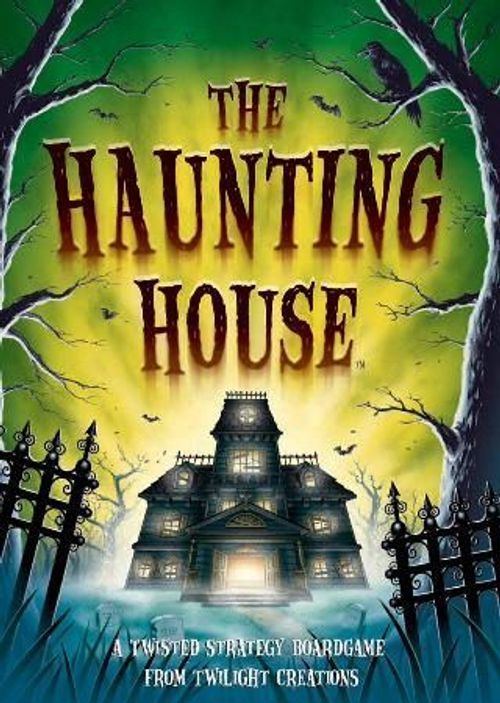
The Haunting House
The Haunting House Rulebook
Table of Contents
Table of Contents
Game Components
60 cards (10 for each player) 6 player figures 38 tiles 1 Starting Player Marker
Object of the Game
Being the rebellious people that you are, you and your friends decided to go through a house that the town has considered "haunted." You've made a wager with your friends, and the person to make it through to the back door and out of the house first wins.
Set-Up
Each player chooses a color and takes the pawn and ten cards (identified by the back) of that color.
Separate the entrance and exit from the other tiles. Place the remaining tiles face down and mix them up. Place these tiles face up to form a 6 x 6 board with about a half inch between each tile (see the Sample Board illustration). Do not change the orientation - just place the tiles as they are turned over.
Place the entrance ("Welcome") and exit ("Get Out") tiles on opposite corners of the board. This is an extension of the 6 x 6 formation. The entrance and exit may be placed on either side of the corner, they don't necessarily have to face each other. Place the player pawns on the entrance tile.
Game Play
Each turn consists of two rounds, a Random card round and a Chosen card round. The oldest player receives the starting player marker and gets to go first. The starting player will go first for one Random Card Round and one Chosen Card Round. The Random Card Round always occurs before the Chosen Card Round.
Random Card Round - Every player shuffles their cards thoroughly. The player to the right of each player randomly chooses four cards, placing them facedown in front of the owner in the order that they were chosen. (Your cards are always placed in front of you by the player to your right.) This should be done for each player, for every Random Card Round. Once four cards are randomly picked and placed in front of each player, turn over the first card. (Each player will turn their card at the same time.) The player with the player marker MUST do the action on the card if at all possible. Play then continues clockwise until each player has taken the action on their first card. Once every player has taken their first action, the second card is flipped and the actions similarly taken. Once all four cards are resolved in this fashion, they are put back in the players' hands for the Chosen Card Round.
Chosen Card Round - During the Chosen card round you may not use the "Move Exit," "Trap Door," or "Hall of Mirrors" cards. Each player removes those cards from their hands and chooses four of the remaining cards, placing them face down in the order in which they wish the actions to occur. Once each player has chosen and arranged their cards, everyone must turn over their first card. (Each player will turn their card at the same time.) The player with the starting player marker goes first and MUST do the action on the card if at all possible. Play then continues clockwise until each player has taken the action on their first card. The second card is then flipped and the actions similarly taken. Once all four cards are resolved in this fashion, they are put back in the players' hands for the Random Card Round.
After both the Random card and Chosen card rounds, the player to the left of the player who went first receives the starting player marker. This player will go first for the next turn, both the Random and Chosen card rounds. This progression occurs throughout the game.
Movement
It takes one movement to go from your current tile to the next tile following the printed pathway.
You may not move diagonally. Nor may you move through walls (unless you play the "Secret Passage" card). Only one player may occupy a trap door tile, and you may not move through an occupied trap door tile. (See "Trap Door" card explaination). You may occupy any other tile with another player(s).
Everyone starts the game on the entrance tile.
To win the game, you must be the first to move on to the exit tile.
Action Cards
Player movement is represented by yellow arrows, card manipulation by blue arrows.
Move 1 - Move your pawn one tile. You may not move diagonally.
(Card diagram: a yellow arrow from one tile across to the next tile.)
Move 2 - Move your pawn two tiles. You may end up on your starting square. You may not move diagonally.
(Card diagram: a yellow arrow across two successive tiles.)
Switch places - Switch your pawn with an adjacent pawn. Adjacency is defined as any tile "touching" your tile including diagonally. You may not switch places when you are on the entrance tile.
(Card diagram: two tiles with opposing yellow arrows between them.)
Rotate 90 - Twist any one unoccupied tile 90 degrees. You may not twist the entrance or exit tiles this way.
(Card diagram: a tile with a blue arrow to the same tile turned 90 degrees.)
Rotate 180 - Twist any one unoccupied tile 180 degrees. You may not twist the entrance or exit tiles this way.
(Card diagram: a tile with a blue arrow to the same tile turned 180 degrees.)
Switch 2 Tiles - Switch 2 adjacent, unoccupied tiles, keeping their orientation the same. Adjacency is defined as any tile "touching" your tile including diagonally.
(Card diagram: a blue arrow from two adjacent tiles to the same two tiles swapped.)
Secret Passage - Move your player figure through one wall to a hallway. You may not move through two walls (one on your tile and one on the tile to which you are moving).
(Card diagram: a yellow arrow passing through a wall between two tiles.)
*Move Exit - Move the exit from the current corner to a different corner, either edge. It may not be placed on the other edge of the same corner or the other edge of the entrance corner.
*Trap Door - Move your player figure to the nearest unoccupied trap door tile. Distance is determined by the number of movements it takes to get to the trap door tile. You must move to the closest one. If there are two the same distance, you may choose which one. If you are standing on a trap door when you must move to the closest trap door, you must move to a different one.
(Card diagram: a yellow arrow path of three moves across tiles.)
*Hall of Mirrors - You have stumbled on to a Hall of Mirrors and do nothing at all for that card.
***These three action cards may never be played in the Chosen Card Round - can only occur in the Random Card Round.
Winning the Game
The first player to move on to the exit tile, wins the game.