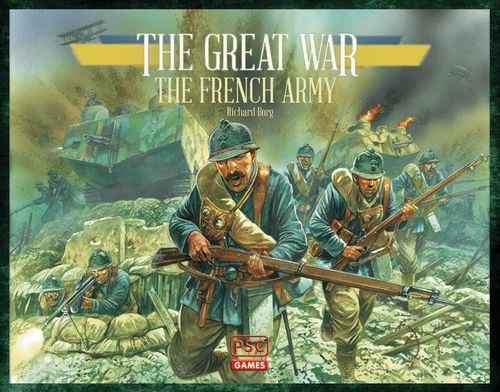
The Great War: French Army Expansion
The Great War: French Army Expansion Rulebook
Table of Contents
Table of Contents
- Components
- Object of the Game
- Setting Up the Game
- Game Turn
- Player's Turn
- End Game & Victory
- Objective Medals
- French Soldier Units
- Special Personnel
- Reserve Artillery
- Terrain
- Scenarios
- Scenario 41 - Verdun (Bois des Caures) - 21-22 February 1916
- Scenario 42 - Verdun (Beaumont) - 22 February 1916
- Scenario 43 - Verdun (Samogneux) - 24 February 1916
- Scenario 44 - Verdun (Fort Douaumont) - 25 February 1916
- Scenario 45 - Verdun (Across the Meuse) - 6-9 March 1916
- Scenario 46 - Verdun (Le Mort Homme) - 13-20 March 1916
- Scenario 47 - Verdun (Fort Vaux) - 7-8 March 1916
- Scenario 48 - Verdun (Malancourt) - 20-22 March 1916
- Scenario 49 - Verdun (French Attack on Fort Douaumont) - 22 May 1916
- Scenario 50 - Verdun (Fight For Fort Vaux) - 2-6 June 1916
- Scenario 51 - Verdun (Fleury) - 23 June 1916
- Scenario 52 - Verdun (French Retake Fort Douaumont) - 24 October 1916
- Scenario 53 - Nivelle Offensive (St. Quentin) - 1-4 April 1917
- Scenario 54 - Nivelle Offensive (La Folie Farm) - 4 April 1917
- Scenario 55 - Nivelle Offensive (Caronne) - 16 April 1917
- Scenario 56 - Nivelle Offensive (Caronne Afternoon) - 16 April 1917
- Scenario 57 - Nivelle Offensive (Berry-au-Bac) - 16 April 1917
- Scenario 58 - Nivelle Offensive (Moulin-de-Laffaux) - 5 May 1917
Components
- 3 Terrain and Accessories punchboards containing
- 33 double-sided terrain tiles
- 5 Fortified Position / Wire double-sided rectangular markers
- 2 double sided French Artillery rectangular tokens (numbered 2/3, 4/5)
- 10 Round French/German double-sided Victory Medal tokens
- 75 WWI plastic French soldier figures:
- 48 French Infantry
- 3 French Special Personnel Bomber
- 3 French Machine Gun teams (1 machine gun figure and 3 crew members)
- 3 French Mortar teams (1 mortar figure and 3 crew members)
- 50 WWI Special Personnel figures:
- 18 German Special Personnel figures
- 18 British Special Personnel figures
- 14 French Special Personnel figures
- 1 Rule & Scenario Booklet
- 2 Special Personnel and Terrain Summary Sheets
Terrain Tiles. The terrain tile hexes represent a wide range of terrain features and are placed on the map board to recreate a historical battlefield for a scenario. For a description of new Terrain tiles: see "Terrain" rules section.
Fortified Position/Wire Rectangular Markers. These double-sided markers have an image of a fortified position on one side and a wire on the other. A fortified position provides both additional cover and security for any soldiers that are fortunate enough to occupy these positions on the battlefield. Fortified position markers, like terrain tiles, are placed on the battlefield prior to a battle as indicated by the scenario map.
Bunker/Fort. A Bunker is terrain tile hex that is a permanent battlefield emplacement that offers more protection than a fortified position or trench. A group of bunker terrain tiles in adjacent hexes, for game purposes, represents a fort.
Reserve Artillery Tokens. The reserve artillery token represents the strength of the army's reserve artillery battery. When the reserve artillery is ordered, the strength number is equal to the maximum number of HQ tokens that can be spent to buy targeting dice that are used in conjunction with the targeting template. The strength of each army's reserve artillery is detailed in the scenario notes.
WWI French Figures. The forces that the French player will command on the battlefield are represented by 75 detailed plastic soldier figures. The French soldier figures have their own distinctive colour.
- 48 French Infantry
- 3 French Special Personnel Bomber
- 3 French Machine Gun teams (1 machine gun figure and 3 crew members)
- 3 French Mortar teams (1 mortar figure and 3 crew members)
An infantry unit is made up of four soldier figures with rifles. An infantry unit is classified as a battlefield soldier unit.
A machine gun team unit is made up of 1 machine gun with a gunner figure and three additional crew member figures. A machine gun unit is classified as a battlefield soldier unit.
A mortar team unit is made up of 1 mortar with a loader figure and three additional crew member figures. A mortar unit is classified as a battlefield soldier unit.
A special personnel figure, when added to a unit, will allow the unit to perform one or more special actions. The French main army, in the expansion, has three special personnel bomber figures.
WWI Special Personnel Figures. A special personnel figure, when added to a unit, will allow the unit to perform one or more special actions. For a description of new special personnel figures: see "Special Personnel" rules section. The number of additional special personnel figures, if any, a player may deploy for an army is detailed in the scenario's notes under Personnel.
Victory Medal tokens. Victory Medal tokens have a French symbol on one side and a German symbol on the other side. Victory Medals are gained when the last figure of an enemy unit is eliminated and by capturing a certain terrain hex or other battlefield objectives. In some battles it is suggested that the Victory Medal is placed directly on the battlefield, with the army's side face up to indicate the army has captured the objective and is in control.
Limited Game Components. Players are not limited by the number of wire/shell crater tokens, fortified position markers, or the number of battle dice included in the core game or expansions. Should the wire/shell crater tokens, or fortified position markers be depleted, players should substitute another marker as necessary. If a player must roll more dice than are available, he should re-roll any of the previously rolled dice and track or remember the previous results.
Object of the Game
The object of a game, depending on the selected scenario victory conditions, is to be the first player to gain a set number of Victory Medals. One Victory Medal is gained for each enemy unit eliminated. When the last figure of an enemy unit is eliminated, a Victory Medal is placed on your Victory Medal Card. In some scenarios, additional Victory Medals may be gained by capturing certain terrain hexes or other battlefield objectives. Victory is achieved the instant the last Victory Medal required is gained.
Setting Up the Game
- Select a battle from the scenario book.
- Each scenario specifies which army is at the top or bottom of the battlefield, and players should sit on the side closest to the army they will command.
- Place the terrain tile hexes, markers and tokens on the battlefield, as indicated by the scenario map.
- Place the units onto the battlefield, matching the various units' positions to the scenario map. Each unit symbol on the map represents an entire unit of figures on the battlefield.
- Each player takes a Victory Medal Card and places the card next to their board edge.
- Each player takes a numbered reserve artillery token, as indicated in the scenario notes, and places it next to their board edge with its proper strength number facing up.
- Shuffle the command card deck thoroughly and deal the number of command cards to each player, as indicated by the scenario notes. Keep the command cards a secret from the opposing player. Set the remaining deck of command cards facedown alongside the game board.
- Shuffle the combat card deck thoroughly and deal the number of combat cards to each player, as indicated by the scenario notes. Keep the combat cards a secret from the opposing player. Set the remaining deck of combat cards facedown alongside the game board.
- Create a common pool of HQ tokens, alongside the battlefield near the deck of combat cards. Each player takes the number of HQ tokens from the common pool as indicated by the scenario notes and places them next to their board edge.
- Set the WWI battle dice, targeting dice, targeting templates and the Victory Medal tokens alongside the battlefield near the deck of command cards.
- Review all special rules and victory conditions that apply to the scenario.
- Prior to the start of a battle, when No-Man's-Land Shelling rules are in effect for the scenario, the starting player will roll for the shelling of No-Man's-Land, to determine the placement of shell craters.
- The starting player, as indicated in the scenario notes, takes the first turn to begin play.
Game Turn
The scenario notes will state which player moves first. Players then alternate taking turns, until one player reaches the number of Victory Medals indicated by the scenario victory conditions.
Player's Turn
The player taking his turn is the active player and will follow the sequence shown below.
- Phase 1 - Play a Command Card
- Phase 2 - Order Units
- Phase 3 - Movement
- Phase 4 - Battle
- Phase 5 - End of Turn
The previous phase must be completed before proceeding onto the next phase.
End Game & Victory
Players alternate taking turns, until one player reaches the number of Victory Medals indicated by the scenario victory conditions. A game ends the moment a player reaches the required number of Victory Medals, regardless of when this occurs during a game turn.
Players accumulate Victory Medals in a number of ways: eliminating enemy units is the most common. The unit's last figure to be eliminated marks the defeat of the unit, and the gain of a corresponding Victory Medal for the opponent.
- For a machine gun unit, the machine gun figure is always the last stand to be eliminated in the unit.
- For a mortar unit, the stand with the figure loading the mortar is always the last stand to be eliminated.
- For a unit with a special personnel figure, see the Special Personnel rules section for stand elimination.
- Accomplishing scenario specific Victory Medal objectives, like occupying a trench or capturing certain terrain hexes, will be explicitly spelled out in the scenario's notes.
Objective Medals
Temporary Medal Objective. The Victory Medal for this objective hex is immediately gained and is retained as long as a unit of the appropriate side occupies the objective hex. If the unit vacates the hex for any reason (movement, retreat or elimination), the medal is immediately lost.
Start Turn Temporary Medal Objective. The Victory Medal for this objective hex is held and captured only as long as a unit of the appropriate side occupies the objective hex at the start of its turn. If the unit vacates the hex for any reason (movement, retreat or elimination), the medal is immediately lost.
A Temporary Medal Objective and a Start Turn Temporary Medal Objective can also apply for a group of hexes, such as a line of trenches, forest or hills. When the side occupies any hex in the group, the Victory Medal for this group is gained. If none of the hexes in the group are occupied for any reason (movement, retreat or elimination), the medal is immediately lost.
Start Turn Temporary Majority Medal Objective. The Victory Medal for this group of objective hexes goes to the side that has units in an absolute majority of these hexes at the start of its turn. The absolute majority means: occupy more of the hexes in the group than your opponent. If your side occupies 1 hex and your opponent does not occupy any of the hexes in the group, your side occupies the absolute majority. If the majority is lost for any reason (movement, retreat or elimination), the medal is immediately lost.
Note - A temporary victory medal objective hex is still considered occupied when an ordered unit moves out of a hex and another friendly unit is ordered to occupy the objective during the movement phase.
Permanent Medal Objective. The Victory Medal in this objective hex is captured and permanently gained the moment a unit of the appropriate side occupies this hex. The medal is not lost, even if the unit later vacates this hex.
Start Turn Permanent Medal Objective. The Victory Medal in this objective hex is captured and permanently gained when the appropriate side occupies the hex at the start of its turn.
Breakthrough Medal Objective. When a player's victory objective requires his forces to achieve a Breakthrough, each unit that exits the battlefield from an opponent's baseline hex gains the player a Permanent Victory Medal. To exit, the unit must be ordered and moved off the battlefield. Moving from a baseline hex on the opponent's baseline off the battlefield counts as one hex of movement to exit. A unit must start its turn on an opponent's baseline hex to exit off the battlefield and thereby gain a Breakthrough Medal.
A player may not exit units from the battlefield when playing the "Rush & Rotation" command card.
Time Pressure Medal Objective. When Time Pressure rules are in effect against the attacker, the defending player, after playing a "Recon (Left, Centre or Right)" command card, may take a Permanent Victory Medal and draw 1 command card, instead of drawing 2 command cards at the end of his turn.
Taking a Permanent Victory Medal instead of drawing 2 command cards is not possible, if doing so would give the player his final Victory Medal to win the battle.
French Soldier Units
Infantry Unit Movement
An ordered infantry unit may move up to 1 hex and battle, or 2 hexes and not battle.
Infantry Unit Combat
A rifle infantry unit has a range of 4 hexes:
- (adjacent no range combat, the 3 dice is close combat)
- (two hexes to target 2 dice)
- (three hexes to target 1 die)
- (four hexes to target 1 die)
An ordered infantry unit may hold or move up to 1 hex and perform ranged combat.
Machine Gun Unit Movement
An ordered machine gun unit may move 1 hex, but may not battle when it moves.
Machine Gun Unit Combat
A machine gun unit has a range of 5 hexes:
- (adjacent no range combat, the 3 dice is close combat)
- (two hexes to target 3 dice)
- (three hexes to target 3 dice)
- (four hexes to target 1 die)
- (five hexes to target 1 die)
Machine Gun Units Cross Fire. Two or more ordered machine gun units may target the same enemy unit in range combat. Each unit will determine the number of battle dice it will roll separately, and then all their ranged combat dice are rolled together at the same time.
Mortar Unit Movement
An ordered mortar unit may move 1 hex, but may not battle when it moves.
Mortar Unit Combat
A mortar unit has a range of 6 hexes:
- (adjacent no range combat, the 3 dice is close combat)
- (two hexes to target 2 dice)
- (three hexes to target 2 dice)
- (four hexes to target 2 dice)
- (five hexes to target 1 die)
- (six hexes to target 1 die)
Special Personnel
PSC Games, as a bonus, has included in this expansion a set of special personnel figures for the French, British and German armies. Like the bomber special personnel figure already introduced, each of these new special personnel figures when added to a unit will allow the unit to modify its normal actions.
- A unit with a special personnel figure will be labeled on a scenario map.
- When a special personnel figure is deployed in a scenario, the special personnel figure is added to a unit when setting up the battle, giving the unit one additional figure.
- A special personnel figure's pose, and its square base, will identify a special personnel figure in the battlefield unit.
- A special personnel figure must move along with its unit.
- The special personnel figure is not transferable to any other unit.
- The special personnel figure does not count as a figure that can be removed to satisfy losses.
- When a unit with a special personnel figure loses one or more figures in combat, there is a chance that the special personnel figure may also be removed. Your opponent will roll one die to see if the special personnel figure is also removed in addition to the other figures. If the Deadly Die side symbol is rolled, the special personnel figure is also lost and removed from the unit. All other symbols rolled on this check are ignored. When the special personnel figure is lost, the unit no longer will receive the special action of the special personnel figure.
- When a special personnel figure is removed, it will not count as a Victory Medal.
- When the last figure in the unit is eliminated, the special personnel figure is also removed from the battlefield along with the last figure of the unit.
Army Special Personnel Figures
German: 3 Bomber (core game), 3 Elite, 1 Engineer, 2 Flame-thrower, 2 Heavy Weapons, 3 Light Machine Gun, 2 Marksman, 3 Officer (2 poses), 2 Spotter
British: 3 Bomber (core game), 3 Elite, 1 Engineer, 0 Flame-thrower, 2 Heavy Weapons, 3 Light Machine Gun, 4 Marksman, 3 Officer (2 poses), 2 Spotter
French: 3 Bomber (French expansion), 2 Elite, 1 Engineer, 1 Flame-thrower, 1 Heavy Weapons, 2 Light Machine Gun, 2 Marksman, 3 Officer (2 poses), 2 Spotter
Special Personnel Special Actions
Bomber Figure
- A bomber figure may only be added to an infantry unit.
- An infantry unit with a bomber figure, when battling at range of 2 hexes, will also score a hit for each Deadly Die side rolled.
- An infantry unit with a bomber figure, when battling in close combat, will roll 1 additional die.
Elite Figure
- An elite (shock troop) figure may only be added to an infantry unit.
- An infantry unit with an elite figure may move up to 2 hexes and battle.
Engineer Figure
- An engineer figure may be added to an infantry or tank unit.
- An infantry unit with an engineer figure may move onto a hex with wire and remove the wire from a hex and still battle.
- An infantry unit with an engineer figure, when ordered and the unit is not adjacent to an enemy unit, instead of moving and battling, may fortify its own hex or an adjacent hex for a cost of 2 HQ. Place a fortified position rectangular marker on the hex. Note, some placement restrictions still apply.
- An infantry unit with an engineer figure, instead of moving and battling, when in an adjacent hex to a damaged bridge may repair the damaged bridge. When a damaged bridge is rebuilt, flip the damaged bridge token over to the bridge side.
- A tank unit with an engineer figure will roll 1 additional die to recover a bogged down tank.
Portable Flame-thrower Figure
- A flame-thrower figure may only be added to an infantry unit.
- An infantry unit with a flame-thrower figure that moves more than 1 hex may not battle.
- When an infantry unit with a flame-thrower figure is attacking in close combat, its targeted enemy unit may not ignore flags.
Heavy Weapon Loader Figure (machine gun)
- A loader figure may be added to a machine gun unit.
- A machine gun unit with a loader figure has a range of 5 hexes:
- (adjacent no range combat, the 3 dice is close combat)
- (two hexes to target 4 dice)
- (three hexes to target 4 dice)
- (four hexes to target 1 die)
- (five hexes to target 1 die)
Heavy Weapon Loader Figure (mortar)
- A loader figure may be added to a mortar unit.
- A mortar unit with a loader figure has a range of 6 hexes:
- (adjacent no range combat, the 3 dice is close combat)
- (two hexes to target 3 dice)
- (three hexes to target 3 dice)
- (four hexes to target 2 die)
- (five hexes to target 1 die)
- (six hexes to target 1 die)
Light Machine Gun Figure
- A light machine gun figure may only be added to an infantry unit.
- An infantry unit with a light machine gun figure may still move 1 hex and battle, or 2 hexes and not battle.
- An infantry unit with a light machine gun figure may "cross fire" with other units with machine guns.
- An infantry unit with a light machine gun figure has a range of 4 hexes:
- (adjacent no range combat, the 4 dice is close combat)
- (two hexes to target 3 dice)
- (three hexes to target 1 dice)
- (four hexes to target 1 die)
Marksman Figure
- A marksman figure may only be added to an infantry unit.
- An infantry unit with a marksman figure, when unit does not move, will roll 1 additional die in ranged combat.
- (adjacent no range combat, the 3 dice is close combat)
- (two hexes to target 3 dice)
- (three hexes to target 2 dice)
- (four hexes to target 2 die)
Officer Figure
- An officer figure may only be added to an infantry unit.
- An infantry unit with an officer figure may move up to 1 hex and battle or 3 hexes instead of 2 hexes, and may not battle.
- An infantry unit with an officer figure, after a successful close combat, may gain ground and is eligible to battle in close combat a second time during the turn.
Spotter Figure (mortar)
- A spotter figure may be added to a mortar unit.
- A mortar unit with a spotter figure that scores a hit in range combat will place a range marker on the enemy unit. A range marker is not placed on the hex, when the unit retreats from its hex.
- When a unit with a range marker is targeted again by any mortar ranged combat, the mortar unit will battle with 1 additional die and Deadly Die side symbols rolled will score a hit.
- If a unit with a range marker in its hex moves, or retreats, or is eliminated, remove the range marker from the hex.
Forward Observer Figure (FOO)
- A spotter figure may be added to an infantry unit. When a spotter figure is added to an infantry unit, the unit is classified as a forward observer unit.
- A forward observer unit, when within line of sight and 5 or fewer hexes to an enemy unit, its reserve artillery has observation advantage to the sighted enemy unit. When the reserve artillery has observation advantage, the first targeting die does not cost an HQ. However, the maximum number of targeting dice rolled still remains the same.
Additional Special Personnel Deployment
Some of scenarios in this expansion already have a number of special personnel figures deployed, but some scenarios will require a player to add additional special personnel figures of a player's own choosing. The number of additional special personnel figures, if any, a player may deploy for an army is detailed in the scenario's notes under Personnel.
Official scenarios prior to this expansion will also require players to deploy a number of special personnel figures. Players should refer to the following Scenario Special Personnel Deployment listing. The list recommends the number of special personnel figures to be deployed for each side. Each scenario therefore can be customized by adding a number of special personnel figures of a players own choosing prior to the start of a game. The number listed is in addition to any special personnel bomber figures already deployed in a scenario.
Should players choose to do so and agree prior to a battle, one or more special personnel figures already deployed can be replaced by another type of special personnel figure. The main objective here is to provide you and your gaming buddy the opportunity to try different special personnel combinations.
When additional special personnel figures are being used in a scenario, the following rules must be followed:
- A special personnel figure may be added to any already deployed friendly unit.
- A special personnel figure must be added to the proper parent unit.
- Only one special personnel figure may be added to a unit.
- The player that is moving first in the scenario will add all his special personnel figures to units first.
Scenario Special Personnel Deployment - Core Game Scenarios
The table gives, for each core game scenario, the recommended number of special personnel figures for the German and British armies. The core game scenarios are numbered 3 to 18.
| Scenario | Battle | German Special Personnel | British Special Personnel |
|---|---|---|---|
| 3 | Loos (2nd Division Diversionary Attack) - 25 September 1915 | 1 | 2 |
| 4 | Loos (Hohenzollern Redoubt) - 25 September 1915 | 1 | 2 |
| 5 | Loos (German Counter-Attack) - 27 September 1915 | 2 | 1 |
| 6 | Loos (Fight for the Trenches) - 29 September to 3 October 1915 | 1 | 2 |
| 7 | Loos (Renewed British Offensive) - 13-14 October 1915 | 1 | 2 |
| 8 | Somme (Hawthorn Ridge Mine Explosion) - 1 July 1916 | 2 |
Scenario Special Personnel Deployment - Tank Expansion Scenarios
The table gives, for each Tank Expansion scenario, the recommended number of special personnel figures for the German and British armies. The Tank Expansion scenarios are numbered 21 to 40.
| Scenario | Battle | German Special Personnel | British Special Personnel |
|---|---|---|---|
| 21 | Somme (High Wood) - 15 September 1916 | 2 | 1 |
| 22 | Somme (Flers-Coucelette) - 15 September 1916 | 1 | 1 |
| 23 | Messines Ridge - 7 June 1917 | 1 | 1 |
| 24 | Passchendaele (Fray Bentos) - 24 August 1917 | 3 | 2 |
| 25 | Cambrai (Siegfried Stellung Line) - 20 November 1917 | 2 | 2 |
| 26 | Cambrai (Siegfried Stellung Line - Part 2) - 20 November 1917 | 2 | 1 |
Suggested Historical Deployment Timing
As the war progressed, personnel and equipment would change dramatically. The following listing is a very broad and general guideline that references when certain special personnel types were commonly found on a WWI battlefield. The year indicates from that time on in the war these figures were present and if there is a recommended maximum number. Of course, you and your gaming buddy may always choose to slightly bend history.
| Special Personnel | German | British | French |
|---|---|---|---|
| Bomber Figure | Entire War | 1916 | 1917 |
| Elite Figure | 1915 - max 2; 1916 - max 3; 1917 - max 4 | 1915 - max 1; 1916 - max 2; 1917 - max 3 | 1916 - max 1; 1917 - max 2 |
| Engineer Figure | 1915 | 1915 | 1915 |
| Flame-thrower Figure | Late 1914 | none | 1917 |
| Heavy Weapons Figure (machine gun) | 1915 - max 1; 1916 - max 2 | 1915 - max 1; 1916 - max 2 | 1917 |
| Heavy Weapons Figure (mortar) | 1916 | 1916 | 1916 |
Reserve Artillery
A player's reserve artillery unit does not have any figures, instead it is represented by a reserve artillery token in a player's play area. The number on the reserve artillery token represents the strength of the army's reserve artillery. The strength of an army's reserve artillery token is detailed in the scenario notes.
- A player's reserve artillery is not a battlefield unit and therefore can only be ordered to perform ranged combat.
- An ordered reserve artillery battery, when it battles, does not have any range or line of sight restrictions.
- A reserve artillery battery can be ordered by using one order from a section command card, unless the section card only issues orders to battlefield units.
- When a reserve artillery battery is ordered by a section command card the enemy unit or the hex being targeted must be in the same section as the section card being played.
- When a reserve artillery battery is ordered when playing an "Artillery Bombard" tactic command card and may target any enemy unit or any hex anywhere on the battlefield.
- A reserve artillery battery may not normally be targeted in combat by a battlefield unit or the opponent's reserve artillery.
- For a description of reserve artillery combat: see "Reserve Artillery Ranged Combat" rules section in the core game.
Key Rule - When the reserve artillery battery is ordered, it is always the first to combat during Phase 4 Battle.
Terrain
Church
A church, for the most part, has the same characteristics as a building.
Movement
- A unit that enters a church hex must stop and may move no further on this turn.
Combat
- A unit that moves onto a church hex may battle, but reduces the number of battle dice rolled by 1 this turn.
- A unit that is already on a church hex does not reduce the number of battle dice it rolls.
- Targeting a unit on a church hex in ranged or close combat, the unit on the church hex will ignore 1 soldier symbol and may ignore 2 flags.
- When reserve artillery targeting dice have 3 or more dice On Target, place a shell crater token on the church hex. When the battle dice are rolled for the On Target hex on this combat, all terrain protection is ignored and all dice symbols rolled will count. The hex, after this combat, is considered a building rubble hex when determining terrain protection: see "Building Rubble" rules section in the core game.
Line of Sight
- A church hex blocks line of sight.
Bunker / Fort
A Bunker is terrain tile hex that is a permanent battlefield emplacement that offers more protection than a fortified position or trench. A group of bunker terrain tiles in adjacent hexes, for game purposes, represents a fort.
Movement
- A unit that enters a bunker hex must stop and may move no further on this turn.
Combat
- A unit that moves onto a bunker hex may battle, but reduces the number of battle dice rolled by 1 this turn.
- A unit that is already on a bunker hex does not reduce the number of battle dice it rolls.
- Targeting a unit on a bunker hex in ranged combat the unit on the bunker hex will ignore 2 soldier symbols and may ignore all flags.
- Targeting a unit on a bunker hex in close combat, the unit on a bunker hex will ignore 1 soldier symbol, and may ignore all flags, except from a flame-thrower attack, see "Special Personnel Flame-Thrower" rules section.
- When reserve artillery targeting dice have 3 or more dice On Target, place a shell crater token on the bunker hex. When the battle dice are rolled for the On Target hex on this combat, all terrain protection is ignored and all dice symbols rolled will count. The hex, after this combat, is considered a rubble hex when determining terrain protection: see "Building Rubble" rules section in the core game.
Line of Sight
- A bunker hex blocks line of sight.
Waterway (River, Canal, Stream)
A waterway is classified as either, impassable terrain and can only be crossed when units move across it via a bridge, or as fordable terrain and can be moved onto and crossed without a bridge. The scenario notes will indicate when the waterway hexes are impassable or fordable.
Movement
- A waterway, classified as impassable terrain, can only be moved across via a bridge.
- When a soldier unit enters a waterway classified as fordable, it must stop, and may move no further on this turn. A waterway that is fordable terrain is still impassable terrain for tanks and field artillery.
Combat
- When a soldier unit moves onto or is already on a waterway hex classified as fordable terrain, it, may not battle.
- Targeting a unit on a fordable waterway hex in ranged or close combat, the unit on a waterway hex does not have any protection and may not ignore soldier symbols or flags.
- When reserve artillery targeting dice have 3 or more dice On Target, do not place a shell crater token on the waterway hex. When the battle dice are rolled for the On Target hex on this combat, all terrain protection is ignored and all dice symbols rolled will count.
Line of Sight
- A waterway hex does not block line of sight.
- A unit on a fordable waterway hex, however, will block line of sight.
Fortified Position
A fortified position token may not occupy the same hex as a wire token, damaged bridge, another fortified position token, building rubble, a waterway hex or a bunker hex.
Movement
- A fortified position token has the same movement restrictions as the hex the fortified position token occupies.
Combat
- A unit, that moves onto a hex with a fortified position token or that is already on the hex, has the same combat restrictions as the hex the fortified position token occupies.
- Targeting a unit on a hex with a fortified position token, the unit will ignore 1 soldier symbol, and may ignore 1 flag. Ignoring 1 soldier symbol and 1 flag is in addition to the protection of the hex the fortified position token occupies. A fortified position token protection will stack with the protection of the terrain hex it is on.
- When reserve artillery targeting dice have 3 or more dice On Target, remove the fortified position token from the hex and continue with the rules governing what happens to the terrain when 3 or more dice are On Target.
Fortified Position Examples
- Targeting a unit on a countryside hex in ranged and close combat - unit will ignore 1 soldier symbol and may ignore 1 flag.
- Targeting a unit on a forest hex in ranged and close combat - unit will ignore 2 soldier symbols and may ignore 1 flag.
- Targeting a unit on a building hex in ranged and close combat - unit will ignore 2 soldier symbols and may ignore 2 flags.
- Targeting a unit on a church hex in ranged and close combat - unit will ignore 2 soldier symbols and may ignore 3 flags.
- Targeting a unit on a hill hex in ranged combat - unit on the hill hex will ignore 2 soldier symbols and may ignore 1 flag.
- Targeting a unit on a hill hex in close combat and the attack is up hill - unit on the hill hex will ignore 2 soldier symbols and may ignore 1 flag.
- Targeting a unit on a hill hex in close combat from an adjacent hill hex - unit will ignore 1 soldier symbol and may ignore 1 flag.
- Targeting a unit on a trench hex in ranged combat - unit will ignore 3 soldier symbols, and may ignore 3 flags.
- Targeting a unit on a trench hex in close combat - unit will ignore 2 soldier symbols, and may ignore 2 flags.
- Targeting a unit on a shell crater in ranged and close combat - unit will ignore 2 soldier symbols and may ignore 2 flags.
- Targeting a unit on a mine crater in ranged and close combat - unit will ignore 2 soldier symbols and may ignore 2 flags.
Line of Sight
- A fortified position token has the same line of sight restrictions as the hex the fortified position token occupies.
Scenarios
The scenario deployment maps are not reproduced in this text. Each scenario's battle notes (army sizes), victory conditions and special rules are transcribed from the booklet. Unit placement, terrain and fortified positions are shown only on the printed map and must be set up from it. The booklet's scenario list is the Verdun scenarios 41 to 52 and the Nivelle Offensive scenarios 53 to 58.
Scenario 41 - Verdun (Bois des Caures) - 21-22 February 1916
German General Falkenhayn's plan for the Verdun Offensive was aimed at securing positions in the Verdun sector, which were of such great pride to the French that they would in his words be "blooding themselves dry" to hold onto these and counterattack to retake any positions that were lost. After the German initial bombardment, three German Corps went over the top against the French in the Verdun sector. This sector had been stripped of many of its defenses to supply more active sectors, yet Driant's 56th and 59th Chasseurs somehow managed to recover after the bombardment and held out for almost two days before the German attack finally overwhelmed them.
The stage is set, the battle lines are drawn, and you are in command. The rest is history.
Battle Notes
Germans
- Command Cards 5
- Combat Cards 3
- HQ Tokens 12
- Reserve Artillery 4
- Personnel 0
- Move First
French
- Command Cards 5
- Combat Cards 5
- HQ Tokens 6
- Reserve Artillery 3
- Personnel 1
Victory - 6
- 1 Medal for each unit eliminated.
- Each of the three bunkers are a Start Turn Permanent Medal Objective for the German forces.
- The German forces gain 1 Permanent Victory Medal for each unit that succeeds in breaking through and exits the battlefield from the French baseline.
- The German forces are racing against time. The French player, when playing a "Recon" command card, may take a Victory Medal and draw only one command card, instead of drawing two command cards.
Special Rules
- German player does the No-Man's-Land shelling roll.
Scenario 42 - Verdun (Beaumont) - 22 February 1916
South of Bois des Caures lay the village of Beaumont. The 208th Regiment occupied the village and had almost completed an intermediate trench line that ran directly through the village, just before the German attacked. Storming forward toward the buildings over the open ground, Germans casualties were starting to mount. As darkness fell, both sides were embroiled in house-to-house fighting.
The stage is set, the battle lines are drawn, and you are in command. The rest is history.
Battle Notes
Germans
- Command Cards 5
- Combat Cards 3
- HQ Tokens 10
- Reserve Artillery 4
- Personnel 0
- Move First
French
- Command Cards 5
- Combat Cards 3
- HQ Tokens 4
- Reserve Artillery 3
- Personnel 1
Victory - 6
- 1 Medal for each unit eliminated.
- The German forces gain 1 Temporary Victory Medal at the start of their turn, when one or more units occupy any French trench hex. Place a Victory Medal with the German side face up, on the trench to indicate it is controlled.
- The five building hexes form a Start Turn Temporary Majority Medal Objective worth 1 Medal for the side that occupies the most buildings. The French start with 1 Victory Medal.
- The German forces are racing against time. The French player, when playing a "Recon" command card, may take a Victory Medal and draw only one command card, instead of drawing two command cards.
Special Rules
- German player does the No-Man's-Land shelling roll.
Scenario 43 - Verdun (Samogneux) - 24 February 1916
After two days of fighting, the German advance had been slower than expected and failed to gained much territory. Near Samogneux, however, the Germans were pressing hard to take the village and Hill 344 just to the east. Near the end of the day, Commandant Duffet reported his French forces had no ammunition, no rations and only a few officers remained in his command. He was instructed to hold on a little longer.
The stage is set, the battle lines are drawn, and you are in command. The rest is history.
Battle Notes
Germans
- Command Cards 5
- Combat Cards 3
- HQ Tokens 10
- Reserve Artillery 4
- Personnel 0
- Move First
French
- Command Cards 5
- Combat Cards 3
- HQ Tokens 4
- Reserve Artillery 3
- Personnel 0
Victory - 7
- 1 Medal for each unit eliminated.
- The 5 building hexes form a Start Turn Temporary Majority Medal Objective worth 1 Medal for the side that occupies the most buildings. The French start with 1 Victory Medal.
- The 10 hill hexes of Hill 344 form a Start Turn Temporary Majority Medal Objective worth 2 Medals for the German forces or 1 Medal for the French forces that occupies the most hills. The French start with 1 Victory Medal.
- The German forces are racing against time. The French player, when playing a "Recon" command card, may take a Victory Medal and draw only one command card, instead of drawing two command cards.
Special Rules
- German player does the No-Man's-Land shelling roll.
Scenario 44 - Verdun (Fort Douaumont) - 25 February 1916
Fort Douaumont dominated the northern approach to Verdun and was touted to be worth 100,000 men in pre-war propaganda. But by the time the German attack reached the Douaumont sector, most of the French infantry had been pulled from the fort to reinforce Beaumont. Remaining in defense of the fort were Adjutant Chenot and a detachment of artillery. The German 24th Regiment, after pushing back the French 95th, broke into the fort and within minutes the French guns were silenced. Through the rest of the Battle of Verdun, the possession of the Fort Douaumont would become a matter of honor for both sides
The stage is set, the battle lines are drawn, and you are in command. The rest is history.
Battle Notes
Germans
- Command Cards 5
- Combat Cards 4
- HQ Tokens 8
- Reserve Artillery 2
- Personnel 1
- Move First
French
- Command Cards 4
- Combat Cards 3
- HQ Tokens 4
- Reserve Artillery 2
- Personnel 1
Victory - 6
- 1 Medal for each unit eliminated.
- Each of Fort Douaumont's bunker hexes are a Start Turn Permanent Medal Objective for the German forces. Place a Victory Medal, with the German side face up, on the bunker hex to indicate when it is controlled.
- The 5 building hexes form a Start Turn Temporary Majority Medal Objective worth 1 Medal for the German forces.
- The German forces are racing against time. The French player, when playing a "Recon" command card, may take a Victory Medal and draw only one command card, instead of drawing two command cards.
Special Rules
- German player does the No-Man's-Land shelling roll.
- The detachment of artillery in Fort Douaumont is represented by a heavy mortar unit.
Scenario 45 - Verdun (Across the Meuse) - 6-9 March 1916
In late February, after an early thaw and the arrival of French reinforcements, the German advance began to stall. In addition, the Germans had gone beyond the range of their artillery covering fire and were now in range of the French artillery west of the Meuse. Realizing something must be done, Falkenhayn laid out a plan to attack across the Meuse. On 6 March the German 6th Corps launched its attack from Forges. After the capture of Bois des Corbeaux, their advance did not meet serious resistance until Cumieres. A bold French counter-attack succeeded in retaking the woods on 8 March, but the French were themselves counter-attacked and thrown back again.
The stage is set, the battle lines are drawn, and you are in command. The rest is history.
Battle Notes
Germans
- Command Cards 5
- Combat Cards 3
- HQ Tokens 5
- Reserve Artillery 3
- Personnel 0
- Move First
French
- Command Cards 5
- Combat Cards 3
- HQ Tokens 5
- Reserve Artillery 3
- Personnel 0
Victory - 7
- 1 Medal for each unit eliminated.
- The German forces gain 1 Temporary Victory Medal at the start of their turn when there are no French units occupying any of the 5 hexes of Bois des Corbeaux woods. In addition, if there are no French in Bois des Corbeaux woods and no French units occupying any of the 3 hexes of Bois des Cumieres woods, 1 additional Medal is gained. Place a Victory Medal with the German side face up when woods are not occupied.
- The German forces gain 1 Temporary Victory Medal at the start of their turn when one or more units occupy any French trench hex. Place a Victory Medal with the German side face up on the trench to indicate it is controlled.
- The German forces are racing against time. The French player, when playing a "Recon" command card, may take a Victory Medal and draw only one command card, instead of drawing two command cards.
Special Rules
- German player does the No-Man's-Land shelling roll.
- The Ruisseau de Forges stream is fordable. In addition, a unit on a stream hex may still battle.
Scenario 46 - Verdun (Le Mort Homme) - 13-20 March 1916
After the initial few days on the left bank of the Meuse, German infantry - unable to make further progress - dug in on 13 March and waited. Their wait was not long, for shortly after the German bombardment resumed and another assault was launched against Mort-Homme, appropriately named "Dead Man", and Hill 304. The fighting for control of these two positions continued for the next week and it was not until 20 March that the French 29th Division defending these positions was finally overwhelmed.
The stage is set, the battle lines are drawn, and you are in command. The rest is history.
Battle Notes
Germans
- Command Cards 5
- Combat Cards 3
- HQ Tokens 5
- Reserve Artillery 4
- Personnel 0
- Move First
French
- Command Cards 5
- Combat Cards 3
- HQ Tokens 5
- Reserve Artillery 4
- Personnel 0
Victory - 6
- 1 Medal for each unit eliminated.
- The German forces gain 1 Temporary Victory Medal at the start of their turn, when there are no French units occupying the 8 hexes of Mort-Homme, and 1 Medal when there are no French units occupying the 7 hexes of Hill 304.
- The German forces gain 1 Temporary Victory Medal at the start of their turn, when one or more units occupy any French trench hex. Place a Victory Medal with the German side face up on the trench to indicate it is controlled.
- The German forces are racing against time. The French player, when playing a "Recon" command card, may take a Victory Medal and draw only one command card, instead of drawing two command cards.
Special Rules
- German player does the No-Man's-Land shelling roll.
- The Ruisseau de Forges stream is fordable. In addition, a unit on a stream hex may still battle.
Scenario 47 - Verdun (Fort Vaux) - 7-8 March 1916
On 7 March the Germans renewed their attack on the right bank of the Meuse, which coincided with the attacks against the French positions on the left bank. The German objective was Fort Vaux, but first the 408th and 409th German Regiments would have to overcome the French defense in Vaux Village and a number of French strong points. After almost 24 hours and many assaults, the village was finally taken. Too weak after taking the village to press on against the fort, it would take the Germans until the end of the month before the fort would be taken.
The stage is set, the battle lines are drawn, and you are in command. The rest is history.
Battle Notes
Germans
- Command Cards 5
- Combat Cards 3
- HQ Tokens 10
- Reserve Artillery 4
- Personnel 0
- Move First
French
- Command Cards 5
- Combat Cards 3
- HQ Tokens 6
- Reserve Artillery 4
- Personnel 0
Victory - 7
- 1 Medal for each unit eliminated.
- Each of Fort Vaux's bunker hexes are a Start Turn Permanent Medal Objective for the German forces. Place a Victory Medal, with the German side face up on the bunker hex to indicate when it is controlled.
- The 5 building hexes in Vaux Village form a Start Turn Temporary Majority Medal Objective worth 1 Medal for the German forces.
- The German forces are racing against time. The French player, when playing a "Recon" command card, may take a Victory Medal and draw only one command card, instead of drawing two command cards.
Special Rules
- German player does the No-Man's-Land shelling roll.
Scenario 48 - Verdun (Malancourt) - 20-22 March 1916
All direct attacks toward Hill 304 had been a costly failure. Therefore a plan to outflank the position was proposed and on 20 March, after a lengthy bombardment by trench mortars, General von Kneussl's 11th Bavarian and 11th Reserve divisions attacked Malancourt and Bois de Malancourt. The attack against the woods was successful, however, the French remained in control of the village at the end of the day. German forces then paused, as another big bombardment was prepared for the next day. On 22 March, the two divisions moved on "Termite Hill" near Hill 304, but the advance was met by a massive French artillery shelling, which ended the German advance.
The stage is set, the battle lines are drawn, and you are in command. The rest is history.
Battle Notes
Germans
- Command Cards 5
- Combat Cards 4
- HQ Tokens 7
- Reserve Artillery 3
- Personnel 1
- Move First
French
- Command Cards 5
- Combat Cards 2
- HQ Tokens 10
- Reserve Artillery 4
- Personnel 1
Victory - 6
- 1 Medal for each unit eliminated.
- The 4 building hexes of Malancourt and Haucourt form a Start Turn Temporary Majority Medal Objective worth 1 Medal for the German forces.
- The German forces gain 1 Permanent Victory Medal at the start of their turn for occupying any of the Hill 304 hexes.
- The German forces are racing against time. The French player, when playing a "Recon" command card, may take a Victory Medal and draw only one command card, instead of drawing two command cards.
Special Rules
- There is no No-Man's-Land shelling roll in this scenario.
- The Ruisseau de Forges stream is fordable. In addition, a unit on a stream hex may still battle.
Scenario 49 - Verdun (French Attack on Fort Douaumont) - 22 May 1916
The French assault to retake Fort Douaumont began at 11:50 AM, 22 May. The plan called for a three-pronged attack. On the left, the 36th Infantry Regiment managed to capture the Morchée Trench, but it was costly and the regiment became pinned down and could advance no further. The 74th, on the right, could not make any progress and only the 129th Infantry Regiment in the center made it to the fort. By nightfall, only a small portion of the fort was under French control. The next day, troops from the French 34th Division tried to reinforce the Frenchmen in the fort, but were repulsed. Without support, the French in the fort surrendered.
The stage is set, the battle lines are drawn, and you are in command. The rest is history.
Battle Notes
Germans
- Command Cards 5
- Combat Cards 4
- HQ Tokens 10
- Reserve Artillery 4
- Personnel 0
French
- Command Cards 5
- Combat Cards 4
- HQ Tokens 10
- Reserve Artillery 4
- Personnel 0
- Move First
Victory - 6
- 1 Medal for each unit eliminated.
- Each of Fort Douaumont's bunker hexes are a Start Turn Permanent Medal Objective for the French forces. Place a Victory Medal with the French side face up on the bunker hex to indicate when it is controlled.
- The French forces are racing against time. The German player, when playing a "Recon" command card, may take a Victory Medal and draw only one command card, instead of drawing two command cards.
Special Rules
- French player does the No-Man's-Land shelling roll.
Scenario 50 - Verdun (Fight For Fort Vaux) - 2-6 June 1916
The Germans artillery had constantly pounded the area around Fort Vaux since the beginning of the offensive. Yet, the fort was still controlled by the French under the command of 49-year-old Commandant Raynal, when on 1 June, the Germans made another strong attempt to take the fort. Surrounded and with water in short supply, Raynal's pleas for a counter offensive against the German attack were finally answered. On 6 June the relief effort went over the top. The French attack, however, failed and shortly after, Raynal's French were forced to surrender. An ill advised plan to retake the fort the following day also ended in failure.
The stage is set, the battle lines are drawn, and you are in command. The rest is history.
Battle Notes
Germans
- Command Cards 5
- Combat Cards 3
- HQ Tokens 8
- Reserve Artillery 3
- Personnel 4
French
- Command Cards 5
- Combat Cards 3
- HQ Tokens 8
- Reserve Artillery 3
- Personnel 3
Victory - 7
- 1 Medal for each unit eliminated.
- The 3 Fort Vaux bunker hexes form a Start Turn Temporary Majority Medal Objective worth 1 Medal for the side that occupies the majority of bunker hexes. The French start with 1 Medal. Place a Victory Medal with the French side face up on the fort to indicate it is controlled.
Special Rules
- To determine which side moves first, each side rolls 4 dice. The player that rolls the most HQ symbols moves first. If a tie, the German side moves first.
- The player that moves first does the No-Man's-Land shelling roll. The player doing the No-Man's-Land shelling may select any rows to shell, starting with the row of hexes closest to the player's side. Rows may be skipped, but once passed over there is no going back.
Scenario 51 - Verdun (Fleury) - 23 June 1916
Having taken Vaux, the Germans had only one more French defensive line to breakthrough. However, the German army had already started to feel the effects of the Allied offensive in the Somme, as artillery and men were being transferred to this new front. Still, on 23 June the Bavarian Guards stormed into Fleury and the French responded and rushed forward reserves to meet the attack. A French strongpoint just to west of Fleury was able to enfilade the German advance, and this along with the French artillery managed to slow the German attack. Although the French line was stretched thin, the French managed to hold and the initial German assault was stopped.
The stage is set, the battle lines are drawn, and you are in command. The rest is history.
Battle Notes
Germans
- Command Cards 5
- Combat Cards 3
- HQ Tokens 5
- Reserve Artillery 3
- Personnel 3
- Move First
French
- Command Cards 5
- Combat Cards 3
- HQ Tokens 10
- Reserve Artillery 4
- Personnel 4
Victory - 7
- 1 Medal for each unit eliminated.
- The 4 Building hexes of Fleury form a Start Turn Temporary Majority Medal Objective worth 1 Medal for the side that occupies the majority of building hexes. The French start with 1 Medal. Place a Victory Medal with the French side face up near the village to indicate it is controlled.
- Each of Fort Souville's bunker hexes are a Start Turn Permanent Medal Objective for the German forces. Place a Victory Medal with the German side face up on the bunker hex to indicate when it is controlled.
- The German forces are racing against time. The French player, when playing a "Recon" command card, may take a Victory Medal and draw only one command card, instead of drawing two command cards.
Special Rules
- German player does the No-Man's-Land shelling roll.
Scenario 52 - Verdun (French Retake Fort Douaumont) - 24 October 1916
With the withdrawal of most of the German artillery to the Somme, the French attack to recapture Fort Douaumont had artillery superiority and was aided by two heavy 400mm rail guns. The fort was evacuated on 23 October after being hit a number of times by the monster shells of the rail guns. During the bombardment of the fort the French infantry regiments had pulled back from their frontline trenches. When orders came to attack on 24 October, the French units near the fort found their startline trench was occupied by German units that had evacuated the fort. Both Douaumont village and fort, however, were taken by the end of the day. On this day the French had regained what had taken the Germans over four months to conquer during the Battle of Verdun.
The stage is set, the battle lines are drawn, and you are in command. The rest is history.
Battle Notes
Germans
- Command Cards 4
- Combat Cards 2
- HQ Tokens 5
- Reserve Artillery 2
- Personnel 3
French
- Command Cards 5
- Combat Cards 4
- HQ Tokens 12
- Reserve Artillery 5
- Personnel 4
- Move First
Victory - 8
- 1 Medal for each unit eliminated.
- Each of Fort Douaumont's bunker hexes are a Start Turn Permanent Medal Objective for the French forces. Place a Victory Medal with the French side face up on the bunker hex to indicate when it is controlled.
- The French forces gain 1 Temporary Victory Medal at the start of their turn, when one or more units occupy any German trench hex in the second line. Place a Victory Medal with the French side face up on the trench to indicate it is controlled.
Special Rules
- French player does the No-Man's-Land shelling roll. In addition, all unoccupied trench hexes and bunker hexes are replaced by a shell crater when hit during the No-Man's-Land shelling roll.
Scenario 53 - Nivelle Offensive (St. Quentin) - 1-4 April 1917
The Nivelle Offensive of 1917 was a Franco-British offensive on the Western Front. The offensive opened with the French Third Army's preliminary attacks on German forward observation points near St. Quentin. The initial French attack was directed against Dallon on 1 April, but failed to gain any ground. On 3 and 4 April additional attacks, preceded by a steady bombardment, captured a number of German-held villages and hill positions southwest of St. Quentin in front of the Siegfriedstellung (Hindenburg Line).
The stage is set, the battle lines are drawn, and you are in command. The rest is history.
Battle Notes
Germans
- Command Cards 5
- Combat Cards 3
- HQ Tokens 8
- Reserve Artillery 3
- Personnel 2
French
- Command Cards 5
- Combat Cards 5
- HQ Tokens 10
- Reserve Artillery 4
- Personnel 3
- Move First
Victory - 6
- 1 Medal for each unit eliminated.
- The French forces gain 1 Permanent Victory Medal at the start of their turn for each village (building hex/building rubble) occupied. Place the French medal on the hex.
- The French forces gain 1 Temporary Victory Medal at the start of their turn for each hill hex occupied.
- The French forces are racing against time. The German player, when playing a "Recon" command card, may take a Victory Medal and draw only one command card, instead of drawing two command cards.
Special Rules
- There is no No-Man's-Land shelling roll in this scenario.
- The Somme Canal is fordable.
Scenario 54 - Nivelle Offensive (La Folie Farm) - 4 April 1917
During the attack on 4 April, just north of the farm of La Folie, the Germans could not hold and were pushed out of their defensive positions. In their haste to gain safety, a number of German artillery pieces were abandoned and a store of supplies were left behind. The French had attacked in intense cold and driving rain and the captured supplies were needed and welcomed.
The stage is set, the battle lines are drawn, and you are in command. The rest is history.
Battle Notes
Germans
- Command Cards 5
- Combat Cards 3
- HQ Tokens 5
- Reserve Artillery 3
- Personnel 3
French
- Command Cards 5
- Combat Cards 3
- HQ Tokens 5
- Reserve Artillery 3
- Personnel 4
- Move First
Victory - 5
- 1 Medal for each unit eliminated. In addition, when the last German artillery crew figure is eliminated, the French forces gain a medal, but do not remove the artillery figure from the hex.
- The French forces gain 2 Permanent Victory Medals for each hex occupied with a German artillery figure. When occupied, removed the artillery figure from the battlefield.
- The French forces gain 1 Permanent Victory Medal at the start of their turn for each farm (building hex/ building rubble) occupied. Place the French medal on the hex.
- The French forces are racing against time. The German player, when playing a "Recon" command card, may take a Victory Medal and draw only one command card, instead of drawing two command cards.
Special Rules
- There is no No-Man's-Land shelling roll in this scenario.
Scenario 55 - Nivelle Offensive (Caronne) - 16 April 1917
The Nivelle Offensive of 1917 was a Franco-British offensive on the Western Front. Robert Nivelle, recently appointed supreme French commander, hoped that the first Schneider CA tank units could be of some use in his planned offensive. The Germans, however, had learned of the French offensive and were aware of the French armor units. On 16 April, waves of French infantry moved against the German trenches. Tank support arrived in the late afternoon.
The stage is set, the battle lines are drawn, and you are in command. The rest is history.
Battle Notes
Germans
- Command Cards 5
- Combat Cards 3
- HQ Tokens 8
- Reserve Artillery 4
- Personnel 3
French
- Command Cards 5
- Combat Cards 4
- HQ Tokens 8
- Reserve Artillery 3
- Personnel 3
- Move First
Victory - 6
- 1 Medal for each unit eliminated.
- The French forces gain 1 Temporary Victory Medal at the start of their turn for each French unit that occupies a German trench hex. Place a Victory Medal with the French unit. The medal is retained as long as the unit is on a German trench hex.
- The French forces are racing against time. The German player, when playing a "Recon" command card, may take a Victory Medal and draw only one command card, instead of drawing two command cards.
Special Rules
- French player does the No-Man's-Land shelling.
- Historically the French tanks deployed in the offensive were Schneider tanks. However, if you do not own three Schneider tank models, remove any one of the tank models. Then replace one of the two remaining tanks with a Saint Chamond tank model and also select and deploy one additional French special personnel figure before the battle.
Scenario 56 - Nivelle Offensive (Caronne Afternoon) - 16 April 1917
On 16 April, waves of French infantry moved against the German trenches. The German front trench line was taken and, when the French tanks arrived, the tanks pushed through the second line. The Germans in the second line, however, did not panic at the sight of the French tanks. The German units remained in cover to allow the tanks to pass and then emerged to engage the French infantry that were moving forward. At the end of the day, the French infantry could not continue and pulled back along with the remaining tanks.
The stage is set, the battle lines are drawn, and you are in command. The rest is history.
Battle Notes
Germans
- Command Cards 5
- Combat Cards 3
- HQ Tokens 8
- Reserve Artillery 4
- Personnel 3
- Move First
French
- Command Cards 5
- Combat Cards 3
- HQ Tokens 8
- Reserve Artillery 3
- Personnel 3
Victory - 6
- 1 Medal for each unit eliminated.
- The French forces gain 1 Temporary Victory Medal at the start of their turn for each French unit that occupies a German trench hex in the German second line. Place a Victory Medal with the French unit. The medal is retained as long as the unit is on a German trench hex in the second line.
- The French forces are racing against time. The German player, when playing a "Recon" command card, may take a Victory Medal and draw only one command card, instead of drawing two command cards.
Special Rules
- There is no No-Man's-Land shelling roll in this scenario. However, players may choose to use the No-Man's-Land shelling results from the previous scenario (# 55) during the set up of this scenario.
- Historically the French tanks deployed in the offensive were Schneider tanks. However, if you do not own two Schneider tank models, replace one of the tanks with a Saint Chamond tank model before the battle.
Scenario 57 - Nivelle Offensive (Berry-au-Bac) - 16 April 1917
North of Berry-au-Bac, the French tanks succeeded in crossing the first two German trench lines. Advancing on the third line, a direct hit on the group leader's tank "Dare-devil" did not prevent the remaining Schneiders from pushing onward through a narrow valley toward the third line of German trenches. Now in plain sight of German batteries on the surrounding hills, the tanks waited for the French infantry. The French infantry, weakened from the attacks on the first set of trenches, were unable to quickly follow up. In the early evening, however, fresh infantry units finally arrived and, together with the tanks, conquered the third German trench, marking this as the high tide of French progress during the entire operation.
The stage is set, the battle lines are drawn, and you are in command. The rest is history.
Battle Notes
Germans
- Command Cards 4
- Combat Cards 2
- HQ Tokens 4
- Reserve Artillery 4
- Personnel 0
French
- Command Cards 4
- Combat Cards 2
- HQ Tokens 8
- Reserve Artillery 4
- Personnel 3
- Move First
Victory - 7
- 1 Medal for each unit eliminated.
- The French forces gain 1 Temporary Victory Medal at the start of their turn for each French unit that occupies a German trench hex in the German third line. Place a Victory Medal with the French unit. The medal is retained as long as the unit is on a German trench hex in the third line.
- The side with the majority of units in the second German trench line gains 1 Temporary Victory Medal.
- The French forces are racing against time. The German player, when playing a "Recon" command card, may take a Victory Medal and draw only one command card, instead of drawing two command cards.
Special Rules
- French player does the No-Man's-Land shelling.
- Historically the French tanks deployed in the offensive were Schneider tanks. However, if you do not own three Schneider tank models, remove any one of the tank models. Then replace one of the two remaining tanks with a Saint Chamond tank model and also select and deploy one additional French special personnel figure before the battle.
Scenario 58 - Nivelle Offensive (Moulin-de-Laffaux) - 5 May 1917
As the Nivelle Offensive drew to a close, the French command focused on the taking of limited objectives. On 5 May, the windmill at Laffaux, being used by the German artillery spotter, became the objective. The 4th, 9th and 11th Cuirassiers, who lost their mounts the year before, were to make the assault. These cavalry units, now acting as infantry units, were supported by tanks.
The stage is set, the battle lines are drawn, and you are in command. The rest is history.
Battle Notes
Germans
- Command Cards 4
- Combat Cards 2
- HQ Tokens 4
- Reserve Artillery 4
- Personnel 0
French
- Command Cards 4
- Combat Cards 2
- HQ Tokens 8
- Reserve Artillery 4
- Personnel 4
- Move First
Victory - 8
- 1 Medal for each unit eliminated.
- The French forces gain 1 Temporary Victory Medal at the start of their turn when one or more units occupy any German trench hex in the front line, and 1 Temporary Victory Medal for the second line, provided the first trench is also occupied, and 1 Temporary Victory Medal for the third line, provided the first and second trenches are also occupied. Place a French Victory Medal on the trench lines to indicate when occupied.
- The French forces gain 1 Permanent Victory Medal at the start of their turn when the windmill (building hex) is occupied. Place a French Victory Medal on the windmill hex to indicate it was captured.
- The French forces are racing against time. The German player, when playing a "Recon" command card, may take a Victory Medal and draw only one command card, instead of drawing two command cards.
Special Rules
- French player does the No-Man's-Land shelling.
- Historically the French tanks deployed in the offensive were Schneider tanks. However, if you do not own three Schneider tank models, remove anyone of the tank models. Then replace one of the two remaining tanks with a Saint Chamond tank model and also select and deploy one additional French special personnel figure before the battle.