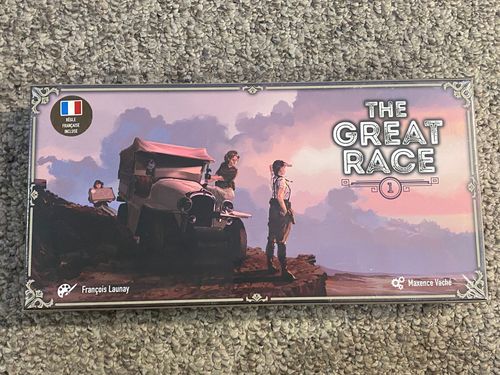
The Great Race: Expansion 1
Official rulebook: Platypus Game · PDF
The Great Race: Expansion 1 Rulebook
Table of Contents
Season
Season module:
Effect on game time: Adds additional time to the game.
Principle: The SEASON module adds weather hazards to the game which all players must overcome.
Set up: Players choose which level of difficulty to use, either normal or difficult, and turn the SEASON board to the appropriate side. Next, the two WEATHER STATION cards are added to the RESOURCE deck and it is shuffled as normal. At the start of the first round of the game, the first player rolls a die to determine which SEASON the race will begin in.
How it works: At the beginning of each BIVOUAC PHASE, the first player rolls a die and compares the result with the conditions listed in the current season. If the result is not shown, then the weather is favorable and nothing happens. If the result of the die roll is represented, all players will add the cost of the weather condition to any tile they attempt to cross. The penalties can take many forms, such as: expending more fuel for each tile crossed, sustaining additional mechanical damage, or not being able to take a boat for transport.
Note: SEASON is the surprise module of The Great Race. Beware of the vagaries and the unforeseen consequences of catastrophic weather. Choosing when to set out and weighing the possibilities of foul weather conditions are imperative when planning your trip. SEASON adds time to the game and increases travel costs. All the modules that allow you to earn money will be useful to limit its effects.
WEATHER STATION card (2x): The WEATHER STATION card acts as a DRIVER card, but also offers protection from the effects of the weather on the tiles you are crossing during that drive action. Normal TERRAIN TILE requirements must still be fulfilled.
In this example: After initial set up, the first player rolls the die once to find out when the race starts. It is a 6, so the race begins in November/December. At the start of the next GAME TURN, the season advances to January/February.
At the start of each BIVOUAC PHASE, the first player rolls the die to determine the current season race conditions. They roll a 1, making the race more difficult. For the remainder of the current GAME TURN, each TERRAIN TILE covered will cost one additional damage to either the ENGINE or CHASSIS gauge (player's choice).
Microclimate
Principle: Weather events can act as a complementary addition to the SEASON module. During the race, players may encounter terrains affected by sudden weather events.
Set up: Add MICROCLIMATE TILES to the bag of TERRAIN TILES for the current race continent. Place the MICROCLIMATE CARD next to the game board.
Operation: When a player draws a MICROCLIMATE TILE, it is placed like a normal TERRAIN TILE. When attempting to cross a MICROCLIMATE TILE, the player rolls a die and adds the consequences of the result (if any) to the listed requirements on the MICROCLIMATE CARD.
MICROCLIMATE CARD (text as printed on the card; the die-face icons at the left of each line are not reproduced as text, and are listed in the order printed, top to bottom):
- [die-face icon, two dice]: In the eye of a hurricane. All weather conditions (including current Season conditions) have no effect on vehicle movement.
- [die-face icon, one die]: Neither worse nor better. Normal Season conditions apply, but no further damage beyond cost on tiles occurs.
- [die-face icon, two dice]: Storm warning. Vehicle suffers the costs of the MICROCLIMATE TILE plus the loss of an additional FUEL level.
- [die-face icon, one die]: Head for shelter. Vehicle suffers the effect of the MICROCLIMATE TILE plus 1 additional damage to either ENGINE or CHASSIS.
Disclosure: the die-face values in the icons were not legible at the resolution of the source, so they are shown as placeholders. The card text is read from a 300 dpi render of the card on page 3.
Postal
Postal module:
Effect on game time: Speeds up the game.
Principle: With the POSTAL service, players deliver parcels to the cities they go through and receive bonuses.
Set-up: Add the two EXPRESS DELIVERY cards to the RESOURCE deck and shuffle the deck. Before the start of the first round of gameplay, the first player draws parcels from the POSTAL bag one at a time and places them on the city tiles until each city contains a parcel. Each player then draws a parcel from the bag and places it in the back of their half-track.
How it works: When a player arrives in a city of the same color as the parcel on their half-track, the parcel cube is put back into the POSTAL bag and the player receives 30F. If there is currently a parcel on that city space, the player may then load it onto their vehicle. All loaded parcels must be delivered before picking up another package. During the MAINTENANCE PHASE, the first player draws and places a new parcel on each city currently without one.
Note: The Postal module adds a unique delivery mechanic to gameplay, requiring players to optimize their routes in order to earn precious parcel bonuses. Money means fuel, and fuel means miles. But beware, a handful of sand can be enough to undo a well oiled machine; in the POSTAL service, the theft of a targeted package by a quicker rival can prove the difference between winning and losing.
EXPRESS DELIVERY CARD (2x): The parcel currently in the player's half-track can be delivered to any city, regardless of color.
Paddock
Paddock module:
Effect on game time: Slows down the game.
Principle: Enjoy the exceptional features of a unique vehicle.
Setup: Add the two PADDOCK cards to the RESOURCE deck and shuffle it. Next, choose either the pre-configured mode or free mode of gameplay.
Pre-configured mode: During game set-up, after choosing their crew, players take the PADDOCK card matching their vehicle color and set their gauges to match levels shown on the card.
Free mode: During game set-up, each player receives 150F in addition to regular starting funds. Starting with the first player (and in turn order), each player chooses either to: modify a gauge on their DASHBOARD, or pass. An increase of one gauge level costs 100F, a reduction of one gauge level pays 100F. Continuing in turn order, players may continue to modify their half-track or pass until all players have passed. Once all DASHBOARD gauges are determined, each gauge level should be set to their maximum limit and the game can start.
Note: With either of these two game modes, PADDOCK adds a noticeable asymmetrical element to The Great Race. In using the pre-configured vehicles or creating your own, the specifics of your half-track's abilities will give rivals significant information about your racing strategies.
PADDOCK Card (2x): Play this card to change a gauge on your vehicle by one level. The modification can be used to raise a level (at a cost of 100F) or to decrease a level (for a profit of 100F).
The page-5 vehicle entries carry no heading in the source; they are shown here as printed under the module.
Each vehicle is printed with a short description. The three gauge values printed on each card are shown in the order listed below, left to right. Disclosure: the card shows these values as icons, and the icon order is inferred from the gauge icons used elsewhere in this module (engine, petrol, chassis). The transcriber should check this against the card before publication.
Citroën Kegresse P17 PAMIR type (values 7 / 5 / 5) This half-track is comparable to the vehicle used by Georges-Marie Haardt during the Central Asian Expedition, which departed from Beirut in April of 1931 and finished in Beijing 10 months later.
Citroën Kegresse P4T CONGO type (values 6 / 5 / 6) This is the same type of half-track as those used during the Central Africa Expedition and its famous «Golden Scarab».
Citroën Kegresse P21 CHINE type (values 7 / 6 / 4) This model shares its design with those used during the Central Asian Expedition under the command of Lieutenant Victor Point.
Lancia 1ZM BRAVADO type (values 5 / 6 / 6) A unique and revolutionary half-track inspired by Citroën and Mercedes vehicles, its development was heavily influenced by Gianni Martinetti.
Mercedes DdKfz 3 (values 6 / 4 / 7) A true masterpiece of engineering, this half-track is a highly reliable redesign of a Mercedes «Sonderkraftfahrzeug», or «Special Motorized Vehicle», by Louis Chevy.
Diplomacy
Diplomacy module:
Effect on game time: Makes the game longer.
Principle: Corrupt influences and political uncertainties can complicate leaving a city, especially in a loud and over-sized half-track. Do you slowly grease the wheels of the local government? Or try to escape unscathed?
Setup: Choose the level of difficulty for DIPLOMACY. Add the two VISA cards to the RESOURCE deck and shuffle it. Place the DIPLOMACY BOARD next to the game board. Place one DIPLOMACY marker from each player on the first space of each line.
Operation: During the CONVOY PHASE, when leaving a city, roll a die. If the result is less than or equal to the level of your influence in the colour of the city, nothing happens.
If the result is higher, you decide whether your driver's action stops there or pay a bribe to get out of the city. The bribe is equal to the difference between your die roll and your influence level in the city color, multiplied by 20F.
Increasing your influence: During the Convoy phase, when you play the FINANCE action (removing ASSISTANTS from the FINANCE box), you may immediately spend money to increase your Diplomacy Influence. Pay the indicated price on the DIPLOMACY BOARD to move your marker. Players may make as many moves as they wish, as long as they can pay the costs involved.
Note: DIPLOMACY is the module that will most significantly impact your financial reserves. With DIPLOMACY, there are two main ways to deal with it: either prevention, by investing on the DIPLOMACY BOARD, or take risks and tempt the devil every time you leave a city.
VISA cards (2x): Play this card to leave a town without rolling a die.
Example (printed caption): In this example, the white player must roll a die roll of 3 or less to leave a red city. The player rolls a 5, so they must pay a bribe of 40F in order to leave or stop their DRIVER action.
Disclosure: the DIPLOMACY BOARD's price grid (the numbered spaces 10 to 60 and the influence levels by colour) is printed as a graphic and is not transcribed here. Its values must be read from the board image.
Patronage
Patronage module:
Effect on game time: Speeds up the game.
Principle: With patronage, each FINANCE action increases the interest of your patrons.
Set up: Add the two DANDY cards to the RESOURCE deck and shuffle it. Next place the SPONSORSHIP BOARD next to the game board and each player's Patron marker on the starting position of the SPONSORSHIP BOARD. Note: The starting position is the only space on the SPONSORSHIP BOARD where there can ever be more than one Patron marker.
How it works: For each ASSISTANT placed on the FINANCE box, the player advances the Patron marker one space. The movement of the Patron marker is triggered by the player taking the FINANCE action. There can be only one marker per space on the PATRONAGE BOARD. Any space occupied by another player's marker is skipped. At the beginning of a convoy phase sequence (before purchasing fuel), the player may choose to remove their patron marker and receive the amount of money equal to the amount under the marker.
In choosing this action, the player forfeits the rest of that CONVOY PHASE sequence, but may rejoin the convoy phase sequences once play returns to them (choosing to remove a Patron marker is NOT the same as passing). After collecting their money, the player returns the Patron marker to the start of the SPONSORSHIP BOARD.
Note: This module makes the most sense to use when coupled with modules requiring large financial funds. With the DIPLOMACY and SEASON modules, this module is essential.
DANDY cards (x2): Move your pawn 2 squares forward on the SPONSORSHIP BOARD, skipping the spaces occupied by the other players' markers as normal.
Example (printed caption): On their turn, the blue player takes the FINANCE action. Since there are 4 ASSISTANTS on the FINANCE box, the blue player advances their Patron marker 4 spaces, jumping over the spaces occupied by the other players.
Disclosure: the SPONSORSHIP BOARD's money values (0, 10, 20, 30, 40, 50) are printed as a graphic and are not transcribed here.