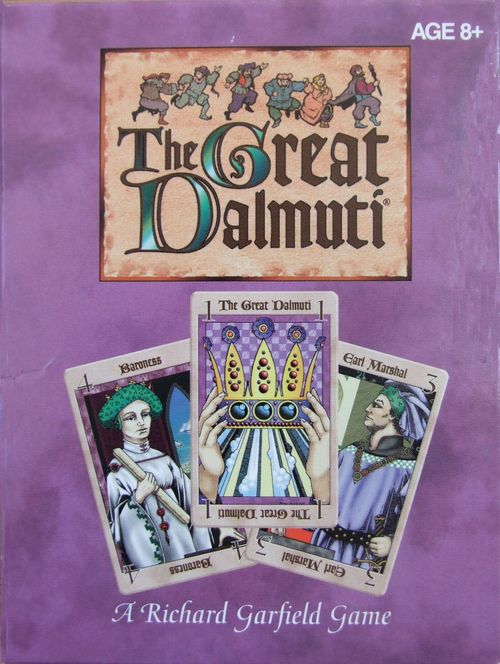
The Great Dalmuti
The Great Dalmuti Rulebook
Table of Contents
Table of Contents
Game Components
- One deck of 80 cards
- One rulebook
The Deck
The number on a card is called its rank. The lower the rank, the better the card (see chart). For example, the Baroness (4) is better than the Abbess (5). A card’s rank also tells you how many cards of its type are in the deck. The only exceptions are the two Jesters, which are a type of wild card. A Jester played alone counts as a card with rank 13—worse than even the Peasants (12)—but when played along with one or more other cards, Jesters take on the rank of the other cards.
Card Ranks
| Card | Rank |
|---|---|
| Jester (alone) | 13 |
| Peasants | 12 |
| Stonecutter | 11 |
| Shepherdess | 10 |
| Cook | 9 |
| Mason | 8 |
| Seamstress | 7 |
| Knight | 6 |
| Abbess | 5 |
| Baroness | 4 |
| Earl Marshal | 3 |
| Archbishop | 2 |
| The Great Dalmuti | 1 |
Object of the Game
In each hand of The Great Dalmuti card game, the object is to get rid of your cards as soon as you can. The faster you get rid of your cards, the higher your social class will be in the following hand.
Setup
Shuffle and fan the deck, and let each player draw and reveal a card. Players arrange their seating to reflect their cards’ ranks: The person with the best card is called the Greater Dalmuti and takes the seat of his or her choice. The person who drew the second-best card, who is called the Lesser Dalmuti, sits to that person’s left, and so forth around the playing area. The player with the worst card is the Greater Peon. The person to his or her right is the Lesser Peon. All other players are varying classes of Merchants. Remember, the lower the rank, the better the card; treat the Jesters as the worst cards possible. Break ties by drawing additional cards.
The Deal
The Greater Peon is responsible for collecting, shuffling, and dealing the cards. He or she deals out the entire deck each hand, starting with the Greater Dalmuti and giving one card to each player in clockwise order until the deck runs out. Some players may get more cards than others—after all, life isn’t fair! Players may look at their hands while the cards are still being dealt.
Taxation
Before play begins, the Peons must pay taxes. The Greater Peon chooses his or her two best cards to give to the Greater Dalmuti, and in exchange the Greater Dalmuti chooses any two of his or her own cards to give to the Greater Peon. (Again, the lower the rank, the better the card, with the Jesters considered the worst cards.) The Lesser Peon and Lesser Dalmuti do the same but with one card rather than two. All exchanges happen at the same time.
Revolution
If any player is dealt both Jesters, he or she may call a revolution. A revolution means there is no taxation, to the disappointment of the Dalmutis and the delight of the Peons. If the Greater Peon declares a revolution, it’s called a greater revolution. In a greater revolution all players exchange seats with their opposites. That is, the Greater Peon becomes the Greater Dalmuti, the Lesser Peon becomes the Lesser Dalmuti, and so forth.
The Play
Each hand starts when the player who has the lead plays a set of cards of the same rank face up. A set is simply one or more cards. The Greater Dalmuti has the lead in the first hand, and then play proceeds clockwise. On his or her turn, each player can either play a set of the same number of cards of better rank or pass. (Remember, the lower the rank, the better the card.) A player who chooses to pass may still play later in the hand, when it’s his or her turn again. Play continues clockwise until everyone passes in a row. This ends the hand, and the Greater Peon collects the played cards and puts them aside. The player who made the last play then gets the lead for the next hand.
Going Out
A player who has played his or her last card is said to have gone out. The first player who goes out wins the hand and becomes the Greater Dalmuti for the next hand. The second person to go out becomes the Lesser Dalmuti and sits to the left of the Greater Dalmuti, and so on around the playing area.
After a player goes out, play continues clockwise as usual. If no one plays a better set, then the lead passes clockwise to the next player who still has cards.
Winners and Losers
Each hand of The Great Dalmuti card game is played for its own sake: Becoming the Greater Dalmuti is winning and becoming the Greater Peon is losing, and all the other positions are somewhere in between. Like life, the game isn’t fair, and it’s often difficult to hold your position, let alone move up in rank.
For even more flavor, get into the roles. Merchants might schmooze with the upper classes while snubbing the lower. Dalmutis might be either kind or spoiled. Peons might show deference or defiance. Just make sure you have fun!
Joining a Game in Progress
New players can join a game at the beginning of any hand. Because the Peons shouldn’t be deprived of the joy of working themselves out of the lower classes, the new player enters as a Merchant, halfway between the Greater Dalmuti and the Greater Peon. If there’s a choice of positions, the Greater Dalmuti decides the order.
The Strategy of Saving Cards
Most of the time you should play your worst cards when you can, but don’t be afraid to pass sometimes even when you can play. A savvy player in a lower position often won’t play a good set until several people are out, saving it until he or she can use it to try to take the lead. Saving cards until they’re the best that are left is a good idea if you’re only trying to move up one rank or you just want to hold onto your position.
Optional Rules
Once you’ve got the basic game down, you might want to try one or more of the following variations.
First Deal Revolution
The first deal automatically has a revolution, so no taxes are collected. If the Greater Peon is dealt both Jesters, he or she may still call a greater revolution as usual.
Stripped Decks for Four or Five Players
When playing with fewer players you may want to use a smaller deck so you have fewer cards to hold. When playing with five players, strip out the Peasants so you’re playing with a deck of sixty-eight cards. For four players, strip out the Peasants and the Stonecutters to bring your deck down to fifty-seven cards.
Scoring
As each player goes out, he or she gets 1 point for every player still in that hand. Set a number of hands to play, and the person with the highest score at the end wins. Twenty hands is a fine number to start with.
Philanthropic Scoring
Use the scoring rules above. In addition, the Greater Dalmuti gets 1 point at the end of the hand if the Greater Peon goes up in status, and the Lesser Dalmuti gets 1 point if the Lesser Peon goes up in status.
More Appropriate Seating
Arrange the playing area with ranked seating. This means the Greater Dalmuti gets the best or most comfortable seat; the Lesser Dalmuti gets a very nice seat; the Merchants get ordinary seats; and the Peons are stuck with the worst seats. The Greater Peon might even have to sit on a suitcase, a box, or the floor—if he or she gets to sit at all!
Other Status Symbols and Perks
Players wear hats that indicate their ranks: A crown for the Greater Dalmuti and a straw hat for the Greater Peon, for example. Allow the Greater Dalmuti first choice of the snacks, with the Lesser Dalmuti getting second choice, and so forth, so that the Greater Peon only gets the bubble-gum-flavored jelly beans. Use your imagination and invent your own status symbols.
Merchant Exchange
During taxation, the highest-class Merchant may choose a card at random and exchange it with another Merchant of his or her choice.
Misdeals
If the Greater Peon accidentally exposes a card while dealing, the Greater Dalmuti decides whether it goes to the intended person or to the Greater Peon. If the card goes to the Greater Peon, he or she must replace it with one randomly drawn from his or her hand.