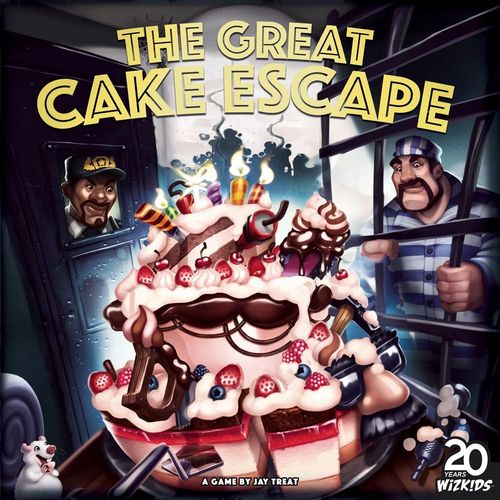
The Great Cake Escape
The Great Cake Escape Rulebook
Table of Contents
Table of Contents
Setup
Choose a color and take the 11 pieces of that color.
Put the cake in the middle of the play area.
The player who baked most recently takes the first turn—or the winner of the last game when playing again.
How to Assemble the Cake Tiers
Insert three spacer pieces into the large bottom tier of the cake. Then place the middle tier on top of that, so that the sides of the cake insert into the spacer pieces. Do the same with the middle tier and top tier to finish cake assembly.
Gameplay
Going clockwise from the start player, on your turn, choose one of your unused pieces and push it between the cake tiers. (In a 2-player game, only play within the two bottom tiers.) Whatever angle your piece is should remain constant, and whatever angle you're pushing in at should remain constant—don't wiggle, rotate, or change the direction while pushing.
Example: Held at a constant angle and pushed in a constant direction, Phillip attempts to place his Dynamite into the cake and hopefully score 9 points for doing so.
Remove any pieces you knock out of the cake as a result of pushing yours in. The knocked out pieces are out of the game and will not score (unless reclaimed with the disguise, see The Disguise see on the back of this sheet).
You may rotate the cake, but be careful: Any opponents' pieces you knock out — other than from pushing in your own piece — are returned to their owners to be played again in a future turn. Your own dropped pieces are knocked out.
Game End
Play continues this way until every player has played all their pieces. Skip any players that are out of pieces.
Inspection
When the game ends, the guards inspect each layer of the cake. A layer is the space between two cake tiers. Fortunately, the guards are lazy and stop after they find the most visible item in each layer of the cake. To inspect the cake:
- Count the number of times a piece's value is visible outside the cake. The guards catch the most visible piece.
- If a piece's value is partially visible, count that as a half.
- If multiple pieces are equally visible, they're all caught.
When guards catch these pieces, they are removed from the cake. These pieces will reduce their owner's score by their value.
Inspection Example: Looking at the total number of times any piece's value is visible outside of the cake, Denice's yellow shovel has two of its values visible, more than any other piece in that layer.
Scoring
Finally, remove all other pieces from the cake and score them. Add the value of all the pieces you scored, then subtract any pieces that were caught. Each piece is worth a number of points equal to the value printed on it.
The player with the highest score wins. Ties go to the player earliest in turn order.
Point Values
Note that the value of each piece is printed multiple times on the piece.
The pieces are valued 1 through 10, with the Disguise valued 0.
The Disguise
Unlike the pieces valued 1-10, the disguise is special. It has no value, but when yours is knocked out of the cake by another player, you may immediately reclaim one of your other pieces that has been knocked out, to play it again on a future turn. If you have none at that time, the ruse is wasted.
FAQ
- If you've got a piece sticking out of the cake further than you'd like, you can try to get it in further by pushing your new piece into your old one on its way into the cake. If the new piece doesn't make it into the cake, it is knocked out.
- With the above exception, you must always push new pieces into the cake; you can't simply place them on top of other pieces hanging out of the cake.
- There is only one level between each layer of the cake. Never push pieces so they stack on top of each other within the cake.
- As long as a piece is hanging from the cake or on pieces in the cake, it's also considered "in the cake," even if it's also touching the table.