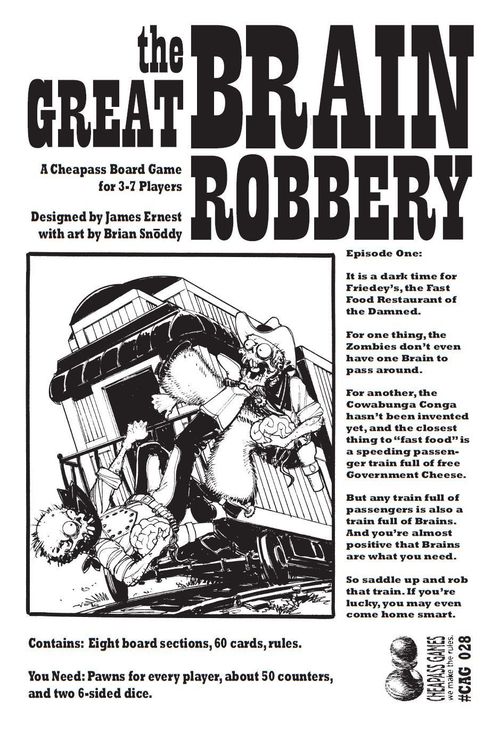
The Great Brain Robbery
The Great Brain Robbery Rulebook
Table of Contents
Table of Contents
What Comes with this Game
Episode One:
- 64 Brain Cards
- 8 double-sided Train Cars
- This Rulebook
What Else You Need
- A Pawn for every player
- A bunch of generic Counters (about 50)
- At least two 6-sided Dice
To Begin
Shuffle the Brain Cards and deal one card to each player. Set the rest of the deck in the middle of the table. Leave space for a discard pile beside the deck. When the deck empties, shuffle the discards and replace it.
Find the Caboose car (it's got the Engine on the other side) and place it at one end of the table. Randomly pick one more train car* and attach it to the Caboose to form the beginning of the train. Put a Counter on every space marked with a Brain icon. Whenever new cars get added to the train later, you will put Counters on all the new Brain icons.
Determine randomly who will go first. Play will proceed to the left. Put each player's Pawn on the Caboose in the space that corresponds to their starting order.
*Randomly Picking Cars: Each train car is double-sided, so "randomly picking" a car works like this: one player shuffles the cars, and another player chooses a car with his eyes closed, deciding which side should be faceup before he sees it.
About the Cards
The Cards in the deck represent Brains and Cheese. Cheese will work as Brains in a pinch, and even gives you a bit of a bonus, but you can't win the game with it.
Since you've only got two hands, you can carry only two cards at once. In addition, you can install one Brain (or Cheese) in your "Head," which means playing it faceup on the table. Installing Brains is described later, and happens only at the end of your turn.
The Numbers on the Brain Card: The Cost is what you must pay to install the Brain in your Head. The Hit and Run are the bonuses that the Brain adds to your fighting and movement. The IQ is the value of the Brain at the end of the game.
[Example card: Nesbith (Lizard) — 2 Cost, 2 Hit, 4 Run, IQ 5.]
On Every Turn
Discard: If you are holding cards you don't want, you can discard them at the beginning of your turn in order to avoid the movement penalty described below.
Movement: You will usually roll two dice to move. However, if you do not have a Brain in your Head, you roll one less die for every card in your hand. For example, on the first turn of the game, you're holding one card to start. You can either roll one die, or you can throw that card away and roll two dice.
You can move as far as you like up to the amount of your roll. You can even stay put or double back. You can't move through walls, you can't move diagonally, and you can't move off the back of the train. If you move off the front, you will add a new car as described later.
Increasing your Move: If you have a Brain in your Head, you always add that Brain's "Run" value to your movement roll.
In addition, you can also play Brain Cards from your hand to add their Run values to your move. Cards you play in this manner cost you nothing, but are discarded after you play them.
Even if you roll no dice, you can still play cards from your hand to add to your move. So, if you're holding Brains with Run values of 4 or higher, you may want to play them for their Run value rather than discarding them to roll dice.
Timing Note: You can play cards to add value to your move in the middle of moving. For example, suppose you roll a 10 and move off the front of the train and into a new car. Once you have seen the new car, you may decide you want to move further than 10 spaces. You can still play cards now to add to your move.
Landing on a Brain Counter: If you stop on a Brain Counter, you pick it up and draw one card from the top of the deck. This Counter is your "experience point" for finding the Brain. You can spend experience points to install Brains in your Head.
You only pick up the Counter in the space where you stop. You don't pick anything else up along the way. As a general rule, you can only interact with the space where you stop, not anything else along the way.
Hand Limit: If you are already holding two cards you are allowed to draw a third, but you must discard back down to two cards by the end of your turn. Basically, you're setting all the Brains on the floor and deciding which ones are worth taking with you.
Fighting: If you stop on another player, you can decide to fight. Fighting has two functions: to earn points, and to steal Brains. Fighting is optional, so it's up to the active player to decide whether to fight or peacefully coexist. If there are multiple players on the space and you decide to fight, then it's one big multi-way fight.
Each player in the fight rolls two dice, unless that player has no Brain installed, in which case they roll two dice minus one die for every card in their hand. (This is similar to the restriction on movement.)
Each player then adds the Hit value of the Brain in his Head (if any), and can also play Brains from his hand to add those Hit values to his roll.
The fight might take several steps, as each player plays extra Hits from his hand to get the advantage, then lets his opponents react. The fight is over only when all players decide to play no more cards.
Ties: If there is a tie, the attacker always wins. This is true even if the attacker isn't one of the tied players. That's more accurate than you think.
[Example card: Uther (King) — 10 Cost, 5 Hit, 5 Run, IQ 170.]
Winning the Fight: The winner of the fight gets to steal, rearrange, or discard the Brains in the Heads of all the players involved in the fight. Typically, he will take his favorite Brain and discard the rest, but he might rarely choose to leave a particularly useless Brain in someone else's head.
Losing the Fight: Experience is what you get when you don't get what you want, so every player who lost the fight earns one experience point for losing. Because of this rule, you might sometimes pick a fight to lose.
Adding Cars to the Train
When you move off the front of the train, you will add a new car by choosing it randomly from the unused train cars. Put that car on the front of the train, and put new Counters on all the Brain symbols in the new car.
Finish your move, which may include moving into yet another new car, then check to see if any cars fall off the back of the train as described below.
Losing Train Cars: Each time a Zombie moves from car to car, he can't resist the urge to hammer on the coupling between them. It's just a matter of time before the train starts falling apart.
After you add new cars to the train, roll one 6-sided die and compare it to the length of the train. If you roll equal to or higher than the number of cars in the train, including the new car, nothing happens. If you roll lower than the length of the train, remove the last car from the train and roll again. You will keep rolling as long as you keep removing cars.
Note: If you move so far in one turn that you add multiple cars to the front of the train, you still check for lost cars only once.
The players who were standing on the destroyed cars now find themselves running along behind the train. Put those Pawns just behind the last car. These players must discard the Brains in their hands to run fast enough to keep up with the train. However, they do hold on to their experience points and the Brains in their Heads.
The space-behind-the-train is a strange space. You're not allowed to fight there, and no one can walk into that space from the back of the train. When you take a turn in this space, you are forced to move at least one space into the back of the last car. So you can't just run along behind the train forever to protect yourself from being attacked. No Zombie is that smart.
Dead Cars: When the Caboose falls off the back of the train, it gets shuffled back into the pack of train cars. However, after the Caboose, remove every used car from the game. This ensures that the game will be short, with a maximum train length of nine cars. For a longer game, you can keep recycling the discarded cars, but be aware that this variant can theoretically continue forever.
About the Engine: When you add the Engine to the train, you can't build any farther. (If you draw the Caboose, flip it over. It's the Engine.) Furthermore, any player who wants to do so can now end the game, by using the Brakes.
The Engine car has two "Brake" spaces, labeled "B." If you stop on one of these spaces, you're braking the train. Each time you brake, the train loses exactly one car off the back, with no die rolling involved. Once the Engine is the last car, the game ends immediately after the next Brake, and the player with the highest IQ wins.
Braking is not optional. If you stop on the Brake, the braking effect happens immediately, before you get the chance to do anything else. If the game ends, it ends before any fighting can happen, and before the active player can install a new Brain. So it won't do you any good to end the game if you're holding the winning Brain in your hand. You will have to install it, and then run to the Brake on your next turn.
Installing a Brain
At the end of your turn, you can install a new Brain from your hand. You must pay a number of experience points equal to the Cost of the Brain, discard any previously installed Brain, and play the new Brain faceup on the table in front of you.
Having a Brain is handy. It removes the movement and fighting penalties you get for holding cards, and it usually makes you better at running and fighting. And of course, you need a Brain to win.
The Cheese: The "Government Cheese" Brains are cheap and plentiful, if you just need to have something in your head. Technically they count as Brains, but they aren't much good for anything else. As it says on the cards, you can't win the game with Government Cheese.
Winning
The game ends immediately when the Engine is the only remaining train car, and a player steps on the Brake.
At the end of the game, the player who has the Brain with the highest IQ in his head wins. If the best IQ on the table is 0, either because players have no Brains or because they have nothing but Government Cheese, everyone loses.
Strategy
This game tends to have two distinct phases. In the beginning, players are running forward and grabbing Brains and points as quickly as they can. At the end, when there are few Brains left on the board, players are jumping on each other trying to grab the best Brain and run to the Brake.
The end of the game usually revolves around properly timing the demise of the train. If you install the winning Brain too early, the other Zombies will dogpile on you and probably either take it away or destroy it. (If the biggest Brain is a weak fighter, it's often better to kill it and keep a stronger Brain in your head.) If you wait too long, you might drop the card by falling off the train, or not get the chance to install it before the game ends.
Typically, only the player who's in the lead will try to stop the train, and everyone else will beat up on him trying to take the lead away. However, each time those players jump on him, they brake the train (if, as is usually the case, he's standing on the Brake).
There is the chance that a Zombie who's had a rotten game will just stop the train out of spite. Whenever that happens, we will be somewhere laughing at you.
Variations
This is a short game, roughly 45 minutes. Because luck can play a strong role, we'd rather play several short games than one long one.
If you're keen to play a longer game, you can recycle the used cars instead of removing them from the game. You can also start the game with a longer train, or prevent the Engine from being drawn for a set number of rounds after the Caboose falls off.
Another option: Start everyone with free Cheese.