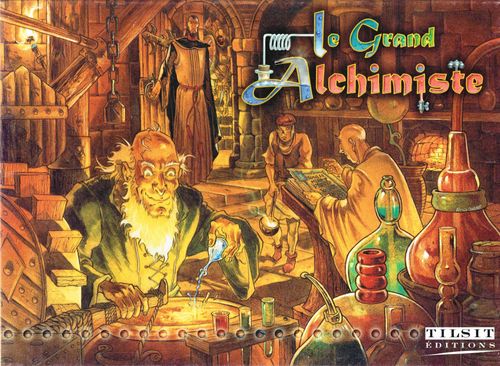
The Grand Alchemist
The Grand Alchemist Rulebook
Table of Contents
Table of Contents
Components
- 1 game board (depicts the map of Renaissance Europe; see the board description at the end of these rules)
- 1 investigation sheet (Fiche d'enquête)
- 3 six-sided dice
- 48 investigation markers (pions enquête)
- 18 ingot markers (pions lingots), used as gold currency
- 1 plague epidemic marker (pion épidémie)
- 14 transmutation markers (pions transmutation), with explosion faces and faces showing one, two or three gold ingots
- 1 wooden Grand Inquisiteur piece (pion en bois Grand Inquisiteur)
- 24 alchemist and assistant markers (pions alchimiste et assistant); each player has 1 alchemist, marked with a cross, and 2 assistants
- 9 Secret Laboratory cards (cartes Laboratoire Secret), one for each of the following cities: Lisbon, Amsterdam, Vienna, Barcelona, Bordeaux, Lyon, Berlin, Milan and Dunbar
- 32 event cards (cartes Événement)
- 36 Savoir cards (cartes Savoir), 6 for each of the six Savoir cities (Paris, London, Oslo, Prague, Rome and Valladolid)
Note: the per-type breakdown of the event cards and the card faces are shown only as images on the source page and are not legible in the text, so only the total of 32 event cards is given here.
Game Rules
Section 1: Setup
First, place the game board on the table in the middle of the players. Next to it, place:
- The deck of event cards.
- The six decks of Savoir cards corresponding to the Savoir cities (6 cards per deck).
- The investigation sheet.
- The transmutation markers (face down), which form a draw pile.
- The ingot markers, which serve as money.
Each player takes three markers of the colour they choose (1 alchemist and 2 assistants), one Secret Laboratory card, which they keep hidden, and 3 event cards. The alchemist markers are marked with a cross. Undistributed Laboratory cards are returned to the game box face down.
First player
The first player is chosen at random. They place their three markers together (alchemist and assistants) on a city anywhere on the board that is not one of the 6 Savoir cities.
With 3 or 4 players
When playing with 3 or 4 players, one Secret Laboratory card must be removed from the game. The first player removes one Laboratory card from the 8 remaining and announces it to the other players.
Section 2: Turn Sequence
The game is divided into turns, each made up of the players' sequences. Each player's sequence must be resolved in three successive phases:
- Receiving event cards,
- Movement and encounters,
- Carrying out the Grand Œuvre.
Each player plays their entire sequence before any other player may play. The first player begins, then the player to their left, and so on clockwise.
Once every player has taken their turn, the Grand Inquisiteur is played.
On the first turn of the game, the first player is chosen at random, and it is they who control the Grand Inquisiteur. They roll a die to determine on which Savoir city it appears. At the start of each following turn, the player who holds the fewest gold ingots and Savoir cards in hand plays the Grand Inquisiteur. If there is a tie, the players are separated by a die roll.
Sequence of player 1:
- Phase 1: Receiving event cards
- Phase 2: Movement and encounters of alchemists and assistants
- Phase 3: Carrying out the Grand Œuvre
Sequence of players 2, 3, 4, 5, 6.
Sequence of the Grand Inquisiteur: movement of the Grand Inquisiteur.
Phase 1: Receiving cards
On the first turn, players draw three event cards during their sequence. After that, at the start of a player's sequence, that player draws as many cards as needed to complete their hand of three cards.
Players must play event cards during their sequence. Event cards allow actions that change the normal course of the rules (see Section 4).
Phase 2: Movement and encounters
Movement of alchemists and assistants
Alchemists and their assistants move from one city to another on the map. For each marker a player controls, they roll 1 die to determine the number of movement points that marker has. The player divides the dice among their markers as they wish.
Example: The green player rolls the dice and divides them as they wish among all their markers. They obtain 3, 4 and 6. They give the 4 to their alchemist, the 3 to their first assistant and the 6 to their second assistant. They can therefore move their alchemist 4 cities, their first assistant 3 cities and their second assistant 6 cities.
Movement is governed by the following rules:
- When a die roll results in a 1, the marker concerned cannot move on that turn.
- A marker may not pass through the same city more than once during a single movement.
- Movement points can never be kept for the following turn. Unused points are lost.
- During the movement phase, players may use the event cards "diligence" (coach), "relais de poste" (post relay) or "raccourci" (shortcut). Several of these cards may be played one after another.
"Raccourci" cards
"Raccourci" cards are used to take the shortcuts marked on the game board. A shortcut may only be used if a card that allows it is played.
Sea passages and storms
Each time a player uses a sea passage marked with a storm symbol, they must roll a die. If they roll a 1, they lose (if they have one) a Savoir card drawn at random by one of the other players from their hand, and their movement continues normally. If they roll any other result, nothing happens and they continue their movement.
Encounters
When a player stops on a space on which other markers are present, the player whose sequence it is may choose one of these actions:
- Inspect one of the encountered markers,
- Or fight a duel with one of the encountered markers.
Inspection and diversion
If the player whose sequence it is decides to inspect a marker, they look at it discreetly and show their own marker to the player who owns the marker they are inspecting.
When an alchemist identifies an assistant, they may try to divert it and take it into their service. The 2 players each roll 1 die and add to the result the number of Savoir cards they hold. If the assistant has the higher score, nothing happens. If the alchemist obtains the higher score, the assistant is diverted and is replaced by a marker of the colour of its new owner. A player may not own more than 3 assistants.
Duel
If the player whose sequence it is decides to fight a duel with a marker, they and the player concerned each roll 1D6 and add +2 to their result for each "Spadassin" (Swordsman) card played. The player who obtains the higher score may examine their opponent's Savoir cards and may exchange as many cards as they wish. Be careful, however: Savoir cards may only be exchanged if they come from the same city. During a duel, the players do not inspect each other's markers. A player who begins their turn on a city where markers of other players are present may not start a duel with those markers.
Phase 3: Carrying out the Grand Œuvre
To carry out the Grand Œuvre, players must be initiated into the alchemical art by studying in the six Savoir cities (Paris, London, Oslo, Prague, Rome and Valladolid). Each time a player passes through a Savoir city and wishes to study there, they must stop there, which ends their movement. They then receive a Savoir card from that city. Players may never hold two Savoir cards from the same city, so they can never have more than 6 Savoir cards in hand.
Once a player holds one Savoir card from each of the cities, they may attempt the Grand Œuvre. A player may carry out the Grand Œuvre in any city they happen to be in, as long as they are not in prison.
There is also a purity code, which determines the success rate. Savoir cards may belong to three different alchemical families: Earth (Terre), Sun (Soleil) and Moon (Lune).
- If the player's cards all belong to the same alchemical family (Earth, Sun or Moon), they draw 3 transmutation markers.
- If their cards belong to 2 different alchemical families, they draw two transmutation markers.
- If their cards belong to 3 alchemical families, they draw only one transmutation marker.
The transmutation markers are then turned over:
- Explosion markers yield nothing.
- Markers showing gold ingots yield 1, 2 or 3 ingots.
The transmutation markers are returned to their draw pile, and the player takes the ingot markers obtained. These ingot markers must be visible to everyone.
The Savoir cards used are placed back under the deck of the corresponding city. The player then goes round the Savoir cities again to attempt a new transmutation, until they total 5 gold ingots.
Section 3: The Grand Inquisiteur
The Grand Inquisiteur (GI) seeks to arrest the alchemists and steal their formulas to prevent them from carrying out the Grand Œuvre. The GI is controlled by the player who holds the fewest gold ingots and Savoir cards in hand. If there is a tie, the players are separated by dice.
Placement
On the first turn, a die is rolled and the GI is placed on the Savoir city bearing the number obtained. Of course, the GI may not search (Perquisitionner) or Control in the city where it starts its turn.
Movement
At the end of the turn, the first player rolls 2 dice and chooses the die that will be used to move the GI. They may also use "diligence" cards. However, they do not need "raccourci" cards to use shortcuts: these are free for the GI. The GI may choose not to use all of its movement points, but in that case the unused points are lost. The GI may perform only one action per city it passes through: either search (Perquisitionner) or Control a marker present in the city it passes through.
Search (Perquisition)
In each city it passes through, the GI may search in an attempt to find an alchemist's Secret Laboratory. In this case, it must name a player and search the city in which it is located. For example, it will say: "I am looking for the green player's laboratory in Bordeaux."
- If the laboratory is not in that city, the GI places an investigation marker on the investigation sheet at the space corresponding to that city and the searched player. In this way, it can see progressively which cities and which players remain to be searched.
- If the laboratory is indeed in that city, the searched player turns over their Laboratory card and loses three Savoir cards drawn at random by the GI (or all of their Savoir cards if they have 3 or fewer). The alchemist then draws a new Laboratory card from the remaining cards in the pile, having first added their old card to it. The player may therefore end up in the same city. The GI then removes all investigation markers concerning that player, and the game continues. Even if the alchemist is in their laboratory at the time of the search, nothing happens to them: they always manage to escape.
Control and arrest
If the GI encounters markers during its movement, it may Control them (one per space). It then turns over the marker of its choice to see who it belongs to. If the controlled marker is an assistant, the GI releases it and nothing happens. If it is an alchemist, the GI arrests it. The alchemist is then taken to the dungeon (cachot).
Note: the GI may perform only one action per city, either Control or Search. For example, it may search one city, then control a marker in another city, then control a second marker in the next city, but it may not carry out these three actions in the same city.
The dungeon (cachot)
The board has two "prison" spaces, representing judgement and prison. When an alchemist is arrested, they are first judged. They are placed on the judgement space. Once judgement has been passed, the alchemist is placed on the prison space. To do this, the GI rolls 1 die:
- 1 or 2: the alchemist passes one turn in the dungeon.
- 3 or 4: the alchemist passes one turn in the dungeon and loses 1 Savoir card at random.
- 5 or 6: the alchemist passes one turn in the dungeon and loses 2 Savoir cards at random.
While an alchemist is in the dungeon, the player may no longer carry out transmutations.
Assistants (see the "Prison" event card) may only pass one turn in the dungeon and never lose Savoir cards because of it.
When a prisoner is released, they roll a die and begin their sequence on the Savoir city bearing the number obtained.
Section 4: Event Cards
- Perquisition (search): Search a Laboratory city of your choice for a player's Secret Laboratory.
- Protection: Cancel a search, a storm, or free one of your markers from the dungeon.
- Prison: Send another player's assistant to prison. That player chooses which assistant is sent to prison.
- Spadassin (swordsman): During a duel, add +2 to the result of your die.
- Épidémie de peste (plague epidemic): The city of your choice (other than the Savoir cities) becomes impassable for one turn. The plague epidemic marker is removed at the turn of the player who placed it the previous turn. Option: the plague epidemic may be placed on a Savoir city. However, it may not be the same city twice in a row.
- Voleur (thief): Take all the Savoir cards or event cards of another player. You may exchange 2 of these cards for 2 of your own. If no card interests you, you are never obliged to exchange.
- Diligence (coach): You receive +2, +3 or +4 additional movement points for one of your markers.
- Raccourci (shortcut): One of your markers may use a shortcut.
- Alliage secret (secret alloy): You change the alchemical family (Earth, Sun, Moon) of one Savoir card to the family of your choice.
Optional Rules
Public judgement (Le Jugement public)
All present players except the imprisoned player vote by a show of hands: guilty or acquitted. The GI manages the vote. Of course, nothing prevents you from corrupting your judges with Savoir or event cards...
- If the majority of players vote for acquittal, the player is released and the game continues normally.
- If the majority of players vote guilty, the player spends two turns in the dungeon.
- In case of a tie, the GI's side wins.
Faster game (Jeu plus rapide)
For a faster game, simply lower the number of gold ingots needed to 4, increase each player's hand to 4 event cards, and remove the explosion transmutation markers.
Control of the Grand Inquisiteur
Each player, one after the other, controls the GI.
Board and Sheet Descriptions
- Investigation sheet (actual size 21 x 30 cm)
- Game board (actual size 50 x 35 cm)
The game board depicts the map of Europe at the Renaissance. The Savoir cities bear a parchment symbol, while the Laboratory cities bear an alembic symbol. The other cities are ordinary cities. Roads are shown as lines, shortcuts as dotted lines, and sea passages are shown as lines with the storm symbol.