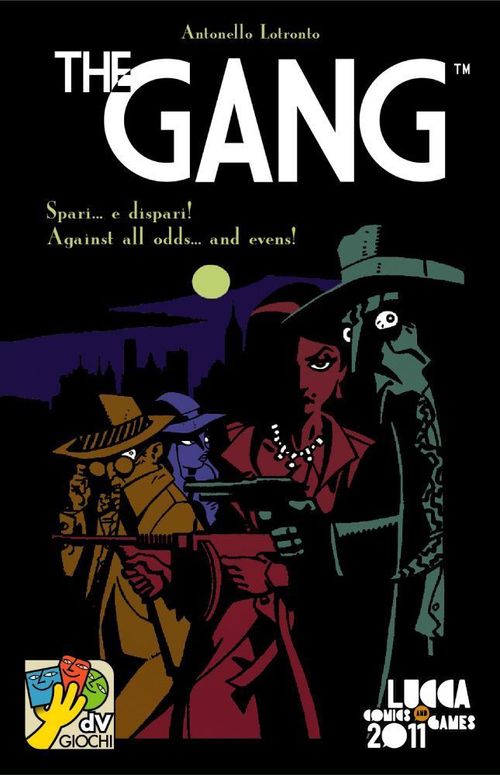
The Gang
The Gang Rulebook
Table of Contents
Table of Contents
Contents
These rules and 110 cards divided as follows:
- 80 Gangster cards (40 even numbers, 40 odd numbers)
- 12 Special cards (4 Lookouts, 4 Spies, 4 The Boss Calls)
- 3 City cards (Chicago, Detroit, New York)
- 15 Tickets for choosing a city (5 sets Chicago – Detroit – New York)
Goal of the Game
The goal of the game is to collect the highest number of "revolver" points, indicated on the gangster cards. To capture gangsters, you need to surround them when they walk in a "gang:" i.e., when there are two or more adjacent cards of the same type — all odd or all even — in the same city.
Preparation
First, sort the cards by type. Shuffle the Gangsters and the Special cards separately. Deal each player a hand of four Gangsters and one Special card, face down. Set the leftover cards to the side as draw decks. Give each player a set of three Tickets (1 Chicago, 1 Detroit, and 1 New York — if there are less than 5 players, return the unused Tickets to the box). Place the three City cards on the table in a column. Create a row of five Gangsters, face up, to the side of each City card (taken from the draw pile). Arrange the Gangsters by number in ascending order, as shown below.
A sample setup.
The Game
The owner of the game chooses a starting player, or you can choose at random.
The game is played over four rounds. Each round is divided into four turns called "Jobs." Once the four Jobs are complete, the round is over. Only then can you draw new cards to play the next round.
At the start of each Job, all players secretly choose cards from their hand. You can choose either:
- 1 Gangster and 1 Ticket; or
- 1 Gangster and 1 Special card.
Once all cards are chosen, all players reveal their cards at the same time. Gangsters are then placed in the cities, starting with the Gangster with the lowest value and moving up to the highest value.
Example: In this Job, Alphonse plays Gangster 12, Louie plays Gangster 43, and Bugsy plays Gangster 9. Bugsy will take his turn first, followed by Alphonse, with Louie playing last.
When placing your Gangster, you must follow these rules:
-
If you played a Gangster and a Ticket: Place your Gangster in the city shown on your Ticket. You must always place your Gangster in numerical order. Then, see if your placement has triggered a "capture" (see "Capturing a Gang"). Finally, return your Ticket to your hand. Tickets can be used any number of times; Gangsters stay in the city where they are played.
Example: Here's the Gangsters in Chicago. Alphonse plays his Chicago Ticket and Gangster 19. He must add his Gangster to Chicago, and he must insert the Gangster in numerical order, between the 17 and the 24. Now Chicago looks like this. Then he takes his Chicago Ticket back into his hand to use later.
-
If you played a Gangster and a Special card: You choose which city to play your cards in. Both cards must be played in the same city. You also choose which order to play the cards in. Your Gangster is played in numerical order, as above. Each Special card has different rules on how it is played (see "Special Cards"). Each of the two cards (or both) may trigger a gang capture (see below). Then the Special card is discarded (to a discard pile).
Prepare for the Next Job or Round
After all players have played their chosen cards, the Job is over and a new Job begins. At the beginning of each Job, there cannot be less than 5 Gangsters in each city. If necessary, draw Gangsters from the deck and add them to the cities until there are at least 5 in each city. As always, arrange them in ascending order.
After four Jobs (i.e., when all players run out of Gangsters in hand), the round is complete. If you did not play your Special card, you must now discard it. Deal each player four new Gangsters and a new Special card (face down) and refill the cities if necessary. If the deck of Special cards runs out, reshuffle the discard pile and create a new draw deck. If the deck of Gangsters runs out, the game ends (see "End of the Game").
Capturing a Gang
As soon as a Gangster steps into a city, he will try to capture a rival gang!
A "gang" is made up of two or more adjacent cards of the same type (all odds or all evens) in the same city.
A gang is captured when it is between two cards of the opposite type. In other words, two odd cards can capture a gang of even cards, and vice versa. It is possible to capture two gangs with a single card play (see the example).
You can only capture a gang if you just played one of the two surrounding cards.
Put all cards you capture face down in front of you (they are used only during the final scoring).
Example 1: Alphonse added Gangster 19 to Chicago. Now there is an "even" gang (24 and 36) surrounded by two odd Gangsters (19 and 57), so Alphonse captures the even Gangsters. Now Chicago looks like this.
Example 2: It's Bugsy's turn to play. He's chosen his Detroit ticket and Gangster 52. Before he plays, Detroit looks like this. Bugsy inserts Gangster 52 between 35 and 58. Now the odd gang (15, 23, and 35) is surrounded by two even cards (14 and 52) so Bugsy captures all three cards.
When Louie adds Gangster 55 to Detroit, he can't capture anything. Even though Gangster 58 is surrounded by two odd Gangsters, he does not count as a gang – a gang must have at least 2 Gangsters. Individual cards cannot be captured.
Example 3: New York has six Gangsters. When Sammy plays Gangster 35, this creates two even gangs, both surrounded by odd Gangsters: Sammy captures both gangs at once (12 and 34 plus 36 and 54) with a single move! All that's left in New York is three odd Gangsters: 11, 35, 55.
Note: The numbers on the Gangsters are color coded to make it easier to spot when you can capture a gang. Even Gangsters have blue numbers, and odd Gangsters have red numbers.
Special Cards
Each round, you have one Special card you can play. If you don't play your Special card during one of the four Jobs, you must discard it.
When you play a Special card, it stays in play only until the end of your turn, then it is discarded. Special cards can never be captured.
There are three types of Special cards: Lookout • Spy • The Boss Calls
Lookout
You must play your Lookout at the end of a row, either to the right or the left. It is a "neutral" card that can count as even or odd, and can be used to capture either type of gang.
Example: Chicago looks like this when Alphonse plays his Lookout. Alphonse could add his Lookout to the left end of the row and count it as an even card so he could capture the odd gang (19, 21, and 23). Or he could add it to the right end and count it as an odd card so he could capture the even gang (26, 30, 32, and 38).
Spy
You must play your Spy on top of a Gangster. That Gangster temporarily changes sides. So, an odd Gangster is treated as if he was even, and vice versa. This may allow you to capture a gang.
Example 1: New York has six Gangsters. Bugsy plays Gangster 18 and a Spy. He places the Gangster first, then puts the Spy on it so it changes sides. Now he can capture a whole group of even Gangsters – That 18 is a real turncoat! Now all that's left is 18 and 45 (the Spy is discarded).
Example 2: Louie looks at Detroit. He plays a Spy and Gangster 55. First, he places his Spy on top of Gangster 35, changing him to even. This doesn't trigger any captures. But then he adds Gangster 55 to the list: now he can capture five Gangsters (12, 34, 35, 36, and 54) since 35 is treated as an even card!
The Boss Calls
This card allows you to move a Gangster from a different city to the city where you played the card. This may allow you to capture a gang, depending on where the Gangster is played.
Example: Here's the spread for two cities. Sammy plays The Boss Calls on Chicago. He takes Gangster 11 out of Detroit, and adds it to Chicago to the left of Gangster 18. Now he can capture all the even Gangsters in that city (18, 24, 26, 30, 32, and 44). Now the two cities look like this.
End of the Game
If there are not enough Gangsters left in the draw pile to refill all three cities and all players' hands at the end of a Job or round, the game immediately ends. It's time to count your points!
Your score is equal to the number of revolvers on the Gangsters you have captured. (Note: each card shows the revolvers on the top and the bottom of the card for practical reasons, but you only count them once!)
The player who captures the most revolvers wins the game!
If there is a tie, the tied player who captured the single Gangster with the highest value (number) wins!
Example: At the end of the game, three Gangsters have made these captures:
- Alphonse: 1, 9, 18, 40, 42, 50, 62, 65 and 71 = 15 revolvers.
- Louie: 14, 16, 25, 35, 41, 44, 64, 67, 68 and 79 = 15 revolvers.
- Bugsy: 5, 6, 26, 28, 31, 32, 47, 49, 57, 59 and 70 = 13 revolvers.
Alphonse and Louie are tied, but Louie has the higher number Gangster (79) so he wins the game!
2 Player Variant
When playing with 2 players, only two cities are used: Chicago and Detroit. Remove New York from the game, and all New York tickets. Before the game begins, remove one Special card of each type from the game. Shuffle the Gangsters and remove 30 of them at random (without looking at them). All other rules remain unchanged.
Transcription note: the printed End of the Game text reads "buy you only count them once"; it is transcribed here as "but". Some decorative overlay text on the cover and example pages is garbled in the PDF text layer; wording was taken from the printed rules as legible.