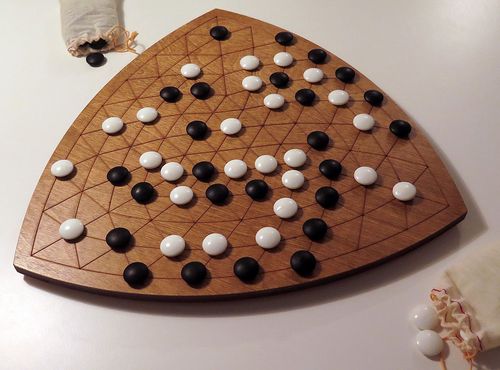
The Game of Y
The Game of Y Rulebook
Table of Contents
Table of Contents
Rules for Playing The Game of Y
About the Gameboard
The curved triangular playing board has 93 nodes (points of intersection) on which the black and white stones are played. There are 24 nodes along its 3 outside edges and 69 interior nodes. Each board side contains 9 nodes.
Three of the interior nodes are pentads (connected to 5 other nodes); the other 66 are hexads (connected to 6 other nodes).
Each corner node "belongs" to both of its two adjacent sides.
Start
One player uses the black stones; the other uses the white. Board empty.
Play
The players take turns placing one of their stones on any unoccupied node. Black plays first. Stones stay put for the duration of the game.
Goal
Each player tries to form a "Y" — a continuous string of stones of their own color that reaches all three outside edges of the board, thus connecting all three sides together. You can think of this string as a "string of beads" where the thread between the beads is made up of lines on the board. This string can look a bit like a "Y" but could look quite different. For example, instead of three branches, it could even be a single string from a corner to the opposite side. Whoever first forms a Y wins.
Fact
In every game, no matter how well or how inexpertly played, one of the two players will eventually make a Y. Only one player will make a Y — there will never be a "draw."
The Pie Rule
The first player has a great advantage if allowed to play the first move wherever desired. As a result it is customary for equal players to use the pie rule, so called because it is derived from the puzzle of how two people can share a piece of pie fairly. The solution is: one person cuts the pie, the other chooses a piece.
The pie rule applied to Y says that one player decides what the first player's first move will be. The other player then decides whether to be the first player (with that first move) or the second player. The pie rule eliminates the large advantage the first player has, and it makes the game more interesting (the player who decides whether to be the first or second player has a slight advantage).
Handicapping
If one player always wins, the game will not be very interesting for either player. Furthermore, neither player will know whether they played better in one game or the next, since the outcome is always the same — so they will both find it very difficult to improve. Ideally both players should win about half the time.
If one player consistently wins even with the pie rule, the weaker player can play first, playing wherever desired. For larger differences in skill, the first player can play two or more stones on the first move only. Always try to adjust the handicap so that the two players both win about half the time.
Six Other Games on the Y Board
The Game of Y book also includes rules for these six other games: Aliens and Amazons, Singularity, Leap Over, Tetra, Quinta, Sexta. The gameboard is as described above. Please check the individual game rules for how each game employs the board's features.
Aliens and Amazons
Differing objectives for two players, by Richard May.
Start: One player (the Amazons) uses 30 black stones; the other (Aliens) uses just 3 white. Board empty.
Play: The players take turns placing one of their stones on any unoccupied node. White (the aliens) plays first. After all 3 white Aliens are on the board, they begin moving. The Amazons do not move until all 30 are on the board. While the Amazons are still being placed, they may be captured and removed from the board by being jumped over by Aliens.
Moving: Stones move one unit in any direction along lines to any unoccupied adjacent node. Amazons may not jump over other pieces, either Aliens or Amazons, and may not capture Aliens. An Alien may jump over an Amazon, if the node immediately on the other side of the Amazon on the same straight line is unoccupied, and the jumped-over Amazon is removed from the board. Multiple jumps and captures of Amazons by an Alien are allowed. Capturing is not mandatory. Aliens may also jump over other Aliens but without capturing them.
Goals: The object of the Amazons (Black) is to block and immobilize the three white Aliens, thereby winning the game. The object of the Aliens (White) is to capture a sufficient number of Amazons to eliminate the possibility of being blocked and immobilized, thereby winning the game.
Singularity
Reduction by fusion.
Start: 12 stones of their own color for each player, arranged alternating around the perimeter of the board as shown (in the diagram).
Play: Taking turns, players move any one of their stones by 1, 2 or 3 unit spaces along an unobstructed line, in any direction. A stone may move in only a single direction on a turn. There are no jumps and no captures of opponent pieces. When a player's stone lands immediately next to a stone of its own color, in any direction, on or within the 15 nodes of the central triangular region of the board, the moving stone captures the resting stone, which is removed from the board. Only one stone may be removed on a turn. A player's stones may be used to block the movement of opponent stones. A player may not occupy more than one of the 3 central nodes of the board at the end of a turn.
Goal: To be the first player to have only one stone remaining on the board, occupying one of the 3 central nodes.
Leap Over
A jumpy modified Chinese Checkers game by Kate Jones.
Start: 10 stones of their own color for each player on the triangular sections whose point is the center of a side of the board, as shown (in the diagram).
Play: Take turns jumping any one of your stones over another stone directly next to it, to an empty intersection immediately on the other side of the stone being jumped, on the same straight line from which the jump began. A stone may jump over stones of either color, in any direction on the board, and over more than one stone, as long as it touches down after each one. The jumping stone may change direction at the end of any one leap in a series. Stones on the outer edge of the board can be jumped over only by stones also on the outer edge.
Jumps over stones at the center of any "pentagon" may follow either fork on the other side of the pentagon. Every move must be a leap.
Goal: To be the first player to move all stones into the opponent's start position.
Tetra
Stretched formations of fours, by Richard May.
Start: Gameboard empty; players each use 10 stones of their own color.
Play: Players take turns placing one of their stones on any unoccupied node of the board, until one player achieves the goal or until all stones are played out. If neither player wins during this placement phase, the game continues into the movement phase.
Moving: Players take turns moving one of their stones to an unoccupied node either one or two units distant along an unobstructed line, in any of the six directions, until one player wins. Moves through a pentagon may follow either fork.
Goal: To form four pieces into either a straight line or a diamond-shaped pattern on alternate rows (shown in the diagram). Note that a winning figure is formed by non-adjacent stones that are separated by either lines or nodes. The interior nodes of a figure may be occupied by other stones of either color. Patterns can thus occur in mutually embedded positions.
Quinta
Alignment game suggested by Christopher Clark.
Start: 12 stones of their own color for each player, arranged in pairs around the board as shown (in the diagram).
Play: Players take turns moving one of their stones any distance along an unobstructed line, in any direction, to an unoccupied node. Through the 3 pentagons movement may follow either fork.
Goal: To be the first player to link up 5 adjacent stones on the same line (sample winning positions are shown in the diagrams).
Sexta
Line-of-6 strategy game.
Start: 6 stones for each player of their own color, arranged on the perimeter of the board as shown (in the diagram).
Play: Players take turns moving any one of their stones any distance along an unobstructed line, in any direction. Movement through a pentagon may follow either of the two forks that exit on the other side.
Goal: To be the first player to form a line of six adjacent stones. The line need not be straight as long as no stone has more than two neighbors (sample wins are shown in the diagrams).
"Supply Line" Solitaires for the Y Board
Original variations of peg solitaire on a triangular board, developed by Kate Jones. Two levels of challenge: Supply Line and Grand Supply Line.
The curved triangular playing board has 93 nodes (points of intersection) on which the stones are placed and onto which they can jump. Three of the interior nodes are pentads (connected to 5 other nodes); the other 66 are hexads (connected to 6 other nodes).
You will be jumping stones over a directly adjacent stone to an empty node immediately on the other side of it. Through the pentads a stone may jump along either fork in a forward direction, from any direction.
Supply Line
Start with 15 stones on the nodes of the central triangle region of the board, as shown in black in the diagram. Note that the three corner stones rest in the center of a pentagon while the rest occupy the centers of hexagons.
Jump stones over each other, always over a directly adjacent stone to an empty node immediately on the other side of it on the same straight line, except for pentads that can veer to either fork. Remove stones jumped over. Stones may jump outside their starting triangle — the whole board is available — and the last stone remaining should land on the farthest-away node in the middle of the border or next to a corner, shown as white circles in the diagram. Minimum number of moves for either solution is 6.
Grand Supply Line
Set up 30 stones as shown in the diagram. Jump them over each other as for regular Supply Line, but this time the goal is to send one messenger to each corner (white circles), or a single messenger to one corner (white circle in the second diagram). All other stones are to be removed by jumps. The minimum number of moves is not known.