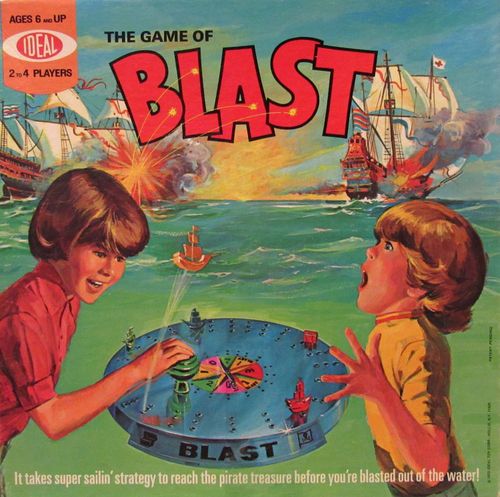
The Game of Blast
The Game of Blast Rulebook
Table of Contents
Table of Contents
Object
To be the first player to arrive at the Treasure Chest by moving his Ship completely around the Outer Ring of the Playing Base.
Materials
- Playing Base
- Treasure Chest
- 1 Bellows
- 1 Bellows Base
- 4 Movers (Ships)
- 4 Rubber Bumpers
Preparation
- Attach Rubber Bumpers to Playing Base (Diagram 1).
- Insert Bellows into Bellows Base (Diagram 2).
- Place Playing Base within easy reach of all players.
- Each player takes one Ship.
Diagram 1
Labelled "Bottom View", "Hole" and "Rubber Bumper".
Diagram 2
Labelled "Bellows" and "Base". Text: Hold the Bellows directly behind Nozzle, and insert Nozzle into hole in Bellows Base, with a twisting motion. Squeeze Bellows back into shape if necessary.
Play
- Choose one player to go first. Play passes to the left.
- Note that the Playing Base includes an Outer Ring consisting of 3 circular rows of holes, and an Inner Ring consisting of 2 circular rows of holes. The first player places the Treasure Chest into ANY HOLE in the CENTER ROW of the Outer Ring. In moving their Ships around the board, players start at the first row of holes COUNTER-CLOCKWISE from the Treasure Chest (Diagram 3).
- The first player spins the spinner in the center of the Playing Base. If he spins "0" he does not move. If he spins "1," "2," or "3," he moves his Ship that number of holes away from the Treasure Chest in a COUNTER-CLOCKWISE direction around the Outer Ring and places his Ship into ANY OF THE 3 HOLES that are that distance from the Treasure Chest.
- The other players take their turns in the same way, and continue to do so for the rest of the game. However, if a player spins "1," he can "BLAST," as indicated on the spinner. He moves his Ship to any of the 3 holes in the next row (a player may "change lanes" with his Ship on any move), then places the Bellows Assembly in either of the 2 circular rows of the Inner Ring, in any hole which is in line with an opponent's Ship in the Outer Ring (see Diagram 4). He squeezes down on the Bellows to try and blast the Ship out of its hole. In each group of 3 holes in the Outer Ring, 1 hole will always be "safe" (a Ship in that hole CANNOT be blasted out) and 2 holes will be "unsafe" (Ships in those holes CAN be blasted out). The location of the unsafe holes varies randomly in each group of 3 holes. If the player succeeds in blasting the Ship out, it is moved 3 holes back toward the Treasure Chest, and the blasting player's turn is over. If he does not succeed in blasting, his turn is over immediately. After a player has used the Bellows, he places it alongside the Playing Base.
- If ALL 3 holes in any of the next 3 rows in front of a player's Ship are occupied by opponent's Ships, the player is BLOCKADED (see Diagram 5). If he spins a number that would land him in the same row as the Blockading Ships (for example, if the Blockade is 2 rows ahead and he spins a 2), the player may move his Ship only up to the row immediately BEHIND the Blockade. If he spins a number that would land him past the Blockade (for example, if the Blockade is 2 rows ahead and he spins a 3), he may move his Ship that number of holes. If he is one row behind the Blockade and spins a "1" he may NOT move his Ship, but may BLAST the opposing Ships as on a normal spin of "1". If he Blasts a Ship out, he may move his Ship into that hole.
Diagram 3
Labelled "Ship", "Outer Ring", "Inner Ring", "Start" and "Treasure Chest".
Diagram 4
Labelled "Opposing Ships".
Diagram 5
Labelled "Blockade".
Winner
The winner is the first player to move his Ship completely around the Outer Ring of the Playing Base and land it either in the same row as the Treasure Chest or past the Treasure Chest.