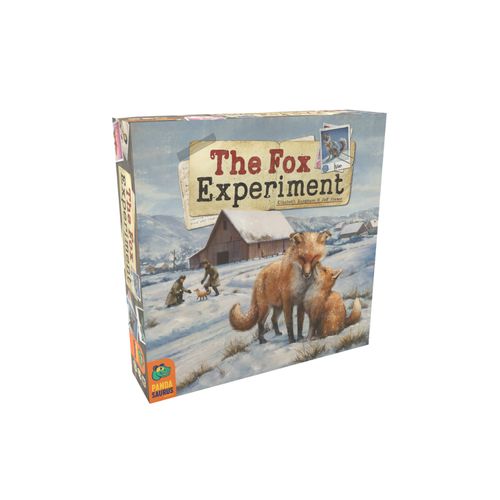
The Fox Experiment
The Fox Experiment Rulebook
Table of Contents
Table of Contents
Components
- Main board (5/6 players on back — the back of the main board requires the 5-6 player expansion sold separately)
- Dice (16 of each): trait dice and friendly dice
- 4 player mats (4 player colors)
- 4 dry-erasable markers
- 48 blank fox cards (12 per player color)
- 36 parent fox cards (male & female)
- Turn order tokens
- 4 reference cards
- 24 study cards
- 6 patron cards
- Score card
- 30 science cards
- 12 A.I. study cards
- 6 A.I. selection cards
- Supply, trait, point & friendly tokens
- 40 fox meeples & 4 gear tokens (10 fox meeples & 1 gear token per player color)
Setup
Board & Kennel Setup
- Game Board: Place the board in the center of the table, with the 1-4 player side faceup (with 5 spaces on the supply track). Use the other side of the board if you are playing with the 5-6 player expansion.
- Science Cards: Shuffle the Science deck and place it facedown in the marked space on the board.
- Study Cards: Shuffle the Study deck and place it facedown in the marked space on the board.
- Supply Tiles: Mix up the octagonal Supply tiles and stack them facedown on the space with a gear icon at the top of the board (the red space on the left is for discards). Then deal faceup tiles in the following locations:
- Supply Track: Leave the first space to the right of the stack empty (it has a red icon to indicate that it does not get a tile). Then fill each following space down the row with 1 faceup Supply tile, until you have filled the space marked with your player count. For example, in a 3-player game, you will place tiles on the second, third, and fourth spaces.
- Patron Spaces: Place 1 faceup Supply tile on each of the 4 patron spaces down the left side of the board.
- Patron Cards: Shuffle the deck of Patron cards and draw 4 Patron cards. Place the first 2 with side A faceup to the left of board, next to the top 2 patron spaces. Place the next 2 with side B faceup next to the bottom 2 patron spaces.
- Fox Kennel:
- Separately shuffle the decks of female parents and male parents.
- Make sure you have enough space, then deal out a faceup row of male parents and a faceup row of female parents. Each row should have 1 more card than the number of players. For example, in a 3-player game, there should be 4 males and 4 females.
Player Setup
- Player Components: Each player chooses a color and takes the following components:
- Their player mat
- 1 player color gear token
- 10 player color fox meeples
- 12 player color blank fox cards
- 1 green friendly die
- 1 dry-erase marker
- 1 player aid card
- Player Foxes: Each player shuffles their blank foxes and places them in a facedown pile on the right side of their player mat.
- Starting Turn Order: Give the "1st" turn order token to the player who has the friendliest pet (or choose randomly). Going clockwise around the table from the 1st player, give each player the next-numbered turn token. Return any leftover tokens to the box.
- Starting Friendly Tokens: Players receive starting friendly tokens based on their position in turn order. (The 1st player receives no token; later players in turn order each receive tokens as shown on the board.)
- Starting Studies: If this is your first game, deal 1 study card to each player. Otherwise, deal each player 3 study cards. Each player chooses 1 to keep, then returns the other 2 to the bottom of the deck. Place your study card faceup near your player mat.
2 Player & Solo Setup: For a 2-player game, set up the board and kennel as if you were playing with 4 players. For a solo game, set up the board and kennel for 3 players. Additional setup and special rules for 2-player and solo games are below.
5-6 Player Setup: To play with 5 or 6 players, you will need the extra player components from the 5-6 player expansion. Use the 5-6 player side of the board (with 7 supply track spaces). All other setup steps are unchanged.
Board Anatomy
- A — Supply Tile Discard Pile
- B — Supply Tile Stack
- C — Supply Track: 1/3 players - 4 spaces; 2/4 players - 5 spaces; 5 players - 6 spaces on back; 6 players - 7 spaces on back.
- D — Patron Spaces: Available patrons accessed via upgrades. Scores at the end of game.
- E — Study Deck
- F — Science Deck
- G — Science Discard Pile
- H — Friendliness Reward Track & Round Counter: Player fox meeples on the track at the end of the game score points above.
- I — Red Reward Track: Reward for players who did not place a fox meeple on the friendliness reward track above that round.
Overview
The goal of the game is to score the most points by the end of the 5th round (generation). You'll do this by breeding the friendliest foxes, completing the most studies, and attracting patrons.
Each round has 4 phases:
- Selection Phase: Players take turns choosing parent foxes and supplies.
- Breeding Phase: Players roll dice to make new fox pups, trying to complete trait symbols. Each different symbol on the dice represents one of the traits that foxes developed during the experiment:
- Tails: Foxes' tails curled up, and some started wagging their tails in reaction to humans.
- Ears: Foxes' ears stayed floppy longer after birth.
- Barking: Foxes started to bark and whimper in reaction to humans.
- Spots: Foxes started getting spots, often in the middle of their foreheads.
- Research Phase: Players use the completed trait symbols on their new pups to:
- Complete studies to score points; and
- Gain trait tokens that can be combined to unlock upgrades.
- Administration Phase: Pups are judged for their overall friendliness (number of completed trait symbols), and then are made available as parents in the next generation.
First Game Tip: The Breeding and Research phases are normally simultaneous. During your first round, you may want to take turns doing each step to be sure that everyone understands the rules.
Phase 1: Selection
Each year, scientists chose the foxes they would breed from the previous year's pups. They selected only based on personality: the friendliest 10 percent of foxes became parents for the next generation.
During the Selection phase, players take turns in order, according to their turn order tokens. Turn order is clockwise in the first round, but may not be in future rounds.
Each player will take a total of 3 turns during each Selection phase. Each time you take a turn, you will select ONE of the following items:
- A female fox parent; OR
- A male fox parent; OR
- A supply track position.
You must select one of each item over the course of your 3 turns, but you may select items in the order of your choice. For example, one player might select turn order then parents, and another might do the opposite.
After everyone is finished selecting items, all players have an opportunity to unlock upgrades before moving on to the Breeding phase.
Selecting Fox Parents
To select a male or female parent, take the desired fox card from the kennel and place it to the left of your player mat. Do not draw a new fox to replace the fox you selected (the kennel will refresh at the end of the round).
Drawing a Random Fox: If you do not like any of the foxes on offer, you may instead draw a random fox from the deck of male or female parents. All foxes in the parent decks have between 1 and 3 random trait dice (2 dice is most common). All traits are equally represented in each deck.
Tip: When selecting parents, foxes that give more dice are generally better for you. You especially want parents with dice that match the traits on your study card(s)!
Selecting a Supply Track Position
Claiming a position on the supply track provides you with immediate supplies and determines your place in turn order for the next round. When you claim a space on the track:
- Immediately collect all supplies shown on that space from the public piles (including ALL icons shown on the supply tile AND any printed on the board underneath). Place the supplies you gain in a personal stash near your player board.
- Discard the supply tile (place it faceup in the discard pile to the left of the stack).
- Place your gear token on the space the tile occupied.
- Keep your current turn order token for now (the token that says "1st," "2nd," etc). These will be redistributed during the Administration phase (see Reset Turn Order).
First Supply Space: The first space on the supply track does NOT have a supply tile. Taking this space grants you no supplies, but guarantees that you will be 1st in turn order next round.
Extra Supply Icons: Positions further right on the supply track have extra supplies printed below the tile. When you claim a position, you gain both the icons printed on the supply tile AND any printed below it.
Supplies
- Science card: Draw 1 science card from the top of the deck. You may look at it and keep it secret until you decide to use it. Science cards provide one-time-use bonus actions.
- Friendly token: Take 1 friendly token from the public pile. Friendly tokens can be spent when breeding fox pups to finish additional trait symbols. Note: Supply tiles never give you dice, only tokens.
- Trait token (shown type): Take 1 trait token of the type shown from the public pile. Trait tokens can be spent to unlock upgrades on your player mat at the end of the Selection phase or the Research phase, so that you can make more pups, work on more studies, roll more dice, and score more patrons. Tip: Early game, if you don't know what supplies you want, try to collect trait tokens that match the dice on your parents. This may help you unlock an upgrade later!
- Trait token (of choice): Take 1 trait token of your choice from the public pile.
End of Selection Phase: Unlock Upgrades
At the end of the Selection phase, after each player has taken 3 turns, players may simultaneously decide whether to spend sets of matching trait tokens to unlock upgrades on their player mats.
Upgrades can be unlocked at the end of the Selection phase AND at the end of the Research phase (explained in more detail in the Research phase section).
Tip: You won't have any full sets of matching tokens at the end of the Selection phase in the first round, but in future rounds unlocking upgrades before you start breeding can be very important!
Phase 2: Breeding
The friendly foxes started showing new traits like spots much more frequently than you would expect from random mutations. The scientists hypothesised – and later showed through DNA analysis – that wild foxes had the genes for these traits all along. The difference was that friendly foxes had much lower levels of stress-related hormones and higher levels of serotonin. These hormonal changes and gene expression caused many of the changes the scientists were seeing.
During the Breeding phase, all players simultaneously roll dice to make pups from the parents they selected. To make each of your fox pups, follow the steps listed below. You do not have to wait for other players to complete a step to move on to the next one.
All blank pups in your deck are the same, except that half are male and half are female.
The steps to make a pup are:
- Draw a Blank Pup
- Gather Dice
- Roll Traits
- Record Traits
- Record Friendliness
- Name Pup
Breeding Multiple Pups: Some upgrades you can unlock allow you to make multiple pups each round. See Making Multiple Pups.
Tip: Don't forget your friendly dice. They are very helpful!
1 — Draw a Blank Pup
Reveal the top card from your blank fox deck and place it to the right of your player board (don't mix it up with your parents, which are placed on the left).
2 — Gather Dice
Next, gather together the following dice from the public pile:
- Friendly Dice: If you have not already, gather friendly dice so you have the number you have unlocked on your player mat. You start the game with 1 die unlocked, and can unlock more through upgrades.
- Parent Dice: Gather ALL trait dice shown on BOTH parent foxes you selected.
3 — Roll Traits
Roll all the dice you gathered and sort them by trait. Arrange them to complete as many trait symbols as you can.
A die showing 2 half-symbols does not have a completed symbol by itself. You must match each half-symbol to another die to complete a symbol.
Friendly Dice and Tokens: As the experiment progressed, friendlier foxes developed more physical domestic traits. Friendly dice and tokens are wild, helping you complete symbols of any trait.
- Friendly dice are wild and can be matched with any other trait dice to complete symbols.
- A friendly die with 2 half-symbols can be matched to 2 different trait dice.
- When you make a complete symbol using ONLY friendly dice (or tokens), it counts as 1 symbol of any trait of your choice.
If you have any friendly tokens in your personal stash, you can spend them exactly as if they were friendly dice with half-symbols on them, except that you must discard each token you use after you finish breeding your pup. You can spend any number of friendly tokens on a single pup. You can even spend 2 tokens together as 1 complete symbol of any trait.
Note: Round trait tokens are the rewards you get for having trait symbols on your pups. They are not used to influence your roll results in any way (see Collect Trait Tokens).
4 — Record Traits
Once you have finished arranging your dice, record the results on your blank fox card. For each complete symbol, mark 1 space on the corresponding trait track, going from left to right.
- Mark each square with an X. When the pup becomes a parent in the next generation, whoever selects it will gain 1 trait die for each marked square.
- Mark each circle with a dot. In the Research phase, you will gain trait tokens based on your best row of marked circles for each trait (see Collect Trait Tokens). Do not gain these tokens yet.
- Do not record any incomplete half-symbols.
More Than 5 of a Trait: Each trait track has only 5 spaces. If you manage to make more than 5 symbols of a single trait type (such that you fill up the track), you gain 1 point token for each extra symbol you were not able to mark. You also write down the number of point tokens you collected to the right of the track (this will be included in the pup's friendliness total).
5 — Record Friendliness
After you have marked your pup's traits, count the total number of trait symbols your pup has (on all 4 tracks) and write this number in the box in the top right of the card. This is your pup's total friendliness score. The fox with the highest score will win an award for being friendliest during the Administration phase.
If you filled a trait track and earned point tokens, include the number at the end of the track in your friendliness total.
6 — Name
After filling in your pup's traits and friendliness, you may give it any name you like.
Phase 3: Research
Throughout the life of the Belyaev-Trut experiment, researchers have conducted studies to understand the biochemistry and genes involved in domestication. Their ground-breaking work has earned them a great deal of prestige.
During the Research phase, all players simultaneously take the following steps in order. You do not have to wait for other players to complete a step to move on to the next one.
- Score Studies
- Collect Trait Tokens
- Unlock Upgrades
1 — Score Studies
Completing studies with your pups is an important way to gain points. Each study card is divided into 3 levels (shown as columns) which can be completed over the course of the game. At the end of the game, you will add up the points printed at the bottom of the highest completed level on each of your studies.
In order to complete a study level, you must assign ONE of your pups to the study that meets the following requirements:
- Each study level shows a minimum number of marked spaces on 2 or more specific trait tracks. In order to complete a study level, your pup must have at least the marked spaces shown. It may have more marked spaces (on any tracks) and still complete the study level.
- The pup must be sufficient to complete the level on its own. You cannot add together multiple pups to complete a study level, or use trait tokens.
- Each pup you make can only complete 1 level of 1 study. You cannot complete multiple levels of a study card with a single pup, and you cannot assign a single pup to multiple study cards.
- Each study's levels must be completed in order, left to right. You cannot "skip ahead" if your pup qualifies for a level you haven't reached yet.
- Once you have completed a study level, you can't complete it again. You can only complete the next level of the study, if there is one. Once you've completed the third level of a study, it is finished and can't be completed again.
Note: Do not take any point tokens when you complete study levels. The fox meeple tracks your points, which will be scored at the end of the game.
When you complete the first level of a study, place one of your fox meeples on top of the first column to show you've completed it. When you complete the next level of that study, you move the fox meeple there up to cover the next level. Once you complete the third level of a study, you've finished it and reached the maximum points it will score (10 points).
2 — Collect Trait Tokens
After you finish breeding and scoring studies, you collect trait tokens that you can spend to unlock upgrades.
If you bred 1 pup, go through each of its 4 trait tracks and collect 1 trait token of the matching type for each marked circle.
Important: If you made multiple pups, you do NOT get trait tokens from every trait on every pup. See Making Multiple Pups.
3 — Unlock Upgrades
Upgrades on your player mat can be unlocked at the end of the Selection phase and at the end of the Research phase (now). Unlocking upgrades follows the same rules in both phases.
Your available upgrades are divided into 4 tracks on your player mat. You must unlock upgrades from left to right on each track. The circle on the right side of each upgrade shows the cost to unlock it, which is always a number of matching trait tokens. The diamond shows the benefit that you unlock.
Each upgrade can be unlocked with trait tokens of any type, as long as they all match (for example, an upgrade that costs "2" can be unlocked with 2 tail tokens, 2 ear tokens, 2 bark tokens, OR 2 spot tokens). When you spend tokens to unlock an upgrade, place 1 of the tokens you spent on the upgrade circle, covering up the cost, to show that you have unlocked it. Return the rest of the tokens you spent to the public piles.
You must have a full set of matching tokens to unlock an upgrade; you cannot partially unlock one. Whenever you unlock upgrades (either at the end of the Selection or Research phase), you may unlock any number of spaces, across any combination of tracks.
Points: When you unlock an upgrade space with a star next to it, you will score points at the end of the game. Do not take point tokens immediately; you will simply add up these points in final scoring.
Tip: Unlocking more pups can be powerful! It will help you complete more studies each round, and improves your chances for getting trait tokens. It can also improve the parents on offer in the kennel – the more pups you make, the more foxes there will be to select from next round!
The 4 Upgrade Tracks
- More Pups: Each pup upgrade you unlock lets you breed 1 additional pup each round. You can breed up to 3 pups each round if you have unlocked all of your pup upgrades. See Making Multiple Pups for detailed rules on breeding and scoring multiple pups.
- Studies: When you unlock a study upgrade, immediately draw 3 new studies and choose 1 to keep. Return the rest to the bottom of the deck. You can acquire up to 4 studies each game (including the one you started with). Tip: The study track is the only way to gain new studies. You always want to be working on at least one study, so don't neglect this track!
- Friendly Dice: Each friendly die upgrade you unlock lets you roll 1 more friendly die each time you make a pup. When you unlock a new friendly die, take a friendly die from the public pile and add it to your stash (as a reminder to roll it each time you make a pup). You can roll a total of 4 friendly dice for each pup if you have unlocked all of your dice upgrades.
- Patrons: When you unlock a patron upgrade, you gain some supplies immediately, and unlock an end-of-game scoring bonus (see Patrons).
- Choose 1 of the 4 patrons and place 1 of your fox meeples on the space next to them.
- Immediately gain the supplies on their supply tile, plus 1 science card (shown below the tile).
- At the end of the game, you will score points as described on the patron card. Note: The supply tiles next to the patrons don't go away when they're gained, so there's no benefit to getting there before other players.
Phase 4: Administration
During the Administration phase, players take the following steps in order:
- Clear Previous Generation
- Move New Pups to Kennel
- Give Friendliness Awards
- Fill Kennel from Decks
- Reset Turn Order
- Refill Supply Track
1 — Clear Previous Generation
At the end of the Research phase, players discard all foxes from the previous generation and return all trait dice they rolled to the public piles.
- Unselected Foxes: All foxes remaining in the kennel are discarded (both male and female).
- Parent Foxes: Each player discards BOTH foxes they used as parents during the Breeding phase.
- Trait Dice: Each player returns all trait dice they rolled to the public piles (but does NOT return unlocked friendly dice; these can be kept near their mat for the following round).
Discarding Foxes: Whenever a fox from one of the parent decks (that does NOT have a player color background) is discarded, place it faceup in a discard pile near the appropriate deck (male or female). Whenever a fox that was made by a player is discarded, it is returned to its owner to be placed in a private discard pile near their blank foxes. (If space is limited, you may erase and put them on the bottom of your deck.)
2 — Move New Pups to Kennel
All players place all new pups they made this round in the kennel, in the appropriate rows (male or female). The order that pups are placed in each row does not matter.
3 — Give Friendliness Rewards
Find the single fox (male or female) that has the highest friendliness score (written in the top right corner of each fox card) of all the pups made this round. The player who made the friendliest fox places one of their fox meeples on the next empty space on the friendliness rewards track (going left to right). This indicates that they will score the points printed above the space at the end of the game (they do not take any point tokens immediately).
- The friendliest fox can be either male or female. Do not evaluate male and female foxes separately.
- If 2 or more foxes are tied for friendliest, every player who made one of the tied foxes places a meeple on the track, sharing the next empty space. All tied players earn full points at the end of the game.
- If a single player has 2 or more foxes that are tied for friendliest, that player still only places 1 fox meeple.
Once the friendliest fox has been awarded, all players who did not place a fox meeple receive the number of friendly tokens shown on the red reward track below the space where the winner placed their fox meeple.
Tip: The friendliness rewards track also serves as a round counter for the game. The number of spaces with no fox meeples shows the number of rounds left in the game (including the current one).
4 — Fill Kennel from Decks
Each row in the kennel should have a minimum of 1 more fox than the number of players.
- If a row does not have enough foxes, fill it up to the minimum by drawing foxes from the appropriate parent deck.
- If a row has at least the minimum number of foxes, do not add any new foxes from the deck.
Note: Remember that leftover foxes from the previous Selection phase must ALL be discarded. At the beginning of this step, the only foxes in the kennel should be the ones players made this round.
Fox Limit: Player fox meeples are not limited. In the unlikely event that a player runs out of meeples and needs to use one, use a placeholder instead. In the unlikely event that there are more than 8 foxes in one row of the kennel, you must discard foxes until there are fewer than 8. Start by discarding the fox(es) with the lowest friendliness score from the row with too many (if there is a tie, discard ALL foxes with the lowest score). Repeat this until there are 8 or fewer. If a large number of foxes are tied, it is possible to end up with fewer than the minimum number of foxes for your player count; if this happens, add wild foxes from the deck until you are at the minimum number.
5 — Reset Turn Order
Next, players redistribute their turn order tokens to match the player order on the supply track. Follow these steps:
- Discard any unclaimed supply tiles left on the supply track.
- Each player returns the turn order token they have had since the beginning of the round, placing it above the gear token that is in that position on the track. For example, if you have the "2nd" token from this round, place your token above the 2nd gear on the track.
- Each player takes back their gear token AND their new turn order token above it. Your new token indicates your position in turn order for the next Selection phase.
6 — Refill Supply Track
Once all players have taken back their gear tokens, deal new faceup supply tiles from the stack. As during setup, leave the first space on the supply track empty, then fill each space with a tile until you reach the space with your player count.
If the stack of supply tiles is ever empty, shuffle the discards to create a new pile.
The Next Generations
Once players have finished the Administration phase, they begin the next Selection phase, starting with the player who has the "1st" turn order token and going in the new turn order. A few things will be different after the first generation:
- Player-made foxes will be in the kennel.
- Some players may have unlocked the ability to make multiple pups.
Selection Phase
From the 2nd round onward, the kennel will contain foxes that were made by other players in the previous round. When a player selects a parent, they may choose ANY of the faceup foxes in the respective row of the kennel. You might or might not get the pup you made last round back as a parent.
Foxes that were made by players give 1 trait die for each marked square on the card (with a die icon printed underneath). Marked circles do not give any dice. The parent's friendliness also has no impact on breeding.
Making Multiple Pups
Unlocking pup upgrades on your player mat allows you to make multiple pups each round. This section covers how to breed, score, and collect tokens from multiple pups.
Breeding Multiple Pups: When you breed more than one pup, follow all steps to roll and record your first pup, then draw a new blank fox card and repeat all the steps for your second pup (and then third, if you have unlocked 2 pup upgrades).
You must fully complete breeding each pup before starting on the next pup. If you use friendly tokens or science cards when making a pup, you must discard them before rolling the next pup. Only move on to the Research phase once you have made all pups you're going to make.
Tip: For each pup you make, you roll the same parent dice AND friendly dice (unless you used a science card to roll additional dice). This means you can re-use the dice you gathered for your first pup when making each subsequent pup.
Scoring Studies for Multiple Pups: During the Research phase, each pup you made may complete 1 level of 1 study. You may assign your pups to studies in any order, and you may assign them to different studies (if you have also unlocked a study upgrade) or to multiple levels of the same study.
Collecting Tokens from Multiple Pups: If you rolled multiple pups, you do NOT gain trait tokens from every marked circle on every pup you made. Instead, you gain trait tokens for each trait from only the fox that best expresses that trait.
To do this, first find the fox that has the most marked circles on the tail track (the first row). Collect 1 tail token for each marked circle on that fox's tail track (ignore any marked tail on your other pups). Next, find the fox that has the most marked circles on the ear track (second row), and collect 1 ear token for each marked circle on that track. Repeat this until you've gone through all 4 traits.
If 2 of your foxes are TIED for the most marked circles of a trait, it doesn't matter which one you choose to gain tokens from (but you still only get tokens from one of them).
Penalty for Breeding Siblings (Optional Rule): This rule can be easy for new players to forget, so we recommend only using it with experienced players.
Breeding foxes that are too closely related can cause genetic problems for their offspring. If players agree before playing to represent this in the game, then any time a player breeds 2 parents that have the same player color (they came from the same player's parents in the previous round), they receive a penalty. After they collect trait tokens in the Research phase, they must immediately discard 2 tokens of their choice that they gained (before unlocking upgrades).
Note: Foxes that were dealt from the parent decks do not have a player color, so they may be bred together with no penalty.
Game End & Scoring
After players earn friendliness rewards at the end of the 5th round (and the friendliness rewards track has fox meeples on all 5 spaces), the game ends.
Use the scorecard and a dry erase marker to tally players' final scores. Players score points as follows:
- Studies: Score the points printed at the bottom of the highest level you've completed on each of your studies.
- Patrons: Score the points as described on each patron where you have a fox meeple (see Patrons).
- Upgrades: Score the points printed on each upgrade you've unlocked.
- Friendliness: Score the points printed above each space on the friendliness rewards track where you have a fox meeple.
- Supplies: Score points for your point tokens and leftover supplies in your personal stash:
- 1 pt per point token
- 1 pt per science card
- 1 pt per 2 trait/friendly tokens (added together)
Winning
The player with the most points wins. In the case of a tie, the player closest to the beginning of the supply track wins.
2-Player Mode
When playing 2-player, you will use a simple automated opponent to make the Selection phase more interesting. It competes against you for foxes and supplies, and adds improved foxes to the kennel, but it does not score points.
Extra Components
- 6 A.I. selection cards
- 12 A.I. study cards
Setup
Set up the board and kennel as if you are playing a 4-player game (draw rows of 5 male and 5 female foxes, and add 4 supply tiles to spaces 2-5 on the supply track).
Assign an unused player color to the A.I. and set it up as follows. The A.I. does not use a player mat; this can be left in the box.
- Shuffle the A.I.'s selection deck and place it within reach of the players.
- Shuffle the A.I.'s study deck and place it near the selection deck. Reveal the top study and place it faceup next to the deck.
- Place the A.I.'s gear token and 5 of its fox meeples near its selection deck. Return its remaining fox meeples to the box.
- Give the A.I. the "3rd" turn order token.
Phase 1: Selection
During each Selection phase, the A.I. will take 3 turns, in turn order, as if it were a third player. However, each time it takes a turn, it selects 2 items instead of just one. Over the course of the round, the A.I. will select a total of 2 of each item (2 male foxes, 2 female foxes, and 2 positions on the supply track).
At the start of the A.I.'s turn, shuffle the A.I. selection deck then flip over the top card. The A.I. selects the 2 items shown on the card, once each.
- 3rd A.I. Turn: On its third turn, it is possible that one of the icons on the selection card will be something that the A.I. has already selected twice. If that happens, the A.I. uses this card to select the item it still needs, then flips a 2nd card to find the final item it needs.
Selecting Foxes: To select foxes, the A.I. uses its study card. Each A.I. study card has 1 trait marked as the A.I.'s #1 priority, and a second trait marked as the A.I.'s #2 priority.
The A.I. always chooses:
- The fox with the most dice of its study card's #1 preference. If tied;
- The fox with the most dice of its study card's #2 preference. If tied;
- The first fox indicated by the arrow showing on the top of the A.I. selection deck. For an arrow pointing left, start from the right hand side and pick the tied first fox that you come to.
When the A.I. selects a fox, do NOT remove it from the kennel. Instead, place one of its fox meeples on the bottom half of the card (lying down to cover the trait dice). Players may not select foxes the A.I. has claimed.
Note: The A.I.'s study cards have other information that is used in solo mode only. You can ignore this in a 2-player game.
Claiming a Supply Track Position: When a gear icon appears, the A.I. claims the rightmost or leftmost available space on the supply track, based on the arrow showing on the top of its selection deck (the back of the top card). The A.I. does not collect any supplies from the supply track. It instead blocks players from choosing certain spaces.
- The first time the A.I. selects a supply track position each Selection phase, discard the supply tile and replace it with the A.I.'s fox meeple. This does not determine its turn order; it only blocks this position.
- The second time the A.I. selects a supply track position each Selection phase, discard the supply tile and replace it with the A.I.'s gear token. This determines its turn order in the next round and blocks this position.
Phase 2: Breeding
After the players have made their foxes, the A.I. simulates breeding new pups by adding extra trait dice to the foxes it selected and leaving them in the kennel to be selected next round.
Go through each of the 4 foxes the A.I. selected and add dice as follows:
- If it is a fox from the deck, take 1 die of each of the A.I.'s 2 priority traits from the public pile and place them on the fox card, next to its printed dice.
- If it is a player fox, mark the next empty SQUARE (die space) on each of the 2 trait tracks that match the A.I.'s priority traits. If needed, you may skip over a circle to do so. If both squares on a track are already marked, do not mark any additional spaces.
- Each fox (either from the deck or a player) can have a maximum of 2 dice of each trait. If a fox already has 2 dice matching one of the A.I.'s priority traits (either printed/placed on the fox card or marked on its trait track), the fox does not get another die of that trait.
- Do not remove the fox meeples from the A.I.'s foxes (this will be done during Administration).
During the next Selection phase, both players and A.I. treat any extra dice placed on a fox as if they were printed on the card.
Phase 3: Research
If any player completes the 3rd level of a study card during this phase, place the A.I.'s study card on the bottom of the deck and reveal a new one to replace it. This changes the A.I.'s priorities going forward.
The A.I. does not participate in any other Research phase activities.
Phase 4: Administration
Follow the normal Administration steps, with these exceptions:
- Clear Previous Generation: When clearing foxes from the kennel, do not clear any fox cards that have fox meeples on them. Instead shift them to the left end of the row.
- Friendliness Rewards: The A.I. does not participate in friendliness rewards (ignore friendliness scores on foxes that have A.I. meeples). After giving friendliness rewards, remove the A.I.'s meeples from all foxes and return them to its stash.
- Reset Turn Order: When resetting turn order, the A.I. gets a turn order token based on where its gear token is. Return both its gear token and its fox meeple to the A.I.'s stash.
End Game & Scoring
Score as normal. The A.I. does not score any points.
Solo Mode
When playing solo, you will compete against a simple automated opponent. It competes against you for foxes and supplies, marks its own fox cards, AND scores points based on its study cards. You must beat the A.I.'s score to win!
Extra Components
- 6 A.I. selection cards
- 12 A.I. study cards
Setup
Set up the board and kennel as if you are playing a 3-player game (draw rows of 4 male and 4 female foxes, and add 3 supply tiles to spaces 2-4 on the supply track).
Assign an unused player color to the A.I. and set it up as follows. The A.I. does not use a player mat; this can be left in the box.
- Shuffle the A.I.'s selection deck and place it within reach.
- Shuffle the A.I.'s study deck and place it near the selection deck. Reveal the top study and place it faceup next to the deck.
- Place 1 friendly token from the public pile on the faceup study card.
- Place the A.I.'s gear token and ALL of its fox meeples near its selection deck.
- Give the A.I. the "2nd" turn order token.
- Give the A.I. a deck of blank foxes in its player color. Shuffle them and place them facedown next to its decks.
Fox Meeples: Each player has 10 fox meeples in five different shapes. Sometimes a symbol is used to represent a fox meeple on the board. You can use any fox shape and it does not need to match.
Phase 1: Selection
The A.I. selects parent foxes and a supply track position as it did in 2-player mode, with the following exception:
- Trait Priorities: Unlike in 2-player mode, in solo mode the A.I. can have multiple uncompleted studies at the same time. As the A.I. draws new studies, it arranges them in a row. Only the leftmost study in the row is used to determine the A.I.'s trait priorities during the Selection phase.
As in 2-player mode, the A.I. does not gain any supplies from the supply track.
Phases 2 & 3: Breeding & Research
At the end of the Selection phase, you must first fully resolve the A.I.'s Breeding and Research phases, before resolving your own Breeding and Research.
The A.I. always makes 2 pups. Unlike a player, it breeds AND researches each pup BEFORE moving on to its next pup.
-
Make a new pup: a. Draw a new blank fox card from the A.I.'s deck. b. Find the leftmost male fox and the leftmost female fox that the A.I. selected in the kennel (with the A.I.'s fox meeples). c. For each trait die on both parent foxes, mark 1 space on the corresponding trait track on the blank fox card. For example, if the father has 2 tail dice and the mother has 1 tail die, mark 3 spaces on the pup's tail track. d. If the A.I. has any friendly tokens on its study cards, mark extra spaces on the pup as follows. Do not spend or discard any friendly tokens when you do this.
- For the first friendly token, mark 1 space of the #1 priority trait from that study.
- If the card has a second friendly token, also mark 1 space for the #2 trait from that study. e. Write the pup's total friendliness score and give it a name. f. If the A.I. fills up a trait track during this process, it gains point tokens and writes the excess number on its pup, just like a player.
-
Assign pup to studies: a. Check if the pup can complete the next study level on any of the A.I.'s uncompleted study cards. If it can, place or move a fox meeple on the study, as a player would. Unlike players, each of the A.I.'s pups can complete 1 level of ANY NUMBER of different studies. b. If the A.I. completed LEVEL 3 of any study, set that study card aside and shift the A.I.'s remaining studies to the left (if it has any). Take any friendly tokens on the completed study and distribute them onto its remaining uncompleted studies, going down the row from the left. c. If the A.I. completed LEVEL 1 of a study, draw 1 new study and place it to the right of its other uncompleted studies. If the A.I. has friendly tokens that are not currently on an uncompleted study, place up to 2 of them on the new study. The pup that was just scored cannot complete this study. Do not draw new studies when the A.I. completes LEVEL 2 or 3 of a study. d. The A.I. does not collect any trait tokens.
-
Repeat for second pup: a. Repeat steps 1 and 2 for the A.I.'s second pup, using the rightmost father and rightmost mother it selected.
Breeding Siblings: If the A.I. ever tries to breed 2 foxes of the same player color, it instead swaps its choices, breeding the leftmost mother with rightmost father and vice versa. If this would still breed 2 foxes of the same player color, the A.I. does so without penalty.
Running Out of Meeples: If the A.I. ever runs out of fox meeples, use another player color from the box.
Player Breeding & Research: Once you have resolved breeding and research for both the A.I.'s foxes, proceed to make and score your own pups exactly as you would in a standard game.
Note: Unlike the 2-player game, the solo A.I. does not draw a new study when you complete LEVEL 3 of a study.
Phase 4: Administration
Follow the steps for Administration phase, with the following exceptions:
- Clear Previous Generation: Discard all parents and all foxes in the kennel, including the A.I.'s selected parents. Return the A.I.'s fox meeples.
- Move New Pups to Kennel: When moving foxes to the kennel, place the A.I.'s first pup at the left end of its row (1st position). Place its second pup at the right end of its row (4th position). Then place your pups in between, in the order of your choice. If you end up with more than 4 pups in a row, place your remaining pups to the right of the A.I.'s second pup.
- Give Friendliness Rewards: The A.I. competes for friendliness rewards as a player would. If the A.I. does not win a friendliness reward, it receives the number of friendly tokens shown below on the red friendliness track. These tokens are placed on the A.I.'s uncompleted studies. The A.I. will place tokens on its leftmost study until it has 2 tokens, then place the remaining tokens on the next study until it has 2 tokens, and so on. If it fills all its uncompleted studies and has tokens remaining, it keeps these until it draws a new study, then immediately adds them to that study.
- Fill Kennel from Decks: Fill the male and female rows up to a minimum of 4 foxes each, as in the standard game.
- Reset Turn Order: As in a 2-player game, the A.I. gets a turn order token based on where its gear token is. Return both its gear token and its fox meeple to the A.I.'s stash.
- Refill Supply Track: Refill the supply track as in the standard game.
End Game & Scoring
At the end of the game, you score as normal. The A.I. scores:
- The points printed on the highest level it completed on each of its studies.
- The points printed above each space on the friendliness rewards track where it has a fox meeple.
- Points for point tokens it earned from filling trait tracks.
Hard Mode: For a more challenging solo experience, change one rule: whenever the A.I. places in a position on the supply track that would gain them friendly tokens, it takes them immediately, and adds them to its study cards in the same way it does when taking friendliness rewards.
Appendix: Science Cards
Science cards can be gained from the supply track and patrons. You may keep them hidden from other players until you play them. Each card indicates when it can be played and what effect it has.
There is no limit to the number of science cards you can have at a time. Unplayed science cards are worth 1 point each at the end of the game.
- Before rolling a pup: Draw 3 foxes (from either deck). You may choose 1 to replace 1 of your parents. (Use this card when you want to try for better parents than what you selected. If you do not like the cards you drew with this card, you may discard them and keep the parents you originally selected.)
- When placing your gear token OR unlocking a patron: You may first swap the supply tile on your space with any tile in the discard pile. OR you may first swap the supply tile on your space with any other faceup tile on the board. (Use these cards to improve the supplies you get. In the event that multiple players use this card, resolve them in turn order.)
- At any time: Trade up to 2 trait tokens of your choice for that many friendly tokens, or vice versa. (You can use this card to get friendly tokens when you need them to complete symbols, or to get trait tokens to complete upgrades.)
- After rolling a pup: Change 1 die to any face. OR Reroll all your dice showing only half a trait. OR Roll 1 extra tail, ear, bark, or spot die. (These cards let you change dice, reroll dice, or add an extra die to your roll.)
- After rolling a pup: Add +1 tail (or other trait) to this pup. (Simply mark one extra space on the corresponding track on your pup.)
- When you unlock upgrades: You may pay for an upgrade with trait tokens that don't match. (As usual, choose one token to leave on your player mat, and discard the rest.)
- After rolling ALL pups: Keep 1 of your pups as a parent for the next round. It cannot earn the friendliest pup reward. (If you use this card, do not put the pup you are keeping in the kennel. Instead move it to the left of your mat, and keep it as a parent. During the next Selection phase, you will take only two turns, because you already have 1 parent.)
Appendix: Patrons
- 1 point per tail token on your player mat (similar goals work the same for other traits).
- 2 points for each of your fox meeples on the friendliness rewards track.
- 4 points per set of all 4 traits on your player mat (the 4 traits do not need to be adjacent).
- 2 points per 2 matching horizontally adjacent tokens on your player mat. One token can be part of more than one pair (there is also a goal for matching vertically adjacent tokens).
- 3 points per fox pup with a friendliness score of at least 12 (last round only — for the fox pups you make in the last round).
- 2 points for each of your study cards with at least 1 completed level.
- 2 points per bonus point token that you have at the end of the game (in addition to the normal score for each).
- 3 points for each column on your player mat where you unlocked 4 upgrades (the column with only 2 upgrade spaces does not score any points).
Notes on patrons:
- You may place a fox meeple on a patron where other players already have meeples. All players gain both supplies and points for patrons they unlock, no matter how many meeples are already on the space.
- You may not place a second fox meeple on a patron where you already have a meeple.
- You may spend the supplies you gain immediately, including to unlock another upgrade during this phase.
Turn Summary
Phase 1: Selection (Turn Order) — Over 3 turns, select: male parent, female parent, a supply track position. After selecting, you may unlock upgrades.
Phase 2: Breeding (Simultaneous) — Draw a blank pup, gather dice, roll traits, record traits, record friendliness, name your pup. If you have unlocked the ability to make multiple pups, finish all of these steps for one pup before starting the next.
Phase 3: Research (Simultaneous) — Score studies (each pup can complete one level of one study). Collect trait tokens (gain tokens only for your BEST fox in each trait). Unlock upgrades.
Phase 4: Administration (Simultaneous) — Clear previous generation, move new pups to kennel, give friendliness rewards (the player(s) with the friendliest fox place meeples on the friendliness reward track; others gain friendly tokens), fill kennel from decks, reset turn order, refill supply track.
Game End and Scoring — After the 5th round.