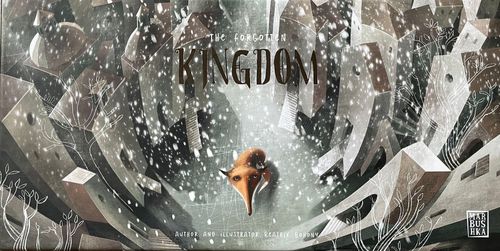
The Forgotten Kingdom
The Forgotten Kingdom Rulebook
Table of Contents
Table of Contents
Short Description and Goal
Short description of the game: This is an adventure game, where the heroes are wandering around the Kingdom and facing challenges. They receive victory points for solving problems and dealing with monsters. Every completed challenge releases a memory piece from the Mine of Memories and helps the heroes to restore the forgotten Kingdom. The revealed memories reduce the difficulty of further challenges and earn extra victory points for the heroes. The player who has the most points at the end of the game is the ruler of the Kingdom and wins the crown.
The goal of the game: The heroes' task is to get all the memories back from the mine and assemble the forgotten cities on the board to break the evil spell.
Contents of the Game
Contents of the game: 1 game board, 54 tiles, 7 figures, 64 cards, 6 scoring markers, 1 spinning arrow.
The components are shown in the rulebook's contents page as numbered groups:
- Gold special tiles: Camp (1a), Temple (1b), Secret Corridor (1c), Snowstorm (1d) and Crown (1e)
- Silver Memory tiles (3), and blue and green Challenge tiles (2)
- Palace tile (3a)
- Adventure cards (4)
- Character cards (5), one per hero figure
- Scoring markers (6)
- Figures (7): six heroes and Wizard Khaos (7a)
- Spinner dial and spinning arrow (8)
Setting Up the Game
Place the game board in the centre of the playing area and source the tiles according to the colour of their back:
- Gold - special tiles (1) must be placed face-up on the game board: the snowstorm (1d) and the crown (1e) on the corresponding spaces on the bottom grey area, the temple (1b), the camp (1a), and the secret corridor (1c) tiles on any empty fields outside of the city borders (marked blue). (10)
- Silver - the Memory tiles (3) must be shuffled and piled up face down on the centre field of the Mine of Memories.
- Blue and green - Challenge tiles (2) must be placed face down, one tile on each field within the city borders (marked blue). (9)
Each player chooses one figure, takes the matching character card and the scoring marker (11). Place the character card in front of you with a single portrait up, put your figure on an empty field on the board (7), and the scoring marker (6) at the beginning of the scoring track. Place Wizard Khaos on the corresponding space marked on the bottom of the board (7a). Shuffle the adventure cards (4) and deal out 3 to each player. If any of the players gets Evil cards (20C) at the first deal, shuffle them back into the deck and draw another. Place the remaining cards (face down) by the side of the board to form a draw deck.
Decide which player will go first, then take turns in clockwise order.
How to Play
On Your Turn
On your turn, move your figure on the board and perform an action (a) OR place Memory tile/s (b).
a. Moving: You can move your figure up to 3 fields in any direction to the sides of the hexagon! (Once your figure stops, you lose your remaining steps.) During the moving action you may use your Adventure cards to complete challenges or gain benefits. If your figure lands on...
- a Challenge tile (2), try to complete the challenge, move your scoring marker on the scoring track according to the result and your turn ends.
- the Temple tile (1b), you can buy a spiritual animal for victory points and your turn ends.
- the Mine of Memories, you can get Memory tiles (3) for your Completed Challenge tiles (2) and your turn ends.
- empty field, you can still use your Adventure cards and your turn ends.
b. Place Memory tile(s) on the board from your stock. Advance your scoring marker on the scoring track according to the result and your turn ends.
Once a player has ended a turn, s/he has to refill her/his Adventure cards to 3, spin the arrow and move Wizard Khaos to the city indicated by the arrow (13)! Then it's the next player's turn.
Spinning arrow: Cities (13). The star (14) is absolute success against the Wizard and in completing challenges. The colour of the rating number on your tile indicates the corresponding number on the spinner (15).
Tiles and Challenges
- Special tiles (1): you can step on or pass through these tiles.
- Camp (1a): You have to place your figure on this tile after failing a challenge.
- Temple (1b): You may get your spiritual animal if your figure reaches this tile.
- Secret Corridor (1c): You can get to anywhere from this tile.
- Snowstorm (1d): In the case of drawing a snowstorm card, the player has to place this tile on the field where her/his figure stands, indicating that both the location and her/his figure are blocked for a turn. (See: Adventure cards / Snowstorm 20C/24.)
- Crown (1e): The player with the most victory points wins this tile.
- Challenge tiles (2): You cannot pass through Challenge tiles! If you step on one, you have to face the challenge. The back of the tiles indicates the difficulty of the challenge. The green tiles are easier, while the blue tiles are more difficult to complete.
Facing a challenge (16): When you reach the Challenge tile you have chosen, flip it face up and place your figure on it. Every tile has a difficulty rating, shown in a coloured circle. This is the number you must equal or exceed. Your total power point consists of the result of spinning (look at the corresponding coloured field on the spinner (17)), the strength of your animal, the completed Challenge tiles you already have and your matching Adventure cards (20).
Example from the rulebook: 2+3+1+1+1+3+4=15.
Completed challenge: If the resulting total is equal to or higher than on the tile, you succeed! Advance your scoring marker 5 victory points on the scoring track, whether you have completed green or blue Challenge tiles! Take the tile and keep it face up in front of you. You are allowed to have up to 3 completed Challenge tiles face up at a time. You can flip a Challenge tile face down in the Mine of Memories (see later). Every completed Challenge tile (faced up or down) counts as +1 power point in the upcoming challenges.
Failing a challenge: If the resulting total of your power points is lower than the number on the tile, you failed! Leave the uncompleted Challenge tile face up on the board, place your figure on the Camp tile, and move your scoring marker 2 victory points back on the scoring track if you failed a green, or 5 victory points back if you failed a blue Challenge tile.
Help Request
There are two kinds of help described under this heading: the Horn card and Spiritual animals.
-
Horn: If the resulting total of your power points is lower than the number on the tile, you may use your Horn card (20/B20) to ask an opponent player to help. The chosen player cannot refuse it. S/he has to place her/his figure next to yours and face the challenge following the rules mentioned above (Facing a Challenge), but it is the player's decision to use her/his adventure cards or not. (If so, s/he can immediately refill her/his cards after the challenge.) The sum of your points gives the final score. If you are successful, the Challenge tile goes to the one who requested help, and the player who helped gets the 5 victory points. Both of your figures stay on that field. If you fail the challenge, you both have to follow the rules of "Failing a Challenge" (except Team Up card - see later). Do not forget to put your figures back to the camp!
-
Spiritual animals: A spiritual animal costs 10 victory points. When your scoring marker passed this value, you are allowed to buy your animal on the Temple Tile (1b). Move your figure there (following the moving rules), place your scoring marker 10 victory points back on the scoring track and flip your character card to the animal side up. From now, your spiritual animal increases your strength with 3 power points in each challenge. Having a spiritual animal is optional.
Memory Tiles
- Memory tiles (3): At the Mine of Memories you may get as many Memory tiles as many completed Challenge tiles you have (1-3 pieces). Flip the Challenge tile(s) face down to remind you that you have already got Memory tiles for them. Keep the Memory tiles in front of you face up and clearly visible for each player. Until they are not placed on the board, another player can exchange her/his tile with you by using the Shaman card (20/A8) to gain more matching city parts and earn more victory points. (See Scoring.)
Placing Memory tiles: Each player on their turn may place any number of Memory tiles on the matching fields of the board and advance her/his scoring marker on the scoring track according to the result. A Memory tile cannot be placed on a location containing an uncompleted Challenge tile, Snowstorm tile or the figure of Wizard Khaos. You can step on or pass through Memory tiles on the board.
Scoring the Memory tiles (18): Placing a Memory tile gives 5 victory points to the player who puts it on the board. Each connecting side to other Memory tiles adds 1 extra victory point upon the 5. This rule is also valid on the tiles of adjacent cities too (18/6). Memory tiles can reduce the difficulty level of the Challenge tiles. On each side a Memory tile is connected to a Challenge tile, the difficulty level of the Challenge tile decreases 1 power point. Example: If 2 Memory tiles are attached to a Challenge tile they weaken the Challenge card by 2 power points.
Palace tile (3a): This is a special memory tile in the game, a kind of "jolly joker". It can be connected to any Memory tiles on the board outside the city borders (marked blue). Figure out how you will get the most victory points for it!
The rulebook shows an example of scoring Memory tiles when they are placed in the following order (points per placement):
- = 5 points
- = 5 + 1 points
- = 5 + 2 points
- = 5 points
- = 5 + 2 points
Wizard Khaos
The spinning arrow indicates the Wizard's move. Once a player has ended a turn, s/he has to spin the arrow and move the figure of Wizard Khaos to the city where the arrow points. As most of the cities consist of two or more fields, he prefers to land on a Challenge tile; if there are no Challenge tiles, then he stands on an empty field.
- The Wizard increases the difficulty of the Challenge tiles by 2 points on every adjacent field (19).
- If the Wizard stands on a Challenge tile (19a), he must be defeated first (or wait for him to leave), and after that the hero may face the challenge.
- The Wizard cannot step on a field which is blocked by the snowstorm or a Memory tile. If he can't move, he must stay where he stands.
- If the Wizard lands on the Mine of Memories, nobody can get Memory tiles while he is there. You must defeat him or wait for him to leave.
- If the Wizard lands on a city where one (or more) player's figure is standing, he attacks the player/s and the battle starts immediately even if it is not any of that players' turn.
The Wizard's difficulty rating is 25 power points. If you are attacked, you must spin the wheel. Your total power point consists of the result of spinning (look at the purple coloured field on the spinner), the strength of your animal, the completed Challenge tiles and the matching Adventure cards. If the resulting total is equal to or higher than 25, you succeed! Place the defeated Wizard back to his starting position (7a). Advance your scoring marker 5 victory points, but if you fail the battle, move your marker 5 victory points back and place your figure on the Camp tile.
If more players are on the same field where the Wizard lands, the players' power points will be added up and they win or lose together according to the rules above. All Friendship cards (20/B) are valid in this battle! At the end of the fight, all the attacked players have to refill their cards and the game continues in the original order.
Adventure Cards
You may have 3 Adventure cards during the game and you can use them on your turn if you choose the moving action. Keep them in front of you clearly visible for each player. If you are not satisfied with your cards, you may discard all and buy another 3 for skipping a turn OR losing 5 victory points.
The adventure deck is numbered 1 to 28, with the cards in three groups labelled A (helping cards), B (friendship cards) and C (evil cards).
Helping Cards (20/A)
You get to keep them and cash in later for a one-time benefit. Put the used adventure cards in a discard pile. If the original draw pile runs out, shuffle the discard pile back.
- Magician (20/A1): Choose an Adventure card from the discard pile!
- Luck Serum (20/A2): You may choose any value from the segment where the spinning arrow has stopped.
- Prophet (20/A3): You may flip any of the Challenge tiles up without having to move your figure there and facing the challenge at once.
- Invisibility (20/A4): After failing a challenge, you have to return to the camp BUT you won't lose victory points!
- Merchants (20/A5-6): Allow you to buy 1 Memory tile for 5 victory points from the mine, without having to go there or having any completed Challenge tile.
- Fox (20/A7): You won 5 victory points!
- Shaman (20/A8): Allows you to exchange one of your Memory tiles with another from an opponent player's stock. The Shaman cardholder decides which tiles s/he wants to exchange.
- Storyteller (20/A9): Allows you to move one uncompleted Challenge tile from a city to an empty field of another city.
- Miners (20/A10-11-12): Help you to get Memory tiles for your completed Challenge tiles from the mine without having to go there.
- Power (20/A13-14): The goat gives you 2, the bison 4 power points in a challenge.
- General (20/A15): You immediately complete the challenge and get the Challenge tile by using this card. This card is also valid in the battle against the Wizard.
Friendship Cards (20/B)
- Horn (20/B20): After failing a challenge or battle you may ask an opponent player to help you. (See Help Request.)
- Team up (20/B21-22-23): These cards allow each player to get 5 victory points for a completed challenge, and none of them has to lose points after failing a challenge (but you have to return to the camp). Any of the participant players can provide this card.
Evil Cards (20/C)
Don't keep it, use it immediately! After you have completed its instruction, or it cannot be completed due to the circumstances, put it on the discard pile and draw a new Adventure card. (Remember! you must refill your Adventure cards to 3.)
- Snowstorm (20/C24): If you draw this card, you must place the snowstorm tile on the space where your figure stands (except Memory Tile). The Snowstorm blocks all the players standing on the same field. The players who are trapped by the snowstorm have to skip their turn (once each player) and they cannot help other players until the storm is over. In their next turn, the Snowstorm tile must be removed from the field and placed back to its original location on the bottom of the board.
- Khaos (20/C25): The Wizard attacks you! Place his figure next to yours and fight!
- Curse - Game changer (20/C26): This curse is valid only on the face-up Challenge tiles in your stock. Return one of your completed Challenge tiles on the board. Place it face up on any empty field of your choice!
- Curse - Loneliness (20/C27): Discard all your Friendship Cards (20B) and have another Adventure cards from the pile!
- Curse - Amnesia (20/C28): Discard all your cards and draw new ones instead!
The End of the Game
If the pile of the Memory tiles runs out in the Mine of Memories, take the Wizard figure off the board, he lost all his power! Players must complete their turns one by one: place all their Memory tiles on the board in their turn and advance their scoring marker according to the result. If any player has a Fox card, take the points for that too! If a player passes the 100th field on the scoring track, continue from 1 (which means 101). The player with the most victory points is the winner and gets the crown.