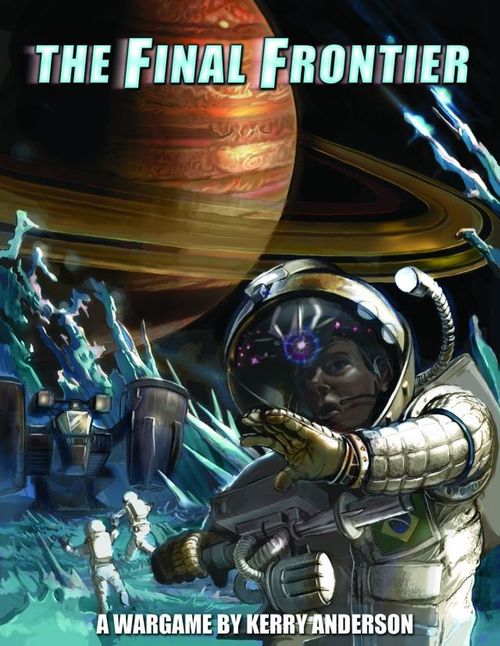
The Final Frontier
The Final Frontier Rulebook
Table of Contents
Table of Contents
2.0 Components
The box contains the following:
- one 10" x 17" map
- three sheets of 280 counters
- 3 player aids
- 1 notepad
- 1 rulebook
- 2 six-sided dice
2.1 Star Map
The map shows the solar system from the Sun to Neptune. A hexagonal grid is printed over the map to regulate movement and combat.
Orbital tracks are shown on the map to indicate the relative positions of the various planets.
2.2 Counters
The counters represent each player's space and surface forces, mines and colonies. Counters with a black background are space units; counters with a coloured background are surface units. The silhouettes printed on the counters are explained on the player aids.
The values printed on the counters are:
- Top: Beam - Missile - Damage
- Bottom: Surface combat value
The values of colonies and the damage markers follow a rotating scheme. The value at the bottom is the one that counts: it shows the current population level or current damage capacity. Each time a population level or damage level increases, the counter is turned 90 degrees clockwise to show the new value.
Unit abbreviations are listed on the Unit Summary and the Production Chart.
2.3 Player Aids
The player aid sheets present the various tables needed for play.
2.4 Rulebook
The rulebook contains the rules needed for play. (Translator's note: the French text for this section reads "et en anglais s'il vous plaît, ou en français si l'on parle de celui-ci", which is garbled in the source and is reproduced here as translated.)
3.0 Game Setup
Players separate the counters by colour and choose their factions. Each player starts with a GNP (Gross National Product) of 100 and a National Interest Level of 1.
Each player receives 10 Build Points (BP) to secretly produce the first units. With these points, players may also choose to spend their Build Points as follows:
- 1 BP for a 5-point increase in GNP
- 2 BP per turn initiative
- 5 BP for a 1-point increase in National Interest Level (NIL)
Players may combine these choices and/or make multiple choices. Players should use the Player Record Sheet, or a copy of it, to track their National Interest Level, base GNP, their current total of resource points, and the production points accumulated.
Example: Player A buys 3 turn initiatives (6 BP) and increases his GNP by 20 (4 BP), keeping no build points for units. At the same time, Player B buys 2 mines with their transport (2 x 3 BP) and 2 turn initiatives (4 BP). Player A can therefore complete a full turn without Player B being able to do anything.
Once the factions are chosen and the Build Points are spent, the players place the planets in a container. After determining an order among themselves at random, they take the planets from the container in turn and place them anywhere on their orbital track on the play area.
Finally, the turn order follows the ranking created by the number of turn initiatives owned by the players, the player with the most turn initiatives playing first. Players who have the same number of turn initiatives roll a die to break the tie (the highest result plays first).
4.0 Sequence of Play
Each turn, the players follow the same series of actions. This is called the sequence of play. Players must follow this sequence precisely to keep the game running smoothly.
4.1 Planetary Movement Phase
Each turn, the turn marker is moved one step along the Game Turn Track. All planets scheduled for that turn are moved one hex along their orbital track, counterclockwise.
4.2 First Player's Turn
The active player is called the phase player and carries out the following actions.
4.2.1 Economic Phase
The phase player calculates the number of resource points available. They then calculate any changes to their GNP and receive their Build Points. These points are used to create new units.
4.2.2 Space Movement Phase
The phase player moves his space units. This includes in particular leaving a planetary surface, initiating an intra-system movement, a deep space movement, and landing without opposition on a planetary surface. Landings with opposition are handled in the Space-Surface Interaction Phase (4.2.4). Inactive players may activate opportunity fire against units in motion (see 9.5).
4.2.3 Space Combat Phase
Players resolve space combat wherever enemy units occupy the same deep space hex, and likewise for orbital boxes occupied by enemy units.
4.2.4 Space-Surface Interaction Phase
The phase player may bombard, deposit surface units, or set up mines or colonies.
4.2.5 Surface Combat Phase
The phase player resolves combat between his units and enemy units present on the same planetary surfaces.
4.3 Second Player's Turn
The second player becomes the phase player and repeats steps 4.2.1 to 4.2.5.
4.3 Third Player's Turn
The third player becomes the phase player and repeats steps 4.2.1 to 4.2.5.
4.3 Fourth Player's Turn
The fourth player becomes the phase player and repeats steps 4.2.1 to 4.2.5.
5.0 Planets
The game depicts the solar system from the Sun to Neptune. The orbital tracks show the location and course of the planets through the solar system.
5.1 Planets
The counters show the eight planets of our solar system plus the planetoid Pluto: Mercury, Venus, Earth, Mars, Jupiter, Saturn, Neptune. These counters are placed on the appropriate orbital track on the map. Venus and Mercury are placed in the same hex as the Sun. Note that although a counter is provided for Pluto, no orbital track is provided for this planetoid. Players who wish to include Pluto in their game may place it in hex 0101, where it will not move.
5.2 Planetary Movement
Each planet moves slowly along its orbital track at a speed relative to its distance from the Sun. At the start of each turn, the players check the Game Turn Track. Each planet marked there must be moved one hex counterclockwise. When this movement would take a planet off the map, it is placed on the first hex of its orbital track on the other side of the map.
5.3 Satellites
Earth, Jupiter, Saturn, Uranus, Neptune and Pluto have relatively large satellites (moons) on which it is possible to establish a presence and whose resources can be exploited. (Note that minor satellites less than 500 km in diameter have been excluded from the game.)
Satellites occupy the same hex as their associated planet on the map. The position of units within a planetary system is shown on the System Display. Units present on the System Display are in orbit around the associated planet. Units in deep space are never considered to be in orbit.
Note that "planetary surfaces" include the surfaces of planets (Earth, Mars, etc.) and of satellites (the Moon, Europa, etc.).
6.0 Economy
6.1 Gross National Product / GNP
In the game, players represent global powers with a major economic base on Earth. This is represented by a GNP given to players at the start of their turn. The base GNP of 100 or more (depending on each player's initial investments, see 3.0) may change due to random events (see 13.2.8 and 13.2.9); otherwise it remains constant throughout the game.
6.2 Resource Points
Mines and colonies in operation on planets and satellites provide resources that supplement the base GNP. During each economic phase, the phase player counts the resources produced by mines and colonies in operation on planetary surfaces and adds them to his base GNP to obtain the final GNP for that turn.
GNP totals below 100 are not marked on the table. If a player should arrive at a total below 100, he uses the 100 value column.
To calculate the resources produced by a mine or colony, multiply the economic value of the planet or satellite (the number printed in its orbital box on the System Display) by the size of the mine (1) or colony (2 to 5).
Resource points are carried by magnetic accelerators to Earth. There is therefore no need for transport ships. There is no delay between the construction of a mine or colony and the adjustment of GNP beyond one game sequence (see exception 6.3.5).
6.3 Build Points
A limited proportion of the final GNP is available for building new units. This proportion depends on the National Interest Level, which represents the importance of a faction's space programme and the dedication of its industries to that programme (see 7.0).
To calculate the number of Build Points available, consult the Economic Table. By cross-referencing the column of the final GNP with the row of the National Interest Level, you obtain the number of Build Points available that turn.
Build Points may be spent on Earth, on mines, or in colonies. There is no limit to the number of points that may be spent on Earth, but the maximum that may be spent on a mine or colony is equal to its size (1 point for a mine and 2 to 5 for a colony).
Build Points not spent in the turn they are allocated may be accumulated on Earth and used in subsequent turns. Build Points cannot be accumulated anywhere other than on Earth.
6.3.1 Building New Units
Build Points (BP) may be used to create new units. The cost of the various units is listed on the "Unit Summary" and on the "Production Costs Chart".
Newly built space units are placed in orbit around their production site. Newly produced surface units are placed on the surface of their production site.
6.3.2 Deep Space Transport
Surface units and orbital stations that move through deep space do so by means of deep space transport. The same units moving within a planetary system travel by intra-system transport.
The cost of deep space transport is 1 BP per unit per trip. This cost represents the various ships and constructions required for this type of transport. The deep space transport system is considered lost (dismantled, abandoned) once the surface unit reaches a planetary surface or an orbital station is deployed at its final location.
Surface units cannot remain in space (deep space or an orbital box) at the end of a player's turn without deep space transport. Such units would then be eliminated.
The number of units for which deep space transport can be built depends on the place of construction (only one transport point can be built at a mine, etc.). Units located at a place without production capacity are stuck in their planetary system. However, they can still move via intra-system transport.
6.3.3 Intra-System Transport
There is no cost for intra-system transport, and likewise movement between planets located in the same deep space hex is free (Mercury and Venus, Earth and Mars when this happens, etc.).
Units using intra-system transport must take off and land within the same planetary system or within the same hex in the same turn, and therefore never appear on the general deep space map (8.2).
6.3.4 Repairing Damage
Damage may be repaired in Earth orbit or in orbit around a friendly mine or colony at a cost of 1 BP per point of damage.
6.3.5 Inhospitable Surfaces
Planets and satellites with black planetary surfaces have no water or ice reserves and are therefore considered inhospitable.
When a mine or colony is deployed on an inhospitable surface, place the unit face down. At a later economic phase, the phase player may decide to pay the production cost again to turn the unit face up and make it operational. This unit may begin producing resources in its next Economic Phase.
Example: On turn 1, a player builds a mine on Earth (2 BP), uses intra-system transport (free), and moves his unit to the Moon where he deploys the mine. Because the Moon's surface is inhospitable, he must pay 2 BP again on turn 2 (or later) to make the mine operational. It will therefore not produce resources before turn 3.
6.4 Asteroid Mines
Players may deploy mines in the Asteroid Belt. Such mines are in fact floating bases stationed in the Belt, which send entire asteroids to Earth where they are used by industry.
Asteroid mines are set up by transporting a mine unit to a hex of the Asteroid Belt. As on an inhospitable surface (see 6.5.3), the owner of the mine must pay the construction cost of the mine again for it to become operational.
There is no surface or orbital box for asteroids. No surface unit other than a mine may occupy an asteroid. Because an asteroid mine can never really land, it never loses its deep space transport component. It may therefore move freely in deep space and is considered a transported unit for purposes of space combat (see 9.0).
However, once operational, a mine cannot move without being dismantled, at least in part. If it moves, it is no longer operational and the production cost must be paid again before it can produce resources again in the Asteroid Belt. It may, however, be normally conveyed to a planet or satellite to become a normal mine without additional cost, other than the cost of deep space transport.
Each turn, a die is rolled to determine the output of each mine located in the Asteroid Belt. Each player may own only one mine per asteroid hex. If another player owns a mine in the same asteroid hex, both roll independently to determine their output.
6.5 Maintenance (Optional Rule)
The onboard systems of spacecraft require regular servicing, updates, in short maintenance; without it, these systems risk malfunctions that may go as far as causing breakdowns or accidents on board the spacecraft.
This rule is optional because of the damage it can cause to space units.
By placing an economic barrier on the maximum number of ships a faction can maintain, this rule prevents players from building an unlimited series of ships.
Under this rule, during the Economic Phase, the phase player must spend BP to maintain his ships. To keep a ship fully functional, he must spend an amount of BP equal to the ship's damage value. He must repeat this expense for each ship he intends to maintain.
Surface units, orbital stations and deep space transports do not need to be maintained in this way.
The BP limit imposed by the various locations always applies (see 6.3). That is, a mine or colony can provide a number of BP equal to its population level.
Maintenance may only be performed on ships located in orbit or one hex away from a station or base capable of providing this service.
Ships that do not receive full maintenance risk suffering damage at the end of their owner's economic phase: roll a die. If the result is equal to or less than the ship's damage value, it immediately suffers 1 point of damage.
Example: A destroyer (2 3 2) and a frigate (2 1 1) are in orbit above a level 2 colony on Ganymede. The player must pay 3 BP to maintain the two ships. But as the colony can only provide 2 points, the frigate does not receive the necessary maintenance. At the end of the economic phase, the player rolls a die and obtains a result of 1. The frigate therefore suffers 1 point of damage, which destroys the ship.
7.0 Political Events
The Final Frontier begins in an era of world peace. Commitment to space development is represented by the investment a faction places in its space programme. While commercial competition is acceptable and normal, acts of aggression and hostility draw national attention to space news, which in turn results in an increase in the production devoted to the faction's space programme.
7.1 National Interest Level (NIL)
Each player keeps track of the level of investment and interest that his faction has in space, represented in the game by the National Interest Level. The NIL is an index running from 1 to 10, where the lowest levels represent the lowest levels of interest and the highest values represent a major national investment (as in wartime).
The National Interest Level (NIL) never falls below 1 and never exceeds 10. All effects that would take it beyond these limits are ignored.
Production levels depend directly on the National Interest Level: the percentage of GNP allocated to the space industry increases as the National Interest Level grows, which gives players more Build Points during the economic phase (see 6.3).
The National Interest Level also affects deep space movement potential, to represent the technological gains associated with additional research effort (see 8.1).
7.2 Colonization
As populations emigrate into space, the national interest of their home faction in space adventure increases. Each time a player increases the population of his largest installation (mine or colony) by one level (1 point), his National Interest Level also increases by 1.
The National Interest Level is never reduced when a colony suffers a population reduction due to bombardment (see 9.0), surface combat (see 10.1) or capture (see 10.2), and it may instead increase as a result of hostilities.
Note: A player's National Interest does not increase when he sets up his first mine, but it does increase as soon as one of his mines becomes a level 2 colony.
Like mines, colonies must be built at legitimate production sites (probably Earth) and then transported to their final destination. During this journey, they may be subject to space combat (see 9.0). Once installed, a colony can no longer be transported, unlike a mine.
Colonies must grow in sequence. A colony must be set up at a population level of 2, replacing an existing mine. After that, to increase the population of the colony, the level 2 must be replaced by a level 3, while a level 4 takes the place of a level 3, and so on. A mine or colony can gain only one population level per turn.
Example: Player A builds a mine (2 BP) on Earth and transports it (1 BP) to Mars. On a later turn he builds a level 2 colony (4 BP) on Earth and transports it (1 BP) to Mars to replace the mine. Later, he builds a level 3 colony on Earth (9 BP) and transports it (1 BP) to Mars to replace the previous one. In the end, establishing this colony will have cost him 18 BP.
7.3 Hostilities
Whatever the result (hit or miss), the first time a certain form of combat is used (first space combat, first surface combat, or first planetary bombardment; see 9.0, 10.1, 11.0), the National Interest Level increases for all players.
The modifiers to be taken into account are printed on the Economic Table.
The modifiers are doubled for the player who is the victim of this first attack.
Some exceptions to the above are linked to random events (see 13.2.10 and 13.2.12).
Example: Player A starts a surface combat to suppress a rebellion. Although this is the first surface combat of the game, no National Interest Level is changed (see 13.2.10). Later, Player B starts a surface combat against Player A. This time, the National Interest Level of all players increases by 1 point, while the National Interest Level of Player A increases by 2 points.
8.0 Space Movement
In Final Frontier there are two levels of movement: deep space movement, and movement within a planetary system. Deep space is the area separating the planets, shown on the star map; this is where deep space movement takes place.
Intra-system movements (from one orbit to another, or from an orbit to a surface within the same planetary system) are depicted on the System Display.
8.1 Deep Space
The area represented on the star map is deep space. Movement is carried out here by tracing a sequence of hexes equal to or less than the unit's movement capacity. Normally, units may either move individually or, if several units began their turn on the same hex, they may move together as a group (a stack), at the player's choice.
A player's movement capacity is determined by his National Interest Level (see 7.1), as shown on the Economic Table. When the National Interest Level increases, all units gain a higher movement capacity, regardless of their position on the map. If, however, a faction's National Interest Level drops, the movement capacity of its units does not decrease.
Because of the complexity of navigating in and through the Asteroid Belt, entering an asteroid hex counts as two hexes of movement. If a unit does not have enough movement capacity, it cannot enter the asteroid hex. Note that this restricts factions with a National Interest Level of 1 to the inner system.
When a unit crosses a hex containing the Sun or one of the gas giants (Jupiter, Saturn, Uranus or Neptune), it may benefit from the effect of the associated gravity well and double its movement capacity for that turn. Gravity well effects are not cumulative, which means that if a ship were to cross the Jupiter and Saturn hexes in a single turn, this would neither triple nor quadruple its movement capacity.
Ships that use the gravity well effect are considered to be passing through the giant's box on the System Display and may therefore, as such, be subject to opportunity fire (see 8.2.1, 9.5).
Example: A player with a National Interest Level of 4 may move a ship 3 hexes per turn. If a ship heads directly from Earth to Jupiter without using the Sun's gravity well, it can at most reach the Asteroid Belt (2 hexes away), since entering the Belt costs 2 movement points. If instead this ship chooses to pass through the Sun's hex, raising its movement capacity to 6, it will end its movement only one hex away from Jupiter.
8.1.1 Space Units
Space units are represented by counters with a black background. With the exception of orbital stations, all these units are capable of deep space movement.
8.1.2 Orbital Stations
Orbital stations must be transported by deep space transport (see 6.3.2) to an orbital box. Once its destination is reached, the orbital station is considered deployed and operational.
Orbital stations cannot be deployed in deep space.
8.1.3 Surface Units
Surface units must be transported by deep space transport systems (see 6.3.2).
8.1.4 Marines
Marine units may either use the usual deep space transport systems (1 BP per unit, see 6.3.2) or use any space unit as transport (free of charge). The limit of troops transported this way is one marine unit per space unit.
Marines may move directly from a planetary surface to a friendly space unit in orbit, or from an orbit to a planetary surface, without needing specific transport (see 8.2.2).
8.2 Intra-System Movement
Movement carried out between a home planet and its satellites, or between the satellites of the same planet, is called intra-system movement. Because it is a smaller scale, units are considered free to move within a planetary system.
For the same reason of the distances involved, space units may occupy the deep space hex of a planet without entering the planetary system, and therefore without appearing on the System Display.
The System Display is divided into nine planetary regions, one for each of the nine planets of the solar system (counting Pluto).
Each region or planetary system is depicted by boxes showing the home planet and its satellites (satellites less than 500 km in diameter have not been included).
Each planet or satellite has a box for its orbital zone and a circle for its surface. It is impossible to land on planets that do not offer a usable surface (Venus, Jupiter, Saturn, Uranus and Neptune), but their orbit may be used. Likewise, it is impossible (in the game) to place a unit in orbit around the Sun, since it has no orbital box.
Units may move freely from one orbital box to another in the same planetary system. Such movement is carried out directly, without passing through the orbits of the other satellites present in the same system.
A movement to or from a planetary surface that meets no opposition is carried out during the movement phase. If it meets opposition, it is resolved during the Space-Surface Interaction Phase.
8.2.1 Orbital Boxes
The orbital box represents the area of space immediately surrounding a planet or satellite. Planetary defence fire (see 9.2) and bombardments (see 10.1) may take place between units present in orbital boxes and the corresponding surface zones.
8.2.2 Planetary Surface
The circle inside each planetary box represents the planetary surface. Only surface units may occupy this zone. Space units cannot land on a planetary surface. Surface units leaving a planetary surface must pay a transport cost (see 6.3.2, 6.3.3, 8.1.3), with the exception of marine units, which may leave the surface to be transported by friendly space units (see 8.1.4).
Movements to and from a planetary surface are carried out during the Space-Surface Interaction Phase.
8.3 Stacking
There is no limit to the number of units (including those controlled by different players) that may occupy a deep space hex or an orbital box.
More than one player may occupy a planetary surface, but each player may have only one mine or colony on the surface of a planet or satellite.
Players may have an unlimited number of other units on a planetary surface.
9.0 Combat
During the Space Combat Phase, any player may declare a space combat between his units and those of another player present in the same deep space hex.
If the space hex is that of a planetary system, the units must be in the same orbital box for them to engage in combat.
Space combat is optional and must be declared by a player who has space combat units.
The first space combat has political consequences (see 7.3).
9.1 Space Combat Procedure
A space combat consists of a series of exchanges of fire between different ships. There is no limit to the number of exchanges per combat round, but at the end of each exchange, each player may decide to withdraw by moving his units into an adjacent empty deep space hex or, if in a planetary system, into an orbital box free of any opposition (within the same system).
At each exchange of fire, place all space units involved, along with the surface units they carry, in two firing lines: one for "beam weapons" and one for "missile launchers".
A ship may not use its beam weapons and its missile launchers in the same round.
A player may decide to protect some of his units by placing them in a line behind the fighting units.
Players then alternate firing individual salvoes from each of their ships. The missile launcher line fires first, followed by the beam weapon line. The initiative to fire in a firing line is given to the player with the most ships in that line. If the number of units is equal, roll a die and the higher result fires first.
To fire a salvo, the player chooses a ship that has not yet fired during this exchange and announces a target unit. Units protected behind a firing line may be targeted only if the units forming their protective line have all already been damaged (in this exchange or a previous one). The salvo is then resolved and its results applied before moving on to the next salvo.
9.1.1 Missile Fire
Roll a number of dice equal to the missile launcher value of the unit. Each result of six (6) scores a hit on the target.
9.1.2 Beam Fire
Roll a single die for each unit that fires. If the result is less than or equal to the value of its beam weapon, the ship inflicts a number of hits on its target equal to the result of the die.
Example: Player A attacks the ships of Player B in orbit around Mars. Player A has three frigates while Player B lines up two destroyers. Player A places two frigates in his "missile launcher" line and one frigate in the "beam weapon" line. Player B places one destroyer on each line.
The missile launcher line fires first. Since Player A has more ships in this line than Player B, he fires the first salvo: a frigate against the destroyer in the beam weapon line. Then Player B uses the destroyer in the missile launcher line, after which Player A uses the frigate he has left in the missile launcher line.
It is then the turn of the beam weapon firing line, but since each player has the same number of ships in this firing line, the initiative for the first salvo is determined by a die roll.
9.2 Planetary Defence Units
Planetary defence units may take part in space combat taking place in their orbit from their surface. These units have "beam", "missile" and "damage" values, and are placed in firing lines just like space units. Planetary defence units cannot withdraw.
9.3 Units Transported in Space
Units transported in space (surface units and orbital stations) are treated as individual targets for space combat.
Units cannot fire while they are being transported, and they are destroyed as soon as they take a hit.
Marine units are an exception to this rule: they are eliminated only if the ship transporting them is itself destroyed.
9.4 Damage
Space units that take enemy fire receive one point of damage per hit absorbed. Damage points are cumulative. When a ship has absorbed a number of damage points equal to or greater than its damage capacity, it is destroyed and removed from the map.
Damage suffered by units may be repaired on Earth or at colonies (see 6.3.4).
9.5 Opportunity Fire
If a unit passes through an orbital box containing enemy units, those units may fire a missile salvo at the passing unit. The moving unit has no opportunity to fire back.
Opportunity fire is therefore resolved during the Space Movement Phase.
Example: Two surface units lift off from Io, heading for Ganymede. An enemy frigate (FG) is in orbit above Io. The frigate may therefore fire at one of the two units in motion before they leave Io's orbital box. An enemy destroyer (DD) in orbit around Europa cannot fire at the two units heading for Ganymede, because intra-system transport goes directly from one orbit to another, and the moving units therefore do not pass through Europa's orbital box.
10.0 Space-Surface Interaction
Space-surface interactions cover all actions that may take place on the System Display between a planetary surface and an orbital box.
10.1 Planetary Bombardment
During the Space-Surface Interaction Phase, space units may bombard surface units.
Bombardments take place after the space combat phase and may only occur if no enemy ship is in the orbital box and no planetary defence is on the surface.
Units carrying out the bombardment are each entitled to fire one missile salvo during this phase. Beam weapons may not be used for bombardments.
As in a space combat, roll a number of dice equal to the total missile launcher value of all ships taking part in the bombardment. Each result of six (6) counts as one hit. Hits are distributed at random among the surface units present. Each hit eliminates one surface unit, except colonies, which lose one population level. A colony may be hit several times.
The first planetary bombardment has political consequences (see 7.3).
10.2 Landing and Leaving a Planetary Surface
During the Space-Surface Interaction Phase, the phase player may move units between the planetary surface and the corresponding orbital box. Transported surface or marine units may land.
Note that landings take place after the space combat phase, so units must survive space combat (see 9.1), including planetary defence fire (see 9.2), before they can land on an enemy planetary surface.
10.3 Setting Up Mines or Colonies
Mines and colonies that land on a surface are considered immediately operational (see 6.2) unless the surface is inhospitable (see 6.3.5).
The resource points they produce will increase the player's GNP during the next economic phase (exceptions, see 6.3.5).
11.0 Surface Combat
During the Surface Combat Phase, the phase player may declare a surface combat between enemy units present on the same planetary surface.
Surface combat is optional and must be declared by the phase player.
The phase player may use only regular troops or marine troops in a surface combat. The defending player may use all surface units present.
The first surface combat has political consequences (see 7.3).
11.1 Surface Combat Procedure
A surface combat consists of a series of exchanges of fire between units. There is no limit to the number of exchanges, but at the end of each exchange, the phase player may choose to withdraw and thus end the combat. All units remain on the planetary surface.
At each exchange, place the surface units involved in a firing line. The players then alternate individual salvoes from the units in their firing line. The first salvo is given to the faction that lines up the greatest number of troops (regular and marine). If the number of units is equal, roll a die to break the tie between the factions.
To fire a salvo, the player chooses a unit that has not yet fired and designates a target for it. Roll a die. If the result is equal to or less than the surface combat value of the firing unit, the target takes a hit. A hit immediately eliminates one surface unit, except colonies.
A colony that is hit is immediately neutralized (turn the counter over to show its status). A neutralized colony can no longer fire and may be captured (see 11.2).
11.2 Capturing a Colony
If all enemy troops are eliminated and a neutralized colony is present on the surface occupied by the attacking player's units, he seizes it. Then replace the captured colony's counter with a counter of the attacking player's faction. A captured colony loses one population level, while a level 2 colony becomes a mine (to reflect holding critical personnel while the refugees return to Earth). If the attacking player already had an installation on this planetary surface, the two are merged, and only the more important of the two remains operational while the other is removed. If both installations are of the same level, one of them gains a population level while the other counter is removed.
Example: Player A attacks Player B's forces on Io and wins the combat. He therefore captures Player B's level 3 colony. The colony is reduced to level 2 and is replaced by a Player A counter. Player A already had a level 2 colony on Io. The two colonies are therefore combined and replaced by a level 3 colony marker.
12.0 Earth
Although the focus of Final Frontier is on the extraterrestrial achievements of the great world powers, terrestrial events have a strong influence on space development. For this reason, some rules apply only to Earth.
12.1 Base GNP
The GNP with which players begin the game represents their terrestrial economy. Its value will be 100 or more, depending on the initial purchases (see 3.0). Each player's base GNP may be modified by random events (see 13.8 and 13.9); otherwise it remains the same throughout the game.
12.2 Production
Resource points are regularly sent to and collected on Earth, and Build Points (BP) may only be accumulated on Earth.
12.3 Combat
Under no circumstances may any form of combat take place on the surface of Earth or in its orbital box. The political and military ramifications of such an action go far beyond the scope of this game.
13.0 Random Events
Occasionally, events normally outside the players' control may have dramatic effects on the course of the game.
13.1 Procedure
The Random Events Table is consulted each time a player's National Interest Level changes. The die is rolled twice, adding the player's new National Interest Level to the result of the first roll.
The Random Events Table is consulted only once per National Interest Level change, whatever that change is and whatever the number of players concerned. The player who caused the change rolls the dice.
Changes to NIL bought at the start of the game do not trigger a die roll, nor do changes caused by random events.
13.2 Events
The results include changes to the terrestrial economy or to National Interest Levels; some offer secret operations to players (espionage), while others bring accidents or calamities. All effects apply to the player who rolled the dice, unless the event specifies otherwise.
The random events and their effects follow.
13.2.2 Solar Flare
A major solar flare strikes Mercury, affecting all mines and colonies on its surface: all mines and colonies are out of service and no longer produce Resource Points. The production cost must be paid again to make them operational.
13.2.3 Mining Accident
An accident occurring during a mining operation destroys a mine. The player rolling the dice chooses one of his mines and removes it from the board.
13.2.4 Space Accident
A serious accident occurs on board a spacecraft. The player rolling the dice must choose one of his ships (including among units being transported in deep space) and roll a new die. The result is the number of damage points suffered by the ship.
13.2.5 Epidemic
An epidemic breaks out on one of the colonies. The player rolling the dice must choose one of his colonies and reduce its population by one level (a level 2 colony becomes a mine).
13.2.6 NIL +1 / -1
Public interest in the space race fluctuates, increasing or decreasing the National Interest Level by one point.
13.2.7 Boom
An economic boom occurs on Earth. Roll two dice and add the result to the GNP of the player rolling the dice.
13.2.8 Depression
An economic depression strikes the faction of the player rolling the dice. Roll two dice, add the results together, and subtract the total from the base GNP of the player rolling the dice.
13.2.9 Espionage
Through secret operations and espionage, the player rolling the dice may inflict the effects of a mining or space accident on another faction (see 12.2.3 or 12.2.4). He chooses a mine or a ship and applies the effects normally.
13.2.10 Rebellion
Following growing discontent among colonial populations due to excessive Earth-based centralization and the contempt shown toward colonies, a dissident faction within a colony overthrows the ruling authorities and declares its independence.
Roll a die: the number of population points equal to the result leaves the player's faction and becomes neutral (rebel). The player concerned chooses which colonies rebel, and all surface units present on the same planet also revolt. The player concerned may engage in combat against his rebel units without political consequences (see 7.3) (bombarding rebels does not count as a first use of planetary bombardment).
13.2.11 Unrest
A wave of discontent caused by the abuses of Earth's administration toward colonial populations causes significant unrest.
Roll a die: a number of population points equal to the result are "turned" to show their new status. As long as they remain in this frame of mind, mines and colonies no longer produce Resource Points. The player who owns them must pay the production cost again to calm the populations and make the installations operational again.
13.2.12 Global Crisis
A global crisis unfolds that justifies the use of force in space. During this turn or the next, the player rolling the dice, and only that player, may use a form of combat without causing any change in National Interest Levels (see 7.3). In this case, a first use of a form of combat is still considered a first use of that form, but does not cause any NIL change.
13.2.13 World War
A world conflict has broken out. As the centre of this conflict is on Earth, all National Interest Levels are frozen. No further modifiers will affect this value until the end of the game. No mine or colony may be built any longer. Players may only build military units and must compete to achieve military victory (see 14.3).
14.0 Victory Conditions
The game continues until one of the players achieves a position of dominance over the solar system. Apart from eliminating all other opponents, the notion of a dominant position is arbitrary. Players must therefore decide which victory condition they are competing for, or which combination of victory conditions they must achieve to win the game.
14.1 Time Limit
Players may decide on a maximum length for the game. When the alarm sounds to signal the end of the game, the phase player is allowed to finish his turn. The player with the highest modified GNP is then declared the winner.
14.2 Economic Goal
Players may decide to play until a certain economic goal is reached, such as a GNP of 300, for example. When one of the players reaches this figure, the game stops immediately and that player is declared the winner.
14.3 Military Victory
A player achieves military victory if he manages to eliminate or capture all of his opponents' mines and colonies.
Other victory conditions:
- The first player to establish a level 3 colony on Pluto.
- The first player to have established mines throughout the entire Asteroid Belt.
15.0 Designer's Notes
[...]
Scale: a level 5 colony represents a population of 100,000 people.
A level 2 colony is made up of a collection of mines, while a level 3 colony consists of a set of level 2 colonies, and so on.