The European Countries
The European Countries Rulebook
Table of Contents
Table of Contents
Contents
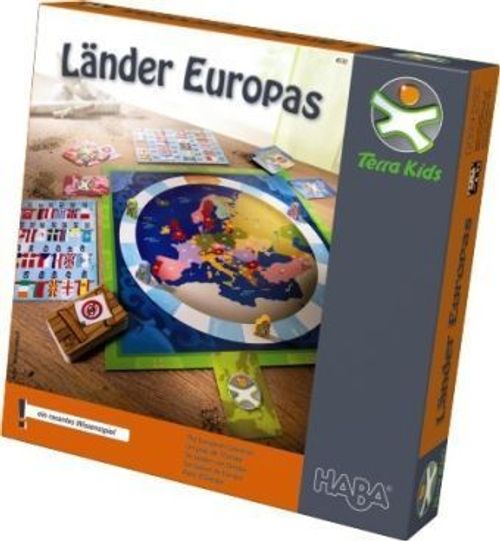
1 game board, 4 tourists, 4 reference boards showing 51 flags, 51 country cards, 16 answer cards, 8 risk cards, 1 Do-Not-Look! card, set of game instructions.
Preparation of the Game
Place the game board in the center of the table. Each player gets a reference board, a tourist and the answer and risk cards of the corresponding color. Place the tourists on the orange starting square. Place the cards face down in front of you.
Shuffle all 51 cards and place only twelve of them in a pile, with the answer side face up. Then cover the pile with the Do-Not-Look! card and place the pile, ready to use, next to the game board. The remaining country cards are not needed for this game and can be returned to the box.
How to Play
Play in a clockwise direction. The oldest player starts. You challenge the other players about their expert knowledge on Europe.
Take the card underneath the Do-Not-Look! card from the pile. Secretly take a look at the hints and choose one of them.
After each hint you give, place the country card in front of you so that the other players can clearly see the options marked with the letters A, B, C and D. The hint should be read out loud slowly and repeated as necessary.
Each card contains four hints:
- The Country Code: Read out loud the number next to the little binoculars. The other players now search for the country with this code on the game board.
- The Capital: Read the name of the capital out loud.
- The Flag Code: Read out loud the number next to the little flag. The other players look on the reference board for a flag with the corresponding number.
- The 50:50 Hint: Choose two countries on the back of the country card that are not correct and say the corresponding letters.
Suggestion: Try not to give the 50:50 hint at the beginning.
How to Give Your Answer
You can place your answer card after a hint has been given, that is after the first, second, third or fourth hint.
Place the answer card face down next to the answer square at the edge of the game board, for example:
- After the first hint: next to the square showing four dots.
- After the second hint: next to the square showing three dots.
- After the third hint: next to the square showing two dots.
- After the fourth hint: next to the square showing one dot.
The challenging player keeps giving out hints until all the players have placed an answer card. Each player must have placed an answer card after the last hint.
Watch out! Once an answer card has been placed it has to stay there! You are not allowed to move it even if you find out that you were wrong after other hints have been given! However, in such a situation you can also use your risk cards.
The Risk Cards
Each player has two risk cards.
-
"Hang on, afterthought!" You can correct an answer card you have already placed by covering it with this risk card. Then you place your new answer card on top of the risk card. If the answer is right, the score of the answer card is valid. If however the first answer was right and the "corrected" answer is wrong, there is no score for you.
-
"Score stealing!" You place the risk card on top of the answer card of another player. If this answer is right you get the points while the other player gets nothing and will not be able to move his play figure in this round. If however his answer was wrong, then the use of your risk card is voided and you receive no points.
Each risk card may be used only once during the game. Risk cards that have been played are then taken out of the game.
End of a Round
A round ends as soon as all the players have placed an answer card. The challenging player announces the solution and the other players turn over their answer cards.
Right answer?
- Yes! Great! Move your tourist as many squares as dots are shown on the corresponding answer square.
- No! Pity! Your tourist continues to be totally disorientated and cannot move. Don't despair! You will have another chance in the next round.
New Round
Once all the players who were right have moved their tourists, a new round starts. Take the country card from the previous round out of the game. Now it's the turn of the next player to challenge the other players and takes a new country card.
End of the Game
The game ends as soon as a tourist has made the round and reached the starting square or has gone past it, thus winning the game. In the case of a draw, the one who moved the furthest past the starting square is the winner.
If after the 12th question still no tourist has reached the starting square, then the player who is furthest ahead wins the game.
Hint: Of course you can also take more country cards from the game box and continue playing until the first tourist has reached the starting square.
Variation for European Experts
This variation is played like the basic game with the following changes:
- You help yourself to little slips of paper and pencil instead of the answer cards.
- The challenging player has to hold the country card in such a way that the other players cannot see the answer options!
- Only three hints are given. The 50:50 hint is dropped.
- For this reason, place your answer on the squares showing four, three or two dots.
- After each hint, the players can secretly write down the country they think is being searched and place their slip of paper next to the corresponding answer square.
The winner of this variation is a true expert on Europe and may set off on tour around Europe anytime and without any worries!
Notes
* While the West, East and South of Europe are all clearly defined by water, the Eastern border with Asia can't be defined so easily. One possible definition, which has been generally accepted up until now, was that given by the Swedish geographer Philip Johan von Strahlenberg (1676 - 1747). According to him, the geographic boundary follows the Urals, the Emba River and the Manych Depression, at the North of the Caucasus Mountain, and has been acknowledged as such in 1730 by the Russian Tsar and scientists. According to this definition, 47 countries lie entirely or partly within the European frontier. In the meantime Europe politically is organized into different institutions, such as the European Union (EU), the Organization for Security and Co-operation in Europe (OSCE) and the European Council. The states of Cyprus, Georgia, Armenia and Azerbaijan geographically belong to Asia, but politically form part of the European Council. Cyprus, since 2004, is also a member of the European Union.
So you will find 51 country cards in this game.