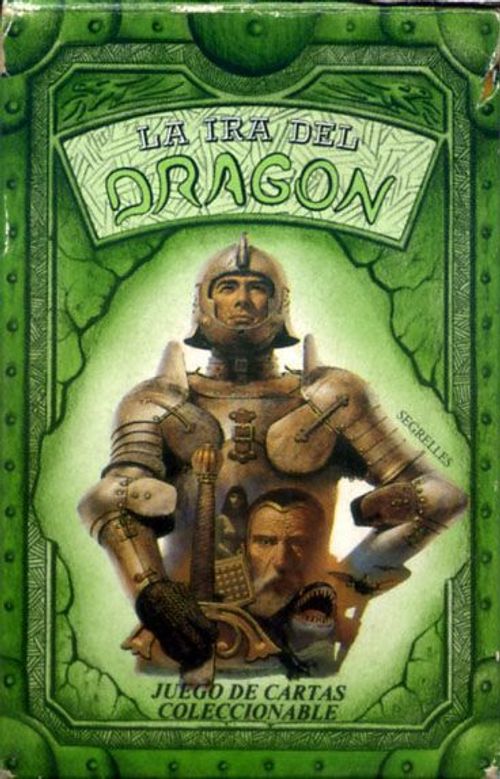
The Dragon's Wrath
The Dragon's Wrath Rulebook
Table of Contents
Table of Contents
Card Types
The cards are of three types: Brotherhoods, Creatures and Magic.
Brotherhoods: These are the sources from which you draw the power needed to put the various cards in your deck into play. There are green, blue, black and red Brotherhoods, and magic Brotherhoods. The magic Brotherhoods are the most powerful and are used as a wildcard: you may use them as a Brotherhood of whatever colour you find most useful at each moment.
Creatures: Creatures are your "armies", with which you will attack and defend. Some Creatures, those bearing the magic-item symbol, may use magic items.
Attack and defence: Attack points are the damage a Creature can inflict on an opponent when it enters combat. Defence is the resistance to damage that a Creature can take before it is eliminated. If the damage a Creature receives during combat is less than its defence resistance, the Creature is completely healed at the end of the turn.
Spell resistance: The number in parentheses on each Creature is the spell resistance it offers. A Creature can only be hexed by spells of a level equal to or higher than its own spell resistance.
Magic: Hex Brotherhoods: There are special cards for hexing Brotherhoods, whose function is specified on each card.
Describing the Cards
The printed manual illustrates the card layouts with two diagrams. The labels are translated below; the diagrams themselves are not reproduced.
Creature card: Name of the card (for example "Red Paladin"); illustration; the symbol that allows the Creature to use magic items; card type; text; attack points; spell resistance in parentheses; defence points.
Magic card: Name of the card (for example "Dragon's Breath"); combination of spheres (colours), shown as circles at the top of the card; illustration; card type (for example "Hex Creature"); text; spell level.
Hex Creature: These cards are always placed on a Creature, and serve to hex both your Creatures and those of your opponent. Every Hex Creature card has a number in parentheses, which is its "spell level". For a spell to be used on a given Creature, its spell level must be equal to or higher than that Creature's spell resistance. For example, if a Creature has a spell resistance of (3), it can only be hexed with a level (3) spell; it cannot be hexed with a level (2) or level (1) spell. Dragons, for example, are Creatures that are very hard to hex.
Instant magic: Instant magic is used at any moment of the game and its action is immediate. Once it has acted, its function is finished, and it is discarded.
Enchantments: Each enchantment has a different function. Once put into play, an enchantment lasts until the end of the game or until it is destroyed.
Magic items: There are four types of magic item: attack, defence, long-range attack, and magic amulets. Each type is shown by its own icon on the card. Magic items may only be used by certain Creatures, namely those bearing the magic-item symbol. Each such Creature may use at most one magic item of each type.
How Cards Are Put Into Play
Brotherhoods are put into play once per turn, if you have one, and they are the cards that give you the power to draw both Creatures and magic.
Creatures are your armies. To put them into play, you need the power that your Brotherhoods provide.
All Creatures have a combination of coloured spheres that must correspond with the Brotherhoods you have in play, in order to draw them. For example, if a Creature needs a red sphere and a green sphere to be put into play, you will need:
- To have in play one red Brotherhood and one green Brotherhood.
- To activate those two Brotherhoods.
Activate: means using the power that each card has. Brotherhoods may be activated once per turn, so to draw more Creatures or magic with the same Brotherhood, you must wait for the next turn.
Magic cards are put into play in exactly the same way as Creature cards: by activating the Brotherhoods needed, according to the combination of coloured spheres the card requires. Within magic there are special cards, such as magic items. Magic items are drawn only one per turn, and only if you have them. You do not need specific Brotherhoods to put them into play; you only need to activate two Brotherhoods of any colour.
Secret cards: Secret cards involve using a power hidden from the eyes of the opponent, which can be very useful. To use secret cards, you must activate 5 Brotherhoods of any colour during your turn. (The printed sentence reads "durante tu turno 5 «cofradías» de cualquier color", translated literally. The manual does not further explain the count.) This allows you to draw a card and place it face down on the table. You may look at it, but your opponents will not know what type of card it is, and you may reveal it when you consider it most opportune. Secret cards count for all effects as a card already in play. Obviously, if the secret card turns out to be a magic item or a Hex Creature card, you will need a Creature in play to use that card.
Only one secret card may be drawn per turn.
Game Progress
All players start with 21 power points, which are the points they begin combat with. If any mage has their power points reduced to zero, that mage loses the game. If at any time any of the mages is left without power to draw because they have run out of cards, that mage has also lost.
Each player participates with their own deck, made up of a minimum of 50 cards selected from all the cards they have. Once everyone has shuffled, it is determined at random who begins. (If the players have faced each other before, whoever has more victories begins.)
Each player draws 5 cards from their own deck, which they place in their hand without their opponents seeing them. Imagine that you are the one who begins. Apart from those 5 cards already in your hand, you draw one more card from the deck, since it is your turn and at the start of your turn you must always draw a card.
You may not have more than 6 cards in your hand. If you have more than 6, you must discard.
Now you will truly begin the game. The first thing you must do is draw a Brotherhood, if you have one, and put it into play (place it on the table). You may not put more than one Brotherhood into play per turn, unless you have a card that allows it. That Brotherhood will give you the power to put the other cards into play; for this you must take into account the colour of the Brotherhood in question and the colour of the Creatures or magic cards you have in hand.
For example: if you draw a blue Brotherhood, you may put into play a card that has only one blue sphere, in the upper corner of the card. To do so you must first activate the Brotherhood.
As you put more Brotherhoods into play, you will be able to draw more powerful cards.
If the card you have put into play is a Creature, you may not attack with it until your next turn. Your opponents now play. When your turn comes around again, you may act as follows: first and always, you deactivate the cards you have activated; then you draw a card; and then, if you have one, you may put another Brotherhood into play. In the best case, you will now have 2 Brotherhoods in play, which will let you draw cards that require the use of 2 Brotherhoods.
Imagine you have a blue Brotherhood and a red one, in addition to a Creature put into play on the previous turn. You may use these Brotherhoods to draw a more powerful card. If that card is a Creature, you may not attack with it. If it is a magic card (spell, enchantment, instant or magic item), it acts immediately. If what you decide is to attack, you may do so with the Creature you put into play on the previous turn, in the following way.
First you turn the Creature sideways. (The printed manual shows two small icons here, not reproduced.) This indicates to your opponents that this particular Creature is attacking. All Creatures have attack points and defence points. Attack points indicate the amount of damage they inflict on your adversary. If your opponents have no Creatures in play to resist your attack, those points pass directly to the opposing mage, who subtracts them from their power points. But if that mage has Creatures in play, they may choose to defend with them, in which case a combat takes place.
The defender always chooses with which Creature it defends and against which attacking Creature.
For example: a Creature with 3 attack points will automatically eliminate another Creature that tries to block it, if that blocker's defence points are less than or equal to 3. The attacking Creature, in turn, receives damage from the defending Creature equal to that defending Creature's attack points. This is a simultaneous attack, and several outcomes are possible:
- Both Creatures are eliminated.
- Only one of them is eliminated.
- Both survive, completely healed at the end of the turn.
For example: a Creature with 3 attack points eliminates or destroys another Creature that tries to block it with just 1 defence point, but the 2 remaining points DO NOT CAUSE THE LOSS OF POWER POINTS TO THE MAGE WHO DEFENDS.
You must keep in mind that an attacking Creature remains turned until it is touched again on your turn to play. TURNED OR ACTIVATED CREATURES CANNOT DEFEND WHEN YOU ARE ATTACKED. You must balance your forces, using some Creatures to attack and keeping others in reserve so you can defend yourself in case of attack.
Hex Creature cards strengthen your Creatures or weaken those of your adversary. They must be placed on top of the target Creature.
Enchantments are placed on the table next to your Creatures, and they are neither activated nor turned. They begin acting immediately. Hex Brotherhood cards are placed on top of the target Brotherhoods.
Magic items enhance your Creatures, and you place them on top of these Creatures. If one of your Creatures destroys an opponent's Creature that carries magic items, those items pass to your control. You must immediately place them on top of one of your Creatures in play that is able to use magic items. If you cannot do so, these magic items are discarded. If it is possible, these magic items become YOUR PROPERTY, with no obligation to return them at the end of the game, even if you end up defeated.
Special Abilities
- Cards marked with the symbol shown as a stylised "A" may either be turned in order to attack, or activated by carrying out the ability described in the card's text. (The symbol is a stylised letter "A" in the printed manual.)
- Creatures that can fly cannot be blocked by Creatures that cannot fly.
- Long-range attack with magic items (marked with the long-range attack symbol): This is a special attack. It is carried out before the conventional "hand-to-hand" attack, and in this attack you choose the target. To use the long-range attack, you do not need to turn your attacking Creature, so it may also attack afterwards, during the conventional attack. Attacks with long-range weapons MAY ONLY BE MADE AGAINST THE OPPONENT'S CREATURES, NEVER DIRECTLY AGAINST THE MAGE.
You may also attack flying Creatures. A Creature damaged by these weapons subtracts the damage received from its defence points, so during your next conventional attack it will be weakened.
Wager. Before a game of The Dragon's Wrath begins, a wager must be made compulsorily: one card chosen at random from each participant, which whoever manages to win the combat wins for themselves.
Besides the cards of The Dragon's Wrath, you will need paper and a pencil to keep the score, and an ample surface is indispensable for laying out the cards.