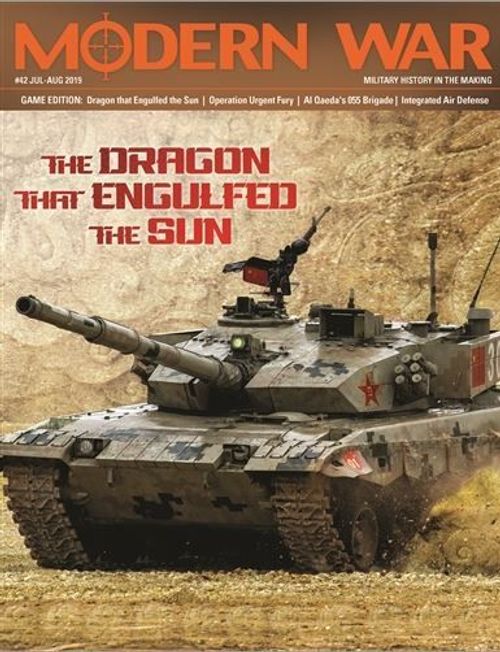
The Dragon that Engulfed the Sun
The Dragon that Engulfed the Sun Rulebook
Table of Contents
Table of Contents
- 1.0 Introduction
- 2.0 Components
- 3.0 Set-Up
- 4.0 How to Win
- 5.0 Sequence of Play
- 6.0 Stacking
- 7.0 Supply
- 8.0 Zones of Control
- 9.0 Movement
- 10.0 Reinforcements
- 11.0 Combat
- 12.0 Naval Units
- 13.0 Air Units
- 14.0 Cyberwar
- 15.0 Air Assault
- 16.0 Missiles
- 17.0 Special Forces (Commando) Missions
- 18.0 Scenario (The Dragon that Engulfed the Sun)
1.0 Introduction
This game simulates a (near future) hypothetical Chinese invasion of Japan. The premise of this game is that a sudden war erupted on the Korean peninsula, compelling China to intervene in the conflict, well before the United States could reinforce South Korea sufficiently to prevent it from being overrun. Moreover, because the Chinese realized that there might never be another opportunity to completely eliminate the US from the Asian mainland, they have irrevocably committed themselves to this path, and thus it is their resolute intention to finally settle old scores with the Empire of the Sun.
2.0 Components
The components of a complete game of Dragon that Engulfed the Sun include these rules, one 22×34 inch map sheet, and one sheet of 176 9/16 inch counters. Players will need to provide themselves with two six-sided die to resolve combat and strikes. When players are required to roll a die or dice, 1d6 refers to rolling one six sided die, and 2d6 refers to rolling two six sided die.
Important: Throughout the rules there are references to scenarios and units that do not exist in this game. The rules are intended for use with the follow-on games using the same system rules and specific exclusive rules for each game set.
2.1 Map
The map depicts Japan and features terrain and infrastructure relevant to simulation of a hypothetical Chinese invasion. A hexagonal grid is printed over the map to regulate placement, movement, and range of game pieces. Each hex represents about 36 miles (58 kilometers) from side to opposite side. Each turn represents a variable number of days (from one to three). Hexes are printed with a unique four-digit number for finding and/or recording specific locations.
Example: The city of Hiroshima is hex 2321.
Map Errata:
- The crossing arrow in hex 2802 should be white (Intra-hex).
- Hex 1723 (Tsushima) should have a port symbol " ".
2.2 Game Pieces
The counters (combat units) represent land units, air units, naval units, air defense formations, missiles, cyberwar capabilities, and other informational markers. Each counter is printed with information that specifies its capabilities during game play:
- Land Units: front (full strength) and back (reduced strength); Unit ID; Unit Size; Unit Type Symbol; Combat Factor.
- Air Units: front and back; Type; Airframe Type; Combat Values (Strike Capable).
- Helicopter Units: front and back; Combat Values.
- Naval Units: front and back; Flotilla Symbol; Type Symbol; ID; Combat Values.
- Surface-to-Air Missile Launcher (SAM): front and back.
- Anti-Ship Missile (ASM): front and back; Missile Type; Missile Range; Strike Value; Strike Capable.
- Hypersonic Glide Vehicles (HGV missiles): front and back; Unlimited Range.
2.3 Sides & Nationalities
A unit's nationality (and therefore its side) is indicated by its color scheme:
- China (Japanese Theater Amphibious Units): Maroon
- China (Japanese Theater Land Force): Red
- Japan: Forest Green
- US: Azure Blue
2.4 Unit Types
Units are distinguished by their specific type:
- Amphibious
- Artillery
- Infantry
- Mechanized Infantry
- Motorized Rifle
- Self-Propelled Artillery
- Armor
- Airborne
- Airmobile
- Marines
- Special Forces
Important: Some Chinese amphibious units are printed with a NATO style symbol. These units are not moving amphibiously when they move via sea hexes. They are not subject to submarine attacks or naval combat. They are flying in low and "below the radar," thus their heliborne movement cannot be intercepted by naval, submarine or air units during and after their movement. SAM units have no effect upon them during combat.
2.5 Markers
The following informational markers are provided: Cyber War; Chinese Satellite Eliminated; Out of Supply; Interdiction; Game Turn; Combat.
2.6 Combat Factors & Values
Land units, naval units, air units, and missile units are collectively called combat units (or units) and are printed with various numbers to indicate their combat capability. A unit may never loan or borrow any combat factor or capabilities.
- Land Units: Are printed with a single combat factor that only applies when resolving land combat.
- Naval units (Flotillas): The "+" and "-" numbers are applicable during sea combat and strikes.
- The "+" is used if attacking during sea combat.
- The "-" is used if the unit is, or if the hex adjacent to it is, the target of a strike.
- Air Units: The "+" and "-" numbers are applicable during land combat when the air unit is participating as air support (only if that air unit is printed with a triangle symbol "p"). Air units' "+" and "-" numbers are also applicable during air combat and when conducting an air strike.
- Missile Units: Missile units are printed with a strike number within a p symbol. This number indicates each missile's strike value when attacking enemy targets (16.0).
Important: Air units that are printed with a p symbol without a number are assumed to have the same strike value as their printed "+" number.
Exception: Helicopters may provide air support, even though they do not have a p symbol on their counter.
2.7 Unit Size
Land combat units are represented using the following unit size/organization:
- XX: Division
- X: Brigade
- III: Regiment
- II: Battalion
2.8 Movement Points
Units are not printed with a movement factor. The movement allowance (MA) of all land and naval units is five. A unit may never share (or divide among) its movement allowance with other units.
- Naval units (including land units moving amphibiously) have two opportunities to move (i.e., up to five hexes) during each game turn.
- A land unit that is eligible to move amphibiously cannot combine sea movement with land movement. When an amphibiously moving land unit "lands" in any coastal hex, its sea movement ends immediately, but it will be eligible to begin land movement in the next game turn.
Important: Airmobile movement is unlimited (15.0).
2.9 Unit Steps
Most land units in the game are two-sided units. The front side of a land unit represents that unit's full-strength side, and the back side of a land unit represents that unit's reduced-strength side. A full-strength unit that becomes reduced due to combat must be flipped to its reduced-strength side. A reduced-strength unit that becomes reduced again is eliminated and removed from the map. It is placed in a "dead pile" off to the side, available to be replaced at the end of the game turn (10.0). All units of both sides begin the game as full-strength; no single unit has more than two sides.
Important: A unit may never be voluntarily depleted or voluntarily eliminated (i.e., to repurchase and then place it somewhere else on the map).
3.0 Set-Up
After determining who will play which side, refer to the game's scenario instructions at the end of these rules to set up the game. Some game pieces are brought into play during later game turns; these are known as reinforcements (10.0).
Important: Throughout the rules, the terms "friendly and/or captured" are used. A hex is friendly to a side if the hex began the game occupied or controlled by any unit allied to that side. A captured hex is a hex that began the game controlled by the other side but has been subsequently occupied by any friendly unit. In most cases, once a hex is captured, it is friendly to the capturing side. Exceptions (if any) to the above are covered in specific rules.
4.0 How to Win
The scenario instructions describe the victory conditions for each side.
5.0 Sequence of Play
Each game turn is divided into two distinct player turns: one Communist player and one Free World player turn. One full game turn is therefore comprised of a Communist player turn and then a Free World player turn (always in that order, and always starting with the Communist player turn). At the end of every full game turn, move the game turn marker rightward one box on the Game Turn Record Track (GTRT) printed on the map. An entire scenario lasts a maximum of ten game turns.
Errata: This Sequence of Play outlined below supersedes the Sequence of Play printed on the map.
5.1 Game Turn Sequence
The game turn sequence is organized here as a series of unique phases, preceded by an Administrative Segment, each of which must be followed in the order presented. All activities that are permitted during a phase may only occur during that specific phase, and any skipped or forgotten activity cannot occur during a different phase.
Administrative Segment
A) Place and resolve Special Forces (Commando) Missions (17.0).
B) Flip all surviving bombers, fighters, helicopters, and strike units (of both sides) from their flown sides back over to their front sides.
Note: Some scenarios do not include bomber and fighter type air units (18.1).
C) Flip all surviving naval units from their fired sides back over to their front sides.
D) The Free World player may remove Chinese satellites, if desired.
Communist Player Turn
A) Communist Strike Phase: The Communist player may pick up any of his currently available fighter, helicopter, strike, and/or missile units and place them atop any Free World land and/or naval units in any hexes anywhere on the map.
- Missiles cannot be placed in hexes that exceed their printed range.
- A maximum of two air units (including missiles) regardless of their type or alliance, may be placed in the same hex during the same Strike Phase.
- Once placed, a strike-capable air unit (printed with a p symbol) and/or missile may then conduct a strike in that hex.
- A player is not required to launch all his intended striking air units and missiles at one time. He may launch his air units and/or missile units one at a time or in groups; resolving each strike (observing the outcome of each strike) one at a time before deciding which of his other available air units and/or missiles to launch during this same phase.
- Each air unit may only strike once per game turn. After the air unit completes its strike, flip the unit to its flown side (if not eliminated) and return it to any friendly airbase or city (or off map, but only if it originated from off the map).
- Missile units may only be used once, after which they are expended.
Note: A player is not required to launch all intended strike capable air and missile units at one time. He may launch his air and/or missile units one at a time or in groups, resolving each of their strikes one at a time before deciding which of his other available air and/or missile units to launch during the same phase.
B) Communist Movement and Reinforcement Phase: The Communist player may move his own naval units and/or land units that are present on the map (including those moving amphibiously).
- Arriving reinforcements are placed. They may move their full movement allowance during this phase.
- Communist air units that did not conduct a strike during the Strike Phase (i.e., are not showing their flown side) may be moved from their current location on/off the map (if at an airbase or a friendly city) to another friendly airbase or city on the map. This transfer is subject to enemy air interception.
- If a Communist naval or amphibiously moving land unit enters a sea containing a Free World naval unit, naval combat is immediately resolved before the Communist unit may continue moving (12.2).
- If a Communist naval or amphibiously moving land unit enters a sea hex that is within the range of an enemy missile unit, the Free World player may conduct a missile strike against the units (16.0).
C) Communist Combat Phase: The Communist player may designate his land units to attack adjacent enemy land units (11.0).
D) Communist Secondary Naval Movement Phase: The Communist player may move his non-fired naval units again (even if they previously moved or participated in combat this turn).
E) Communist Replacement Phase: The Communist player may replace eligible eliminated units using his available replacement points (10.0).
- Communist units that are replaced become reinforcements during the next Communist Movement and Reinforcement Phase.
- Place replaced units onto the GTRT in the next game turn's box. They will arrive as reinforcements that turn.
F) Communist Supply Phase: Determine if any Communist units are out of supply (7.0).
- Units that are out of supply may be supplied by expending helicopter units (7.2).
- Units that begin the phase marked with an out of supply marker and that are still out of supply are reduced one step.
- Mark all out of supply units with an out of supply marker.
Free World Player Turn
A) Free World Strike Phase: The Free World Strike Phase is identical to the Communist Strike Phase, except the player roles are reversed.
B) Free World Movement and Reinforcement Phase: The Free World Movement and Reinforcement Phase is identical to the Communist Movement and Reinforcement Phase, except the player roles are reversed.
C) Free World Combat Phase: The Free World player may designate his land units to attack adjacent enemy land units (11.0).
D) Free World Secondary Naval Movement Phase: The Free World player may move his non-fired naval units again (even if they previously moved or participated in combat).
E) Free World Replacement Phase: The Free World player may replace eligible eliminated units using his available replacement points (10.0).
- Replaced Free World units become reinforcements during the next Free World Movement and Reinforcement Phase.
- Place replaced units onto the GTRT in the next game turn's box. They will arrive as reinforcements that turn.
F) Free World Supply Phase: Determine if any Free World units are out of supply (7.0).
- Units that are out of supply may be supplied by expending helicopter units (7.2).
- Units that begin this phase marked with an out of supply marker and that are still out of supply are reduced one step.
- Mark all out of supply units with an out of supply marker.
6.0 Stacking
Stacking is the term used to describe putting more than one friendly unit in a land hex at the same time. There is no stacking limit in all sea hexes.
- A maximum of four land units of any type may be stacked in a land hex at one time.
- Opposing land units may never be stacked in the same hex.
Exception: Friendly and enemy units may occupy the same coastal hex only if the opposing units are in different elements (sea vis-à-vis land).
- Stacking limits only apply at the end of each phase. Limits do not apply when moving units (i.e., during the movement phase).
Note: Terrain has no effect on stacking.
6.1 Stacking Exception
Stacking limits never apply to the following types of units:
- Missile units.
- Battalion-sized land units.
- Air units (while in the air) (6.3).
- Naval units or amphibiously moving land units while at sea (6.4).
- Informational markers.
6.2 Stack Movement
Units may move together as stacks, ignoring stacking limits as they move.
- Units moving as a stack are not required to move together as a stack during the entirety of their movement.
- Some units may stop as other units continue moving.
- Units in a stack may split off and move in multiple directions (players must be careful to remember each unit's movement point expenditure).
- A stack cannot pick up another unit as that stack is moving. Units moving as a stack must begin their movement as a stack.
6.3 Stacking Air Units
Stacking limits do not apply to air units that are currently being flown to conduct an interception or a strike.
- A maximum of two friendly air units, regardless of their type or alliance, may be based together in the same airbase hex at the same time.
- Air units that are based off-map are not subject to stacking limits while they are off the map.
- Air units that are based in a hex have no effect on any friendly land units in that hex.
Note: Air units that have been launched to intercept or conduct a strike are considered aloft for the duration of the game turn and therefore are ignored when considering stacking.
6.4 Stacking Naval Units
Stacking limits do not apply to naval units (or amphibiously moving land units) that are at sea. A maximum of two friendly naval units (and/or amphibiously moving land units), regardless of their type or alliance, may occupy the same coastal hex at the end of their Movement Phase.
Exception: If a friendly port is present in that same coastal hex, the stacking limit is doubled to a maximum of four friendly naval units and/or amphibiously moving land units.
6.5 Overstacking Penalty
If the stacking limit in any hex is exceeded at the end of any phase, the owning player must eliminate enough of his units from that hex (his choice) to comply with the stacking limit.
6.6 Inspecting Stacks (No Fog of War)
Representing the near impossibility of avoiding detection in the modern battlespace environment, both players are always free to know exactly what units comprise each enemy stack.
7.0 Supply
All land units on the map must be in supply to avoid penalties (except units that are currently moving amphibiously).
Important: Naval units (including amphibiously moving land units), air units, missile units, as well as all units that are off-map are always in supply and are not subject to supply rules. Amphibiously moving land units become subject to supply requirements the moment they are landed in a hex.
During each player's friendly Supply Phase (5.1), the owning player must demonstrate a path of contiguous land hexes (regardless of terrain types) from his land units to a friendly city (3.0).
- The path of hexes may follow any route of any length of land hexes.
- The path may not:
- a) Cross an all-water hexside (unless printed with a noninterdicted crossing arrow).
- b) Enter a hex that is occupied by an enemy unit, including a based (available or flown) enemy air unit.
- c) Enter an enemy zone of control (EZOC).
Exception: A supply path may always enter a friendly unit's hex, even if that hex is within an EZOC.
7.1 Naval Supply
A friendly naval unit (naval units only, not land units moving amphibiously) that is present in any friendly (3.0) coastal hex (port or city may or may not be present) will function as a supply source exactly as if it were a friendly city.
7.2 Air Supply Missions
If a land unit is out of supply, the owning player may declare an air supply mission during his Supply Phase. To do so he must:
- Eliminate a friendly non-flown helicopter unit. Remove the helicopter unit from the game. It may be replaced normally (10.0).
- Remove one out of supply marker from one friendly land unit; OR,
- Not place an out of supply marker on one friendly land unit.
A player may eliminate multiple helicopters to remove multiple out of supply markers (or prevent the placement of out of supply markers) in each hex in each friendly Supply Phase.
Important: Air supply missions cannot be intercepted or engaged in air combat, nor can they be attacked by any SAM unit. They are not impeded by EZOC.
Optional Air Supply Support Attrition
Instead of automatically eliminating a helicopter unit, players may use the following optional helicopter attrition rule when conducting air supply.
When conducting air supply, count the number of enemy occupied hexes that are adjacent to the unit being supplied. For this purpose, count any hex that is occupied by an enemy land combat unit, naval unit, or SAM. Roll 1d6. If the result is less than or equal to the number of enemy occupied hexes, the helicopter unit is eliminated as noted in the standard rule. No matter the result, the actual supply attempt succeeds.
7.3 Out of Supply
A land unit that is out of supply has:
- A movement allowance of two.
- All combat values/factors halved (round up).
Important: If a unit begins a friendly Supply Phase already marked with an out of supply marker and is found during the phase to still be out of supply, it is reduced or, if already reduced it is eliminated.
8.0 Zones of Control
The six hexes immediately surrounding a hex containing one or more land units is known as the zone of control (ZOC) of the unit(s) in that hex. ZOC extend into all types of land terrain hexes and across all land hexsides. ZOC do not extend across an all-sea or all-lake hexside (unless a cross hexside arrow symbol is printed there).
- All land units of both sides project ZOC regardless of their supply status.
- Units of both sides/nationalities can project ZOC into the same hex.
- Opposing units always simultaneously project ZOC into the same adjacent hexes (except as restricted above).
- The following units do not project ZOC and are not affected by enemy zone of control (EZOC).
- Naval units.
- Air units.
- Missile units.
- Surface-to-Air Missile Launchers (SAM).
- Special Forces units.
- Amphibiously moving land units.
8.1 Enemy Zone of Control Effects
When a land unit enters an EZOC, it must immediately stop its movement for the remainder of that Movement Phase.
- If a unit begins its movement in an EZOC, that unit may exit that ZOC without inhibition, but it must immediately stop if it subsequently enters an EZOC.
- A unit may move directly from an EZOC hex to an adjacent EZOC hex, but it must then cease movement.
- A supply path may not enter an EZOC unless that hex is occupied by a friendly land unit.
9.0 Movement
During a friendly Movement Phase, friendly units that are capable of movement may be moved individually or as stacks from their present hex to an adjacent hex or path of connected hexes up to the limit of their movement allowance.
Important: Land units, including missile and SAM units, cannot be placed, move, or land on any island that does not contain a city, port, or airbase. Amphibiously moving land units, naval units, and air units may move into and/or through these hexes.
- The allowable movement allowance (MA) is the number of movement points (MP) that unit can expend. The MA of the various types of units are as follows:
- Land units: 5 (including SAM units and missile units on land).
- Naval units: 5 (including land units while being moved amphibiously).
- Air units: Unlimited (regardless of their types, including helicopter units).
- A unit is not required to move.
- A unit is not required to expend its entire MA.
- MP may not be accumulated from turn to turn, loaned, or borrowed.
- If a unit does not or cannot expend its entire MA, the remaining MP are lost.
- As each unit is moved on the map, it must expend its available MA.
- The amount of MP a unit must expend for each hex depends on the type of terrain in each hex and the hexsides the unit crosses.
- The MP cost for each type of terrain is listed on the Terrain Effects Chart (TEC).
- If a hex contains multiple types of terrain, the terrain that imposes the highest movement cost determines the number of MP required to enter that hex (Exception: 9.1).
- Units that exit the map are eliminated.
Exception: Air units returning to off map bases during the Strike Phase.
Exception: Airmobile and Special forces units do not move when conducting an air assault or commando mission; they are placed in the hex where they will be conducting that mission (15.0 & 17.0).
9.1 Road Movement
Hexes printed with a road symbol allow land movement at a reduced cost (TEC) rather than the other terrain feature(s) in the hex.
- The road movement cost only applies to a unit that is moving from a road hex to an adjacent road hex via a connected road symbol.
- If a land unit enters a road hex from a non-road (or disconnected road) hex, the terrain cost to enter that road hex is per the other type of terrain in that hex.
- If a road crosses a river or is connected by across hexside arrow, it is assumed to be bridged and therefore negates the normal movement point cost of the hexside.
Example: The cross hexside arrow connecting hex 2423 and hex 2323.
9.2 Enemy Units
Hexes that are occupied by enemy land units cannot be entered by land units during movement, although hexes that are only occupied by air units (even if flown), missiles (on land), and/or SAMs may be entered normally. Eliminate all such units when entering their hex.
Note: Naval units do not affect land movement when using crossing arrows.
9.3 Sea Movement
Naval units and land units moving amphibiously may only move via sea hexes (not across lake hexsides). This is known as sea movement.
Note: The scenario instructions indicate which land units are capable of amphibious movement.
- Sea movement is conducted per 9.0. A unit using sea movement may not move through a hexside with a land depiction that completely separates a sea hex from another sea hex (via its direction of travel), nor may it enter an enemy coastal hex that is printed with an arrow symbol (unless that arrow's hex is currently friendly to the moving side).
Note: An enemy player may compel a moving naval unit to temporarily halt its movement in order to conduct a missile strike against that moving naval unit (16.0).
- Units using sea movement may enter coastal hexes as if they are normal sea hexes.
- Amphibiously moving land units that will be landed in an unoccupied coastal hex must end their movement in that hex.
Important: Units that enter a coastal hex while moving amphibiously and that do not land cannot participate in land combat, whether offensively or defensively.
- An amphibiously moving land unit may not be landed in a hex that is occupied by an enemy land unit (9.2). Direct amphibious assaults against enemy occupied coastal hexes are not permitted (owing to modern weaponry).
Exception: Missile, air, and/or SAM units do not prohibit an amphibious landing and are eliminated if their hex is occupied.
- At the instant that an amphibiously moving land unit is landed, it may not move amphibiously again; that land unit is treated as a normal land unit in all respects thereafter, including the retreat restriction that prohibits land units from retreating across an all-sea hexside.
9.4 Submarines
The presence of unknown submarines from both sides is represented in the game abstractly, not as actual game pieces. When sea movement is completed in a sea or coastal hex by the owning player, the opposing player may declare a single submarine attack.
- In the case of amphibious units in a coastal hex, the submarine attack is conducted prior to landing.
- No more than one submarine attack may be declared in any single hex (regardless of how many units ended their movement in that same hex).
- To conduct a submarine attack, the enemy player must roll 2d6 and consult the Submarine Attack Chart (on the map).
Designer's Note: The above rule makes it a wise decision to move naval units and amphibiously moving land units in stacks.
9.5 Retreats (on Land)
Retreat only occurs during the Combat Phase. It does not require the expenditure of movement points. Terrain movement costs are ignored. All other movement restrictions apply. A land unit that cannot retreat is eliminated.
10.0 Reinforcements
Reinforcements are units that are scheduled by a scenario to enter the map during the friendly Movement Phase of later game turns (either by moving onto the map or placed as noted in the following rules).
- All movement and stacking rules apply to reinforcements that enter or are placed on the map.
- Reinforcements may be delayed (either because of an inability to arrive where required or voluntarily) until a later game turn. Delayed reinforcements must arrive where originally specified by the scenario.
- Reinforcements enter the map supplied, even if they move into a hex that does not have a supply path to a supply source.
Important: If any reinforcement cannot arrive on the map for any reason (such as the presence of any enemy unit or stacking restrictions), its entry is simply delayed until a game turn when it can legally enter the map.
10.1 Replacements
During a friendly Replacement Phase, a player may be permitted to rebuild reduced and/or eliminated units.
- Replacement points are received in the amount given by the scenario being played.
- One replacement point can be used to rebuild one reduced unit on the map back to its full-strength side, or to rebuild one single-sided unit (such as a missile unit).
- An eliminated two-sided unit may be rebuilt. It costs two replacement points are required to rebuild an eliminated unit as a full-strength unit.
- A two-sided unit may be rebuilt in its reduced state by expending one replacement point.
Exception: A unit that is in an EZOC or marked out of supply cannot be rebuilt.
- Replacement points cannot be accumulated from turn to turn. Replacement points that are not used are forfeited permanently.
10.2 Replacement Arrivals
If an eliminated unit is rebuilt, it must arrive in a hex that is not in an EZOC, and that contains:
- Air Units: A friendly airbase.
- Naval Units: A friendly port hex.
- Land Units: A friendly city hex.
Important: In the case of air and naval units, the airbase/port must have been friendly controlled at the beginning of the scenario.
- If a rebuilt ASM missile and/or naval unit (of the same nationality) are in the same hex, they can be combined at any time (the naval unit may be loaded with that missile). Only one missile may be carried by any one naval unit at the same time.
- If a rebuilt air unit that began the scenario stacked with a naval unit is rebuilt in the same hex as a friendly naval unit (of the same nationality), they can be combined at any time (the naval unit may be loaded with that air unit). Only one air unit may be carried by any one naval unit at the same time.
- When a replacement arrives on the map, it immediately functions normally.
11.0 Combat
During a friendly Combat Phase, the phasing player may, although is not required to, announce an attack with any of his eligible land unit(s) that are adjacent to any enemy land unit(s) that are on the map (if otherwise legal to do so).
- He may announce as many attacks as he desires, though he is not required to commit to all his intended attacks at the outset of his Combat Phase.
- Attacks may be declared one at time, in any order desired by the owning player.
- The attacking player must resolve each attack to completion before beginning another attack.
- A player may decline to conduct any attacks.
- The attacking player may cancel an attack after resolving air combat in the hex, but not after committing a cyberwar marker or after rolling the attack die.
- To conduct a land attack the attacking player declares the unit(s) from his side that will be attacking, and the enemy-occupied hex will be attacked.
- All the land units that will be attacking an enemy-occupied hex must be adjacent to that hex when the attack occurs.
- An enemy-occupied hex can be attacked by a combination of attacking units from any hexes that are adjacent to that enemy-occupied hex.
- Allied units may participate in the same attack without restriction.
To resolve an attack, the attacking player must follow the attack sequence below:
1) Determine the Attack Odds:
- Add all the defending unit's combat factors in the hex in which the attack has been declared. All defending unit(s) that are stacked in the defending hex must be attacked as one combined total (i.e., the attacker may not choose to only attack some of the defending units in a hex).
- Add all the combat factors of all eligible attacking units that will be attacking that hex (which may include stacks, if any). No unit is ever required to attack (even if in the same stack).
- A land unit's combat factor may not be shared or divided among other units nor can it be assigned to any other hex than its own.
- Divide the attacker's total combat factors (that will be attacking the defender's hex) by the defender's total combat factors. Multiply that value by 100 and drop all fractions. The net result is the combat odds, which is expressed as a percentage.
Example: If the total attacking combat factors equal 35, and the total defending combat factors equal 10, divide the attacker's factors by the defender's factors [35 is divided by 10], which equals 3.5. That total is then multiplied by 100 [3.5 is multiplied by 100], resulting in a result of 350 (350% on the Combat Results Table). The attack would take place on the 300–399% column.
Important: The combat factor of a unit that is out of supply is halved (7.3) whether it is attacking or defending.
- Regardless of the final combat odds (including shifts), all attacks at 600% or greater are resolved on the 600–699% column. Conversely, all attack at 100% or less are resolved on the <100–199% column.
2) Declare Naval Support:
- If the defending hex is a coastal hex, the attacker and/or then the defender may choose to add the combat value of a single friendly naval unit that is in the same coastal hex.
- A naval unit's combat value will shift the land combat odds in favor of its side's land units. Shift the odds column the number of columns (rightward if the attacker, leftward if the defender) equal to that naval unit's printed combat value. This shift is cumulative with any other applicable combat shifts (12.1).
Note: Naval units may support land units that are allied to them.
3) Declare Air Support:
The attacker and then the defender may each also choose to launch and fly a maximum of two non-flown air units (if printed with a p symbol) into the defending hex (13.1).
4) Terrain Combat Shift:
Players determine what type of defensive terrain exists in the defending hex. Consult the Terrain Effects Chart and cross reference the terrain symbol row with the combat column to determine the number of leftward shifts that must be applied to the combat odds. Use the terrain most favorable to the defender if there are multiple types of terrain in that same hex.
Exception: If there is also a river symbol between any attacking unit (even if only one of the attacking units) and the defender's hex, one additional leftward column shift must be added to whatever terrain is in the defender's hex.
5) Cyberwar Shift:
If a player declares the use of a cyberwar marker, that player imposes a one-column shift in favor of his side (whether as the attacker or the defender). If both players declare the use of a cyberwar marker, they cancel out and no shift is imposed to that land combat.
Important: Each player may only use one cyberwar marker during the same land combat.
6) Resolve Combat:
Once the final combat odds column has been determined, the attacking player rolls 1d6 die and cross-references the result (as listed along the leftmost column of the Combat Results Table) with the shifted odds column. This letter code is the combat result. Each type of letter code is unique and is explained below:
Important: Air and naval units are not affected by land combat results. If a result calls for the reduction or elimination of more than one unit and only one unit from that side participated in the combat, perform the reduction and/or elimination on that single unit.
Note: Losses and retreats/advances must be taken by participating units only.
- AE: Attacker Eliminated: All attacking units are immediately eliminated. Advance after combat is not permitted.
- AR: Attacker Retreated: All attacking units must immediately retreat to an adjacent hex (attacking player's choice). Advance after combat is not permitted.
- MD: Military Disaster: The attacking player must reduce two of his units (defending player's choice). Advance after combat is not permitted.
- AM: Ambush: The attacking player must reduce two of his units (attacking player's choice). Advance after combat is not permitted.
- CA: Counterattack: The attacking player must reduce one of his units (defending player's choice). Advance after combat is not permitted.
- Ex: Exchange: The attacking and defending player must each reduce one unit (owner's choice). Advance after combat is not permitted.
- DR: Defender Retreated: All defending units must immediately retreat to an adjacent hex (defending player's choice). The attacking side may advance after combat with armor type unit(s) only (11.2).
- DE: Defender Eliminated: All defending units are immediately eliminated. The attacking side may advance after combat (11.2).
Important: When unit(s) must be reduced, the choosing player may choose to eliminate one already-reduced unit instead. In cases where two units must be reduced, the choosing player may choose to eliminate one full-strength unit instead.
7) After the Battle:
After completion of the above combat steps, that land combat is concluded. Surviving attacking units are not eligible to conduct any further attacks during that same game turn. Surviving defending units are not eligible to be attacked again during that same game turn. Retreats must be implemented immediately (11.1), and advance after combat (11.2) must then be implemented. The active player (attacker) may then declare and conduct another combat elsewhere on the map per 11.0.
Note: Players may place a combat marker atop any units (attacker and defender) that participated in combat as a mnemonic.
11.1 Retreat
If either the attacking or defending player is required to retreat, that retreat must be to an adjacent hex of the owning player's choice. All retreats are conducted immediately after each individual combat resolution.
- Retreats do not require the expenditure of MP.
- A unit that is unable to retreat for any reason is immediately eliminated.
- Units may retreat as a stack into one hex or into different hexes. Each unit may retreat into a separate hex.
Units cannot retreat into a hex:
- Occupied by an enemy land unit.
- That will become over-stacked because of that retreat.
- Off the map's hex grid.
- In an EZOC, even if a friendly unit or friendly ZOC is also present in that hex.
- That consists of terrain prohibited to that unit (such as a sea hex).
Important: An amphibiously moving land unit, once it is landed in a coastal hex, is not eligible to retreat into any all-sea hex or across any all-water hexside.
11.2 Advance After Combat
DR and DE combat results allow attacking units to advance after combat into the defender's hex. Advance after combat is at the discretion of the attacking player: it is not required. The attacking player may advance any or all attacking units; however, he must comply with the below restrictions and procedures:
- Only units that participated in the attack are eligible to advance.
- A DE result allows any type of attacking land unit to advance.
- A DR result only allows armor-type units to advance. Armor units include; mechanized infantry, self-propelled artillery and armor for this rule (2.4).
- Advance after combat does not require the expenditure of MP.
- Units can only advance into the hex occupied by the defending units.
- Units advancing after combat ignore all EZOC.
- Advancing units must comply with stacking restrictions in the hex of advance.
- Advance after combat must be conducted immediately after each combat resolution and prior to initiating any further attacks.
12.0 Naval Units
Both sides are provided with naval units that represent flotillas. A scenario may specify that some naval units will begin the game on the map while others arrive during specific turns.
- Naval units are moved via sea hexes with an MA of five. Naval units may move in both the Movement and Reinforcement Phase and the Secondary Naval Movement Phase of each player turn. They may expend their entire MA in each allowable movement segment (5.1).
- Whenever a land combat is announced in a coastal hex where a naval units are present, one naval unit may be used to support that land combat on behalf of its own land units there, even if that naval unit participated in any combat there during that same game turn.
- A naval unit may support any friendly land unit regardless of its nationality.
Important: Naval units in a coastal hex do not affect the stacking limits of land units there, nor do naval units project any ZOC.
12.1 Naval Support
A naval unit's combat value will shift the land combat odds in favor of friendly land units that are participating in a land combat in the same hex.
- The final calculated odds are shifted the number of columns (rightward if the attacker, leftward if the defender) equal to that naval unit's printed combat value. This shift is cumulative with any other applicable combat shifts.
- Naval units that conduct naval support are flipped over to their fired side to indicate that they are ineligible to move again during that same game turn.
12.2 Naval Combat
Whenever opposing naval units occupy the same hex, immediately resolve naval combat by rolling 1d6 for each naval unit in that hex.
- Modify each naval unit's die roll by adding the "+" combat value to that naval unit's die roll.
- After all die rolls have been modified, the side with the single highest die roll result has won the naval combat.
- The losing side must eliminate one naval or amphibiously moving land unit (owning player's choice).
- In the case of a tie, both sides lose one naval or amphibiously moving land unit (owning player's choice).
- All remaining naval units of the losing side must then be moved five hexes away from that naval combat hex (in any direction of the winning player's choice). This movement is not subject to a submarine attack. Those naval units may not conduct any further movement.
- The winning side may continue moving if eligible to do so.
Note: Naval units are not flipped to their fired side after naval combat.
Example: The Free World player moves two naval units (both have a combat value of "+2") into a hex occupied by one Communist side naval unit with a combat value of "+1." The Free World player rolls 2d6, adding 2 to each die roll. The Communist player rolls one die and adds 1 to the die roll. The Free World player rolls a 1 and a 2. The Communist player rolls a 5. The Communist player wins the naval combat (modified die roll of 6 versus modified dice rolls of 3 and 4.
13.0 Air Units
Air units represent bombers, fighters, helicopters, and strike aircraft.
Important: Not all scenarios in this series include all types of air units.
- Air units are placed on the map at friendly cities and/or airbases, or off map.
- Naval flotillas may be allowed (see scenario instructions) to act as a base for friendly air units. Only those air units designated as starting aboard a flotilla may be based there. If a flotilla is eliminated, the air unit based on the flotilla is transferred to any friendly airbase or city of the owning player's choice.
Note: Each scenario will specify where air units can be placed (base).
- Each air unit, regardless of its type, may only be launched and flown once per game turn. After an air unit has flown a mission, it is returned to a friendly base and flipped to its flown side.
Important: Air units returning to base cannot be intercepted.
- Air units do not have range limits at this game's scale. They may move to any hex on the map.
- A maximum of two friendly air units, regardless of their type, may ever be moved into the same target hex at the same time (irrespective of their intended missions in that hex).
- When conducting any kind of air mission, the owning player moves the air unit across the map, tracing each hex of the route of flight. He is not required to declare his intended target hex, nor the type of mission being flown.
- Moving air units may be intercepted while moving. Intercepted air units that survive the resulting air combat may continue to their target.
13.1 Air Missions
There are three types of air missions that can be conducted depending on the type of air unit that is being flown:
13.1.1 Air Strikes
A bomber or strike air unit (if printed with a p symbol) may be moved to a hex that contains an enemy factory, city, naval unit(s), or land unit(s) of any type to conduct a strike. Fighters and helicopters cannot conduct air strikes.
Note: The above targets may not be valid targets in every scenario. See scenario instructions.
Important: Air units, SAM, and missile units of any type cannot be targeted by air strikes.
To conduct an air strike, roll 1d6 for each attacking air unit. Modify each die roll as follows.
- If an enemy SAM unit is in or adjacent to the target hex, add the SAM unit's "+" combat value to each die roll. A maximum of one SAM unit may be added to any one die roll. This modifier is cumulative with a targeted naval unit's printed combat value.
- If the target is an enemy naval unit, add that naval unit's "+" combat value to the die roll. A maximum of one naval unit may be added to any one die roll. This modifier is cumulative with a SAM modifier.
- If the striking player applies a cyberwar marker, subtract one from the die roll.
- If the defending player applies a cyberwar marker, add one to the die roll.
- If the target is or occupies any kind of city or port hex, add one to the die roll.
If the modified die roll result is less than or equal to (≤) than the air unit's printed combat value, the target is hit.
Important: A unmodified die roll of six is always a miss, regardless of the modifiers.
- Land Unit: Reduce the target unit by one step (eliminate if already reduced or one-sided). Amphibiously moving land units are land units for this purpose.
- Factory or City: See the scenario's victory conditions (if factory or city targets are relevant).
Important: Some games in the series do not award VP for cities or factories. Players should read the scenario rules prior to conducting these attacks.
- Naval Unit: Eliminate the targeted naval unit (including embarked ASM). Air units stacked with an eliminated naval unit are transferred to any friendly airbase or city of the owning player's choice. Flip such air units to their flown sides.
Important: An air strike does not prohibit a missile strike into the same hex.
13.1.2 Air Support
Air units (if printed with a p symbol) and helicopter units (p not required) may be launched and flown to a defending hex where land combat is pending to modify (shift) the land combat odds in favor of the friendly land unit(s) that are attacking or being attacked there. Air units not printed with a p symbol cannot conduct air support.
- Helicopter units cannot be intercepted en route (only in the land combat hex itself). Bomber or strike air units that are flown as air support may be intercepted en route (13.2). Successful air interception only temporarily halts an air unit's movement (to resolve air combat). It does not force an air unit to abort its mission (unless it is shot down).
- The attacking player always declares air support first. After the attacking player has declared and flown his air units to the target hex, the defender may then declare and fly his air units to the target hex.
- Air units may be voluntarily aborted at any time prior to entering the target hex. They are returned to base and flipped to their flown side.
- An air unit becomes committed to air support (and any resulting air combat) when entering the target hex.
- If both players commit air support to a combat hex, air combat must be resolved before the land combat there is resolved (13.3).
- Surviving air units (including helicopter units) shift the land combat odds in favor of the owning side (whether as the attacker or the defender).
- Each air unit shifts the combat odds in favor of the owning player one column for each air unit that survived the air combat. Air support shifts are cumulative with all other shifts.
- Helicopters cannot provide a shift, but instead contribute their printed combat value to the land combat. Add their combat value to the total combat factors of the land units participating in the combat (either attacking or defending).
Note: Air units may be used as air support for allied land units without restriction.
13.1.3 Air Interception
Non-flown air units (except helicopters) may intercept enemy air units (except helicopters) as they move to their designated target hex.
Important: Air units returning to base cannot be intercepted.
- If a moving enemy air unit enters a hex within six hexes of a non-flown friendly air unit (count the hex the moving air unit is in, but not the starting hex for the intercepting unit), the intercepting player may call a temporary movement halt to those enemy air units.
- Air units that are based off-map may intercept. The owning player selects any friendly map-edge hex of his choice (hex row 36xx for the US player and see 18.3 for Chinese entry hexes) as their starting point. That point is counted as one hex from the off-map air unit's base.
- The intercepting player rolls 2d6 and modifies the total of the two dice by subtracting the lowest "-" combat value of the air unit(s) being intercepted.
- If the modified total is equal to or greater (≥) than the distance (in hexes) from the intercepting enemy air unit's base to (count the enemy air unit's hex, but not the base hex) the moving enemy air unit's hex, a successful interception has occurred.
- Each non-flown, non-helicopter air unit is eligible to attempt one air interception per each enemy non-helicopter air unit that enters within its air interception range of six hexes, until it successfully intercepts. Intercepting air units that conduct a successful interception conduct air combat in the interception hex and, if they survive, are returned to base and flipped to their flown side.
- Air units attempting but failing interception remain at their base and may attempt interception against different air unit(s) during the same phase as many times as another air unit comes within six hexes of the non-flown unit. Air units attempting interception are not marked flown until they make a successful interception.
Example: The Free World player is moving two air units and his traced flight path moves into a hex that is six hexes from a Communist air unit (count the hex the Free World air units have entered but do not count the hex occupied by the Communist air unit) that does not have its flown side showing. The Communist player could halt the air movement at that point; however, to improve his chance of interception, the Communist player allows the air units to continue moving. The Free World player moves his air units one hex (now five hexes from the intercepting air units). The Communist player again allows him to continue moving. As the Free World player moves into the next hex (now four hexes distant), the Communist player decides to conduct the interception. Remember that the Free World player has yet to declare his actual target hex, so the Communist player is guessing that this hex will probably be the closest hex he will be able to intercept. The Free World air units both have a "-1" combat value. The Communist player attempts the intercept with one air unit, and rolls two dice, subtracting one from their combined total. The total modified roll is five. Because the modified total is greater than the distance to the intercept hex, the Communist player has successfully intercepted the moving air units.
13.2 Air Combat
When opposing air units occupy the same hex because of an air interception, air strike, or air support; air combat ensues. Resolve air combat as follows:
- If one side only has helicopter unit(s) present, that side automatically loses the air combat (no die rolls required). The side with only helicopters must eliminate one helicopter unit (enemy player's choice). If a second helicopter is present, it would be immune to an elimination and would remain to contribute air support to its own side.
- Both players roll 1d6 for each friendly air unit conducting air combat (including helicopters).
- Each player adds the "+" combat value of their respective non-helicopter air unit(s) to each die roll.
- If a friendly SAM unit is in or adjacent to an air combat hex, subtract the SAM's combat value from each enemy die roll. A maximum of one SAM may affect each air combat.
- If a player commits a cyberwar marker to the air combat, add one to each owning player's die roll (14.0).
- After all die rolls have been modified, the side with the single highest individual modified die roll result has won the air combat.
- The losing side must eliminate one air unit (winning side's player's choice).
- The losing side must then abort his remaining air unit, if any, and return it to base, flipping it over to its flown side.
- The winning side's air units may continue to move or to conduct their intended mission in that hex.
- Participation in air combat does not in and of itself impede an air unit's eligibility to conduct a mission in the intended target hex.
- If both players tie for the highest modified die roll, all air units of both sides are eliminated (including helicopters).
Important: Missile units (any type) do not participate in or affect air combat in any way.
13.3 Aborts
Aborts represent everything from inclement weather to navigational errors.
- If a player rolls a one during his air combat die roll, regardless of any modifiers (and regardless of the enemy's air combat die roll), his own present non-helicopter air units there are immediately aborted and returned to base.
- Aborted air units are flipped to their flown side.
Exception: Helicopters are immune from being forcibly aborted.
Important: In the case above, cyberwar markers already committed (14.0, second bullet) are still expended.
13.4 Return to Base
After an air unit completes its mission (regardless of the result), it must be returned to a friendly base and flipped to its flown side. There is no need to trace a line of flight back to a base because returning air units cannot be intercepted.
Note: All cities are assumed to possess airbases, even if not printed with an airbase symbol.
14.0 Cyberwar
Both sides are provided with cyberwar markers that are useable during any combat occurring during the game that is resolved with a die roll (unless specifically exempted by the scenario).
- A maximum of one cyberwar marker may be used by each side during a single combat.
- The decision to commit a cyberwar marker must be made prior to any die rolls for that combat.
- The player who instigated the combat always decides first if he will be applying his cyberwar marker to a combat die roll. After that player has declared his decision, the other player then declares whether he will commit a cyberwar marker or not.
- Cyberwar markers modify the owning player's die roll by one to benefit the owning player.
- If both players commit a cyberwar marker, the effect of both markers is cancelled out.
- Cyberwar markers are expended when used (regardless of the outcome of the combat they are affecting). Cyberwar markers may be replaced by expending one replacement point (10.0).
Note: Cyberwar markers may be used interchangeably amongst allies without restriction.
15.0 Air Assault
During their Movement Phase, land units that are printed with an airborne or airmobile NATO symbol (2.4) are eligible to be moved any distance of hexes from their location to any enemy-unoccupied land hex (irrespective of any EZOC).
Note: In this context, land units include only land combat units (i.e., those units with a single combat factor). It does not include missile units, SAMs or units moving amphibiously.
- This movement is immune from air interception and/or missile strikes.
- Each airborne or airmobile unit moved (even if all units moved together) in this manner requires the elimination of one friendly available helicopter unit (regardless of the distance the air assaulting unit moved).
15.1 Air Assault Procedure
When a unit is placed into the target hex, the air assaulting player must roll 1d6 and follow the below procedure:
- If there is an enemy SAM unit in or adjacent to the target hex, the assaulting player subtracts the SAM's printed "-" modifier from the die roll. A maximum of one SAM unit may modify an enemy air assault.
- If the modified die roll result is one, the air assaulting unit is immediately eliminated.
- If the modified die roll result is two, the air assaulting unit loses one step and is placed in the target hex.
- If modified die roll result is three through six (inclusive), the air assaulting unit successfully occupies the target hex.
- The assaulting unit cannot conduct any further movement.
- The assaulting unit is in supply for the remainder of the game turn.
- The assaulting unit cannot conduct an attack during the Combat Phase of the game turn that it landed in the target hex. It can be attacked by enemy units.
- An eligible unit may conduct repeated air assaults throughout the game (though no more than once per game turn), but each air assault requires one friendly helicopter to be eliminated.
16.0 Missiles
Missile units can perform strikes against enemy naval units, amphibiously moving land units, land units (on land), and against factories and cities.
- Missile units may be launched and flown to conduct a single air strike in the same manner as a strike air unit.
- Missile units cannot be used to conduct air support.
- Missile units are printed with a range number (within a hexagon symbol in the upper right corner) that indicates the maximum distance of hexes that missile may be moved (from the location it launches from) to an intended target hex. Some missiles are printed with a "U" instead of a range number to indicate that their range is unlimited.
Note: SAM units are not missiles, thus cannot conduct strikes.
16.1 Moving Missiles on Land
A missile unit that is not launched to conduct a strike may be moved independently from its current hex exactly like a land unit (MA of five). Missile units:
- Cannot participate in land combat.
- Do not project ZOCs.
- Are automatically eliminated if their hex is occupied by an enemy land unit.
16.2 Anti-Ship Missiles (ASM)
ASM units are the only types of missiles that may be stacked aboard naval units (same nationality only).
- Each naval unit may only be armed with one ASM at a time.
- Naval units may be rearmed with an ASM if both the naval unit and an ASM occupy the same friendly port hex during a friendly Movement and Reinforcement Phase.
- ASMs may be moved via land hexes like any land unit per 16.1.
- ASM cannot be launched when not aboard a naval unit.
16.3 Missile Strikes
Missiles may be launched toward target hexes during their owning player's Strike Phase exactly like a strike air unit (albeit within each missile's printed range limit).
- If a Communist naval or amphibiously moving land unit enters a sea hex that is within the range of an enemy missile unit, the enemy player may temporarily halt the movement of that unit(s) to resolve a missile strike against it. After the strike, that Communist unit may then continue its movement (assuming it survived) until it is halted again or its movement is complete.
- Missiles cannot be intercepted in flight and they cannot intercept other missiles or air units.
- An unlimited number of missiles may conduct strikes into a target hex (even if there is only one target in that hex).
- Missile strikes have no effect on any air unit in that same hex or air unit that is striking that same hex.
- Each missile may strike a single enemy naval unit, amphibiously moving land unit, land unit, factory, or city in the target hex. The owning player must then announce the specific target in that hex prior to conducting the strike procedure.
- To conduct the strike, the owning player rolls 1d6.
- If there is an enemy SAM and/or naval unit in or adjacent to the target hex, the assaulting player adds the SAM and/or naval unit's printed "+" modifier to the die roll. A maximum of one SAM and/or one naval unit may modify a missile strike die roll.
- Cyberwar markers may be used to increase or decrease a missile strike's die roll (14.0).
- If the missile's modified die roll result is less than or equal to (≤) its printed strike value (or is less than or equal to its adjusted strike value if that missile is reliant on satellite units included in the scenario), it has hit its intended target.
- An unmodified die roll of six is always a miss.
16.4 Target Effects
Missile strikes and resultant hits have the same effect as air unit strikes, see 13.1.1 for results.
Important: Air, SAM, and missile units of any type cannot be targeted or hit by missile strikes.
16.5 Expending Missiles
After any type of missile conducts a strike, regardless of the result, it is immediately expended (eliminated). Expended missiles may be rebuilt normally (10.1).
16.6 Eliminating Missiles
A missile is automatically eliminated if its hex is occupied by an enemy land unit. An ASM unit is eliminated if embarked on a naval unit that is eliminated.
17.0 Special Forces (Commando) Missions
The Communist player may use any or all of his special forces type land units during the Administrative Segment of any game turn to conduct commando missions. The player is not required to use his special forces units in this way and may, instead, employ his special forces like regular land units. Free World special forces cannot conduct commando missions, but they can be used to thwart Communist commando missions (17.3). To conduct a commando mission the Communist player:
- Designates the Communist special forces unit(s) he wishes to conduct the mission.
- The Special Forces unit is placed in a city or airbase hex of the owning player's choice.
- Declares the type of commando mission each such unit will attempt.
- A Communist special forces unit can attempt a maximum of one commando mission each game. If the commando unit survives, it functions per the normal rules regarding land units.
Important: Communist commando units can perform only one commando mission per game, not per game turn.
17.1 Major Insertion or Minor Insertion
After the Communist player announces his intention to conduct a commando mission, he must decide whether it will be a major insertion or a minor insertion.
- If he chooses a major insertion, the performing unit suffers an automatic "+1" modifier to the commando mission die roll.
- If he chooses a minor insertion, he must first reduce the special forces unit attempting that commando mission (lose one step in all designated units). Special forces units attempting a commando mission using a minor insertion gain a "-1" modifier to the commando mission die roll.
17.2 Helicopter Insertion
Prior to rolling the die for a commando mission, the Communist player may eliminate a maximum of one Communist helicopter unit. The helicopter elimination awards a "-1" modifier to his commando mission die roll. An eliminated helicopter unit is eligible to be rebuilt.
17.3 Counter Operation
If the target hex of a Communist commando mission is adjacent to a Free World special forces unit, the Communist player receives a "+1" modifier to his commando mission die roll.
17.4 SAMs
If the target hex of a Chinese commando mission is in or adjacent to a SAM unit, the Communist player must add the "+" combat value of the SAM to his commando mission die roll.
Important: The modifiers listed in 17.1 through 17.4 are cumulative.
17.5 Commando Missions
Any of the following commando missions may be attempted by any Communist special forces unit:
- More than one special forces unit may attempt the same commando mission in the same target hex.
- The Communist player rolls one die for each special forces unit to determine the success of each commando mission (described with each mission explanation below) and its potential consequences.
- If the Communist player has committed two or more of his special forces units to perform the same commando mission, each of them are committed to that mission and must roll separately, regardless of the outcome of the other's die roll. It is thus possible for one special forces unit to successfully accomplish a mission while the other special forces units fail to accomplish that mission, thus the Communist player could both succeed and fail causing the effects of both as stated with each type of commando mission.
- The resulting victory points are added to or subtracted from the Communist side's victory point total as appropriate.
- Roll one die for each commando unit attempting the mission and modify the die roll using the modifiers listed in 17.1 through 17.4. Implement the results listed under each type of mission. If the modified die roll is:
- 1–2: The mission is successful.
- 3: The mission is a failure, but the special forces unit is unaffected. It remains in the hex and is eligible to conduct normal land unit functions immediately.
- 4: The mission is a failure and the special forces unit is reduced. It may be rebuilt. It remains in the hex and is eligible to conduct normal land unit functions immediately.
- 5: The mission is a failure and the special forces unit is eliminated. It may be rebuilt.
- 6: The mission is a failure and the special forces unit is permanently eliminated and may not be rebuilt.
Important: Use the mission determination results above for all commando missions except Occupy Strategic Position.
- Capture the Government: Place a Communist special forces unit in any unoccupied hex adjacent to a Free World capital hex (e.g., Tokyo).
- If the mission is successful, no Free World land units may move or attack (though they defend normally) during the current game turn. Add one victory point.
- If the mission is a failure, subtract two victory points.
- No matter the result, this mission may only be conducted once per game.
Note: Capturing the capital with land units does not capture the government. Only special forces units performing the Capture the Government mission have this effect.
- Raid Airbase: Place the special forces unit in any unoccupied land hex adjacent to a Free World airbase or city.
- If the mission is successful, immediately eliminate one Free World (but not US) air unit (the air unit may be located anywhere on the map) of the Communist player's choice. Add one victory point.
- If the mission is a failure, subtract one victory point.
- Sabotage SAM Battery: Place the special forces unit in any unoccupied land hex adjacent to a Free World SAM unit.
- If the mission is successful, immediately eliminate that Free World SAM unit. Add one victory point.
- If the mission is a failure, subtract one victory point.
- Sabotage SSM Battery: Place the special forces unit in any unoccupied land hex adjacent to a Free World SSM unit.
- If the mission is successful, immediately eliminate that Free World SSM unit. Add one victory point.
- If the mission is a failure, subtract one victory point.
- Destroy Bridge: Place the special forces unit in any unoccupied road hex whose road exits the hex across an adjacent river hexside.
- If the mission is successful, that river hexside is no longer considered a bridged hex (meaning that no road rate movement is permitted across that river hexside). Place an interdicted marker on that hexside. This does not affect regular (non-road) movement across that same hexside. Add one victory point.
- If the mission is a failure, subtract one victory point.
Designer's Note: This raid simulates a special forces unit disrupting the command organization of a specific unit, thereby reducing its effectiveness.
- Occupy Strategic Position: Place the special forces unit in any unoccupied land hex (merely to occupy that hex).
- Roll 1d6 for each special forces unit attempting the mission and modify the die roll using the modifiers listed in 17.1 through 17.4. If the modified die roll is:
- 1–4: The mission is successful. The special forces unit occupies the hex. Add one victory point.
- 5: The mission is a failure. The special forces unit is reduced one step. The reduced special forces unit occupies the hex. Subtract one victory point.
- 6: The mission is a disaster. The special forces unit is permanently eliminated and may not be rebuilt. Subtract one victory point.
- Roll 1d6 for each special forces unit attempting the mission and modify the die roll using the modifiers listed in 17.1 through 17.4. If the modified die roll is:
18.0 Scenario (The Dragon that Engulfed the Sun)
The sudden outbreak of the Second Korean War was a surprise to both sides, but the Chinese were quick to realize that this presented an opportunity to intervene early in the conflict and expel US forces from the Korean Peninsula altogether as well as overthrow the troublesome North Korean regime. After overrunning the whole of Korea, the Chinese (now openly at war with the United States) have undertaken a preemptive invasion of Japan itself. This extemporaneous adventure requires the entirety of China's extant amphibious capability, and it therefore precludes any concurrent invasion of Taiwan. However, a follow-on landing by regular Chinese line divisions (which are intended to be brought over by commandeered civilian container ships) will be possible once the initial invasion force has captured a Japanese home port (presumably well before US forces can arrive in sufficient strength to interfere).
18.1 Free World Set-Up
A) Set up all four Japanese naval units, each with a single Japanese ASM missile stacked atop it, in any Japanese port hex(s) of the Japanese player's choice (within stacking limits).
Hyper-Glide Vehicles and Chinese Satellites: Chinese HGV missiles require the presence of Chinese satellite units to operate at full effectiveness.
- To reduce the effectiveness of Chinese HGV missiles (but not any other type of Chinese missile), the US player may opt to automatically eliminate as many Chinese satellite units as he prefers (representing US anti-satellite weapons destroying them in orbit) during the Administrative Segment of each game turn.
- Each Chinese satellite that is eliminated by the US player permanently reduces the printed strike value of all HGV missiles (but not any other kind of missile) to one numeral lower.
Note: Japanese naval units have no ability to embark or transport units other than ASM missiles.
B) Set up all Japanese air units in any Japanese city and/or port hexes of the Japanese player's choice (within airbase stacking limits).
C) Set all the Japanese and US cyberwar markers off to the side of the map. They are available to be used by the Free World player when the game begins.
D) Set up all Japanese land, SSM, and SAM units in any Japanese land hexes of the Free World player's choice (within stacking limits).
E) Set up all US units in the 4 box on the Game Turn Record Track. Each US naval unit must be stacked below a single US ASM missile and a single US strike air unit. US air units are based on the naval units. They may not be based on land bases.
18.2 Free World Special Rules
Replacements: The Free World player receives two replacement points each game turn. They may be used to rebuild Japanese and/or US units.
The US 7th Fleet: The US forces will arrive during the Free World Movement and Reinforcement Phase of Game Turn 4. They enter the map via any eastern map edge hex. All US land units are moving amphibiously. When the US forces arrive, place the US cyberwar markers off to the side of the map. They are available for use immediately.
Example: If the US player opts to eliminate two Chinese satellites, the strike value of all Chinese HGV missiles is three rather than five for the duration of the game.
- If the US player opts to eliminate Chinese satellites prior to the start of Game Turn 4, the US player must move all US forces on the Game Turn Record Track to the next game turn box (i.e., from Turn 4 to Turn 5). The US forces are moved one box for every Chinese satellite eliminated. If US forces have already arrived, there is no additional effect. This represents the delayed departure of US forces as the Chinese satellites are being shot down.
- The US may opt to eliminate as many Chinese satellites during each Administrative Segment as he desires (with the attendant effects), even after the arrival of the US forces. Eliminated Chinese satellites cannot be replaced.
18.3 Communist Set-Up
A) Set up all four Chinese satellite units in the Chinese Satellites Box.
B) Set all Chinese air units and cyberwar markers off to the side of the map. They are available to be used by the Chinese player when the game begins. All Chinese air units are held on off-map bases that represent bases on the Chinese mainland and in occupied Korea. They enter the map starting on any numbered hex containing any red terrain in Korea, or in any of the red hexes on the western map edge (hexes 1021 to 1035).
C) Set all Chinese HGV missiles off to the side of the map. They are available to be used by the Chinese player when the game begins.
D) Set up all three Chinese naval units, each with a single Chinese ASM stacked atop it, on the Chinese Home Ports symbol printed in the southwest corner of the map.
E) Set up six maroon Chinese land units (1st, 86th, 123rd, 124th, 1st, and 164th) on the symbol printed in the southwest corner of the map. These units must enter the map via amphibious movement (18.4).
Note: The source lists "1st" twice in this unit list, as printed; the text does not identify the second unit, so both are transcribed as printed.
F) Set three maroon Chinese special forces units (Arrow, Siberian Tiger, and Oscar) off to the side of map. They are available to be used immediately when the game begins to conduct special forces missions; OR, if the Chinese player prefers, set the Arrow, Siberian Tiger, and/or Oscar units in the red symbol printed in the southwest corner of the map from where they may enter as outlined in 18.4.
G) Set the red Chinese airborne units (127th, 128th, and 129th) off to the side of the map, available to be used during any Chinese Movement and Reinforcement Phase to conduct air assault missions; OR, if the Chinese player prefers, set the 127th, 128th, and/or 129th off to the side of the map to be available as an eventual reinforcement (see I below).
H) Set the red Chinese special forces unit (Eagle) off to the side of the map, available to be used immediately when the game begins to conduct a special forces mission; OR, if the Chinese player prefers, set the Eagle unit off to the side of the map to be available as an eventual reinforcement (see I below).
I) Set all remaining Chinese land units off to the side of the map to be available as eventual reinforcements (10.0). Each of these units may automatically arrive on the map during each Communist Movement and Reinforcement Phase in any captured Japanese port(s) not within any Free World land unit's ZOC (and within stacking limits) if that port is occupied by a non-fired Chinese naval unit. Any of these units that are unable to arrive must be delayed until they can legally arrive.
18.4 Communist Special Rules
Replacements: The Communist side receives two replacement points each game turn.
Amphibious Movement: Chinese units that begin the game set up on the red Chinese home port symbol in the southwest corner of the map must enter the map amphibiously during Game Turn 1.
- They may arrive in any of the red-outlined western map edge sea hexes printed south of the Korean Peninsula (hexes 1022 to 1035).
- While moving amphibiously, each Chinese land unit possesses a MA of five.
- There is no limit to the distance that such units may move by sea across the map over the course of multiple game turns.
- The unit's amphibious movement permanently ends the moment that the Chinese player declares it landed in a coastal hex that is not currently occupied by an enemy land or naval unit.
Note: In this context, land units include only land combat units (i.e., those units with a single combat factor). It does not include missile, SAMs or units moving amphibiously.
- An amphibiously moving land unit may be attacked by enemy air and naval units exactly as if it is a naval unit (to include the possibility of submarine attacks), but it cannot attack or be attacked by land combat until it is landed.
18.5 Victory Conditions
At the end of the last game turn, players count the number of red star hexes that are presently occupied by Chinese land units, and score that many victory points for the Chinese player.
- For each US naval unit (not Japanese naval units) that is currently eliminated when the game ends, add one victory point to the Chinese player.
- The Chinese player must add and/or subtract the victory points that he gained or lost because of special forces missions (17.0).
If the total number of victory points gained by the Communist player is five or more, he has won the game. If it is less than five, the Free World player wins the game. The game never ends in a draw.